You came here for a number and you are not going to get one. That is not evasion, and the reason is worth two paragraphs because it is also the most useful thing on this page.
Rug cleaning is priced on variables nobody can quote blind: the size, the fiber, the construction, whether the dyes are stable, what the damage is, whether the rug leaves your house, and above all which country and which city you are in. Every published figure we could find was either a single company's own rate or a range wide enough to be useless. We will not invent an average, and a site that gives you one has either made it up or has copied somebody who did.
What we can do is tell you when the answer is "stop," what you are actually buying, and how to check the person you are about to hand a hand-knotted rug to. Get two or three quotes on your own rug and you will have a real number in a day. That number will be right and ours would not.
The two words that decide everything: maintenance and cleaning
The WoolSafe Organisation draws a line that most people never hear, and once you have it, half the decisions on this page make themselves:
"Maintenance is a planned procedure, started on the day the carpet is installed… Cleaning is the removal of accumulated dirt not eliminated by regular maintenance."
Maintenance is yours. Vacuuming, rotation, dealing with a spill in the first minutes, keeping it out of the wrong room.
Cleaning is periodic, and past a certain point it is not a home job. It is not a failure of your maintenance. It is the thing maintenance postpones and does not replace.
The reason the distinction matters: people call a cleaner when the rug looks dirty, which is usually late, and they skip the periodic clean when the rug looks fine, which is usually the moment it would do the most good.
How often, according to somebody who is not selling it
WoolSafe publishes intervals by how hard the floor is used. For restorative cleaning, the deep clean rather than the surface refresh, its recommended maintenance table gives:
| Soiling level | Restorative cleaning |
|---|---|
| Light | every 18 to 24 months |
| Medium | every 12 to 18 months |
| Heavy | every 6 to 12 months |
| Very heavy | every 3 to 6 months |
Two things to note before you use that table.
It is written for carpet in buildings, including commercial ones, so read your own room honestly. A rug in a spare bedroom is not on the same schedule as one inside a front door with three children and a dog.
These are the numbers of an accreditation body, not of a cleaning company. That is the reason we are quoting them rather than the intervals on a cleaner's own site, and you should apply the same test to any frequency anybody gives you: who benefits if the number is smaller?
The five situations that are not DIY
Some of these are obvious and one of them is not.
A dried urine stain. WoolSafe's own spot guide gives fresh urine a four-step home treatment and gives an old urine stain one line: "This type of stain may require treatment by a professional cleaner." The mark, the odor in the fiber, and whatever reached the foundation are three problems and home attempts usually address only the first.
Anything involving dye that has already moved. Once color has traveled from one area into another, the window for flushing it has closed and the work is specialist. Adding water at this stage moves more dye.
An active moth infestation. Working out whether the infestation is active is a home job. Treating a hand-knotted rug that has one is not, and the difference matters because a partial treatment leaves survivors.
A flood, a burst pipe, or anything that soaked the rug. The clock here is short, the rug is heavier than you expect when wet, and the failure mode is mold rather than a mark.
Any rug you would not replace. This is the one people skip. If the piece is old, if it carries natural dyes, or if it is simply the one you would be upset to lose, the calculation changes before the damage does. Everything that makes a wool rug hard to wash at home applies to every rug; on an irreplaceable one it applies with the stakes raised.
What you are actually paying for
Understanding this makes a quote legible.
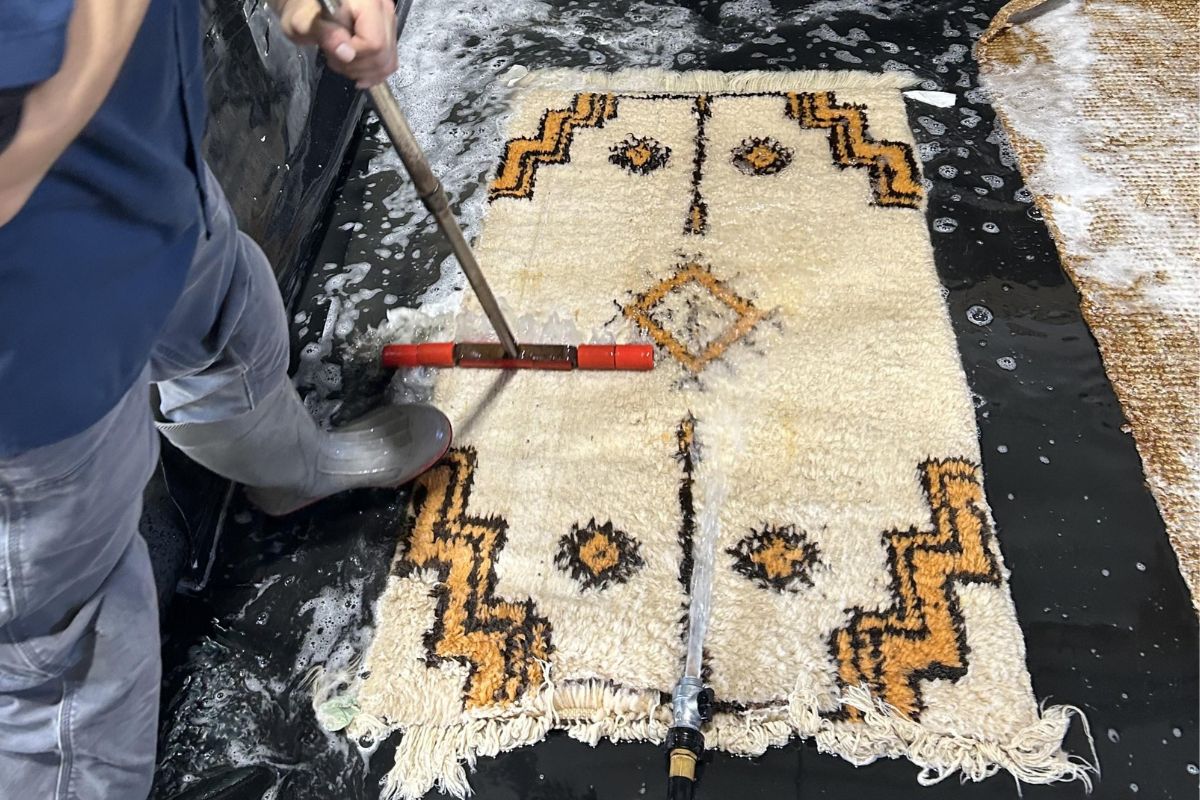
Dust removal before any water. WoolSafe describes two kinds of soil: "Type 1 coarse, dry, heavy soil" removed mechanically, and "Type 2 fine, sticky, lightweight soil" removed chemically. A hand-knotted rug can hold a startling quantity of Type 1 dry soil deep in the pile, and a proper job removes it before anything wet happens. A cleaner who goes straight to water is turning that dust into mud inside your rug. This is the single best question to ask.
Controlled washing, with the right chemistry. WoolSafe's requirements for anything used on wool are "low alkalinity (buffering capacity), non-sticky residue on drying, good cleaning power, no added bleaches, dyes etc." Note "buffering capacity": it also observes that high alkalinity is "often, but by no means always, reflected in high pH," which is why a claim that a product is pH neutral is not on its own an answer. The consequences it lists for getting this wrong include "pigment bleeding in natural Berbers" and, in extreme cases, "yellowing and weakening of wool fibres." The categories that do this damage are the same ones sitting under most kitchen sinks.
Controlled drying. Frequently the largest part of the job and the least visible on an invoice.
Fringe and edge work, if the quote includes it. Ask, because it is often separate.
How to check the cleaner
You are handing over an object you cannot replace, to somebody whose work you cannot assess while it happens. Three checks.
Look for accreditation, and know what it requires. WoolSafe's Approved Service Provider program publishes its bar: providers "have been in business continuously for a period of at least 5 years and have appropriate insurance cover," they "have completed the WoolSafe Fibre Care Specialist training course, have passed the exam and meet other requirements relating to their business and professional qualifications," and they "use WoolSafe-approved products whenever they clean or otherwise maintain wool carpets or rugs." That is a checkable standard rather than a logo. Whatever scheme operates in your country, ask what its members actually have to do.
Ask what happens before the water. Covered above. The answer separates people who clean rugs from people who clean carpets.
Ask about insurance, and about what happens if the rug is damaged. Get it in writing. This is the question that feels rude and is not.
And be specific about what you have. Say it is hand-knotted, say it is wool, say whether you believe the dyes are natural, and say if you do not know. A cleaner who does not ask you these things has not started the job well.
Cost, one last time, honestly
A clean is cheap relative to the rug. That is the only comparison we will make, and it does not need a currency: whatever a competent clean costs where you are, it is a fraction of what the piece cost, and a much smaller fraction of what replacing it would cost. What actually drives the price of a Moroccan rug covers the other half of that comparison.
The expensive outcome is not an expensive cleaner. It is a cheap one, or a home attempt, on a rug that needed a good one.
The part worth remembering
Do the maintenance, and let a professional do the cleaning, on a schedule rather than in an emergency.
Get quotes on your own rug rather than trusting an average, ask what happens before the water, check the accreditation against what it actually requires, and treat a dried stain or a moved dye as somebody else's job from the start. Everything that keeps the gap between cleanings as long as possible is in the main care guide.