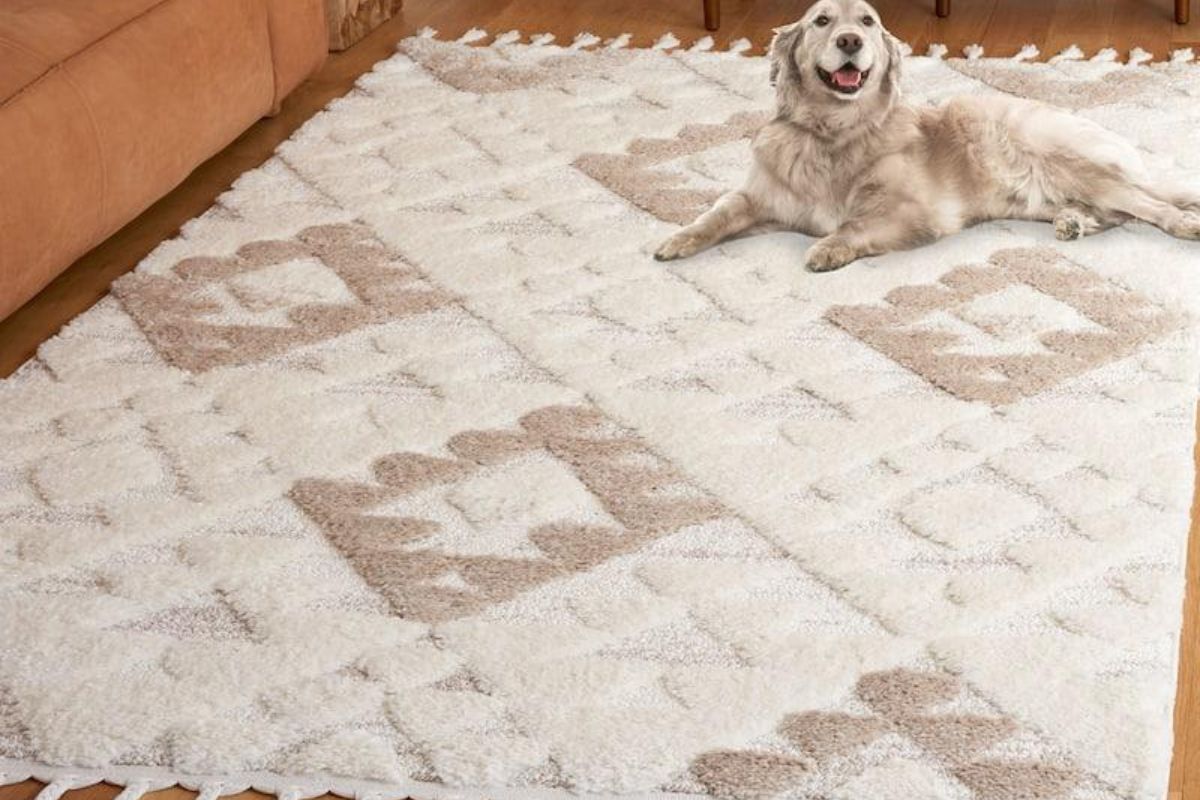
The short version is better news than most people expect. Wool is one of the better floor surfaces to own alongside an animal, and it fails in one specific, predictable way that almost nobody is warned about until it has already happened.
This page is about the rug you already have. It recommends no product and no purchase.
What wool is genuinely good at here
Three things, and they are real rather than marketing.
It hides hair and dirt. A mid-tone, variegated hand-knotted pile is close to the ideal surface for concealing what an animal deposits on it. That is a maintenance advantage every day of the year.
It survives being walked on. A hand-knotted wool pile is built to take footfall for decades. Claws are a different question, covered below, but weight and traffic are what the construction is for.
It does not shred into loops. Most Moroccan rugs are cut pile. A cat that hooks a claw into a cut pile pulls at individual tufts. The same cat on a looped carpet can pull a loop and run a line through it. This is a genuine structural advantage and it is the reason a hand-knotted rug often ages better around a cat than a fitted carpet does.
The one way it fails, and it is the important part
Here is the thing nobody says. A wool rug can be holding a large amount of liquid and still feel dry to your hand.
The Woolmark Company puts it plainly: "Wool can absorb up to 35% of its weight before feeling wet and clinging to the skin." The International Wool Textile Organisation states the same figure independently, describing wool as able to absorb up to 35% of its own weight in moisture.
Both of those are written about wool worn on a body, and the property is the same in a rug. It is why wool is comfortable to wear and why it fails quietly on the floor.
A pet accident on wool does not look like a pet accident. On a hard floor it is a puddle. On a synthetic rug it beads. On wool it is absorbed, the surface reads as damp at worst, and a great deal of liquid can have reached the foundation and the floor beneath while the pile still feels like nothing much has happened.
The consequence: the size of a wool accident is almost always underestimated, and the response is almost always too small. That is the mechanism behind most of the permanent pet damage that reaches professional cleaners.
Fresh, and what to do about it
The most useful thing on this page is that a genuine standards body publishes a step sequence for exactly this, and it is short.
The WoolSafe Organisation's Spot Removal Guide lists Urine (fresh stain) as four steps in order:
- "Blot up as much of the spill as possible using a clean white cloth, tissue or paper towel."
- "Apply WoolSafe Approved Pet Stain Remover to a damp white cloth and blot."
- "Repeat the blotting with clean water again to remove any residues."
- "Dry the treated area with white cloth, tissue or paper towel and align the pile."
Four things in that sequence are worth reading twice.
Blotting comes first and it is most of the work. Given the 35% figure above, assume there is more liquid in the pile than you think and keep going after you believe you are done. Press down and change the cloth. Do not rub.
The product goes on the cloth, not on the rug. WoolSafe's general instruction is the same for every stain on its chart. Applying liquid directly to the pile puts more water into a fiber that is already holding more than it appears to be.
White cloth, every time. A colored cloth can transfer its own dye into wet wool.
Align the pile at the end. A treated patch that dries with the pile pushed the wrong way stays visible as a mark even when the stain is gone.
WoolSafe is an approval program, not a shop. It exists to test whether a product is safe on wool, and this site earns nothing from any product carrying its mark. Naming it is a way of saying check for an approval mark rather than trusting the label, which is the whole of the point.
Dried, and the honest answer
WoolSafe treats an old urine stain differently from a fresh one. It groups it with bleach and rust marks, and the treatment it gives is a single line: "This type of stain may require treatment by a professional cleaner."
That is the correct answer and it is worth accepting quickly. A dried urine stain in wool is not one problem, it is three: the visible mark, the odor compounds that have set into the fiber, and whatever reached the foundation and the floor. Home attempts on the first of those routinely make the second and third worse by adding water without removing it.
Why the standard pet cleaner is the wrong bottle
This is the trap, and it is a well-designed one.
The default recommendation for pet accidents on carpet is an enzyme cleaner, and it is good advice on synthetic carpet. Enzyme products work by breaking down protein.
Wool is protein. That is the entire problem in four words. The full list of what quietly destroys wool covers the other categories, and enzymes are the one most likely to be recommended to you in good faith by somebody who has not thought about the fiber.
The WoolSafe guidance above never reaches for an enzyme. It reaches for a product tested on wool. That difference is the difference between a stain and a bald patch.
Claws, and what they actually do
Two different problems that get treated as one.
Scratching is a cat behavior with a purpose, and a rug that gets scratched is a rug the cat has chosen as a scratching site. Nothing you put on the rug changes the underlying preference. This is a behavior question rather than a rug question, and the useful move is to make a better site available in the same room.
Ordinary walking damage is different and mostly benign on cut pile. Claws pass through it. The visible result over years is not holes, it is a slightly opened, slightly fluffier surface in the routes an animal habitually takes, which on a hand-knotted rug reads as wear rather than damage.
The edges are the vulnerable part. Fringes and selvedges are the structure holding the rug together, and they are exactly what a playing animal grabs. A fringe pulled out of a hand-knotted rug is a repair, not a trim.
Hair, and the vacuum question
Animal hair works its way down into a wool pile and mats there, which is a different problem from hair sitting on the surface.
The technique matters more than the machine, and it is not the one most people use: the full method for vacuuming a wool pile is slow overlapping passes with the beater bar off. On a rug carrying animal hair, the practical addition is more passes, and passes in more than one direction, because hair lies flat along the pile and only lifts when you come at it from the other side.
Do not compensate for embedded hair with a more aggressive machine. A beater bar on a hand-knotted pile does its own damage, and the hair is still there afterward.
Where the rug should and should not be
Placement does more than any product.
Not where an animal eats or drinks. A water bowl is a small, permanent, twice-daily spill onto a fiber that hides moisture. This is the single most avoidable cause of wool rug damage in a home with animals.
Not in the doorway an animal comes in wet through. Wet paws carrying grit are Type 1 and Type 2 soiling arriving together, which is WoolSafe's way of describing the two kinds of dirt that need two different removal methods.
Not where an unwell animal sleeps. A temporary move costs nothing and a set stain cannot be undone.
And not the newly arrived animal's first room. House training and a hand-knotted rug can share a home. They should not share a floor in the first weeks.
What this page will not tell you
We have not tested any product, on wool or on anything else, and this site has handled no rug. Where a product category is named above it is because a named standards body named it, and the naming stops there.
We will not tell you a rug is pet-proof. None is.
An animal urinating indoors, repeatedly or suddenly, is a veterinary question before it is a cleaning question. That order matters and it is not our subject.
The part worth remembering
Wool is a good surface to live with an animal on, and it conceals liquid better than it should for your own good.
Assume every accident is bigger than it looks, blot far longer than feels necessary, keep enzymes away from it, and treat a dried stain as a professional's job rather than a project. The rest of the routine that keeps a hand-knotted rug alive is in the main care guide, and the first five minutes of any spill, animal or otherwise, are covered in what to do the moment something goes on it.