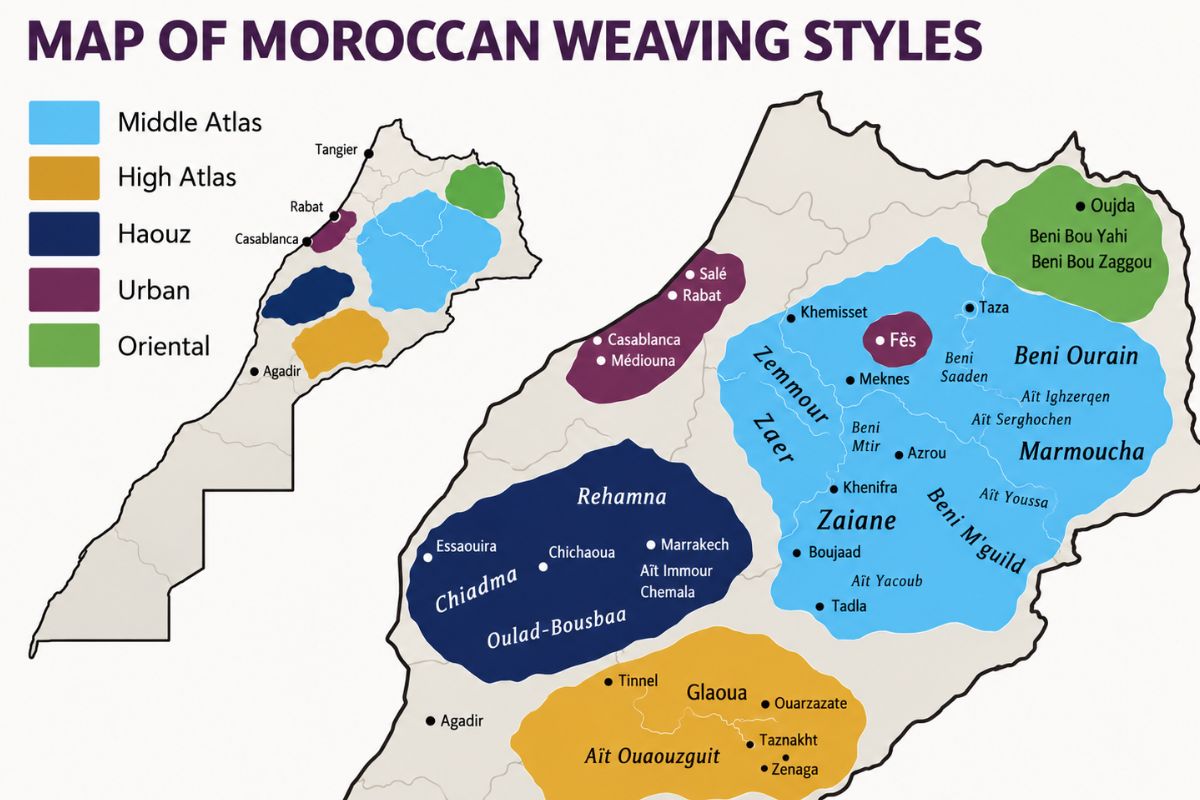
Most named Moroccan rug styles sit in four broad zones. The Middle Atlas holds Beni Ourain, Beni Mrirt, Beni Mguild and Marmoucha, with Zemmour on its northern edge between Rabat and Meknès. The High Atlas holds Azilal and Glaoui, with Ait Bou Ichaouen at its far eastern end. The western plains hold Boujad and Rehamna. The south holds Taznakht, near the Anti-Atlas and Jbel Sirwa. Those are placements, not borders, and a region name on a listing is a style description rather than proof of where a rug was woven.
This guide lays out that map in words and tables, shows how Morocco's own museums group the country's weaving, and explains the three different kinds of names hiding in the style list.
The map, zone by zone
Read this from north to south. Each placement matches this site's individual style guide, where the evidence for it is set out.
The Middle Atlas: the pile rugs most buyers picture
The Middle Atlas is the mountain range running roughly southwest to northeast across the middle of the country. It is where the thick, high-pile rugs best known abroad are placed.
- Beni Ourain: undyed cream wool with dark lines, from the Middle Atlas. The Beni Ourain guide covers the tribal name and how loosely it is now used.
- Beni Mrirt: a denser, heavier Middle Atlas pile rug, often confused with Beni Ourain.
- Beni Mguild: a Middle Atlas style known for indigo and deep colors.
- Marmoucha: from the eastern Middle Atlas, a quieter relative of Beni Ourain.
- Zemmour: from the area between Rabat and Meknès, further north than most Middle Atlas styles, and best known as a red flatweave. The Zemmour guide explains why it sits apart from its pile-rug neighbors.
The High Atlas: color and mixed technique
The High Atlas lies south of the Middle Atlas and runs toward the Algerian border in the east.
- Azilal: from Azilal province in the High Atlas, with a natural wool ground and bright motifs. The Azilal guide covers how older and newer pieces differ.
- Glaoui: associated with the Glaoua, a documented tribal confederation of the High Atlas, and known for combining pile and flatweave techniques in one rug.
- Ait Bou Ichaouen: from the far eastern edge of the High Atlas near Algeria, sold under the market-town name Talsint. The Ait Bou Ichaouen guide covers this eastern outlier.
The western plains: lower country, warmer palettes
West of the mountains, the land drops toward the Atlantic plains.
- Boujad: from the plains around the market town of Boujaad, in Khouribga Province, between the Atlantic coast and the Middle Atlas. Known for pinks, reds and purples.
- Rehamna: from the Haouz plains north of Marrakech.
- Boucherouite: rag rugs whose practice this site's guide places first in the plains around Beni Mellal and Boujad, later spreading into the mountains.
The south: Taznakht and Jbel Sirwa
- Taznakht: a town near the edge of the Anti-Atlas and the Sirwa massif, known for rugs from its weaving cooperatives. Independent reporting names wool from the Sirwa mountains.
Summary table
| Zone | Styles placed there | Typical construction |
|---|---|---|
| Middle Atlas | Beni Ourain, Beni Mrirt, Beni Mguild, Marmoucha | Mostly pile |
| Northern Middle Atlas edge | Zemmour | Mostly flatweave |
| High Atlas | Azilal, Glaoui | Pile, and mixed pile and flatweave |
| Far eastern High Atlas | Ait Bou Ichaouen (Talsint) | Pile |
| Western plains | Boujad, Rehamna, Boucherouite | Pile, and rag weaving |
| South, Anti-Atlas edge | Taznakht | Pile and flatweave |
"Typical" is doing real work in that last column. Weavers in every zone use more than one technique, and the complete guide to Moroccan rug styles covers each style's range in more detail.
How Morocco's own museums group the map
The seller version of this map is a list of tribal names. Morocco's museums group the same material more broadly, by region.
The National Museum of Weaving and Carpets at Dar Si Saïd in Marrakech, run by the Fondation Nationale des Musées and checked on 11 September 2026, describes a collection of urban and rural carpets, including pile carpets and hanbel flatweaves, "from all regions." It names the Marrakech region in particular, with Tensift, the Sous, the High Atlas, the Anti-Atlas, the Bani and the Tafilalet.
The Maison Culturelle du Tapis, a carpet museum in Marrakech directed by Nasser Ksikes and described by the city's official tourism guide, Visit Marrakech (read on 11 September 2026), organizes its rooms around four weaving regions: the High Atlas, the Middle Atlas, Rabat and the Haouz. It states that its oldest pieces date to the 1850s.
Two things stand out. Both institutions use regions rather than dozens of tribal names. And both include traditions that rarely appear on seller maps at all: the urban carpets of Rabat, and the southern and eastern regions such as the Sous, the Bani and the Tafilalet. A map made only from the styles that sell well abroad leaves out much of the country's weaving.
Three kinds of names on one list
The style names above are not all the same kind of name, and knowing which kind you are looking at changes what it can tell you.
Tribal or confederation names. Beni Ourain, Beni Mguild, Zemmour and Glaoui refer to groups of people. They describe a weaving tradition associated with those communities. They do not certify that a particular rug was woven by a member of that group.
Town and market names. Boujad, Taznakht and Talsint are places. Some of these names attach to rugs because of where they were traded, not only where they were woven. Ait Bou Ichaouen rugs are sold as "Talsint" after the market town, for example.
Administrative names. Azilal is a province. The name covers a large mountainous area and many communities, which is one reason "Azilal" is applied so broadly in listings.
Most of these communities are Amazigh. "Berber," the more common word in the trade, comes from an outside name that some communities reject, which is why this site uses Amazigh alongside it.
Why a region name is not a provenance
A style name on a listing tells you what a rug looks like. It does not tell you where that rug was woven.
Style names travel. A popular look is copied by weavers in other areas, commissioned by middlemen from wherever there is capacity, and sometimes made outside Morocco entirely. This site's style guides note regional blends being sold under the best-known name, and the pattern is common across the category.
A seller who says "Beni Ourain" is naming a style. A seller who says "woven by a cooperative in a named town, and here is how I know" is making a provenance claim, and that is the one worth weighing. Where no one can say where a rug was woven, the honest description is the style, with no place attached.
FAQ
Where do Moroccan rugs come from?
Most named styles are placed in four zones: the Middle Atlas (Beni Ourain, Beni Mrirt, Beni Mguild, Marmoucha, and Zemmour to the north), the High Atlas (Azilal, Glaoui, Ait Bou Ichaouen), the western plains (Boujad, Rehamna) and the south around Taznakht. Morocco's museums also include urban Rabat carpets and southern and eastern regions.
What is the difference between Middle Atlas and High Atlas rugs?
In broad terms, the best-known Middle Atlas styles are thick pile rugs, many in undyed or deep-dyed wool, while High Atlas styles such as Azilal and Glaoui are known for color and mixed techniques. Both regions produce more than one kind of rug.
Does a style name tell me where my rug was made?
No. A style name describes a look. Popular styles are woven in other areas and sometimes outside Morocco. Only a seller who can say where and by whom a rug was woven is making a provenance claim.
Is there an official map of Moroccan rug regions?
This guide found no single official map. The National Museum of Weaving and Carpets at Dar Si Saïd and the Maison Culturelle du Tapis in Marrakech both group Moroccan weaving by region rather than by tribal style name.