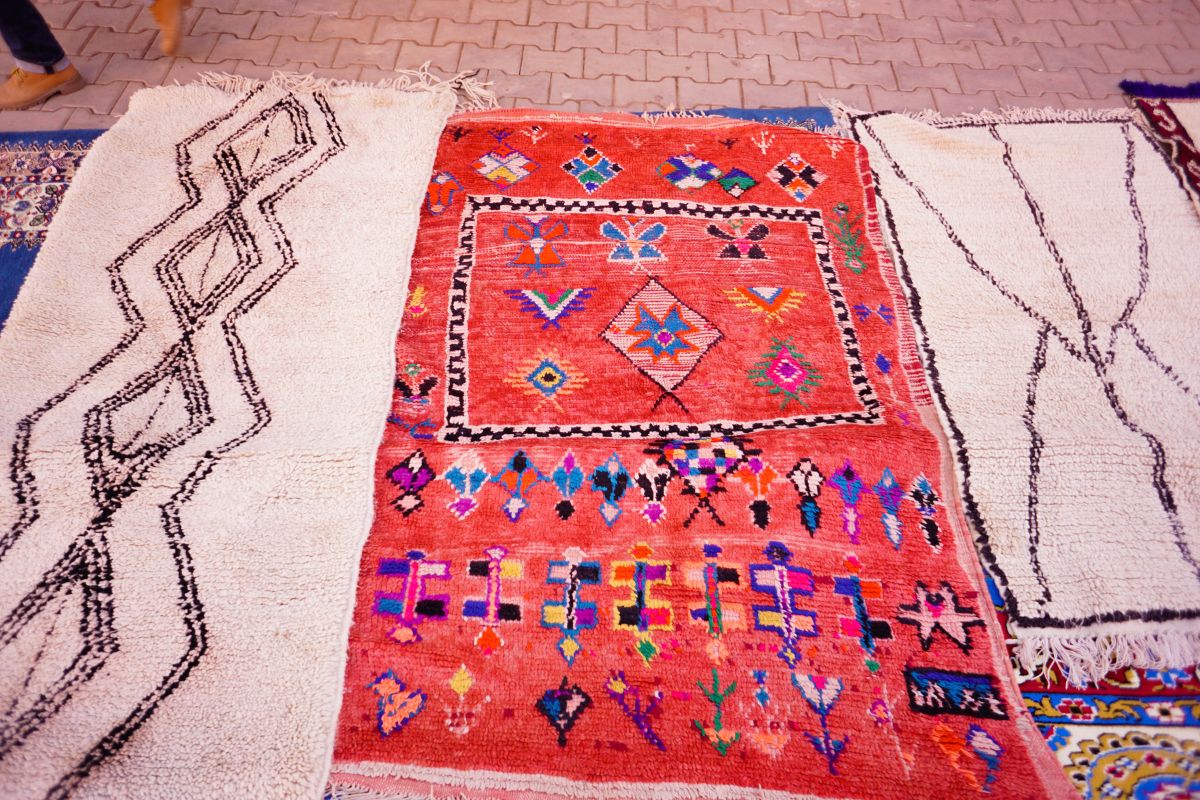
The four Moroccan rug styles you will run into most often are Beni Ourain, Boucherouite, Azilal, and Boujad, and each one comes from a different part of Morocco with its own look. Beni Ourain rugs are thick cream wool with simple black geometric lines. Boucherouite rugs are bright and busy, woven from recycled fabric scraps rather than pure wool. Azilal rugs have a natural wool background scattered with colorful, freehand motifs. Boujad rugs run warm, in pinks, reds, oranges, and purples. Sort them by material, pile height, and color palette, and the whole category stops feeling like one blurry "Moroccan rug" and starts making sense.
Here is the fast version before we go deeper.
| Style | Region reported | Base material | Palette | Feel underfoot | Best for |
|---|---|---|---|---|---|
| Beni Ourain | Middle Atlas | Natural undyed wool | Cream with black or brown lines | Thick, plush, high pile | Living rooms, bedrooms, cold floors |
| Boucherouite | Made across Morocco | Recycled cloth, cotton, sometimes synthetic scraps | Bold, mixed, no fixed palette | Thin to medium, uneven | Color accents, playrooms, low-traffic spots |
| Azilal | High Atlas | Natural wool ground with dyed wool or cotton motifs | Ivory base, bright abstract accents | Medium pile | Rooms that want art on the floor |
| Boujad | Central plains near Boujaad | Sheep wool | Pink, red, orange, purple | Low to medium pile | Warm, bohemian, layered interiors |
A note on how this guide is written: Atlas Rug Guide does not sell rugs. Almost every other page you will find on this topic is a rug seller's blog, which is fine, but it means the "best" style is usually the one that seller happens to stock. Here, no style is being sold to you. Where a fact is genuinely contested or thinly sourced, this guide says so instead of pretending it is settled.
What "Moroccan rug" actually means
"Moroccan rug" is not a single product or a certified category. It is a shorthand for a wide family of hand-weaving traditions practiced by the Indigenous Amazigh (Berber) peoples of Morocco, most of them in and around the Atlas Mountains, where each tribal area developed its own visual language over generations. Amazigh weaving is also found in Algeria and Tunisia, but the largest and most varied production comes from the Moroccan Atlas, as reported by Berber-rug specialists.
That matters for one practical reason: the style names are descriptive, not regulated. "Beni Ourain," "Azilal," and "Boujad" point to a region or a group of tribes and the general weaving tradition there, not to a stamped, guaranteed grade. Two rugs sold under the same name can look quite different, and origin dates you see repeated online (everything from "a few centuries" to "thousands of years") are rarely sourced and rarely agree. Treat the names as a helpful map, not a certificate.
Beni Ourain: the cream wool classic
Beni Ourain is the style most people picture first: a thick, ivory or cream wool pile marked with thin black or dark brown geometric lines, often diamonds or loose lattice patterns. The rugs are made from natural, undyed sheep wool, which is where the soft off-white ground comes from.
The name refers to the Beni Ourain (also written Beni Ouarain), described by rug specialists as a confederation of Amazigh tribes in the lower Middle Atlas Mountains, in the area between Fez and Taza. The plush, warm pile has a functional origin: these were floor and sleeping coverings made to insulate against hard mountain winters, not decorative objects first. Because the palette is so restrained, Beni Ourain reads as calm and modern, which is why it shows up constantly in minimalist interiors.
Best use: high-traffic living rooms and bedrooms where you want warmth and a neutral base. For the full breakdown of knots, wool grades, and how vintage pieces differ from new production, see our deep-dive Beni Ourain rug guide.
Boucherouite: color from recycled cloth
Boucherouite is the outlier of the group, and the most misunderstood. Instead of wool pile, these rugs are woven from whatever fabric was on hand: strips of old clothing, cotton, fabric scraps, and sometimes nylon or plastic. The name itself comes from a Moroccan Arabic term for a scrap or torn piece of used cloth, which tells you exactly what they are made from.
That origin is the opposite of luxury. Boucherouite rugs grew out of thrift, made in households where wool was scarce or too valuable to use on the floor, so weavers improvised with textile leftovers. The result is unpredictable: saturated, clashing color, loose or improvised patterns, and a texture that changes across the rug. No two are alike, and there is no "correct" Boucherouite palette.
Best use: a jolt of color in an otherwise quiet room, kids' spaces, or as a layered accent. Keep them out of the highest-traffic paths, since mixed materials wear less evenly than dense wool. Our Boucherouite rug guide covers materials, washing cautions, and why condition varies so much piece to piece.
Azilal: the painterly one
Azilal rugs sit between Beni Ourain's restraint and Boucherouite's chaos. They usually start from a natural, undyed ivory wool ground, then add sparse, freehand motifs in dyed wool or cotton: diamonds, lines, hooks, and abstract shapes that look almost drawn on. The effect is closer to a canvas than a carpet.
The name comes from the Azilal region, which specialists place in the High Atlas, northeast of Marrakech, on the seam between the High and Middle Atlas. One reported detail worth knowing: Azilal rugs stayed largely off the international market until the late 20th century, which is part of why they feel fresher and less formula-driven than the more commercialized styles. Weavers there are described as using a single knotted line worked between woven rows, a technique passed down among women in the region.
Best use: a room that wants one expressive, art-like piece without going full rainbow. See the Azilal rug guide for how to read the motifs and tell older pieces from newer, brighter production.
Boujad: warm tones from the central plains
Boujad (also spelled Boujaad) rugs are the warm-blooded ones, built on pinks, magentas, reds, oranges, and purples, often layered over each other so the color feels sun-faded and lived-in. They are woven in sheep wool at a low to medium pile.
The name comes from the town of Boujaad, and here is a genuinely contested point this guide will not paper over: many sources place Boujad production in the central plains at the foothills of the Middle Atlas, while some sellers loosely file these rugs under the Haouz region near Marrakech. The town of Boujaad sits in Morocco's central plains, not in Marrakech, so the "central plains" description is the more precise one. Rug specialists also note these rugs are made by Arab and Arabised Berber tribes, a reminder that Moroccan weaving traditions are not all strictly Amazigh.
Best use: bohemian and maximalist rooms, or as a warm layer over a neutral floor. The Boujad rug guide goes deeper on the dye story and why mid-century pieces are collected.
The part sellers skip: handmade versus machine-made imitation
Here is the section most "types of Moroccan rugs" articles leave out, because most of them are trying to sell you a rug. A large share of "Moroccan rugs" sold online, especially the cheapest ones, are machine-made imitations produced in factories, often outside Morocco, from synthetic fibers designed to mimic the look. They can copy the pattern. They do not copy the construction.
You do not need a "burn test" or any of the unsourced tricks that circulate online to see the difference. A few honest signals do most of the work:
- The back. A handmade rug shows individual knots and slightly irregular rows on the reverse. A machine-made one looks mechanically uniform, sometimes with a grid backing or glued layer.
- Regularity. Handwoven pieces have small imperfections: a line that wobbles, a motif that is not perfectly symmetrical. Flawless, ruler-straight repetition is a machine tell.
- Edges and fringe. Authentic rugs have hand-finished edges and fringe that is part of the weave, not a separately sewn-on strip.
- Material and weight. Real wool (or genuine recycled cloth, for Boucherouite) feels denser and warmer than thin synthetic pile.
One honest limit: photos and words can only take you so far. Atlas Rug Guide is a reference, not an appraisal or authentication service, and no online guide can certify a specific rug you are looking at. For a high-stakes purchase, a hands-on inspection by a specialist beats any checklist, including this one. What this guide can do is stop you from mistaking a mass-produced copy for the tradition it is imitating.
How to choose a Moroccan rug style for your room
Skip the "which is best" question, because it depends entirely on your space. Choose by use instead:
- Want warmth and a calm, neutral base? Beni Ourain. Thick wool, quiet palette, forgiving in busy rooms.
- Want the floor to be the color? Azilal for an art-like, controlled pop, or Boucherouite if you want maximum, unpredictable energy.
- Want warm, cozy, lived-in tones? Boujad, especially layered over a plain floor or a larger neutral rug.
- High-traffic hallway or entry? Favor dense wool pile (Beni Ourain, some Boujad) over thinner recycled-cloth Boucherouite, which wears less evenly.
Match the pile height to the room too. Thick pile feels great in a bedroom and reads busy in a small office; a lower pile is easier under doors and dining chairs.
FAQ
What are the main types of Moroccan rugs?
The most common named styles are Beni Ourain (thick cream wool with black geometric lines), Boucherouite (bright rugs made from recycled cloth), Azilal (ivory wool grounds with colorful freehand motifs), and Boujad (warm pink, red, and purple tones). Other styles exist, but these four cover most of what people mean by "Moroccan rug."
What is the difference between Beni Ourain and Azilal rugs?
Beni Ourain rugs are minimalist: undyed cream wool with a few dark geometric lines. Azilal rugs keep a similar natural wool base but add bright, abstract colored motifs, so they read as more artistic and less neutral. Beni Ourain comes from the Middle Atlas; Azilal comes from the High Atlas region.
Are Moroccan rugs always handmade?
Traditionally yes, they are handwoven by Amazigh (Berber) weavers. But many rugs sold as "Moroccan" online are machine-made imitations in synthetic fibers. Check the back for irregular hand knots, look for small imperfections in the pattern, and feel the material to tell a genuine handmade rug from a factory copy.
What is a Boucherouite rug made of?
Recycled textiles: strips of old clothing, cotton, fabric scraps, and sometimes synthetic material. The style grew out of thrift, when wool was scarce or too valuable, so weavers used whatever cloth they had. The name itself comes from a Moroccan Arabic word for scrap or torn cloth.
Why do Boujad rugs vary so much in color?
Boujad rugs are built on warm dyed wool, and many are vintage pieces where the color has softened over decades, so pinks, reds, and purples layer and fade differently in each rug. Because they are one-of-a-kind handmade pieces, no two share the exact same palette.
Leave a Reply