Short answer: With a Moroccan rug, small room worries usually point the wrong way. A rug that is too small makes a compact room look more broken up than one that is slightly too big. What makes a Moroccan rug overwhelm a small room is less its size than its pile height, its contrast with the floor and the density of its pattern. Size it so a border of bare floor shows on every side, choose a flatter or quieter piece if the room is already full, and test the outline with tape first, because a hand-woven size is approximate.
When we checked this search on September 24, 2026, every result on the first page was a shop or a seller's styling blog. That is not surprising, and some of their advice is sound. But the reader behind this search usually has one particular rug in mind and a room that cannot get any bigger, and nobody is selling them a second opinion. This guide has no rug to sell.
Moroccan rug small room sizing: size up, but leave a border
The design advice that ranks for rug sizing agrees on one thing and disagrees on another.
What it agrees on: when in doubt, go larger. The rug and interior design studio Kevin Francis Design, in its living room placement guide, which we read on September 24, 2026, advises readers to "size up when in doubt" and says a larger rug makes a room feel "more considered and spacious, not smaller." The rug retailer Rugs.net, in its size guide read the same day, makes the same point, recommending the larger of two sizes when you are unsure.
What it disagrees on: how much bare floor to leave around the rug. Kevin Francis Design suggests leaving 12 to 18 inches of bare floor between the rug's edge and the walls, calls that border "a starting point, not a ceiling," and notes that in an intimate room, less can feel enveloping. Rugs.net says to "leave 18 to 24 inches of bare floor between the edge of the rug and the wall on all sides."
Those two ranges barely overlap, and both come from businesses that sell rugs. Neither is a standard. In a small room the difference matters, because a few inches either way changes the size of rug you need noticeably. Treat the border as a range to try, not a number to hit, and decide by eye with the tape test further down.
What actually makes a rug swallow a room
"Too big" is usually a feeling about visual weight, not about square footage. Three things drive it on a Moroccan rug:
| Trait | Effect in a small room | What helps |
|---|---|---|
| Contrast with the floor | A rug much lighter or darker than the floor draws a hard outline, and the room reads as smaller inside it. | A tone closer to the floor, or a wider border so the outline sits away from the walls. |
| Pattern scale and density | A dense, busy field fills the eye. Large, sparse motifs on a plain ground read calmer. | In a room that already has pattern elsewhere, choose the quieter rug. In a plain room, a bold rug can be the one focal point. |
| Pile height | Deep pile adds physical bulk: a raised edge, furniture that sits unevenly, doors that catch. | A lower pile or a flatweave, or keeping furniture fully on or fully off a deep-pile rug. |
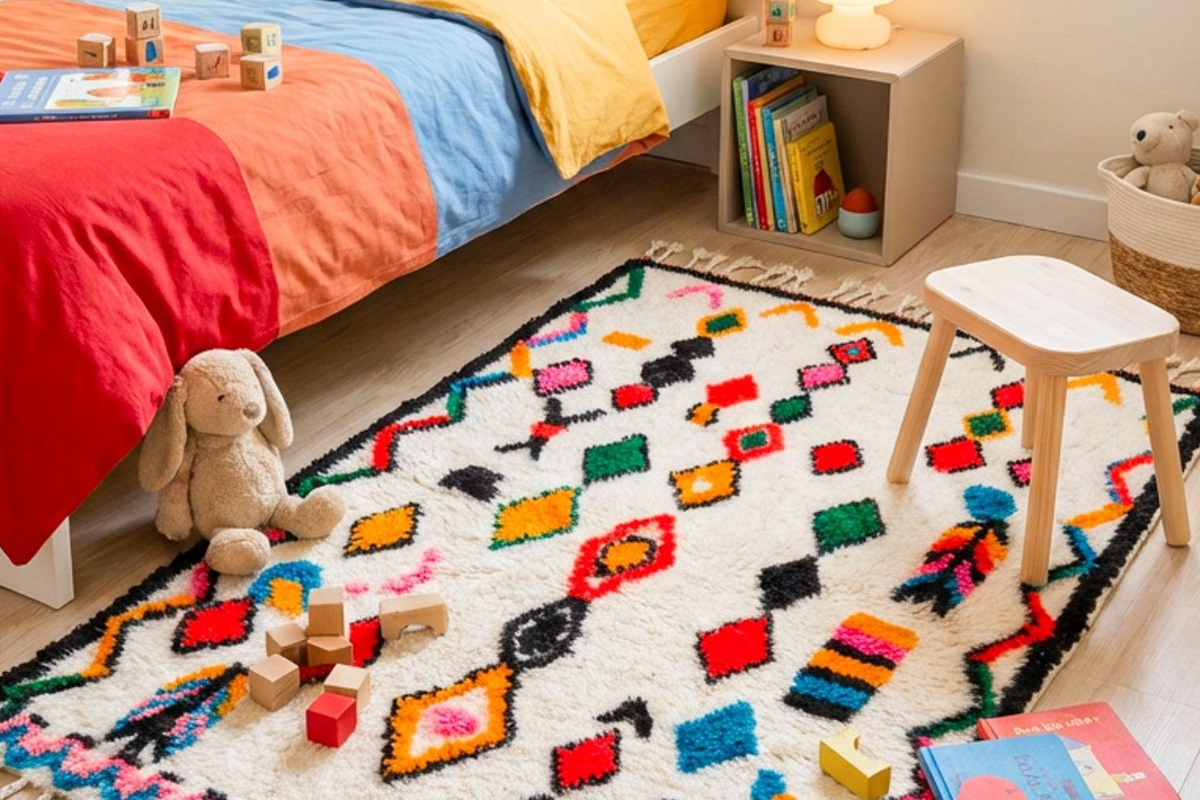
This is why two rugs of the same size can feel completely different in the same small room. A pale, mostly undyed pile rug on a light wood floor tends to recede. A strongly colored piece, such as many Azilal or Boucherouite rugs, becomes the room's main event. Neither is wrong. The question is whether the room has space for a main event, or whether it already has one.
Pile height deserves a practical check in small rooms, because everything is close together. Measure the gap under any door that swings over the rug, and ask the seller for the pile height before you buy. Our comparison of flatweave and pile Moroccan rugs explains how the two constructions differ in feel and bulk.
The small-room problem with hand-woven sizes
A hand-woven Moroccan rug is not cut to a size chart. That matters more in a small room than a large one, for two reasons.
First, the listed size is approximate. The Anou Cooperative, a weaver-owned organization that commissions rugs from Moroccan weaving groups, explains on its made-to-order page, which we read on September 24, 2026, that it measures finished rugs at its office in Fes and holds each group to its own record: "A group known for landing the measurement is held to exactly that," while "a looser group is held to their average plus a 10% margin." If an organization that commissions to order treats accuracy as varying by group, a resale listing is unlikely to be more exact. Ask the seller for the length on both sides and the width at both ends, and whether the figure includes the fringe. Our list of questions worth asking any rug seller covers what to get in writing.
Second, a small room puts the rug's edges close to the walls. The closer an edge sits to a straight wall or baseboard, the more readily the eye compares the two, and any slight skew in a hand-woven rug shows. A wider border hides it; a narrow one exposes it. That is a real argument for the narrower rug in a very tight room, even if a design rule suggests the larger one. Plan with the smallest measurements you are given, without the fringe.
The tape test
Before you commit to a particular rug:
- Mark the rug's outline on the floor with painter's tape, using the smallest length and width the seller confirms.
- Put the furniture where it will go, including any chair legs you intend to sit on the rug.
- Open every door that swings over the area and walk the paths you use every day.
- Leave it for a day or two. First impressions of tape on a floor are unreliable; living with it for a day is not.
If the outline feels cramped against the walls, try the narrower option. If it looks like an island floating in the middle of the floor, the rug is probably too small. The tape costs almost nothing, and a hand-woven rug often cannot be exchanged for the next size.
Layouts that tend to work in small rooms
- Front legs on. Sofa and chair front legs rest on the rug, back legs on the floor. This connects the seating with a smaller rug than an all-legs-on layout needs. On deep pile, check that the sofa does not rock.
- The rug under the coffee table only. Works in a very tight seating area, but in anything larger it tends to look undersized.
- A runner for a narrow room. In a long, thin room or a passage-like space, a runner can suit the proportions better than a rectangle. Our guide to Moroccan runners, rounds and odd shapes explains which formats genuinely exist.
- One zone, not the whole floor. Under a reading chair or beside a bed, a smaller rug defines a spot rather than trying to cover the room.
In a small room, the rug almost always sits in the main walking path, because there is nowhere else for it to go. That makes a pad and flat edges more important, not less. Our guide on how to stop a rug from slipping covers pads and edge fixes, including which ones are hard to undo on a hand-knotted piece.
When the smaller rug is the right call
Size up is a useful default, not a law. A smaller rug can be the better choice when:
- A door, radiator or built-in cuts into the floor, and a larger rug would run under or into it.
- The room is already full of pattern, and a big patterned rug would add one more thing competing for attention.
- The rug is deep pile and a larger one would put furniture half on and half off it in several places.
- The rug is a piece you love that simply is the size it is. A well-placed smaller rug that defines one zone is better than a room planned around a rug you do not have.
What we cannot tell you
We have not seen your room or your rug, so we cannot say whether a particular piece will overwhelm it. The border figures above come from two businesses that sell rugs, and they disagree; there is no official standard. An interior designer who can see the room will judge proportion better than any general rule, including ours. And no one can confirm a hand-woven rug's true size from a listing alone; only a tape measure along each edge can.
FAQ
Will a large Moroccan rug make my small room look smaller?
Usually not. Design guides that rank for rug sizing more often warn about rugs that are too small. What makes a rug overwhelm a small room is high contrast with the floor, a dense pattern or a very deep pile. A quieter, flatter rug can be large without dominating.
How much floor should show around a rug in a small room?
Sources disagree. Kevin Francis Design suggests 12 to 18 inches as a starting point and says less can suit an intimate room; Rugs.net says 18 to 24 inches on all sides. Try both with painter's tape and decide by eye.
Is a deep-pile Moroccan rug a bad idea in a small room?
Not necessarily, but it adds bulk. Check door clearances, keep furniture fully on or fully off it where you can, and expect the raised edge to be more noticeable in a tight space. A flatweave is lighter both visually and physically.
Can I buy a Moroccan rug in the exact size my room needs?
Rarely off the shelf. Hand-woven sizes are approximate, and even organizations that commission to order accept some variation. Measure the room, work out a range that fits, and look for a rug within that range rather than an exact number.
Leave a Reply