Category: Rug Styles

  • Glaoui Rug: The Three-Technique Moroccan Weave

    Glaoui Rug: The Three-Technique Moroccan Weave

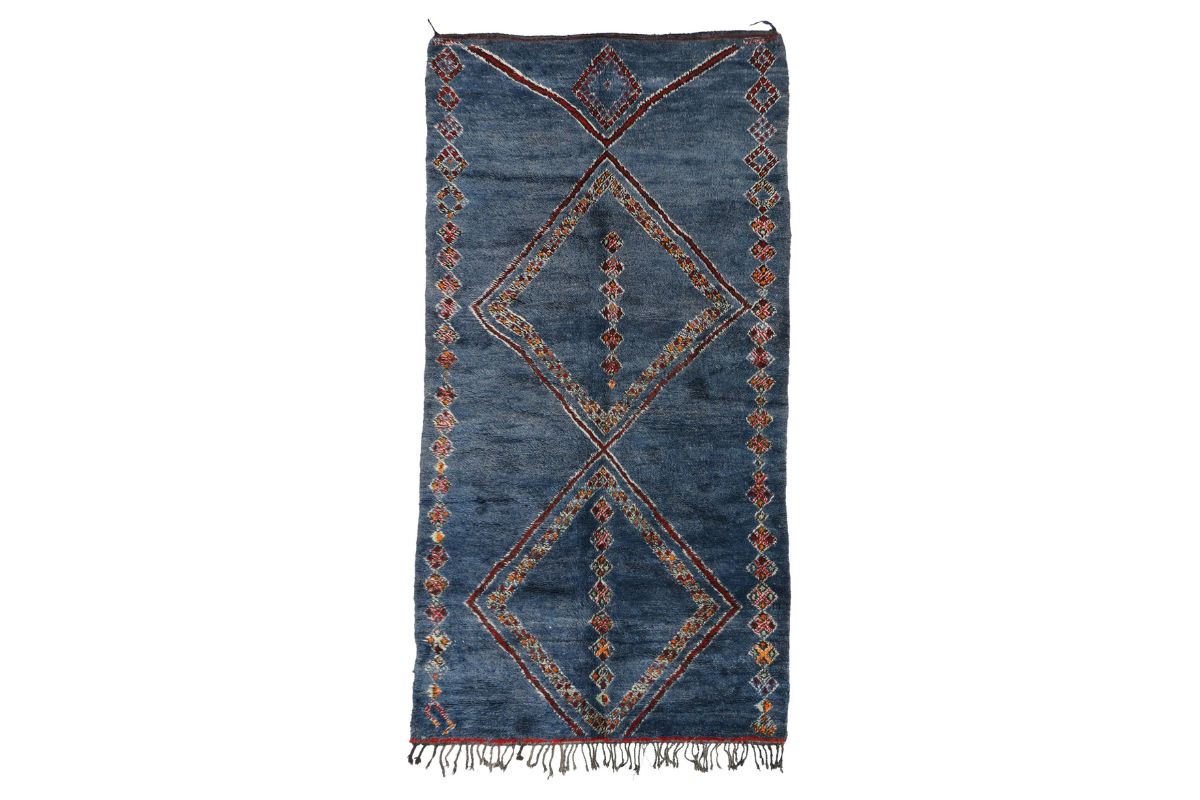
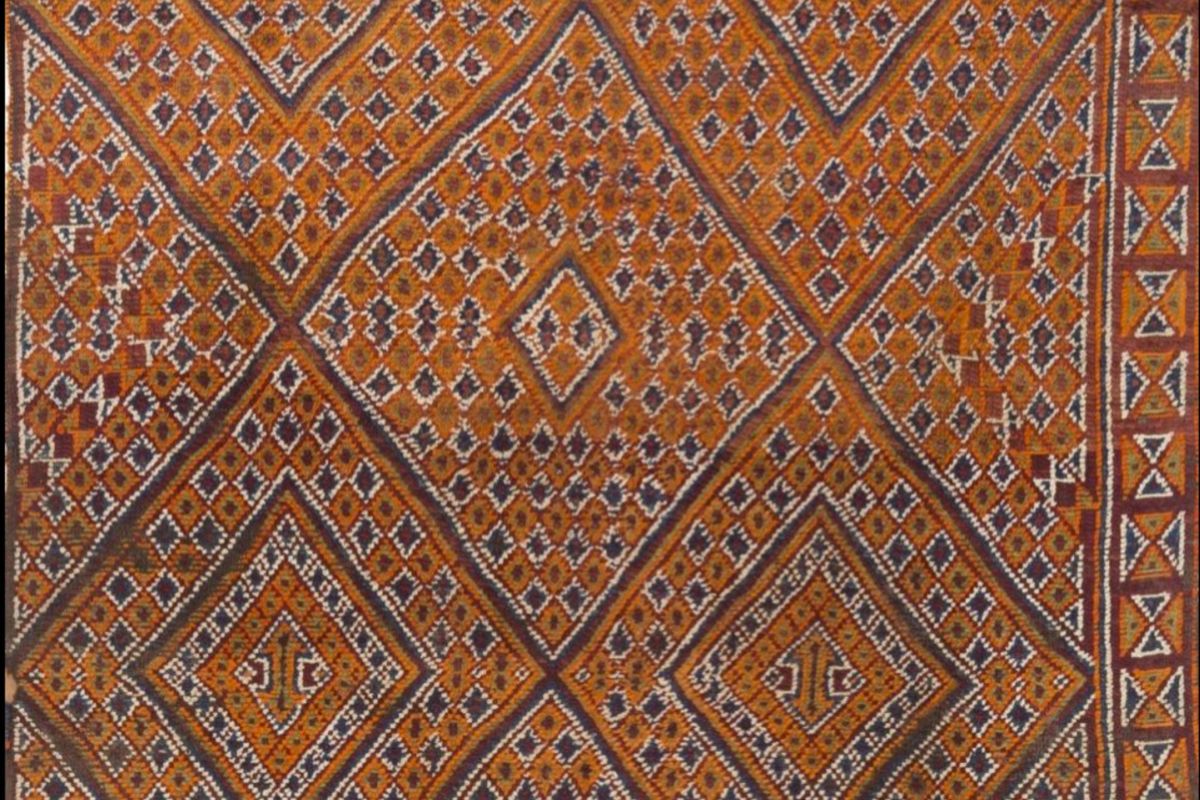
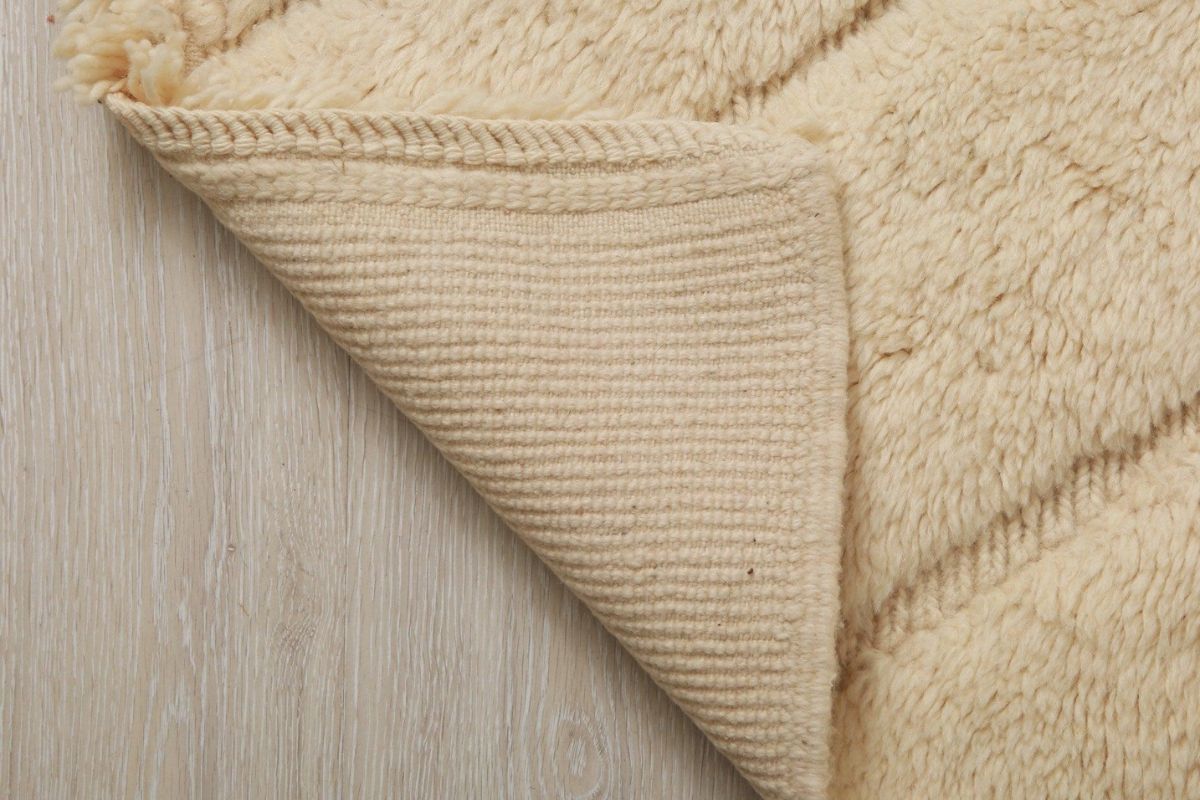
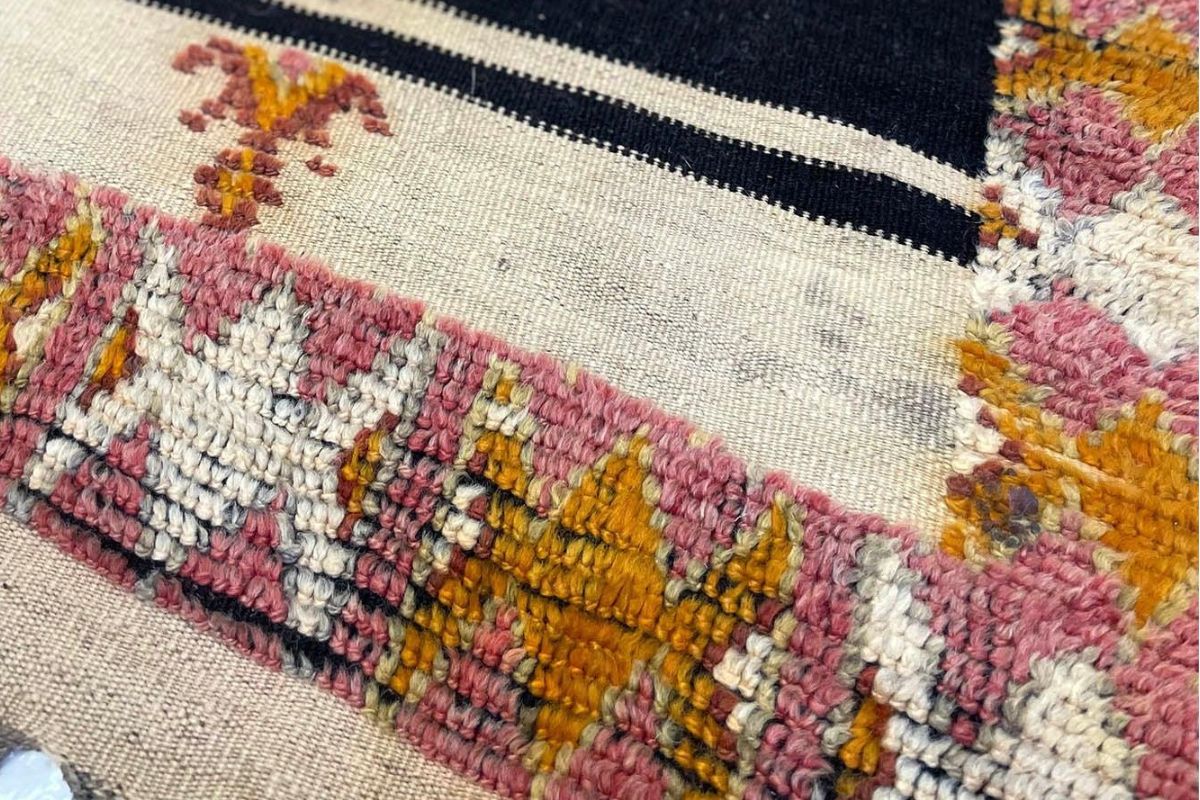
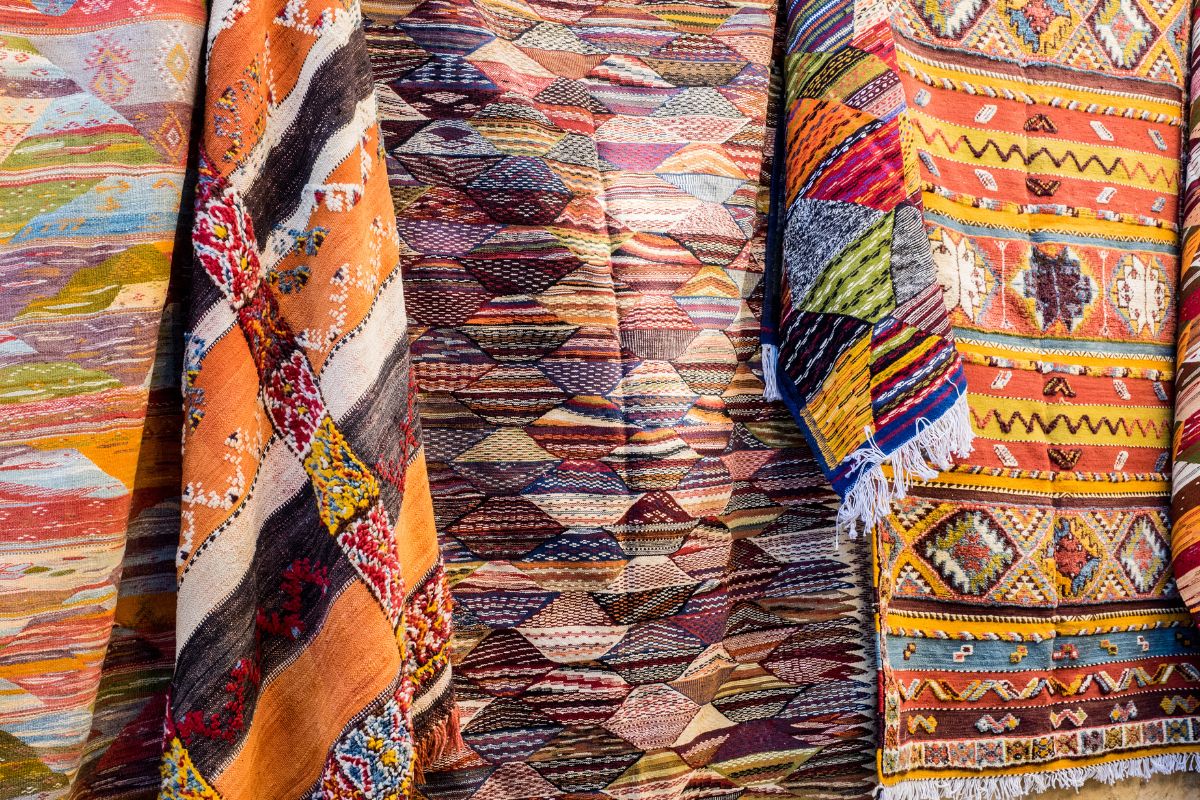
    A Glaoui rug is not one weaving technique but three, combined in a single piece: sections of hand-knotted pile, sections of flat weave, and passages of black-and-white embroidery called chedwi, often alongside narrow, tufted flatweave bands similar to those found on Zanafi rugs. If a rug you're looking at seems to switch construction partway across its surface, thicker and plush in one band, flat and graphic in the next, that is very likely a Glaoui, and it is a deliberate, technically demanding choice rather than an inconsistency.

    Where the name comes from

    The name is associated with the Glaoua, a real and well-documented Berber tribal confederation of the High Atlas, historically seated at the Kasbah of Telouet. Their leadership rose to significant regional power in the 20th century: Thami El Glaoui served as Pasha of Marrakesh from 1912 to 1956, and the family's history is covered in detail in Gavin Maxwell's book "Lords of the Atlas" and by outlets including Arab America. That makes the Glaoua one of the better-documented named groups referenced anywhere in this cluster.

    Worth being precise about, though: the historical record documents the Glaoua as a tribal confederation and a powerful political dynasty. It does not, on its own, confirm that every rug sold under the "Glaoui" name today was woven by identified members of that lineage, and this guide has no independent source connecting a specific piece to a specific weaver's tribal identity. Treat the name as pointing to a High Atlas regional and historical association, real and citable, rather than as a guarantee about who wove any individual rug in front of you.

    The three techniques, explained

    • Hand-knotted pile sections. Built the same way as a Beni Ourain or Beni Mrirt: individual knots tied into a foundation, producing a raised, textured surface.
    • Flat-woven sections. Built like a kilim or hanbel, with no knots and no raised pile, giving a thinner, flatter passage within the same rug.
    • Chedwi embroidery. A specific embroidery technique pairing black and white wool to create diagonal lines, curves, and figures, worked as a distinct decorative passage rather than as part of the base weave.
    • Zanafi-style tufted bands. Narrow flatwoven strips that run through the rug and tuft out from either side, the same construction found in dedicated Zanafi rugs.

    Combining all of this in one piece is genuinely more technically demanding than any single technique alone, since the weaver has to manage transitions between construction methods without weakening the structure at each seam.

    Why this matters for a buyer

    A rug built from multiple techniques gives you more places to check quality, and more places something can go wrong in a lower-quality copy:

    • Check each section separately. Run your hand across the knotted, flat, and embroidered passages individually. A genuine piece should feel intentional and consistent within each section, not just uniformly "busy."
    • Look at the transitions. Where one technique meets another is the most structurally demanding part of the weave. Loose threads, obvious gaps, or a poorly finished seam at a transition point are a sign of lower-quality construction.
    • Don't expect a single, simple description. Because a Glaoui rug is inherently mixed, "what pile height" or "what construction" doesn't have one answer for the whole piece the way it would for a Beni Ourain. Ask a seller to describe each section if that level of detail matters to your decision.
    • Compare pattern legibility. The chedwi embroidery's diagonals and curves should read clearly rather than looking muddy or rushed, since this passage is entirely decorative rather than structural.

    Where it fits

    Because a Glaoui rug visually mixes a plush knotted texture with a flat, graphic embroidered passage, it tends to work as a statement piece rather than a quiet neutral base, more comparable in spirit to Boujad or Azilal than to the restrained Beni Ourain. Its combination of textures also means it reads differently depending on the light and the angle you view it from, a genuine visual complexity that a single-technique rug doesn't offer. That can make it a strong focal point in a room that otherwise stays simple, since the rug itself supplies enough visual interest that it doesn't need much competition from patterned furniture or wall treatments around it.

    What a genuine piece should not look like

    Because a Glaoui rug is more technically demanding to produce than a single-technique piece, it is also more expensive to fake convincingly, and cheaper imitations tend to cut corners in specific, checkable ways. A machine-made or simplified copy will often print or embroider a pattern that only mimics the chedwi look on the surface, without the actual black-and-white embroidery passage standing proud of the base weave, or will use a printed pattern across the whole rug rather than genuinely switching construction technique section to section. Running a hand across the surface should reveal real, physical differences in texture between the knotted, flat, and embroidered passages; a rug that feels uniform all over despite looking visually mixed is worth a closer look before you assume it is a genuine multi-technique piece.

    For how it sits alongside the rest of the named Moroccan styles, see the complete guide to Moroccan rug styles, and for the flatweave-only construction it partly shares, see Moroccan kilim and hanbel rugs.

    FAQ

    What is a Glaoui rug?
    A Moroccan rug that combines three weaving techniques in one piece: hand-knotted pile, flatweave, and black-and-white chedwi embroidery, often with narrow tufted flatweave bands as well.

    Where does the name "Glaoui" come from?
    It is associated with the Glaoua, a documented Berber tribal confederation of the High Atlas whose leadership, including Thami El Glaoui, held significant political power in 20th-century Marrakesh. This is a real, citable historical association, though it does not by itself confirm the specific origin of any individual rug sold under the name today.

    What is chedwi?
    An embroidery technique used on Glaoui rugs, pairing black and white wool to create diagonal lines, curves, and decorative figures as a distinct passage within the rug.

    Is a Glaoui rug the same as a Zanafi rug?
    No, though they share one element: the narrow tufted flatweave bands. A Zanafi rug is a flatweave throughout; a Glaoui rug mixes flatweave with knotted pile and embroidered sections in a single piece.

    Are Glaoui rugs harder to make than single-technique rugs?
    Generally yes. Combining knotted, flat, and embroidered construction in one piece, and managing the transitions between them, is more technically demanding than weaving a single consistent technique across the whole rug.
  • Moroccan Kilim Rugs: Kilim, Hanbel, Flatweave Explained

    Moroccan Kilim Rugs: Kilim, Hanbel, Flatweave Explained

    "Kilim," "hanbel," and "flatweave" all describe the same thing in the Moroccan rug market: a rug woven flat, with no knotted pile standing up from the base. "Hanbel" is the Moroccan-Arabic name for this construction, and "kilim" is the international term used more widely across the rug trade. They are not two different products; they are two names for one technique, and understanding that clears up most of the confusion buyers run into when a listing uses one word and a competing listing uses the other.

    How a flatweave is actually made

    A knotted rug, like a Beni Ourain or Beni Mrirt, is built by tying individual knots of wool into a woven foundation, which is what creates a raised pile you can sink your fingers into. A flatweave skips the knots entirely. The pattern and color come from interlacing weft threads directly through the warp, the same basic principle as a woven textile or a tapestry, with nothing standing proud of the surface.

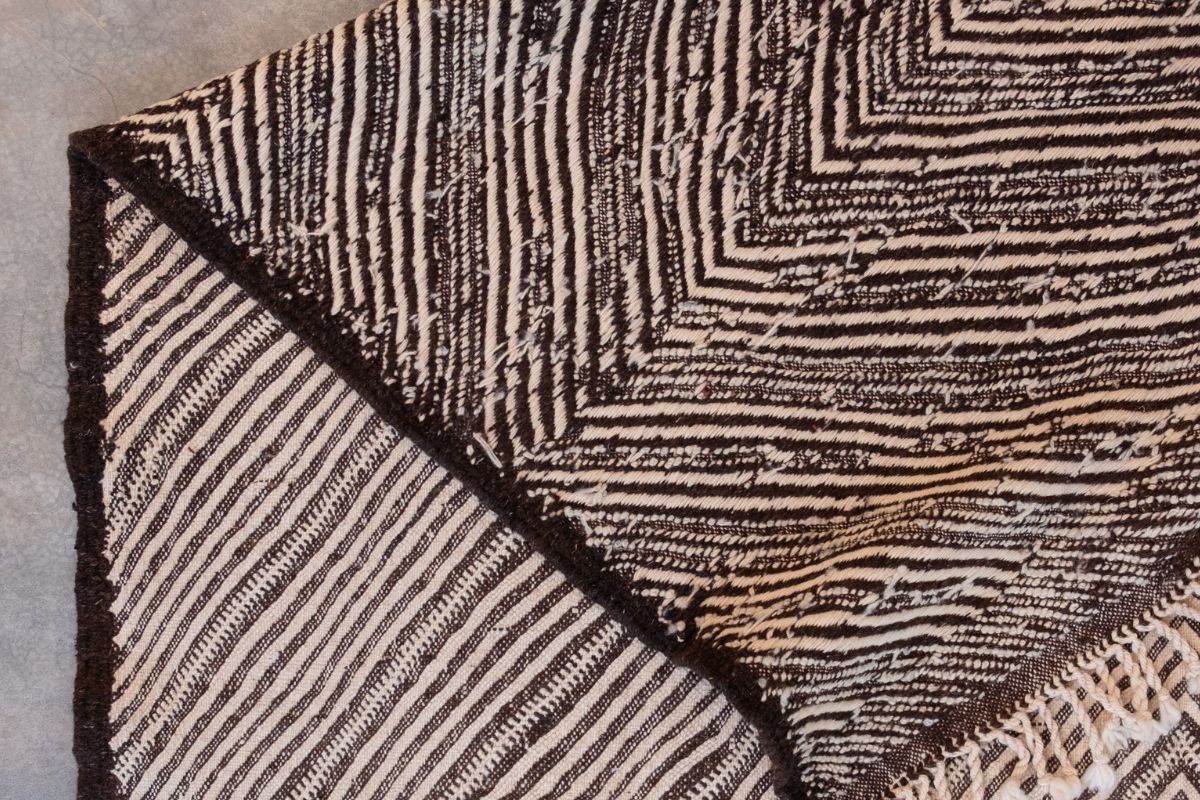
    That construction difference explains two things buyers notice immediately: a flatweave is thinner and flatter than a pile rug of the same size, and because there is no pile with a distinct "right side," the pattern often shows through to both faces, which is why genuine flatweaves, including named styles like Zanafi, are frequently reversible.

    What you gain, and what you give up

    No sampled listing frames this honestly as a trade-off rather than a pure sales pitch, so here it is plainly:

    What you gain:

    • Less weight and a lower profile, which clears doors and furniture more easily than a thick pile
    • Easier cleaning and moving, since there is no deep pile to trap debris
    • Often a lower price than a comparably sized knotted pile rug, reflecting less material and, in some cases, less labor time
    • Reversibility on genuine pieces, which can extend how long a rug looks presentable before wear shows

    What you give up:

    • Cushioning underfoot. A flatweave will never feel as soft or insulating as a thick wool pile, which matters if you're covering a cold floor or want a plush feel
    • Some visual weight. A flatweave reads as flatter and more graphic; if you want the deep, textured look of Beni Ourain or Beni Mguild, a flatweave will not deliver it regardless of pattern

    Neither is objectively better. It depends on whether you want warmth and texture (a pile rug) or a lighter, more graphic, easier-care piece (a flatweave).

    Named flatweave traditions within Morocco

    "Kilim" and "hanbel" describe the technique broadly, but specific regional and stylistic traditions exist within that broader family, the same way "pile rug" covers Beni Ourain, Beni Mrirt, and Beni Mguild as distinct named styles. Zanafi is one such tradition, associated by rug specialists with the High Atlas and known for bold two-tone geometric patterns. Other flatweaves in the market carry regional names of their own; where this guide cannot independently verify a specific attribution, it says so rather than presenting every name as an equally confirmed fact.

    Sizing and placement notes

    Because a flatweave sits lower and lighter than a pile rug, it behaves differently underfoot and in a room. It won't anchor a space with the same visual and physical weight as a thick Beni Ourain, so in a large open room it can read as thinner or less substantial than the space calls for, unless layered over a larger neutral rug or paired with heavier furniture to balance it. In smaller rooms, hallways, and transitional spaces, that same lightness is an advantage: a flatweave doesn't compete for visual or physical space the way a deep pile does, and its lower profile is genuinely practical under doors that swing close to the floor.

    What to look for when buying one

    • Check both sides. A genuine flatweave should show a coherent pattern on both faces, since there is no pile hiding a rough or unfinished back. A rug that looks flat on top but has a distinctly different, machine-backed reverse is worth questioning.
    • Feel for density. A well-made flatweave, despite being thin, should feel tightly woven and firm rather than loose or gappy.
    • Ask what "kilim" or "hanbel" means on that specific listing. Since the terms are used interchangeably and loosely, they don't by themselves tell you which region or tradition a piece comes from; ask the seller directly if a specific origin matters to you.
    • Match it to the room, not just the price. A lower price than a pile rug isn't automatically a better deal if what you actually wanted was thickness and warmth underfoot.

    For the broader family of named Moroccan styles, including the thick-pile traditions this construction contrasts with, see the complete guide to Moroccan rug styles.

    FAQ

    What is the difference between a kilim and a hanbel?
    There isn't a meaningful difference in construction. "Hanbel" is the Moroccan-Arabic name for a flatwoven rug, and "kilim" is the international term for the same technique. Listings may use either word for the same type of rug.

    Are Moroccan kilim rugs the same as flatweave rugs?
    Yes. "Flatweave" describes the construction, no knotted pile, and "kilim" (or "hanbel") is the name for that category of rug within the Moroccan and broader rug trade.

    Is a kilim rug less durable than a pile rug?
    Not necessarily less durable, but different. A well-made flatweave holds up well in high-traffic areas because there's no pile to crush, though it offers less cushioning and insulation than a thick knotted rug.

    Why are kilim rugs usually cheaper than pile rugs?
    Generally less material and, in many cases, less labor time go into a flatweave compared with a densely knotted pile rug of the same size, which tends to be reflected in price. This varies by specific piece and seller, so treat it as a general pattern rather than a fixed rule.

    Is Zanafi a type of kilim?
    Yes. Zanafi is a specific named flatweave tradition, associated by rug specialists with the High Atlas, known for bold two-tone geometric patterns and genuine reversibility. See our Zanafi rug guide for the details.

    Can a Moroccan kilim replace a pile rug in a living room?
    It can, but it changes what the room feels like underfoot. A kilim gives a lighter, flatter, more graphic look and is easier to clean and move, but it won't provide the same cushioning, insulation, or visual bulk as a thick pile rug like Beni Ourain. Choose based on whether warmth and texture or a lighter, easier-care floor covering matters more for that specific room.

  • Zanafi Rug: The Reversible Moroccan Flatweave

    Zanafi Rug: The Reversible Moroccan Flatweave

    A Zanafi rug is a Moroccan flatweave, woven in the kilim style rather than knotted with a pile, and it is genuinely reversible: both faces are finished and usable, not just one side dressed up to look that way. Bold, symmetrical geometric patterns in contrasting two-tone colors, often black and white or cream and deep brown, are the style's signature look, along with fringe finished along the vertical sides. It is one of several named traditions within the wider family of Moroccan rug styles.

    Where the name is associated

    Rug specialists commonly associate the Zanafi name with weaving communities in the High Atlas, around the Ouarzazat area. This guide did not find an independent, non-commercial source confirming that specific attribution, so it is presented here as what rug-trade sources report, not as a confirmed regional or tribal fact. What can be said plainly is the construction and look, which is consistent and checkable across the pieces sold under this name.

    Why a flatweave can genuinely be reversible

    This is the part worth understanding before anything else, because "reversible" sounds like a marketing word and here it is actually a structural fact. A knotted, pile rug (like Beni Ourain or Beni Mrirt) is built by tying individual knots into a foundation, which means one face carries the pile and the back shows the knot structure. There is a clear right side and wrong side, and only one of them is meant to be walked on.

    A flatweave, by contrast, is woven by interlacing weft threads directly through the warp, the same basic technique as a kilim, with no knots and no pile standing up from a base. Because the pattern is created by the weave itself rather than by tufts sitting on top of a foundation, the design typically shows through to both faces, sometimes as a mirror image, sometimes nearly identical. That is the real, physical reason a genuine flatweave like a Zanafi can be flipped and used on either side, and it is worth knowing because it means the "reversible" claim is a consequence of construction, not a special extra technique unique to this one style name.

    The look: pattern, palette, and fringe

    Zanafi designs lean toward bold, symmetrical geometry: diamonds, chevrons, and tribal-style motifs worked in strong, contrasting two-tone combinations, most often black against white or cream against a deep brown. The effect reads graphic and confident rather than busy, closer in spirit to the restrained lines of Beni Ourain than to the color-saturated Boujad or Azilal styles. Fringe is typically finished along the vertical sides of the piece, a detail worth checking on a genuine hand-woven example versus a machine-made copy, where fringe is often a separately sewn-on strip rather than part of the weave itself.

    Practical fit: where a flatweave earns its keep

    Because there is no pile standing up from the foundation, a flatweave like a Zanafi is lighter and flatter than a knotted rug of the same size, which has real practical consequences:

    • Easier under doors. A low-profile flatweave clears door swings and furniture that a thick pile rug can catch on.
    • Simpler to clean and move. Without a deep pile trapping dust and debris, a flatweave is generally easier to shake out, vacuum, or reposition.
    • Doubled wear life, in principle. Because both faces are finished, a worn or faded piece can in theory be flipped to present the less-worn side, extending how long it stays presentable, though heavy fading or a stain that has soaked through will still show on both sides.
    • A good fit for high-traffic, low-fuss spots. Hallways, kitchens, and entryways suit a flatweave's lighter, flatter profile better than a thick, shaggy pile that can bunch or trip underfoot in a narrow space.

    Checking whether a "reversible" claim is genuine

    Because "reversible" is a real selling point, it is also a claim worth verifying rather than taking on faith from a listing photo of one side only. On a genuine flatweave, both faces should show the interlaced weave structure directly, with the pattern visible (even if slightly softer or mirrored) on the back. A rug that shows a clean woven pattern on the front but a fuzzy, felted, or backed reverse is not a true reversible flatweave, whatever the listing calls it; that kind of construction, a pile or tufted rug with a separate backing material glued or stitched on, cannot be flipped and used on the other side no matter how the fringe or edges are finished. If a seller advertises reversibility, ask to see or describe both faces specifically before assuming the claim holds.

    How this compares to other Moroccan flatweaves

    Zanafi is not the only Moroccan flatweave on the market; kilims and hanbels made across other regions share the same basic no-pile construction with different regional patterns and palettes. See our guide to Moroccan kilim and hanbel rugs for how the wider flatweave family relates. For a contrast with the thick, high-pile end of the spectrum, our Beni Ourain guide covers the opposite construction entirely.

    FAQ

    What is a Zanafi rug?
    A Moroccan flatweave rug, woven kilim-style without a knotted pile, known for bold two-tone geometric patterns and genuine reversibility, meaning both faces are finished and usable.

    Why is a Zanafi rug reversible?
    Because it is a flatweave. The pattern is created by interlacing threads directly, without knots or a raised pile, so the design typically shows through to both sides of the fabric. That is a structural consequence of the weave, not a special added feature.

    Is a Zanafi rug the same as a kilim?
    It shares the same basic flatweave construction as a kilim. "Zanafi" refers to a specific regional style and pattern tradition within that broader flatweave family rather than a separate construction technique.

    Where are Zanafi rugs from?
    Rug-trade sources commonly associate the name with weaving communities in the High Atlas, around the Ouarzazat area. This guide could not independently confirm that specific attribution, so it is presented as reported by rug specialists rather than as a settled fact.

    Are flatweave rugs like Zanafi durable?
    Yes, generally. They are lightweight and hold up well in high-traffic areas because there is no pile to crush or wear unevenly, though the trade-off is less cushioning underfoot than a thick knotted pile rug.

  • Taznakht Rugs: The Cooperatives Behind the Name

    Taznakht Rugs: The Cooperatives Behind the Name

    Taznakht is a town in southeastern Morocco, and rugs sold under its name, sometimes also labeled "Ouaouzguit," come from one of the best-documented weaving traditions in the country. Unlike most of the styles on this site, where the only accounts available are seller marketing copy, Taznakht's cooperatives have been reported on directly by international journalists, which means this page can name real organizations, a real number of weavers, and a real person, rather than repeating unsourced tribal lore.

    Who actually makes these rugs

    According to Africanews (July 2025), the town of Taznakht is home to a genuine, organized weaving economy built around women's cooperatives. The most prominent is the Women's Centre for the Promotion of the Taznakht Carpet, established in 2016, which brings together 35 cooperatives and roughly 3,500 women weavers. The centre is reported to produce up to 300 carpets a month. Abderrahmane Janah, who manages the centre, is quoted describing the rugs as a way weavers "expressed their creativity" and "used it as a medium to convey their emotions."

    This is a genuinely different kind of evidence than most Moroccan-rug content online, which tends to describe an unnamed, anonymous "tribal craft." Taznakht's weavers are not anonymous: they work through named, dated, sourced organizations, at a documented scale.

    The same reporting notes that a new exhibition space in Taznakht now lets some weavers sell their work directly to buyers, alongside training in digital marketing, both aimed at cutting out the middlemen who have traditionally set prices at the region's markets. That detail matters for anyone buying a Taznakht rug who wants their money to reach the person who made it, not just the person selling it.

    Materials and process

    Africanews's reporting describes the process in specific, checkable terms: wool is sourced from sheep in the region, including animals from the nearby Sirwa mountains. Weavers wash the wool, spin it, and dye it using colors drawn from plant materials: henna, pomegranate peel, saffron, and indigo leaves. The rugs are woven on a traditional wooden loom, and a single piece is reported to take several weeks to several months to complete, depending on its size and the complexity of the design.

    That plant-based dye list is worth noting on its own: it means at least some Taznakht production carries the same natural-dye character found in other named Moroccan traditions, rather than relying purely on modern synthetic dyes.

    The tribal-name question

    You will see "Taznakht rugs" also referred to as "Ouaouzguit" rugs, and several rug-trade sources attribute this second name to the Ait Ouaouzguite, described as an Amazigh (Berber) tribal grouping associated with the mountain villages around Taznakht. This guide could not confirm that specific tribal attribution against the journalism sources used above, which discuss the cooperatives and the town but do not name this tribal grouping directly. Treat the "Ait Ouaouzguite" name as a claim made by rug specialists and sellers, useful context, but not independently verified here the way the cooperative numbers above are.

    You may also see these rugs described in listings as traditionally part of a bride's dowry, exchanged as a way of marking a marriage. That is a claim reported by rug-trade sources rather than the journalism used elsewhere on this page, so it is noted here as an attributed detail rather than a confirmed fact about the tradition as a whole.

    How this differs from the Middle Atlas styles

    Everything covered so far in this Cluster (Beni Ourain, Beni Mrirt, Beni Mguild) comes from the Middle Atlas, in the country's north-central mountains. Taznakht sits much further south, near the edge of the Anti-Atlas and Sirwa ranges, and its rugs are generally more colorful and pattern-dense than the restrained, largely undyed Middle Atlas wool styles. If you are trying to place a rug geographically from a listing, "Taznakht" or "Ouaouzguit" on the label should point you south, not to the Beni Ourain / Beni Mrirt / Beni Mguild family covered in our complete guide to Moroccan rug styles.

    What to look for

    • Ask who made it, specifically. Given how well-documented Taznakht's cooperative network is, a seller who cannot say which cooperative a rug came from, or whether it passed through the Women's Centre network, is giving you less information than is actually available for this style.
    • Look for the plant-dye palette. Henna, pomegranate, saffron, and indigo produce a warmer, earthier range than purely synthetic dyes. A flat, uniform, highly saturated color across the whole piece is worth a second look.
    • Don't assume every "Ouaouzguit" claim is verified. The cooperative facts above are journalism-sourced; the specific tribal name and the dowry tradition are not, and this guide treats them accordingly.

    One honest limit: this page describes a documented weaving economy, not a specific rug you may be looking at. It cannot authenticate an individual piece or confirm which cooperative made it from a photo alone; that requires asking the seller directly.

    FAQ

    What is a Taznakht rug?
    A rug produced in or attributed to Taznakht, a town in southeastern Morocco, home to a documented network of women's weaving cooperatives, including the Women's Centre for the Promotion of the Taznakht Carpet, established in 2016.

    What does "Ouaouzguit" mean?
    It is an alternate name used for Taznakht-area rugs. Rug-trade sources attribute it to the Ait Ouaouzguite, described as an Amazigh tribal grouping in the region, though this guide could not independently confirm that attribution against available journalism.

    How many weavers are involved in Taznakht rug production?
    Africanews reported in 2025 that the Women's Centre for the Promotion of the Taznakht Carpet alone includes 35 cooperatives and roughly 3,500 women weavers, producing up to 300 carpets a month.

    What materials go into a Taznakht rug?
    Wool from sheep in the region, including the nearby Sirwa mountains, washed, spun, and dyed with plant materials such as henna, pomegranate peel, saffron, and indigo leaves, then woven on a traditional wooden loom.

    Is it true Taznakht rugs were traditionally part of a bride's dowry?
    That claim appears in rug-trade sources but was not confirmed in the journalism used for this guide. Treat it as an attributed detail from sellers and regional specialists rather than an independently verified fact.

  • Boucherouite Rugs: Morocco’s Rag Rugs Explained

    Boucherouite Rugs: Morocco’s Rag Rugs Explained

    A Boucherouite rug is a Moroccan rag rug woven from recycled fabric scraps, and it is bright, bold, and genuinely one of a kind. Instead of raw sheep's wool, weavers use torn strips of old clothing, leftover yarn, cotton, and synthetic remnants, knotting them into a dense, multicolored surface. The name comes from the Moroccan Arabic phrase often written as "bu sherwit," meaning a scrap of torn or used clothing. That practical, thrifty origin is the whole point of the style: a Boucherouite is a real Berber weaving tradition built from whatever a household had on hand, which is why no two look the same.

    If you found one of these rugs through a photo and thought "what is this, and why does it look so different from every other Moroccan rug," this guide walks through the origin, the materials, the look, the care, and the one question buyers ask most: is it less authentic because it isn't wool.

    What a Boucherouite rug actually is

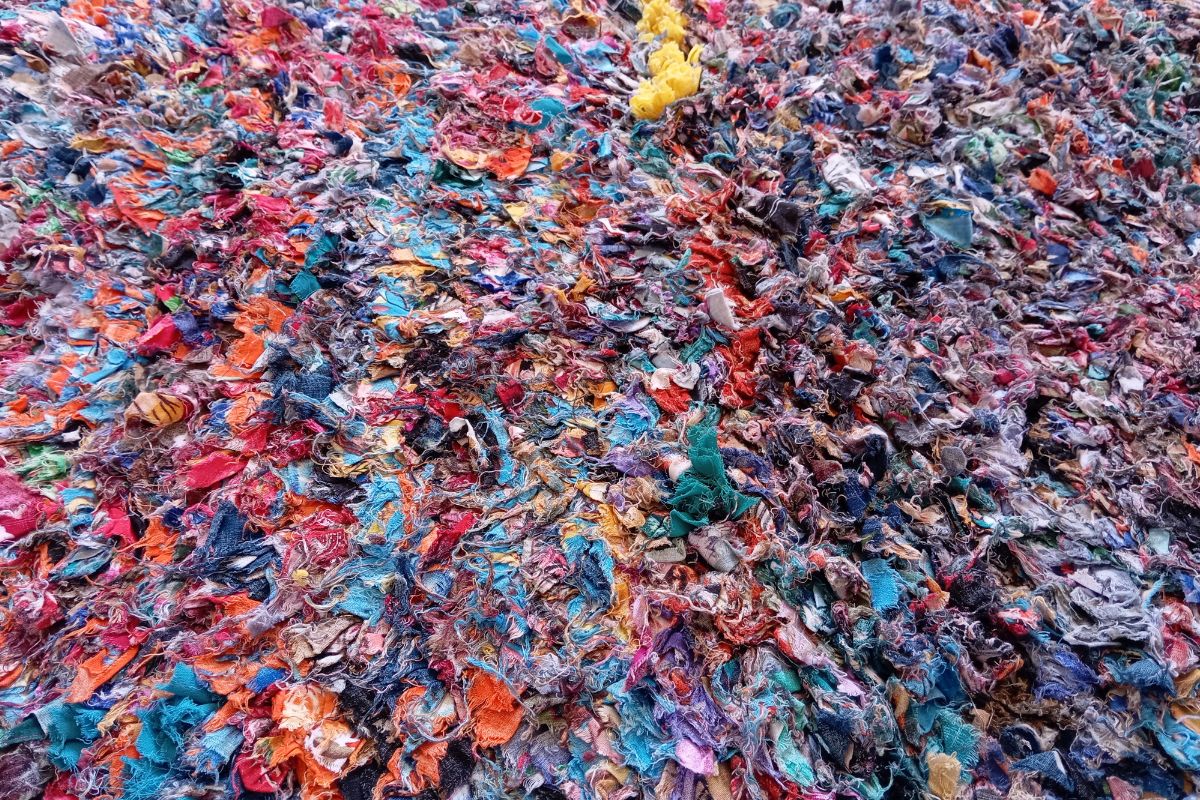
    Most of Morocco's famous rugs are woven from sheep's wool. A Boucherouite is the exception. It is a pile or flat-woven rug whose "yarn" is reclaimed textile: strips cut from worn-out clothing, blankets, and fabric offcuts. Weavers commonly mix in cotton, wool, nylon, polyester, and sometimes shiny lurex thread or even plastic from packaging. The scraps are torn or cut into ribbons, then hand-knotted or woven onto a simple loom, usually by women weaving for their own homes rather than for sale.

    That mixed-material makeup is the defining feature. A Beni Ourain rug is defined by its cream wool and minimal design; a Boucherouite is defined by the opposite, a maximal patchwork of recycled color with no single fiber ruling the piece. Because the raw material is whatever was available, the same rug can hold a dozen different textiles at once. That is not a flaw. It is the tradition working exactly as intended.

    Where the style comes from, and why

    The honest version of the origin story is a practical one, and it is worth telling plainly rather than dressing it up as pure artistic vision.

    For generations, Berber (Amazigh) weavers made rugs from wool they spun themselves. Through the middle of the 20th century, as many families moved away from nomadic herding toward town life and wage work, wool became harder and more expensive to come by. Weavers did what resourceful people everywhere do: they used what they had. Old djellabas, worn sweaters, cotton shirts, and market-bought secondhand clothing were torn down and rewoven into floor coverings. Sources generally place the rise of Boucherouite in this period, roughly the 1960s and 1970s, with early momentum in Morocco's Central Plains around Beni Mellal and Boujad before the practice spread into the Middle and High Atlas regions near Azilal and Marrakesh.

    For a long time these rugs carried little commercial value. They were domestic objects, not souk merchandise, and shopkeepers did not display them. Collector and design interest arrived later, spreading through Europe, the United States, and Japan, which is when the Boucherouite went from household necessity to sought-after textile. Keep that timeline in mind when you see a rug described as "antique." The style itself is only decades old, so most genuine pieces are vintage at the oldest, not centuries-old heirlooms.

    For the fuller picture of how this style sits alongside the wool-based traditions, see our overview of Moroccan rug styles.

    What it looks like, and why no two are alike

    Here is a point most seller pages skip past: there is no "standard" Boucherouite look, because the style is improvised by design.

    A wool Beni Ourain has a recognizable template, ivory ground with a thin diamond lattice. A Boucherouite has no template. The weaver works with whatever colors and textures are in the scrap pile, and the pattern emerges as she goes. The results tend to share a family resemblance rather than a fixed formula:

    • Color: saturated and clashing on purpose. Hot pink next to lime, red beside turquoise, stripes that change halfway across the rug when one fabric ran out and another began.
    • Pattern: loose and spontaneous. Chevrons, uneven stripes, blocks, and scattered motifs, rarely perfectly symmetrical.
    • Texture: varied within a single rug, because cotton, nylon, and wool strips do not sit the same way.

    So when you compare two Boucherouite rugs and they look nothing alike, that is expected. Uniqueness is not a premium feature layered on top of the style. It is the style. Anyone claiming a "classic" or "correct" Boucherouite pattern is applying a rule the tradition never had.

    Is a Boucherouite less authentic because it is not wool?

    This is the question that trips up new buyers, so it deserves a direct answer: no. A Boucherouite is a real Berber weaving tradition, not an imitation or a lesser rug.

    The word "authentic" gets used loosely in the rug trade, and it is worth being precise about what it can and cannot mean. If "authentic" is taken to mean "made from handspun wool in an old nomadic style," then of course a rag rug does not qualify, but that is the wrong test. Boucherouite weaving is authentic on its own terms: made by Amazigh weavers, in Morocco, using a genuine and well-documented practice with its own name and history. The recycled-material story is not a compromise of its value. It is the source of it. These rugs are prized precisely because they turn thrift and improvisation into something original.

    A fair, non-salesy way to hold this: judge a Boucherouite as a Boucherouite. Ask whether it is well made, hand-woven, and honestly described, not whether it matches a wool rug it was never trying to be. Atlas Rug Guide does not appraise or authenticate individual rugs, and no online guide can confirm a specific piece for you. For a high-value purchase, a hands-on expert is the right call.

    Caring for a rug made of mixed fibers

    Care is where the recycled makeup genuinely matters, and where generic "how to clean a Moroccan rug" advice can steer you wrong. A wool rug and a nylon-heavy rag rug do not behave the same way, so the fiber mix should guide how you treat it.

    A few principles that travel well across most Boucherouite rugs:

    • Know what you are cleaning first. A small, mostly cotton rug tolerates more than a wool-heavy or lurex-flecked one. When you do not know the mix, treat the rug as delicate.
    • Vacuum gently, without a rotating beater brush, which can catch and pull the knotted strips. A suction-only setting or a handheld attachment is safer.
    • Blot spills, do not rub. Use a cloth with mild soap in cool water, and test on a hidden corner first, since mixed dyes can bleed and reclaimed fabrics may not be colorfast.
    • Air it out by taking it outside and shaking it rather than beating it hard.
    • Be cautious with machine washing. Some small, cotton-dominant Boucherouite rugs are washed on a gentle cold cycle and dried flat, but this is not safe across the board. Heat and agitation can shrink wool content, distort the weave, or set dye bleeding. When in doubt, hand wash cool or use a rug cleaner familiar with mixed-fiber textiles.
    • Store rolled, not folded, in a breathable cotton or muslin wrap, never sealed plastic, which traps moisture.

    The short version: the same trait that makes these rugs interesting, the fiber mix, is exactly why you cannot treat them like a uniform wool rug.

    Where a Boucherouite fits in a modern home

    Because the color does the talking, a Boucherouite tends to work best as the loud element in a calm room. Set against neutral walls, a pale sofa, and plain flooring, its clashing palette reads as intentional art rather than chaos. Many people use them in high-traffic, forgiving spaces such as kitchens, hallways, kids' rooms, and studios, partly because the busy pattern hides everyday wear and the cotton-heavy examples are easier to clean than fine wool.

    If your taste runs quieter, the same room might call for a wool piece instead. It is worth comparing the mood of a rag rug against a minimal Beni Ourain rug or a hand-painted Azilal rug before you commit, since these styles sit at very different ends of the Moroccan rug spectrum. The rule of thumb is simple. Let the Boucherouite be the star and keep everything around it quiet.

    What to look at before buying one

    A Boucherouite is judged differently from a wool rug, so the usual wool-rug tests do not all apply. A few honest signals to check:

    • Handmade, not printed. The back should show the woven or knotted structure and irregularities, not a flat machine-printed pattern.
    • Secure edges and a stable weave. Because the materials are reclaimed and varied, construction quality varies too. Look for tight, even knotting and finished sides rather than loose, fraying strips.
    • Honest description. A trustworthy seller will call it what it is, a recycled-textile rug, and will not oversell it as antique or as handspun wool.
    • Condition of the fibers. Reclaimed cloth ages unevenly, so check for thin spots and weak areas, especially on vintage pieces.

    Note that a common wool test, the burn test for fiber content, does not map cleanly onto a Boucherouite, since the rug is a deliberate blend of natural and synthetic fibers. A mixed result tells you almost nothing here, which is one more reason these rugs need their own eye rather than borrowed wool-rug rules.

    FAQ

    What does "Boucherouite" mean?
    It comes from a Moroccan Arabic term often written as "bu sherwit," meaning a scrap or piece of torn, used clothing. The name literally describes the material: rags.

    What are Boucherouite rugs made of?
    Recycled textiles. Weavers use torn strips of old clothing and leftover yarn, commonly mixing cotton, wool, nylon, polyester, and sometimes lurex thread. The exact blend depends entirely on what scraps were available.

    Are Boucherouite rugs authentic Moroccan rugs?
    Yes. They are a genuine Amazigh (Berber) weaving tradition from Morocco, developed mainly since the mid-20th century. Being made from recycled material rather than pure wool does not make them less authentic; it is the defining feature of the style.

    Can you wash a Boucherouite rug?
    Some small, cotton-heavy examples can handle a gentle cold wash and flat drying, but this is not safe for every rug, especially those with wool or lurex. Because the fibers are mixed, the safest default is gentle vacuuming, spot-blotting with mild soap, and a spot test before any wet cleaning.

    Why do no two Boucherouite rugs look the same?
    Because they are improvised. There is no fixed pattern or color scheme. Each weaver works with whatever scraps she has, so every rug is a one-off. Uniqueness is built into the tradition rather than added as a premium.

  • Boujad Rug Guide: Colors, Patterns & How to Buy

    Boujad Rug Guide: Colors, Patterns & How to Buy

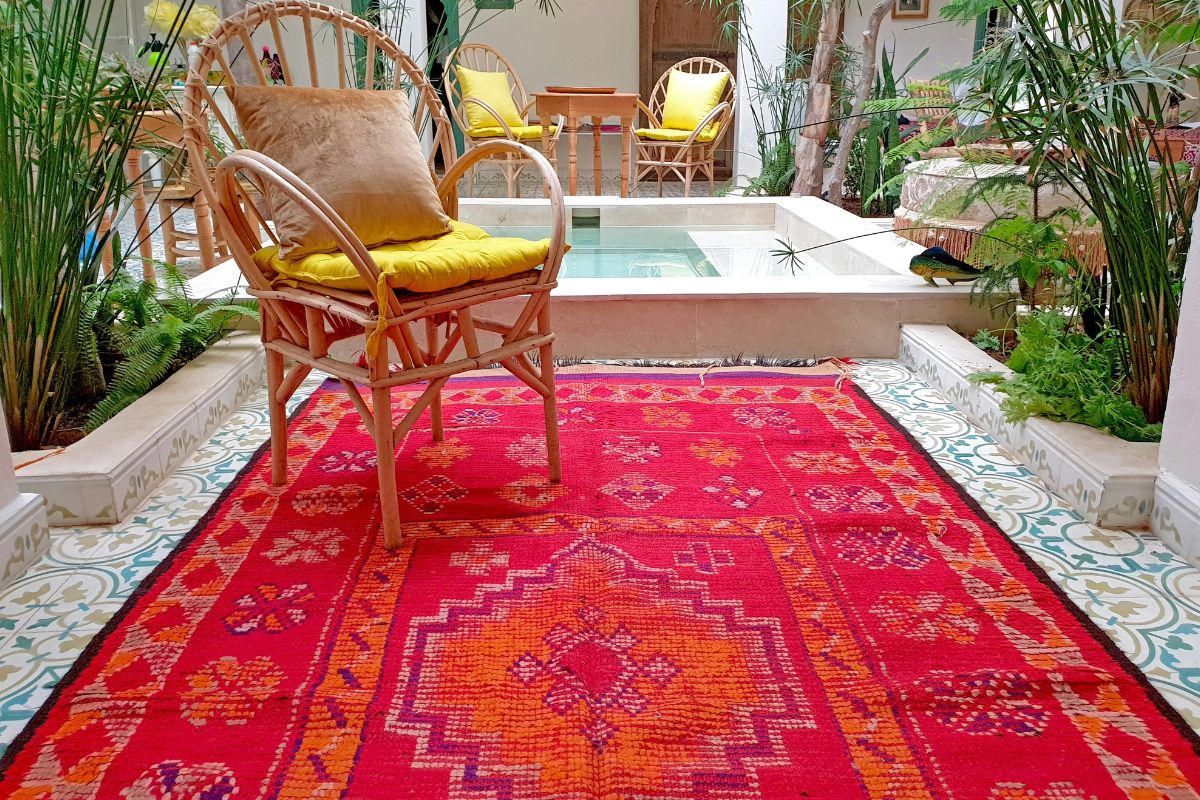
    A Boujad rug (also spelled Boujaad or Bejaad) is a handwoven Berber rug from central Morocco, best known for its warm palette of pinks, oranges, reds, and purples arranged in free, improvised abstract patterns. It comes from the plains around the market town of Boujaad, not the mountains, and it is woven in wool by Amazigh (Berber) women who design as they go rather than following a fixed grid. If you found a rug that glows in sunset colors with loose diamonds and zigzags floating across it, you are very likely looking at a Boujad.

    This guide covers where Boujad rugs come from, why their colors look the way they do, how they are made, how they differ from Beni Ourain and Azilal rugs, and what to actually check before you buy one. Where a fact is genuinely contested or unverifiable for an individual rug, we say so instead of guessing.

    What makes a rug a "Boujad"

    The name comes from the town of Boujaad in Khouribga Province, in Morocco's Beni Mellal-Khenifra region, roughly 90 kilometers southeast of Rabat. This is central Morocco, on the plains between the Atlantic coast and the Middle Atlas, not the high mountain country that many rug listings imply. You will often see Boujad described online as a "Haouz region" or "Atlas mountain" rug. That placement is inconsistent with the town's actual location, and it is one of the most repeated errors in Boujad descriptions.

    Boujaad functioned historically as a market hub. Surrounding tribes brought surplus rugs into town to trade, which is how a whole family of rugs from the wider area came to carry the single trade name "Boujad." So the label describes a regional weaving style and a market of origin more than one narrow tribe. The town still holds a moussem (a seasonal festival) that celebrates both horses and rugs, a sign of how central weaving is to local life.

    The short version: a Boujad is a central-Moroccan, plains-region Berber wool rug in warm colors with a loose, expressive design. Hold onto those three traits, warm palette, wool, and improvised pattern, because together they are what separate a Boujad from its more famous cousins.

    The warm color palette, and where the color comes from

    Color is the reason most people fall for a Boujad. The signature run of tones is pink, magenta, red, orange, and purple, frequently layered together in the same rug so the field reads like a faded sunset. Some pieces also work in warm neutrals, saffron yellows, or the occasional turquoise accent, but the warm reds-to-pinks range is the family signature.

    Here the honest part matters. Sources consistently say the colors come from natural, plant and vegetable-based dyes, and locally documented Berber dye plants include henna and indigo among others. The specific dye behind any one rug's pink or red is rarely recorded, however. Madder root, a classic red-yielding dye used widely across Moroccan and North African weaving, is often named as the source of these warm reds, but that attribution is applied loosely and is more firmly documented for other Moroccan rug types than for Boujad specifically. So it is fair to say Boujad's warm tones are traditionally natural-dyed, and fair to name madder as a likely red source in the broader tradition, but it is not fair to promise that a given rug's magenta is "madder root" unless the seller can actually show that.

    Two more things affect the color you see:

    • Age and light. Natural dyes soften over decades. A vintage Boujad's dusty, gone-to-seed pink is often faded color, not the shade it left the loom.
    • Modern production. Newer Boujad and "Boujad-style" pieces may use synthetic dyes, which can read brighter and more uniform. Synthetic dye does not make a rug fake, but it is a different thing from the natural-dye tradition, and it should be described accurately rather than sold as always-natural.

    Wool, weave, and pile

    Boujad rugs are woven in wool, typically hand-spun sheep's wool from the region's flocks. The pile is usually medium to plush and soft underfoot, warmer and denser than a flatweave kilim but generally not as deep and shaggy as a classic high-pile Beni Ourain.

    Because the weaver works freehand, the knotting and the pile height can vary within a single rug, and the shape itself is often slightly irregular rather than perfectly rectangular. Those small inconsistencies are normal for a genuine handwoven piece and are part of what a machine-made reproduction cannot convincingly fake.

    Pattern and motif: the free abstract aesthetic

    If Beni Ourain is minimalism, Boujad is improvisation. The motifs are geometric and abstract: diamonds and lozenges, triangles, zigzags, chevrons, and freely drawn borders. Many of these shapes are commonly described as drawing on Amazigh (Berber) visual language, including tattoo and architectural motifs. You will also see them assigned fixed meanings tied to protection, fertility, and daily life. Treat that as interpretation rather than settled fact. This guide could not trace those readings to a named source, meanings vary by weaver, family, and region, and a great deal of it is undocumented or read into the rug after the fact.

    The key word is freely. A Boujad weaver typically works without a fixed cartoon or repeated template, letting the pattern evolve as the rug grows. That is why two Boujads are rarely alike and why the composition can shift partway up the rug, with a motif appearing once and never returning. Collectors read that spontaneity as the style's charm rather than a flaw.

    Boujad vs Beni Ourain vs Azilal

    Boujad is one of several Berber styles, and it is easy to mix them up from a photo. Here is the quick contrast:

    Style Colors Pattern Feel
    Boujad Warm pinks, reds, oranges, purples Free, all-over abstract; diamonds, zigzags Cozy, expressive, color-forward
    Beni Ourain Neutral cream or ivory with black or brown lines Sparse, minimal geometric Calm, modern, understated
    Azilal Bright colors (reds, blues, yellows) on an ivory or natural ground Storytelling; single motifs on open field Playful, graphic

    The simplest way to tell them apart: Beni Ourain is neutral and quiet, Azilal is bright color on a pale background, and Boujad is warm color across the whole field. For a deeper look at the two color-forward styles, see our Azilal rug guide, and for the neutral end of the spectrum, our Beni Ourain rug guide. All of these sit inside the wider family covered in our complete guide to Moroccan rug styles.

    What "vintage Boujad" actually means

    "Vintage" is one of the most-used words in Boujad listings, and it is worth being clear-eyed about it. Vintage is not a regulated or certified term in the rug trade. When a seller calls a Boujad vintage, they usually mean it is an older, used piece, often implied to be several decades old, but the label on its own does not verify an exact age, and it is not a guarantee of natural dyes, hand-spinning, or any particular quality.

    That does not mean vintage is meaningless. Genuine older Boujads do tend to show softened colors, gentle wear, and the wool sheen that comes from years of use. But those are things you assess by looking at the rug, not by trusting the word in the title. Treat "vintage" as a starting description to verify, not as proof. The same caution applies to the other unregulated trade words that surround these rugs, including authentic and tribal.

    It is also worth naming that "Boujad style" reproductions exist. Some rugs are woven or manufactured elsewhere to imitate the Boujad look. A Boujad-inspired piece can be a perfectly nice rug, but it is a different thing from a rug woven in the Boujaad region tradition, and the two should not be described as if they were the same.

    What to check before buying one

    Atlas Rug Guide is a reference, not an appraisal service, so nothing here replaces hands-on inspection by a specialist for a high-value purchase. With that said, a few practical checks apply:

    • Ask about fiber. Confirm it is wool, and ask whether the wool is hand-spun. A quick, careful feel and a look at the yarn tells you more than the listing does.
    • Ask about dye. If a rug is described as naturally dyed, ask the seller how they know. An honest answer ("older piece, dyes look natural, but not lab-tested") is more trustworthy than a flat guarantee with no basis.
    • Read the shape and back. Handwoven Boujads are usually slightly irregular, and the back should show the pattern and hand-tied knots, not a printed or glued backing.
    • Take "vintage" as a claim to check. Look for the actual signs of age rather than relying on the word.
    • Match it to your room honestly. Boujad's warm tones are strong. They are a feature, not a neutral, so buy the color you genuinely want to live with.

    Where a Boujad fits in a home

    Because the palette is warm and the pattern is busy, a Boujad tends to act as the anchor of a room rather than a quiet backdrop. It sits comfortably against neutral walls, natural wood, and simple furniture that lets the color lead. In lower-traffic, cozy spaces like bedrooms, reading corners, and living rooms, the plush wool pile is part of the appeal.

    Frequently asked questions

    What is a Boujad rug?
    A Boujad rug is a handwoven Berber wool rug from the plains around Boujaad in central Morocco, known for warm pink, red, orange, and purple tones and free, improvised abstract patterns.

    Where do Boujad rugs come from?
    From the region around the town of Boujaad (also spelled Boujad or Bejaad) in Khouribga Province, central Morocco, roughly 90 kilometers southeast of Rabat. Despite common listings, it is a plains market region, not a high-mountain area.

    Why are Boujad rugs pink and red?
    The warm tones traditionally come from natural plant and vegetable dyes. Madder root is often named as a red source in the broader Moroccan tradition, but the exact dye in a specific rug is rarely documented, and newer pieces may use synthetic dyes.

    What is the difference between a Boujad and a Beni Ourain rug?
    Beni Ourain rugs are neutral, usually cream or ivory with sparse black or brown geometric lines. Boujad rugs are warm and color-forward, with pinks, reds, and oranges across the whole field and busier abstract patterns.

    Does "vintage Boujad" guarantee the rug is old or natural-dyed?
    No. Vintage is not a regulated term. It usually signals an older, used rug, but it does not by itself verify a specific age, natural dyes, or hand-spinning. Check the rug itself rather than relying on the label.

  • Azilal Rugs: The Colorful Berber Rug Explained

    Azilal Rugs: The Colorful Berber Rug Explained

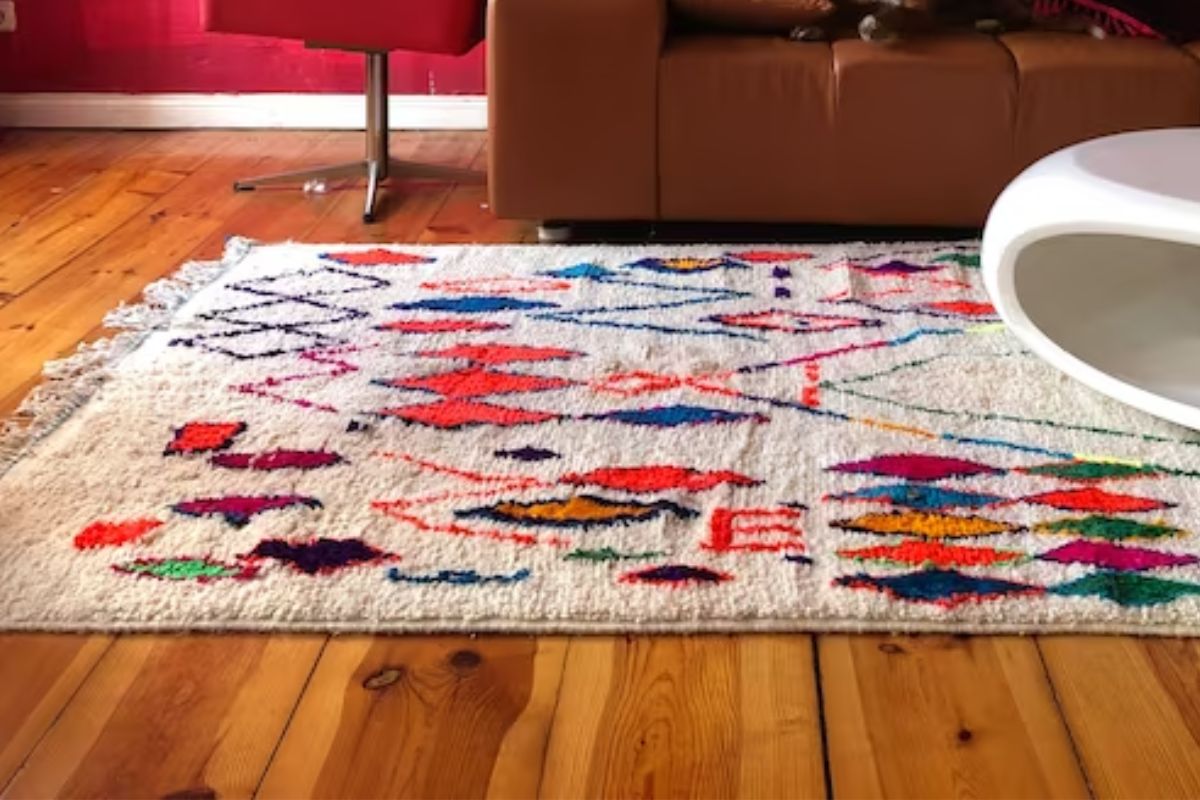
    An Azilal rug is a hand-knotted Berber rug from the Azilal province in Morocco's High Atlas Mountains, built on a natural, undyed cream or ivory wool base and covered with vivid, freeform, abstract patterns. It is the colorful, expressive counterpart to the neutral Beni Ourain: thinner in pile, brighter in palette, and far less bound by fixed tribal templates. Each Azilal is essentially a one-off, improvised by the weaver, so no two are truly alike. If you found a bright, loosely drawn Moroccan rug floating on a cream ground and wondered what it was, it is almost certainly an Azilal.

    The rest of this guide covers where the style comes from, why the designs never repeat, what the rugs are made of, how they differ from the two styles they are most often confused with (Beni Ourain and Boujad), and the honest parts most rug listings leave out. For the wider family this style belongs to, see our complete guide to Moroccan rug styles.

    Where Azilal rugs come from

    Azilal is both a rug style and a real place. The province and town of Azilal sit in the High Atlas Mountains, roughly 100 miles from Marrakech, and the rugs take their name from that region. They are woven by Azilali Berber (Amazigh) communities, and by long tradition the weaving is done by women, with techniques passed down within families.

    Beyond that, the deep history gets murky, and this is a good moment to be honest about it. You will see origin dates for Azilal weaving stated confidently across the web, from a few centuries to "ancient," but there is no firmly documented, agreed-upon start date. What is clear is that the style stayed local and largely unknown to outside collectors until the late twentieth century, when Moroccan tribal rugs found a Western design audience. So the safe, accurate statement is this: Azilal is a regional High Atlas weaving tradition that became internationally collected fairly recently. Precise founding dates are not settled, and any single source that pins one should be read with caution.

    Why no two Azilal rugs match

    This is the trait that defines the style, and it is the one most worth understanding before you buy. Where a Beni Ourain follows a fairly restrained visual template, the Azilal weaver works freehand. The motifs (lines, diamonds, chevrons, ladders, and looser figurative shapes) are arranged from the maker's own imagination rather than a set pattern book. The results are personal, improvised, and often asymmetric.

    The practical consequence: you cannot shop for "the Azilal design," because there isn't one. Two rugs from the same village, the same year, even the same weaver, will not match. Irregular spacing, a color that appears once and never again, a motif that drifts off-center: these are features of the tradition, not flaws or signs of a mistake. If you want a rug that reads as a single artistic object rather than a repeating textile, that improvised quality is the whole appeal. If you want two matching runners, this is the wrong style to hunt for.

    What Azilal rugs are made of

    The ground of an Azilal is typically natural, undyed sheep's wool in cream, ivory, or soft beige. The colored motifs are worked in dyed wool, and often cotton, laid over that light base. Some newer pieces incorporate recycled cotton or mixed fibers for the bright accents, which is part of why modern Azilals can look more saturated than older ones.

    Construction-wise, Azilal rugs are single-knotted, commonly with a cotton warp and wool knots and weft. The pile tends to be lower and the rug lighter and thinner than a plush Beni Ourain. That makes them easier to layer and move, though it also means they feel less cushioned underfoot.

    Azilal vs Beni Ourain: the honest comparison

    These two are the styles buyers most often weigh against each other, because they sit at opposite ends of the same shelf: one neutral, one colorful. Neither is "better." They solve different problems in a room.

    Feature Azilal Beni Ourain
    Region Azilal province, High Atlas Beni Ourain tribes, Middle Atlas
    Palette Cream base with bright, multicolor motifs Cream or ivory base with brown or black lines
    Design Freeform, abstract, improvised Minimalist, geometric, restrained
    Pile Lower and thinner Thick, plush, high pile
    Materials Wool plus cotton, sometimes recycled fiber Typically all wool
    Feeling in a room Playful, artistic, a focal point Calm, neutral, a backdrop

    The short version: choose an Azilal when you want the rug to be the color story in the room, and a Beni Ourain when you want the rug to disappear into a neutral scheme and let everything else stand out. For the full breakdown of the neutral option, see our Beni Ourain rug guide.

    Azilal vs Boujad: the other easy mix-up

    Boujad is the style most often confused with Azilal once color enters the picture, and telling them apart comes down to one word: space. Boujad rugs are woven in the Middle Atlas near the town of Boujad, by Arab and Arabised Berber communities, and they tend to flood the entire field with saturated color, especially pinks, reds, oranges, and purples. The color fills the rug edge to edge.

    An Azilal does the opposite. It keeps a lot of open cream ground showing, with bright motifs floating on top of it. So a quick tell: if most of the rug is cream with color drawn onto it, you are likely looking at an Azilal; if the whole surface is soaked in warm color, it leans Boujad. Our Boujad rug guide covers that saturated style on its own terms.

    Older Azilal vs newer production

    "Azilal" is not one static look, and the difference between older and newer pieces is real enough to explain rather than blur. Older Azilal rugs lean on natural undyed wool and plant-based dyes, with sparser designs and a more muted, earthy set of accent colors. Many newer pieces are brighter, use more cotton, and may rely on synthetic dyes to hit those electric blues, pinks, and yellows.

    This matters because natural and synthetic dyes age differently. Natural dyes tend to mellow and harmonize over years, softening into the wool. Synthetic dyes are generally stable in a good modern rug, but some can fade or shift over time rather than settle. Neither is automatically "better," but they are not the same thing, and price and expectation should follow the reality of the piece.

    One caution: "vintage" is not a regulated term in the rug trade, and the age of a specific rug is hard to verify from a photo or a listing alone. Treat an age claim as a claim, not a certified fact, and ask what it is based on.

    What the motifs might mean, and why "might" is the right word

    You will find blogs that hand you a tidy dictionary of Azilal symbols, assigning fixed meanings to diamonds, zigzags, and figures. Read those with care. The motifs are commonly described as touching on rural life, motherhood, birth, and protection, and many weavers do work personal or symbolic content into their rugs. But there is no single, universal, decoded code. Meanings vary by weaver, family, and region, and a great deal of it is undocumented or interpreted after the fact.

    So the accurate framing is that Azilal motifs may carry meaning, often personal to the maker, and that specific "this shape always means X" claims should be treated as interpretation rather than settled fact. When a source states a precise symbolic meaning, look for what it is sourced to.

    The part most rug listings leave out

    Here is the honest section a seller has little reason to write. Because the defining traits of an Azilal are loose ("colorful abstract motifs on a light ground"), the label gets applied broadly in the market. A colorful High or Middle Atlas rug that is arguably Boujad-adjacent or a regional blend may still be listed as "Azilal," simply because that name sells. And the words that surround these rugs, including Azilal, vintage, authentic, tribal, and Berber, are not regulated or certified by anyone. The label on a listing is a description, not a guarantee of origin.

    That is not a reason to distrust every rug. It is a reason to buy the rug in front of you rather than the word attached to it: judge the wool, the ground, the knotting, and the look you actually want. Atlas Rug Guide is a reference, not an appraisal or authentication service, and we will not tell you a specific rug is genuine from afar. For a high-stakes purchase, an in-person expert who can handle the piece is the right authority.

    Before you buy or live with one

    A few grounded checks, in plain terms:

    • Feel the wool. Real sheep's wool has a slightly greasy, springy hand and recovers when you press it. A flat, squeaky, or plasticky feel is worth questioning.
    • Look at the ground. A classic Azilal shows a natural, undyed cream or ivory base with color drawn on top, not color everywhere.
    • Check the back. Hand-knotting shows on the reverse. Ask whether the piece is knotted rather than machine-made or tufted.
    • Ask about dyes and age. A confident seller can tell you natural versus synthetic dye and roughly how old the piece is, and will not oversell what they cannot prove.
    • Expect asymmetry. Irregularity is normal here. Do not treat an off-center motif as a defect.

    In a room, an Azilal earns its keep as a color anchor over neutral floors, and its thinner pile makes it easy to layer over a larger natural rug or a flatweave. Because the palette is already doing the work, it usually looks best with fairly restrained furniture around it.

    FAQ

    Are Azilal rugs handmade?
    Yes. Azilal rugs are hand-knotted, traditionally by women in the Azilal region of the High Atlas, using wool and often cotton. Handwork is why each one is slightly irregular and one of a kind.

    Is an Azilal rug better than a Beni Ourain?
    Neither is better; they are built for different rooms. An Azilal brings color and acts as a focal point, while a Beni Ourain is neutral and recedes into the background. Choose based on whether you want the rug to be the color story or a quiet backdrop.

    Why are Azilal rugs so colorful?
    The style is defined by expressive, improvised design. Weavers work freehand rather than to a fixed template, laying bright dyed wool and cotton over a natural cream base. Newer pieces often look more saturated because they use more cotton and, in some cases, synthetic dyes.

    What are Azilal rugs made of?
    A natural undyed wool ground, with motifs in dyed wool and often cotton. Some newer pieces use recycled cotton or mixed fibers for the bright accents. They are usually knotted with a cotton warp and wool knots.

    How can I tell a real Azilal rug?
    Look for real wool, a natural cream ground with color drawn on top, visible hand-knotting on the back, and honest answers about dyes and age. Keep in mind that "Azilal" is an unregulated market label, so for an important purchase, a hands-on expert appraisal is the only reliable way to confirm origin.

  • Beni Mguild Rug: The Indigo Middle Atlas Style

    Beni Mguild Rug: The Indigo Middle Atlas Style

    A Beni Mguild rug is a thick-pile, hand-knotted wool rug from Morocco's Middle Atlas region, built on the same heavy-wool tradition as Beni Ourain and Beni Mrirt but set apart by its color: deep indigo, plum, aubergine, and dark pomegranate-red tones instead of undyed cream. If Beni Ourain is the neutral classic of this family, Beni Mguild is its darker, more saturated relative, and it gets confused with the other two far less on look, and far more on name recognition, since it is the least commercially prominent of the three.

    What makes a rug a Beni Mguild

    The name points to a weaving tradition based in the Middle Atlas, the same broad mountain region that produces Beni Ourain and Beni Mrirt rugs. Sellers commonly attach the name to a specific tribal group, but this guide did not find an independently sourced account of that attribution and will not repeat it as settled fact. What is safely observable is the rug itself: a heavy, thick wool pile, worked in geometric motifs including diamonds, lozenges, zigzags, and herringbone bands, set on a dark, dyed ground rather than the natural undyed cream of Beni Ourain.

    Like its Middle Atlas neighbors, the style is described as originating from a practical need: a thick wool rug that doubled as floor covering and bedding against cold mountain winters. That functional origin is consistent with the whole Middle Atlas wool-rug family and is a reasonable, low-risk description rather than a claim about a specific date or century, which this guide will not invent.

    The look: motifs, pile, and palette

    The palette is what actually distinguishes Beni Mguild at a glance. Where Beni Ourain and Beni Mrirt stay in cream, taupe, and gray, Beni Mguild leans into darker, richer dye tones: indigo blue is the color most associated with the style, alongside plum, aubergine, and deep brick or pomegranate reds. Older pieces in the market are often dominated by indigo specifically, with newer production showing a somewhat wider range of dark tones.

    The motifs sit in the same geometric vocabulary as the rest of Middle Atlas weaving: diamonds and lozenges, zigzag lines, and herringbone bands, worked into a heavy pile that gives the surface real texture and shadow. You will see these rugs described as having an especially deep or high pile in some listings, sometimes with a specific inch measurement attached. This guide could not independently verify any specific pile-height figure, so none is stated here; treat any exact number you see in a listing as the seller's claim, not a confirmed spec.

    How it relates to Beni Ourain and Beni Mrirt

    All three sit in the same family: thick, hand-knotted wool pile from the Middle Atlas, originally made for warmth rather than decoration. The practical difference for a buyer is mostly about color and finish rather than construction:

    Style Palette Pile Best known for
    Beni Ourain Undyed cream with dark line work High, loose, shaggy The neutral, minimalist classic
    Beni Mrirt Similar neutrals, denser weave Lower, tight, velvet-like Marketed as the denser "upgrade"
    Beni Mguild Deep indigo, plum, aubergine, dark red Thick, heavy The dark, saturated option in the same family

    If you want the full profile of either of the other two, see the guides to Beni Ourain and Beni Mrirt, including what actually separates them beyond the unsourced numbers you'll see quoted elsewhere.

    What to look for when judging one

    • Color depth, not brightness. Genuine dark-palette Middle Atlas rugs tend to show some variation and softening in the dye rather than one flat, uniform indigo across the whole field. Total flatness of color can be a sign of a modern reproduction or a synthetic dye batch rather than the older, more irregular look buyers are often seeking.
    • The back of the rug. As with any hand-knotted piece, the back should show individual knots and small irregularities. A mechanically uniform back or a printed/glued backing is not a hand-knotted Middle Atlas rug, regardless of the name on the listing.
    • Weight and pile. A genuinely thick pile carries real weight for its size. A thin, lightweight rug marketed under this name is worth a second look.
    • Ask before you assume "vintage." Dark, deeply saturated tones read as older to many buyers, but color depth alone does not establish age. See our guide on Beni Ourain rugs for the same caution applied to that style, and ask a seller directly for whatever age claim they are making rather than inferring one from color.

    One honest limit, repeated because it matters on every style page here: Atlas Rug Guide is a reference, not an appraisal service, and no article can authenticate a specific rug from a photo or listing. These are questions to ask, not a substitute for an expert's hands-on judgment on a significant purchase.

    For how Beni Mguild sits alongside the rest of the named Moroccan traditions, see the complete guide to Moroccan rug styles.

    FAQ

    What is a Beni Mguild rug?
    A thick-pile, hand-knotted wool rug from Morocco's Middle Atlas, part of the same broad tradition as Beni Ourain and Beni Mrirt, but distinguished by a dark, saturated palette, especially indigo, plum, and aubergine, rather than undyed cream.

    What color are Beni Mguild rugs?
    Deep, dark tones dominate: indigo blue is the color most associated with the style, alongside plum, aubergine, and dark pomegranate or brick reds. This is the main visual difference from the cream-toned Beni Ourain.

    How is a Beni Mguild different from a Beni Ourain rug?
    Both are thick Middle Atlas wool rugs from the same broad tradition, but Beni Ourain stays in undyed cream with sparse dark line work, while Beni Mguild uses a dark, dyed palette. Beni Mrirt sits closer to Beni Ourain in color but is denser and tighter woven.

    Does a dark color mean a Beni Mguild rug is older or more authentic?
    Not on its own. Color depth alone does not establish age, and this guide could not verify the specific age or pile-height figures sometimes quoted in listings. Ask a seller directly for the basis of any age claim rather than inferring one from how dark or faded a rug looks.

    Is "Beni Mguild" a specific tribal name?
    Sellers commonly present it that way, but this guide did not find an independently sourced account of that attribution. Treat it as a style name pointing to a Middle Atlas weaving tradition rather than a confirmed, single tribal attribution.

  • Beni Ourain vs Beni Mrirt: The Real Difference

    Beni Ourain vs Beni Mrirt: The Real Difference

    Beni Ourain and Beni Mrirt rugs feel genuinely different by hand: one is loose, shaggy, and open, the other dense, tight, and closer to velvet. That much is observable and true. What is not true, or at least not verifiable, is the specific pair of numbers that nearly every seller page uses to explain the difference: a knot-per-square-inch figure and a wash-count claim, repeated almost word for word across multiple sites with no source named anywhere. This guide states plainly what can be checked by hand and what cannot be checked at all.

    What actually differs, and this part is real

    Set the numbers aside for a moment, because the physical difference between these two Middle Atlas wool styles does not need a disputed figure to be true.

    • Pile height and openness. Beni Ourain has a higher, looser pile that reads as shaggy and cloud-like. Beni Mrirt is lower and packed tighter, closer to velvet underfoot.
    • Weight for size. A denser weave carries more wool per square foot, so a Beni Mrirt rug typically feels heavier than a Beni Ourain of the same dimensions.
    • Surface texture. Run a hand across both and the difference is immediate: one gives and fluffs under pressure, the other resists and feels compact.
    • Palette. Both stay in the same neutral family, undyed cream, taupe, and gray with sparse dark line work, so color is not a reliable way to tell them apart.

    None of that requires trusting a specific knot count. It is something you, or any buyer, can verify directly with your own hands on the actual rug.

    The KPSI claim, and where it comes from: nowhere anyone names

    Search this comparison and you will run into the same figure again and again: Beni Ourain at roughly 6-8 knots per square inch, Beni Mrirt at roughly 15-18. It shows up on moroccans.us, benisouk.com, berbercreations.com, and atelierbeni.com, phrased differently but landing on close to the same numbers.

    Here is what none of those pages do: cite where the figure came from. No lab measurement, no named textile researcher, no cooperative source, no citation of any kind. A number repeated across four competing sellers' websites in almost the same range looks authoritative, but repetition is not sourcing. It is at least as consistent with one page's figure being copied by the next as with it being independently measured. This guide checked for an independent source and did not find one. That is the honest state of the evidence, and it is worth knowing before you let a specific number justify a specific price.

    None of this means the underlying idea is wrong. A denser weave almost certainly does take more time, more wool, and more labor, and that is a reasonable, structural explanation for why Beni Mrirt tends to cost more. What is not reasonable is treating "15-18 KPSI" as a verified specification rather than a number nobody will source.

    The wash-count claim gets the same treatment

    The second recurring claim is that Beni Mrirt wool is washed several times while Beni Ourain wool is washed only once, offered as the reason Beni Mrirt feels softer and more refined. Same problem as the knot count: it appears across the same cluster of seller sites, and none of them attribute it to a supplier, a cooperative, or any documented process. It may be true of some rugs from some workshops. It is not something this guide can confirm as a defining, category-wide fact, so it is presented here as a claim you will see, not as something you should shop against.

    Why an unsourced number spreads this fast

    It is worth naming, carefully, why this happens rather than just flagging it and moving on. A specific figure is persuasive in a way that "generally denser" is not: "15-18 KPSI" sounds like a spec sheet, and a shopper comparing two rugs wants something that sounds measurable. Once one page states a number with confidence, a competing seller writing about the same comparison has every incentive to state a similar number rather than admit uncertainty, and very little incentive to go find an actual source. That is an observation about how this particular corner of the internet reads, not a claim about any one seller's intent, and it is exactly the kind of pattern an independent guide with nothing to sell is positioned to point out plainly.

    What to do instead of trusting the number

    • Feel the density yourself. Press into the pile near the base. A tighter, more resistant feel with less visible backing between tufts is the real signal, not a number on a listing.
    • Compare weight, not specs. Pick up a corner of each, if you can. The denser rug will feel noticeably heavier for its size.
    • Ask the seller a direct question. "Where does your knot-count figure come from?" is a fair question before a four-figure purchase, and a vague or defensive answer tells you more than the number itself would.
    • Choose by feel and look, not by which number is bigger. A higher knot count is not automatically the "correct" choice. The looser, shaggier Beni Ourain pile is exactly what a lot of buyers want, and it is not a lesser rug for being less dense.

    For the individual style profiles this comparison draws from, see our guides to Beni Ourain and Beni Mrirt. For how both fit into the wider family of named Moroccan styles, see the complete guide to Moroccan rug styles.

    FAQ

    What is the real difference between Beni Ourain and Beni Mrirt rugs?
    Beni Ourain has a higher, looser, shaggier pile. Beni Mrirt is denser and tighter, closer to velvet. Both stay in the same neutral cream-and-dark-line palette. That physical difference is real and checkable by hand.

    Is it true that Beni Mrirt has 15-18 knots per square inch versus 6-8 for Beni Ourain?
    That specific figure is repeated across several seller sites, but none of them cite a source for it, and this guide could not independently verify it. Treat the general idea, denser weave means more labor, as reasonable, and treat the exact numbers as unverified.

    Is Beni Mrirt actually washed more times than Beni Ourain?
    That claim also appears without a named source on the same cluster of seller pages. It may be true of specific workshops, but it is not confirmed as a category-wide fact.

    Does a denser knot count mean a better rug?
    Not automatically. A denser weave generally means more labor and durability, which can justify a higher price, but the looser Beni Ourain texture is a deliberate preference for many buyers, not an inferior version of Beni Mrirt.

    How can I judge rug density without trusting a seller's number?
    Press into the pile near the base and feel how much it resists, and compare the weight of two rugs of similar size. A denser rug will feel heavier and less springy. That is a more reliable signal than any figure printed in a listing.

  • Beni Mrirt Rug: What It Is and Why It Costs More

    Beni Mrirt Rug: What It Is and Why It Costs More

    A Beni Mrirt rug is a hand-knotted wool rug from the Middle Atlas region of Morocco, sold in the market as a denser, more tightly woven, and generally more expensive counterpart to the better-known Beni Ourain. Where Beni Ourain is loose and shaggy, Beni Mrirt is described as tighter and more velvet-like underfoot. Rug sellers commonly attach specific knot-count and washing figures to that comparison. Those figures are repeated across seller sites with no named source and no independent verification, so this guide states the underlying idea (denser weave, more labor, generally higher price) without adopting any seller's numbers as settled fact.

    Atlas Rug Guide sells no rugs and carries no commission on this or any style, so nothing below is written to move you toward the pricier option.

    Where the name comes from

    "Mrirt" is a real, checkable place name: Mrirt is a town in Khenifra Province, in the Béni Mellal-Khénifra region of the Middle Atlas. Rug-seller sites commonly describe the style as woven by a "Mrirt tribe," but none of the pages sampled for this guide cite a source for that specific tribal claim, and this guide will not repeat it as settled. What can be stated plainly is the geography: the name points to a Middle Atlas weaving area, the same broad mountain region that produces Beni Ourain rugs, and the market uses "Beni Mrirt" as a style name for wool rugs associated with that area and its denser weaving tradition. Beyond that, treat any specific tribal attribution you see in a listing as a seller's claim, not a verified fact.

    What to expect: pile, weight, feel

    Where a Beni Ourain reads as open, fluffy, and cloud-like, a Beni Mrirt is described consistently across the market as denser and more compact, with a surface closer to velvet than to loose fur. That comes from a tighter weave and, sellers say, a double-knotting technique rather than a single knot per point. A denser weave uses more wool and more labor per square foot of finished rug, which is the honest, non-numeric version of why Beni Mrirt pieces tend to sell for more than a comparable Beni Ourain.

    The palette stays in the same neutral family as Beni Ourain: creamy whites, warm taupes, and soft grays, often with the same sparse dark geometric line work. If you are looking at a rug loaded with saturated color, you are looking at a different Moroccan style, whatever the listing calls it. This neutral palette is what both Middle Atlas wool styles have in common.

    Beni Mrirt vs. Beni Ourain, at a glance

    Feature Beni Ourain Beni Mrirt
    Pile Higher, shaggier, more open Lower, denser, closer to velvet
    Feel Loose, fluffy, cloud-like Compact, plush, tightly packed
    Knotting Single knot, looser weave Described by sellers as double-knotted, tighter weave
    Palette Undyed cream with dark marks Similar neutrals, sometimes richer taupe/gray
    Market position The familiar, widely available classic Marketed as the denser, pricier upgrade

    Neither pile type is objectively "better." A tighter weave generally means more labor went into the rug, which tends to track with price, but the looser, shaggier Beni Ourain pile is exactly what a lot of buyers are actually shopping for. For the full breakdown of the Beni Ourain side of this comparison, see our Beni Ourain rug guide.

    The numbers you'll see quoted, and why this guide won't repeat them

    Search for Beni Mrirt and you will quickly run into a specific pair of claims, repeated almost word for word across multiple seller sites: a knot-per-square-inch figure for each style (commonly given as roughly 6-8 KPSI for Beni Ourain against 15-18 KPSI for Beni Mrirt), and a claim that Beni Mrirt wool is "washed several times" against Beni Ourain's "washed once."

    Here is the problem: not one of the pages making these claims names where the figures came from, and the exact numbers are not consistent from site to site even when two pages are making the same general point. That pattern, an identical-sounding claim with no shared source and no agreement on the specific number, is exactly what this guide's editorial standard treats as unverified rather than fact. A dedicated comparison article, Beni Ourain vs. Beni Mrirt: what the knot-count claims actually rest on, works through this specific claim in more depth, including why the wash-count story doesn't hold up as stated either. The short version for this page: treat "denser weave, more labor, generally more expensive" as the honest takeaway, and treat any specific KPSI number you see in a listing as a claim to ask about, not a spec to shop against.

    What actually helps you judge one in front of you

    Since the numbers themselves are not reliably sourced, the more useful approach is what you can check directly:

    • Feel the density with your hand. Press your fingers into the pile near the base. A denser weave resists more and shows less visible backing between tufts than a looser one.
    • Turn it over. A hand-knotted rug, whichever style, shows individual knots and small irregularities on the back. A uniform, machine-neat back or a glued backing is not a hand-knotted Middle Atlas rug at all, regardless of what name is on the listing.
    • Compare weight for size. A denser weave carries more wool per square foot, so two rugs of the same dimensions should feel noticeably different in hand.
    • Ask the seller directly where the wool came from, whether the rug is hand-knotted, and what specifically they mean by the knot-count figure they are quoting. A vague or evasive answer to a specific question is worth more than the number itself.

    One honest limit worth repeating: this is a reference guide, not an appraisal service, and no article can authenticate a specific rug from a photo or a listing description. For a significant purchase, weigh these signals alongside your own judgment of the seller, not instead of it.

    Where a Beni Mrirt fits in a room

    Because the palette and general look sit close to Beni Ourain, the styling logic is similar: a neutral base that reads as warm and textural without fighting the rest of the room. The denser pile holds its shape a little better in higher-traffic spots than a looser, shaggier weave, which is one practical (not aesthetic) reason it sometimes gets recommended for busier rooms.

    For how this style relates to the other named Middle Atlas and Atlas traditions, see the complete guide to Moroccan rug styles.

    FAQ

    What is a Beni Mrirt rug?
    A hand-knotted wool rug associated with the Mrirt area of Khenifra Province in Morocco's Middle Atlas, sold in the market as a denser, tighter-woven, and generally pricier counterpart to Beni Ourain.

    Is a Beni Mrirt rug better than a Beni Ourain rug?
    Not objectively. Beni Mrirt is typically denser and more compact, which generally reflects more labor and a higher price, while Beni Ourain's looser, shaggier pile is exactly what many buyers prefer. It comes down to the feel and look you want, not a fixed hierarchy.

    Are the knot-count figures for Beni Mrirt accurate?
    The specific KPSI numbers circulating online (commonly cited as 15-18 for Beni Mrirt versus 6-8 for Beni Ourain) are not sourced on any seller page sampled for this guide, and the exact figures are not consistent between sites. Treat the general idea, a denser weave takes more labor, as reasonable, and treat any specific number as an unverified claim.

    Is "Beni Mrirt" a specific tribe?
    Sellers commonly describe it that way, but none of the pages checked for this guide cite a source for that attribution. What is verifiable is the geography: Mrirt is a town in Khenifra Province in the Middle Atlas. Treat the tribal claim as a seller assertion, not a confirmed fact.

    How can I tell if a Beni Mrirt rug is genuinely hand-knotted?
    Turn it over. A hand-knotted rug shows individual knots and small irregularities on the back, regardless of style name. A perfectly uniform back or a glued backing is a sign of a machine-made piece, not a genuine Middle Atlas weave.