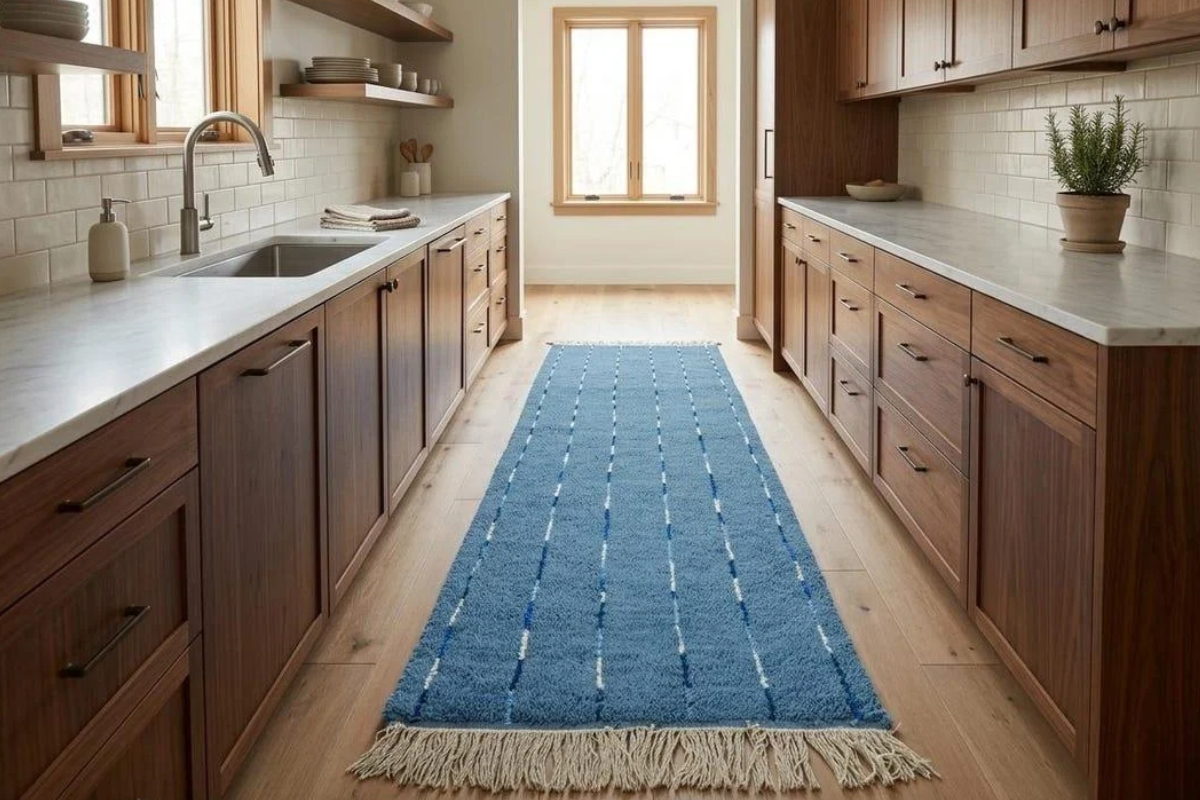
Short answer: A wool rug in kitchen spaces can work, and a bathroom is a much harder case. In a kitchen, the problems are specific: cooking grease, water splashing at the sink, crumbs lodging in thick pile, and a rug that shifts or catches a toe while someone carries a hot pan. A flat, low, dense Moroccan rug on a grip pad, placed away from the sink and stove, is a reasonable choice. A deep, pale, long-pile rug is not. In a bathroom, the floor gets wet every day, damp wool is slow to dry, and fall-prevention guidance points to non-skid bath mats, not decorative rugs.
So when everyone says "don't," they are half right. This guide separates the half that holds up from the half that does not, and says plainly what we cannot judge from a distance. We do not sell rugs, and nothing here recommends a product.
Why the advice against a wool rug in kitchen spaces exists
The warning comes from real failure modes, not snobbery. Kitchens combine four things that rugs handle badly, and they all arrive in the same few square feet in front of the counter.
- Liquid, often. Water at the sink, drips from the dish rack, boiling-over pots.
- Fat and oil. Splatter from the stove and drips from pans carried to the table.
- Food. Crumbs, flour, rice and anything sticky that falls and gets stepped on.
- Movement with hazards in hand. People turn quickly in kitchens while holding knives, hot dishes and full pans.
Retailer pages that rank for this question tend to say wool is ideal for kitchens because it resists stains and springs back underfoot. There is something to that, and we cover it below. What those pages rarely do is separate the four problems, because each one has a different answer, and one of them is a safety issue rather than a cleaning issue.
What wool actually does with spills, and what it does not
Wool has a genuine head start with water-based spills. The Woolmark Company, the wool industry's own organization, explains on its page on what the wool fiber is, which we read on September 25, 2026, that the water-repelling outer scales of the fiber help stop water-based liquids from seeping deeper, and that this assists wool's natural stain resistance. The same page says plainly that wool is not waterproof, only water resistant. Woolmark promotes wool, so read that as the industry's case.
Notice what that claim covers and what it leaves out. It is about water-based liquids. Cooking oil and grease are a different problem, and Woolmark's page makes no claim that wool resists them. A grease spot on a hand-knotted rug is exactly the kind of mark that is worth showing to a professional rug cleaner before you try anything yourself.
That is the honest version of the stain question:
| Spill | How wool tends to behave | What decides the outcome |
|---|---|---|
| Water, clear drinks | Resists briefly, buys time | Blotting quickly, then drying fully |
| Coffee, tea, wine, juice | Buys a little time, can still stain | Speed and the right first steps |
| Cooking oil, butter, grease | No resistance claimed by the industry | Placement away from the stove |
| Crumbs and dry food | Lodges in pile, especially deep pile | Pile height and vacuuming |
The first few minutes matter more than the fiber. Our guide to what to do in the first minutes after a spill on a wool rug covers blotting, what not to put on wool, and when to stop and call a cleaner.
The safety half: slips, trips and a hot pan
This is the part of the kitchen question that retailer pages tend to treat as an afterthought, and it is the part that can actually hurt someone.
A rug in a kitchen is walked on by people whose hands are full. A corner that curls, a rug that slides on tile, or a thick edge that catches a slipper is a minor annoyance in a living room. In front of a stove, the same stumble happens while someone is holding boiling water or a knife.
Fall-prevention guidance is blunt about loose floor coverings. MedlinePlus, the US National Library of Medicine's consumer health service, advises in its bathroom safety page for adults, which we read on September 25, 2026, to remove floor coverings that block the entry, to use a non-skid bath mat outside the tub for firm footing, and to keep the floor outside the tub or shower dry. That page is written about bathrooms, but the principle carries into any wet, busy floor: whatever is underfoot has to stay put and stay dry.
For a kitchen rug, that means:
- A grip pad under it, sized slightly smaller than the rug so the edges lie flat. Our guide on how to stop a rug from slipping explains what actually holds a rug in place on hard floors.
- Flat, low edges. A thick or curling edge is the trip point.
- No rug in the path between stove and sink if the household includes anyone unsteady on their feet, young children who run through, or pets who skid.
- Wiping up water on the floor around the rug, not just on it, because a wet hard floor at the edge of a rug is where feet slide.
If anyone in the home has had a fall or is at higher risk of one, the right people to ask about floor coverings are their doctor, a physical therapist or an occupational therapist, who can look at the actual room. We cannot.
What about heat from the stove?
Wool has a reputation for resisting flame. The Woolmark Company's page on merino wool in workwear, read on September 25, 2026, describes merino as "naturally flame resistant" and says it "does not melt or drip like many synthetics." That is a statement about the fiber in clothing. It does not make a rug a safe thing to leave in front of an open burner, and we would not rely on it. The real stove risk is the trip, not the ignition. Keep the rug back from the cooking zone.
Where a Moroccan rug fits in a kitchen, and where it does not
The type of Moroccan rug matters more than the word "wool." Moroccan rugs come in very different constructions, and a kitchen treats them very differently.
Better candidates:
- Flatweaves such as hanbel or kilim-style pieces, which have no pile to trap crumbs and lie close to the floor. Our comparison of flatweave vs pile rugs explains the construction difference.
- Low, dense pile rugs, which give up crumbs to the vacuum more easily and show less flattening.
- Busy, darker or multicolored designs, which hide the small marks a kitchen inevitably leaves.
- Runners set along a counter run, away from the sink's splash zone.
Poor candidates:
- Long, shaggy pile in the Beni Ourain manner. Deep pile traps food, holds moisture down near the knots and is hard to clean in place.
- Pale, cream or undyed wool in the main working zone, where every drip shows.
- Valuable vintage pieces, or any rug whose loss would upset you. A kitchen is where accidents happen by definition.
- Rag rugs of mixed materials, where wool's behavior with water does not apply evenly across the rug.
What we cannot tell you is how a specific rug will perform. Knot density, wool quality and how the rug was finished all vary, and none of that can be judged reliably from a listing photo.
Wool rugs in bathrooms: a different answer
A bathroom is not a slightly wetter kitchen. It is a room where the floor gets soaked on purpose, the air is humid for part of every day, and people step out of a shower barefoot onto whatever is there.
Three things make a thick wool rug a poor fit here:
- It stays wet. Woolmark describes the wool fiber as hygroscopic, able to absorb and retain liquid moisture. That is comfortable in a sweater. In a dense pile rug that takes on water from wet feet every morning, it means the rug may not dry fully before the next shower.
- Damp wool smells. A rug that never quite dries is a classic source of a musty smell, and a smell that keeps coming back after drying is the point to have the rug looked at by a cleaner.
- It is not a non-skid mat. The fall-prevention advice from MedlinePlus is specific: a non-skid bath mat outside the tub and a dry floor. A decorative wool rug does neither job well.
If you want a Moroccan rug in a bathroom, the realistic version is a small flatweave well away from the shower, in a room with good ventilation, lifted and dried when it gets wet. A powder room with no shower is a different story from a family bathroom used by several people every morning. For how lingering moisture damages wool over time, our piece on humidity and wool rugs in basements applies to steamy bathrooms as well.
A practical setup if you go ahead
If the kitchen rug is a decision you have already made, this is the setup that gives it the best chance:
- Choose the spot first. In front of a pantry, a counter run or a table area, not directly at the sink or stove.
- Put a pad under it and check that the edges lie flat.
- Vacuum often, without a beater bar on long pile, to lift crumbs before they grind in.
- Blot spills at once, and dry the area fully afterward.
- Rotate it occasionally so wear spreads out.
- Know when to stop. Grease stains, large spills and any smell that returns after drying are the point to call a professional rug cleaner rather than experiment.
What we can and cannot tell you
We can explain why wool behaves as it does with water and why kitchen and bathroom floors are hazardous. We cannot inspect your rug, your floor or your household. Whether a particular rug will stain, how it was dyed and how it will react to cleaning are questions for a rug cleaner who can handle it. Whether a rug is safe for someone at risk of falling is a question for their health professional.
FAQ
Is it a bad idea to put a wool rug in the kitchen?
Not always. A flat or low-pile wool rug on a grip pad, placed away from the sink and stove, can work well. A deep, pale, long-pile rug in the main cooking zone is a poor choice because of grease, crumbs and trip risk.
Does wool resist kitchen stains?
Wool resists water-based spills for a short time, which gives you time to blot. The Woolmark Company's stain-resistance claim is about water-based liquids. Cooking oil and grease are a different problem and are worth showing to a professional cleaner.
Can I put a Moroccan rug in a bathroom?
A thick pile rug in a bathroom with a shower tends to stay damp and can develop a musty smell. Fall-prevention guidance points to non-skid bath mats and dry floors. A small flatweave away from the shower, in a well-ventilated room, is the realistic exception.
Do I need a rug pad in the kitchen?
Yes. A kitchen rug on tile or wood should not move when stepped on, especially while someone carries hot food. A pad slightly smaller than the rug keeps it in place and the edges flat.
What type of Moroccan rug is best for a kitchen?
Flatweaves and low, dense pile rugs in darker or multicolored designs handle kitchens better than long, shaggy pile. We do not recommend specific products, and the performance of any single rug depends on how it was made.
Leave a Reply