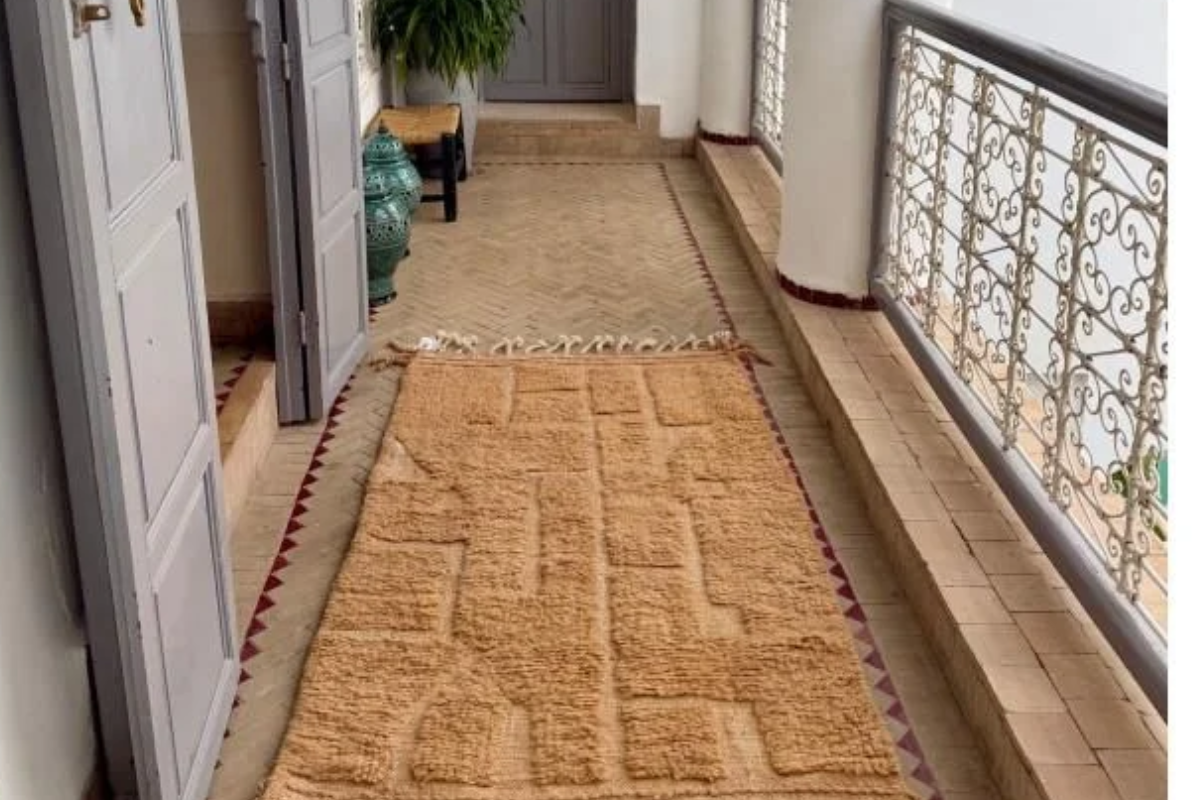
Short answer: The Moroccan rug high traffic question has a practical answer: it is not automatically a bad idea, but the construction and the setup decide how it ends. Wool recovers well from being walked on. What wears a rug out in a busy entry is grit tracked in on shoes and ground into the pile, plus water, spills and the same few paths walked every day. A flatweave or a low, dense pile copes far better than a deep, soft pile. Put a doormat before the rug, a pad under it, and vacuum often. Keep a valuable vintage piece somewhere quieter.
So, front door and three kids? It can work with the right rug and some routine. It is a bad idea with the wrong rug, and the wrong rug is usually the one people want most there: a thick, pale, deep-pile piece right inside the door. This guide explains why, what holds up better, and what we cannot promise. We sell no rugs.
Why the front door is the hardest spot in the house
Every room has traffic. The entry has traffic plus whatever comes in from outside. The Carpet and Rug Institute, the US carpet industry's trade association, says on its page about heavy-traffic areas, which we read on September 25, 2026, that "foot traffic wears on carpet and can grind in dirt." That is the mechanism. The damage comes less from feet than from what is on them: sand and grit worked down into the pile, where every step rubs it against the fibers.
A front door adds three more pressures:
- Water. Rain, snow and wet boots put moisture into the first few steps of floor, again and again.
- Pivot points. People stop, turn, take shoes off and swing bags down in the same spots.
- The door itself. A rug that sits under the door's swing gets scuffed, bunched or caught at the edge.
None of this is special to Moroccan rugs. Any rug in that spot takes the same beating. What changes with a hand-woven wool rug is how it responds, and how much you will mind.
What wool brings to a busy floor
Wool is a sensible fiber for a busy floor, with limits. The Woolmark Company, the wool industry's own body, explains on its page about the wool fiber, which we read on September 25, 2026, that the natural crimp in wool lets the fiber stretch and recover without breaking. It also says the water-repelling outer scales of the fiber help stop water-based liquids from seeping deeper, which it credits for wool's natural stain resistance. Woolmark promotes wool, so read that as the industry's case, but the recovery it describes is why wool pile tends to spring back rather than stay crushed.
What wool does not do:
- It does not make grit harmless. Recovering from being stepped on is not the same as resisting sand grinding in the pile.
- It does not make every spill vanish. Resisting a spill for a moment buys time to blot it, nothing more.
- It does not stop a deep pile from showing paths. Long pile tilts and flattens along the routes people walk, and in a pale rug those routes also turn gray with soil.
Moroccan rug high traffic: which constructions hold up best
Moroccan rugs are not one construction, and that matters more here than style or color. A rough guide:
| Construction | In a busy entry or hallway | What tends to go wrong |
|---|---|---|
| Flatweave (kilim, hanbel, zanafi) | Usually the most practical. Thin, no pile to crush, doors clear it more readily. | Slides on hard floors without a pad; grit can sit in the weave, so vacuum it often. |
| Low, dense pile | A reasonable choice. Less pile to flatten or trap dirt. | Traffic paths still show over time; rotation helps. |
| Deep, soft pile (for example, many Beni Ourain-type rugs) | The hardest fit for a front door. | Paths flatten and gray, grit sinks deep, doors catch, drying out after wet days is slow. |
| Boucherouite (rag rug) | Varies with the fabrics used. | Mixed fibers wear unevenly; judge the specific piece. |
| Old or vintage piece | Better kept out of the busiest spot. | Existing wear, thin areas and fragile ends take the worst of it. |
Our comparison of flatweave and pile Moroccan rugs goes further into how the two constructions differ in weight, feel and wear. Pile height and density vary a great deal even within one style, so ask the seller for both before buying for a busy spot.
Set up the entry before the rug
Where the rug sits matters as much as which rug it is.
Put a doormat first. The Carpet and Rug Institute's guidance for commercial buildings describes entrance matting as a system: scraper mats outside, wiper mats inside, to catch soil before it reaches the carpet. A home does not need a lobby's worth of matting, but the principle carries over. A tough mat outside and a washable one inside the door take the grit and the water, so your Moroccan rug does not have to.
Start the rug past the wet zone. If the first step through the door lands on the rug, the rug becomes the doormat. Setting it back even a short way makes a difference.
Check the door swing. Open the door fully over the planned spot. If it drags on the rug, choose a thinner rug or move it.
Consider shoes off. It is the single biggest change most households can make to what reaches the rug.
Stop it moving. A rug that slides or has a curled edge in an entry is a trip hazard, especially with children running in and out. A pad and flat edges come first. Our guide on how to stop a rug from slipping covers pads, curled corners and edge fixes.
Three kids: spills, running and everything else
Children add spills, crumbs, toys dragged across the pile and a lot of running. A few things help:
- Treat spills as urgent. What you do in the first minutes matters more than any product. Keep our guide to the first five minutes after a spill on a wool rug where you can find it, because the instinct to scrub usually makes things worse.
- Choose a forgiving color and pattern. A mid-tone rug with some pattern hides everyday soil far better than a plain pale one. This is taste, but it is also the practical reason many families choose a busier rug for busy spaces.
- Keep the fringe out of the main path where you can. Fringe at the ends is part of the rug's structure, and it is the part that catches on feet, toys and vacuum brushes first. Loose or broken fringe is repairable, but it is better avoided.
- Accept some wear. A rug in a family entry will age faster than the same rug in a guest bedroom. If that would upset you, it is the wrong rug for the spot.
Maintenance that matches the traffic
The Carpet and Rug Institute's vacuum schedule guidance, which we read on September 25, 2026, recommends that high-traffic or pet areas be "vacuumed daily," that medium-traffic areas "require about twice a week," and that light-traffic areas be done once a week. That guidance is written for carpet in general, and it may be more than most households manage for a single rug. The logic behind it holds for a Moroccan rug too: grit removed today is grit that is not grinding in the pile tomorrow.
How you vacuum a hand-woven wool rug matters as much as how often. A rotating beater bar set too low can pull at the pile and fringe. Our guide to vacuuming a wool rug without damaging the pile covers settings, direction and the fringe.
Two more habits help a rug in traffic:
- Rotate it. Turning the rug end for end from time to time spreads the walking paths across more of the pile, so no single stretch takes all the wear.
- Shake out or turn over a flatweave. Many flatweaves are light enough to shake outside, and some are reversible, which spreads wear across both faces.
When a rug in a busy spot looks gray along its paths despite regular vacuuming, it is due for a proper clean. That is the point to talk to a rug cleaner who handles hand-woven wool, rather than to reach for a household carpet shampoo.
When it really is a bad idea
- A deep-pile, pale rug directly inside a muddy front door, with no mat before it. This is the setup most likely to disappoint.
- An old, thin or already worn vintage piece. Traffic takes the weakest areas first.
- A rug that cannot be kept flat. If a pad will not stop it sliding or curling, a busy entry with children is the wrong place for it.
- A rug you cannot bear to see age. Wear in a busy spot is not a failure. It is what happens.
What we cannot tell you
We cannot tell you how long a particular rug will last in your entry, because we have not seen the rug, your floor or your household, and nobody has a reliable figure for that. The vacuuming frequencies here come from a carpet industry body writing about carpet in general, and the wool fiber claims come from a wool industry body; both are named so you can weigh them. Pile height and density are things to ask the seller about for the specific rug. A rug cleaner or repairer who can see the piece will judge its condition better than any guide.
FAQ
Are Moroccan rugs good for high traffic areas?
Some are. Flatweaves and low, dense pile rugs cope well in busy spaces, especially with a doormat before them and a pad beneath. Deep, soft pile rugs show traffic paths and trap grit, so they suit quieter rooms better.
Can a Beni Ourain rug go in an entryway?
It can, but it is the hardest fit. A deep, pale pile flattens along walking paths, collects soil and can catch under a door. If you want one near the entry, set it well back from the door, put a mat before it and vacuum often.
How often should I vacuum a Moroccan rug in a busy area?
The Carpet and Rug Institute recommends daily vacuuming for high-traffic areas and about twice a week for medium traffic. That is general carpet guidance, so treat it as a target and use settings that do not pull at the pile or fringe.
Is a flatweave or pile rug better for a hallway with kids?
A flatweave is usually more practical. It has no pile to crush, it clears doors more readily and it is light enough to shake out. It does slide on hard floors, so use a pad that holds it flat.
Will a wool rug wear out quickly at the front door?
It will wear faster there than anywhere else, as any rug does. Wool fiber recovers well from being walked on, but grit and water do the damage. A doormat first, shoes off, frequent vacuuming and rotation slow the wear considerably.
Leave a Reply