Category: Rug Care

  • Wool Rug in Kitchen or Bathroom: What Goes Wrong

    Wool Rug in Kitchen or Bathroom: What Goes Wrong

    Short answer: A wool rug in kitchen spaces can work, and a bathroom is a much harder case. In a kitchen, the problems are specific: cooking grease, water splashing at the sink, crumbs lodging in thick pile, and a rug that shifts or catches a toe while someone carries a hot pan. A flat, low, dense Moroccan rug on a grip pad, placed away from the sink and stove, is a reasonable choice. A deep, pale, long-pile rug is not. In a bathroom, the floor gets wet every day, damp wool is slow to dry, and fall-prevention guidance points to non-skid bath mats, not decorative rugs.

    So when everyone says "don't," they are half right. This guide separates the half that holds up from the half that does not, and says plainly what we cannot judge from a distance. We do not sell rugs, and nothing here recommends a product.

    Why the advice against a wool rug in kitchen spaces exists

    The warning comes from real failure modes, not snobbery. Kitchens combine four things that rugs handle badly, and they all arrive in the same few square feet in front of the counter.

    • Liquid, often. Water at the sink, drips from the dish rack, boiling-over pots.
    • Fat and oil. Splatter from the stove and drips from pans carried to the table.
    • Food. Crumbs, flour, rice and anything sticky that falls and gets stepped on.
    • Movement with hazards in hand. People turn quickly in kitchens while holding knives, hot dishes and full pans.

    Retailer pages that rank for this question tend to say wool is ideal for kitchens because it resists stains and springs back underfoot. There is something to that, and we cover it below. What those pages rarely do is separate the four problems, because each one has a different answer, and one of them is a safety issue rather than a cleaning issue.

    What wool actually does with spills, and what it does not

    Wool has a genuine head start with water-based spills. The Woolmark Company, the wool industry's own organization, explains on its page on what the wool fiber is, which we read on September 25, 2026, that the water-repelling outer scales of the fiber help stop water-based liquids from seeping deeper, and that this assists wool's natural stain resistance. The same page says plainly that wool is not waterproof, only water resistant. Woolmark promotes wool, so read that as the industry's case.

    Notice what that claim covers and what it leaves out. It is about water-based liquids. Cooking oil and grease are a different problem, and Woolmark's page makes no claim that wool resists them. A grease spot on a hand-knotted rug is exactly the kind of mark that is worth showing to a professional rug cleaner before you try anything yourself.

    That is the honest version of the stain question:

    Spill How wool tends to behave What decides the outcome
    Water, clear drinks Resists briefly, buys time Blotting quickly, then drying fully
    Coffee, tea, wine, juice Buys a little time, can still stain Speed and the right first steps
    Cooking oil, butter, grease No resistance claimed by the industry Placement away from the stove
    Crumbs and dry food Lodges in pile, especially deep pile Pile height and vacuuming

    The first few minutes matter more than the fiber. Our guide to what to do in the first minutes after a spill on a wool rug covers blotting, what not to put on wool, and when to stop and call a cleaner.

    The safety half: slips, trips and a hot pan

    This is the part of the kitchen question that retailer pages tend to treat as an afterthought, and it is the part that can actually hurt someone.

    A rug in a kitchen is walked on by people whose hands are full. A corner that curls, a rug that slides on tile, or a thick edge that catches a slipper is a minor annoyance in a living room. In front of a stove, the same stumble happens while someone is holding boiling water or a knife.

    Fall-prevention guidance is blunt about loose floor coverings. MedlinePlus, the US National Library of Medicine's consumer health service, advises in its bathroom safety page for adults, which we read on September 25, 2026, to remove floor coverings that block the entry, to use a non-skid bath mat outside the tub for firm footing, and to keep the floor outside the tub or shower dry. That page is written about bathrooms, but the principle carries into any wet, busy floor: whatever is underfoot has to stay put and stay dry.

    For a kitchen rug, that means:

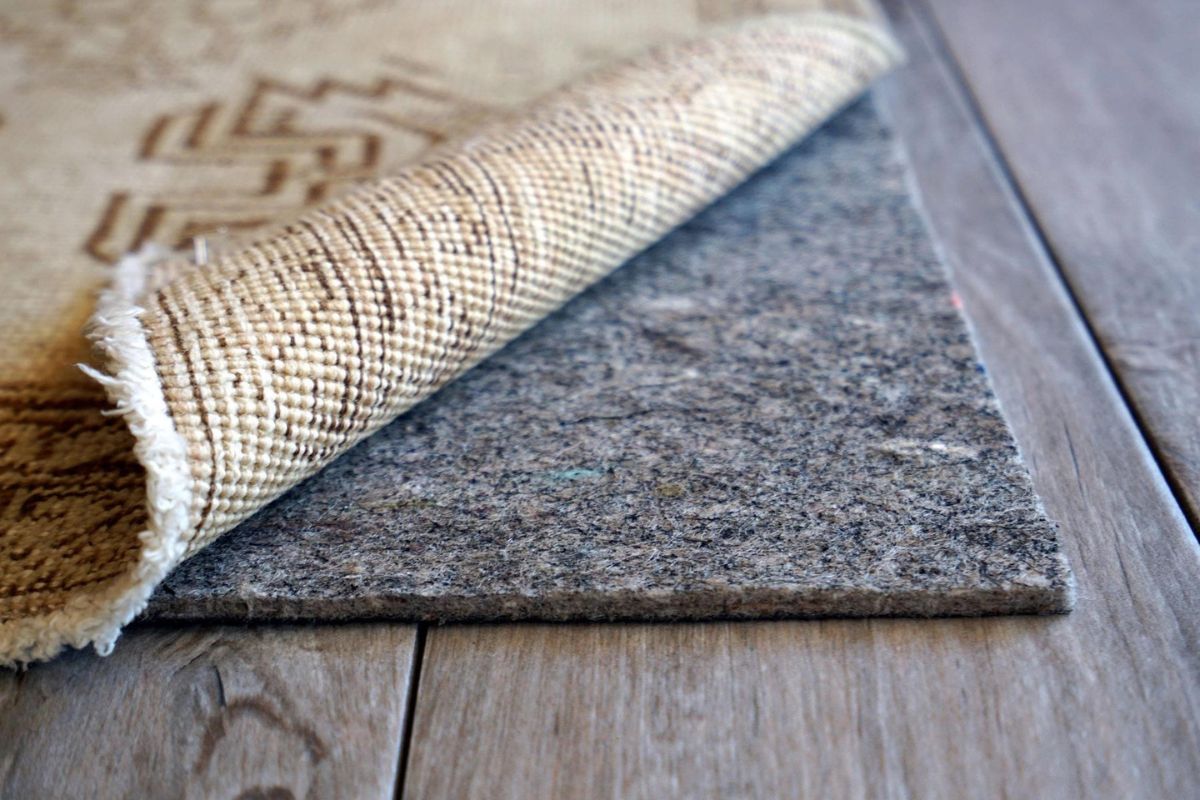
    • A grip pad under it, sized slightly smaller than the rug so the edges lie flat. Our guide on how to stop a rug from slipping explains what actually holds a rug in place on hard floors.
    • Flat, low edges. A thick or curling edge is the trip point.
    • No rug in the path between stove and sink if the household includes anyone unsteady on their feet, young children who run through, or pets who skid.
    • Wiping up water on the floor around the rug, not just on it, because a wet hard floor at the edge of a rug is where feet slide.

    If anyone in the home has had a fall or is at higher risk of one, the right people to ask about floor coverings are their doctor, a physical therapist or an occupational therapist, who can look at the actual room. We cannot.

    What about heat from the stove?

    Wool has a reputation for resisting flame. The Woolmark Company's page on merino wool in workwear, read on September 25, 2026, describes merino as "naturally flame resistant" and says it "does not melt or drip like many synthetics." That is a statement about the fiber in clothing. It does not make a rug a safe thing to leave in front of an open burner, and we would not rely on it. The real stove risk is the trip, not the ignition. Keep the rug back from the cooking zone.

    Where a Moroccan rug fits in a kitchen, and where it does not

    The type of Moroccan rug matters more than the word "wool." Moroccan rugs come in very different constructions, and a kitchen treats them very differently.

    Better candidates:

    • Flatweaves such as hanbel or kilim-style pieces, which have no pile to trap crumbs and lie close to the floor. Our comparison of flatweave vs pile rugs explains the construction difference.
    • Low, dense pile rugs, which give up crumbs to the vacuum more easily and show less flattening.
    • Busy, darker or multicolored designs, which hide the small marks a kitchen inevitably leaves.
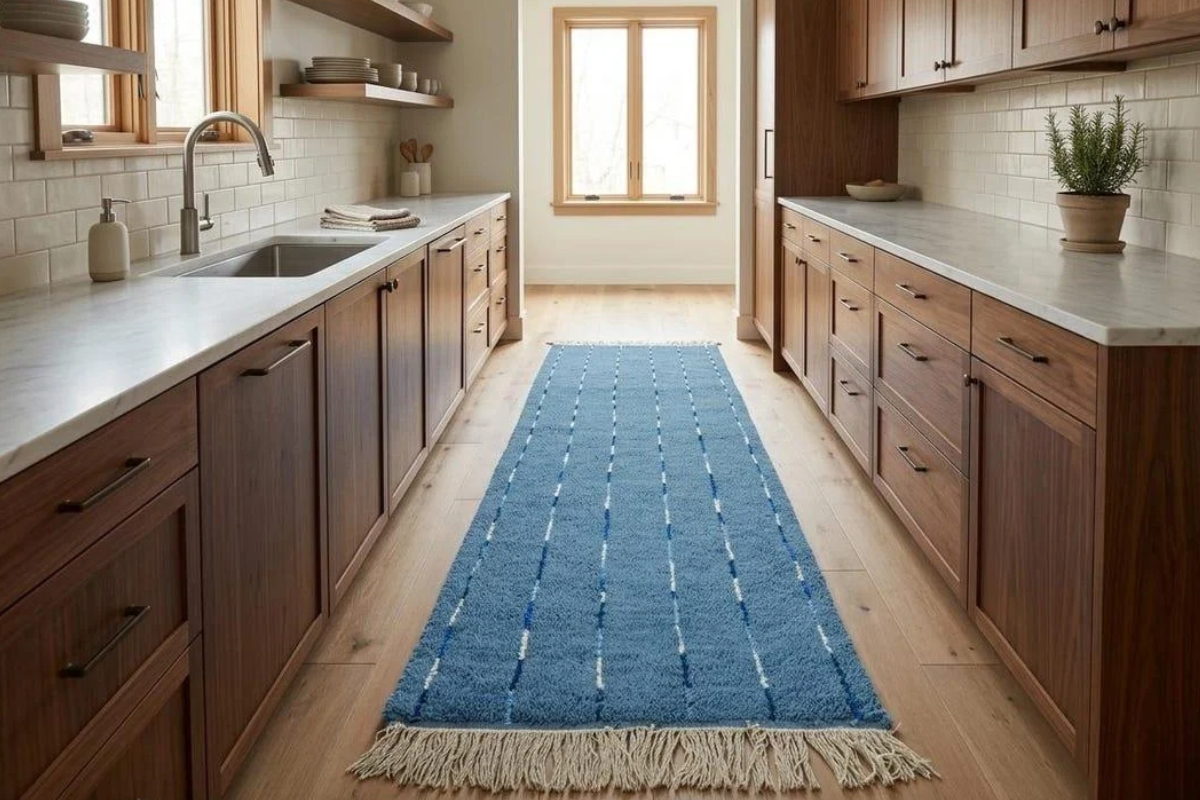
    • Runners set along a counter run, away from the sink's splash zone.

    Poor candidates:

    • Long, shaggy pile in the Beni Ourain manner. Deep pile traps food, holds moisture down near the knots and is hard to clean in place.
    • Pale, cream or undyed wool in the main working zone, where every drip shows.
    • Valuable vintage pieces, or any rug whose loss would upset you. A kitchen is where accidents happen by definition.
    • Rag rugs of mixed materials, where wool's behavior with water does not apply evenly across the rug.

    What we cannot tell you is how a specific rug will perform. Knot density, wool quality and how the rug was finished all vary, and none of that can be judged reliably from a listing photo.

    Wool rugs in bathrooms: a different answer

    A bathroom is not a slightly wetter kitchen. It is a room where the floor gets soaked on purpose, the air is humid for part of every day, and people step out of a shower barefoot onto whatever is there.

    Three things make a thick wool rug a poor fit here:

    1. It stays wet. Woolmark describes the wool fiber as hygroscopic, able to absorb and retain liquid moisture. That is comfortable in a sweater. In a dense pile rug that takes on water from wet feet every morning, it means the rug may not dry fully before the next shower.
    2. Damp wool smells. A rug that never quite dries is a classic source of a musty smell, and a smell that keeps coming back after drying is the point to have the rug looked at by a cleaner.
    3. It is not a non-skid mat. The fall-prevention advice from MedlinePlus is specific: a non-skid bath mat outside the tub and a dry floor. A decorative wool rug does neither job well.

    If you want a Moroccan rug in a bathroom, the realistic version is a small flatweave well away from the shower, in a room with good ventilation, lifted and dried when it gets wet. A powder room with no shower is a different story from a family bathroom used by several people every morning. For how lingering moisture damages wool over time, our piece on humidity and wool rugs in basements applies to steamy bathrooms as well.

    A practical setup if you go ahead

    If the kitchen rug is a decision you have already made, this is the setup that gives it the best chance:

    • Choose the spot first. In front of a pantry, a counter run or a table area, not directly at the sink or stove.
    • Put a pad under it and check that the edges lie flat.
    • Vacuum often, without a beater bar on long pile, to lift crumbs before they grind in.
    • Blot spills at once, and dry the area fully afterward.
    • Rotate it occasionally so wear spreads out.
    • Know when to stop. Grease stains, large spills and any smell that returns after drying are the point to call a professional rug cleaner rather than experiment.

    What we can and cannot tell you

    We can explain why wool behaves as it does with water and why kitchen and bathroom floors are hazardous. We cannot inspect your rug, your floor or your household. Whether a particular rug will stain, how it was dyed and how it will react to cleaning are questions for a rug cleaner who can handle it. Whether a rug is safe for someone at risk of falling is a question for their health professional.

    FAQ

    Is it a bad idea to put a wool rug in the kitchen?

    Not always. A flat or low-pile wool rug on a grip pad, placed away from the sink and stove, can work well. A deep, pale, long-pile rug in the main cooking zone is a poor choice because of grease, crumbs and trip risk.

    Does wool resist kitchen stains?

    Wool resists water-based spills for a short time, which gives you time to blot. The Woolmark Company's stain-resistance claim is about water-based liquids. Cooking oil and grease are a different problem and are worth showing to a professional cleaner.

    Can I put a Moroccan rug in a bathroom?

    A thick pile rug in a bathroom with a shower tends to stay damp and can develop a musty smell. Fall-prevention guidance points to non-skid bath mats and dry floors. A small flatweave away from the shower, in a well-ventilated room, is the realistic exception.

    Do I need a rug pad in the kitchen?

    Yes. A kitchen rug on tile or wood should not move when stepped on, especially while someone carries hot food. A pad slightly smaller than the rug keeps it in place and the edges flat.

    What type of Moroccan rug is best for a kitchen?

    Flatweaves and low, dense pile rugs in darker or multicolored designs handle kitchens better than long, shaggy pile. We do not recommend specific products, and the performance of any single rug depends on how it was made.
  • Moroccan Rug High Traffic Guide: Entries, Kids, Wear

    Moroccan Rug High Traffic Guide: Entries, Kids, Wear

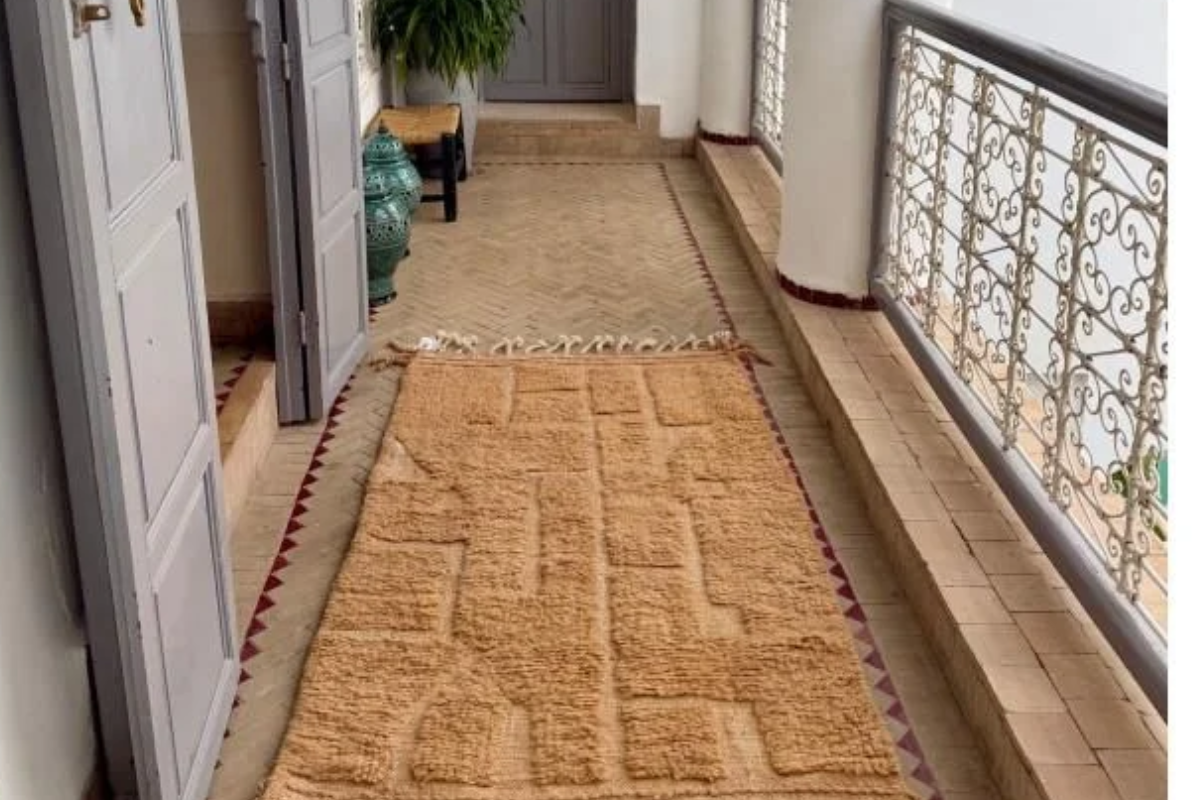
    Short answer: The Moroccan rug high traffic question has a practical answer: it is not automatically a bad idea, but the construction and the setup decide how it ends. Wool recovers well from being walked on. What wears a rug out in a busy entry is grit tracked in on shoes and ground into the pile, plus water, spills and the same few paths walked every day. A flatweave or a low, dense pile copes far better than a deep, soft pile. Put a doormat before the rug, a pad under it, and vacuum often. Keep a valuable vintage piece somewhere quieter.

    So, front door and three kids? It can work with the right rug and some routine. It is a bad idea with the wrong rug, and the wrong rug is usually the one people want most there: a thick, pale, deep-pile piece right inside the door. This guide explains why, what holds up better, and what we cannot promise. We sell no rugs.

    Why the front door is the hardest spot in the house

    Every room has traffic. The entry has traffic plus whatever comes in from outside. The Carpet and Rug Institute, the US carpet industry's trade association, says on its page about heavy-traffic areas, which we read on September 25, 2026, that "foot traffic wears on carpet and can grind in dirt." That is the mechanism. The damage comes less from feet than from what is on them: sand and grit worked down into the pile, where every step rubs it against the fibers.

    A front door adds three more pressures:

    • Water. Rain, snow and wet boots put moisture into the first few steps of floor, again and again.
    • Pivot points. People stop, turn, take shoes off and swing bags down in the same spots.
    • The door itself. A rug that sits under the door's swing gets scuffed, bunched or caught at the edge.

    None of this is special to Moroccan rugs. Any rug in that spot takes the same beating. What changes with a hand-woven wool rug is how it responds, and how much you will mind.

    What wool brings to a busy floor

    Wool is a sensible fiber for a busy floor, with limits. The Woolmark Company, the wool industry's own body, explains on its page about the wool fiber, which we read on September 25, 2026, that the natural crimp in wool lets the fiber stretch and recover without breaking. It also says the water-repelling outer scales of the fiber help stop water-based liquids from seeping deeper, which it credits for wool's natural stain resistance. Woolmark promotes wool, so read that as the industry's case, but the recovery it describes is why wool pile tends to spring back rather than stay crushed.

    What wool does not do:

    • It does not make grit harmless. Recovering from being stepped on is not the same as resisting sand grinding in the pile.
    • It does not make every spill vanish. Resisting a spill for a moment buys time to blot it, nothing more.
    • It does not stop a deep pile from showing paths. Long pile tilts and flattens along the routes people walk, and in a pale rug those routes also turn gray with soil.

    Moroccan rug high traffic: which constructions hold up best

    Moroccan rugs are not one construction, and that matters more here than style or color. A rough guide:

    Construction In a busy entry or hallway What tends to go wrong
    Flatweave (kilim, hanbel, zanafi) Usually the most practical. Thin, no pile to crush, doors clear it more readily. Slides on hard floors without a pad; grit can sit in the weave, so vacuum it often.
    Low, dense pile A reasonable choice. Less pile to flatten or trap dirt. Traffic paths still show over time; rotation helps.
    Deep, soft pile (for example, many Beni Ourain-type rugs) The hardest fit for a front door. Paths flatten and gray, grit sinks deep, doors catch, drying out after wet days is slow.
    Boucherouite (rag rug) Varies with the fabrics used. Mixed fibers wear unevenly; judge the specific piece.
    Old or vintage piece Better kept out of the busiest spot. Existing wear, thin areas and fragile ends take the worst of it.

    Our comparison of flatweave and pile Moroccan rugs goes further into how the two constructions differ in weight, feel and wear. Pile height and density vary a great deal even within one style, so ask the seller for both before buying for a busy spot.

    Set up the entry before the rug

    Where the rug sits matters as much as which rug it is.

    Put a doormat first. The Carpet and Rug Institute's guidance for commercial buildings describes entrance matting as a system: scraper mats outside, wiper mats inside, to catch soil before it reaches the carpet. A home does not need a lobby's worth of matting, but the principle carries over. A tough mat outside and a washable one inside the door take the grit and the water, so your Moroccan rug does not have to.

    Start the rug past the wet zone. If the first step through the door lands on the rug, the rug becomes the doormat. Setting it back even a short way makes a difference.

    Check the door swing. Open the door fully over the planned spot. If it drags on the rug, choose a thinner rug or move it.

    Consider shoes off. It is the single biggest change most households can make to what reaches the rug.

    Stop it moving. A rug that slides or has a curled edge in an entry is a trip hazard, especially with children running in and out. A pad and flat edges come first. Our guide on how to stop a rug from slipping covers pads, curled corners and edge fixes.

    Three kids: spills, running and everything else

    Children add spills, crumbs, toys dragged across the pile and a lot of running. A few things help:

    • Treat spills as urgent. What you do in the first minutes matters more than any product. Keep our guide to the first five minutes after a spill on a wool rug where you can find it, because the instinct to scrub usually makes things worse.
    • Choose a forgiving color and pattern. A mid-tone rug with some pattern hides everyday soil far better than a plain pale one. This is taste, but it is also the practical reason many families choose a busier rug for busy spaces.
    • Keep the fringe out of the main path where you can. Fringe at the ends is part of the rug's structure, and it is the part that catches on feet, toys and vacuum brushes first. Loose or broken fringe is repairable, but it is better avoided.
    • Accept some wear. A rug in a family entry will age faster than the same rug in a guest bedroom. If that would upset you, it is the wrong rug for the spot.

    Maintenance that matches the traffic

    The Carpet and Rug Institute's vacuum schedule guidance, which we read on September 25, 2026, recommends that high-traffic or pet areas be "vacuumed daily," that medium-traffic areas "require about twice a week," and that light-traffic areas be done once a week. That guidance is written for carpet in general, and it may be more than most households manage for a single rug. The logic behind it holds for a Moroccan rug too: grit removed today is grit that is not grinding in the pile tomorrow.

    How you vacuum a hand-woven wool rug matters as much as how often. A rotating beater bar set too low can pull at the pile and fringe. Our guide to vacuuming a wool rug without damaging the pile covers settings, direction and the fringe.

    Two more habits help a rug in traffic:

    • Rotate it. Turning the rug end for end from time to time spreads the walking paths across more of the pile, so no single stretch takes all the wear.
    • Shake out or turn over a flatweave. Many flatweaves are light enough to shake outside, and some are reversible, which spreads wear across both faces.

    When a rug in a busy spot looks gray along its paths despite regular vacuuming, it is due for a proper clean. That is the point to talk to a rug cleaner who handles hand-woven wool, rather than to reach for a household carpet shampoo.

    When it really is a bad idea

    • A deep-pile, pale rug directly inside a muddy front door, with no mat before it. This is the setup most likely to disappoint.
    • An old, thin or already worn vintage piece. Traffic takes the weakest areas first.
    • A rug that cannot be kept flat. If a pad will not stop it sliding or curling, a busy entry with children is the wrong place for it.
    • A rug you cannot bear to see age. Wear in a busy spot is not a failure. It is what happens.

    What we cannot tell you

    We cannot tell you how long a particular rug will last in your entry, because we have not seen the rug, your floor or your household, and nobody has a reliable figure for that. The vacuuming frequencies here come from a carpet industry body writing about carpet in general, and the wool fiber claims come from a wool industry body; both are named so you can weigh them. Pile height and density are things to ask the seller about for the specific rug. A rug cleaner or repairer who can see the piece will judge its condition better than any guide.

    FAQ

    Are Moroccan rugs good for high traffic areas?

    Some are. Flatweaves and low, dense pile rugs cope well in busy spaces, especially with a doormat before them and a pad beneath. Deep, soft pile rugs show traffic paths and trap grit, so they suit quieter rooms better.

    Can a Beni Ourain rug go in an entryway?

    It can, but it is the hardest fit. A deep, pale pile flattens along walking paths, collects soil and can catch under a door. If you want one near the entry, set it well back from the door, put a mat before it and vacuum often.

    How often should I vacuum a Moroccan rug in a busy area?

    The Carpet and Rug Institute recommends daily vacuuming for high-traffic areas and about twice a week for medium traffic. That is general carpet guidance, so treat it as a target and use settings that do not pull at the pile or fringe.

    Is a flatweave or pile rug better for a hallway with kids?

    A flatweave is usually more practical. It has no pile to crush, it clears doors more readily and it is light enough to shake out. It does slide on hard floors, so use a pad that holds it flat.

    Will a wool rug wear out quickly at the front door?

    It will wear faster there than anywhere else, as any rug does. Wool fiber recovers well from being walked on, but grit and water do the damage. A doormat first, shoes off, frequent vacuuming and rotation slow the wear considerably.

  • Wool Rug Underfloor Heating: Tog, Pads and Risks

    Wool Rug Underfloor Heating: Tog, Pads and Risks

    Short answer: The honest wool rug underfloor heating answer is that a rug does a little of both. It holds some heat in the floor beneath it and lets less of that heat into the room. You can use one, within limits. Heating manufacturers measure those limits in tog, a unit of thermal resistance, and they do not agree: Nu-Heat suggests a rug of 2.5 tog or less, while Warmup's UK guidance for electric systems caps everything above the heater at 1.5 tog. A hand-woven Moroccan rug does not come with a tested tog rating, so a thin flatweave is the safer choice than a deep pile.

    The final word belongs to your heating system's manual and its installer, not to us or to any rug seller. This guide explains what the manufacturers actually say, where they disagree, and why a thick hand-knotted rug is a different proposition from a thin flat one. We sell no rugs and no heating.

    What a rug does to a heated floor

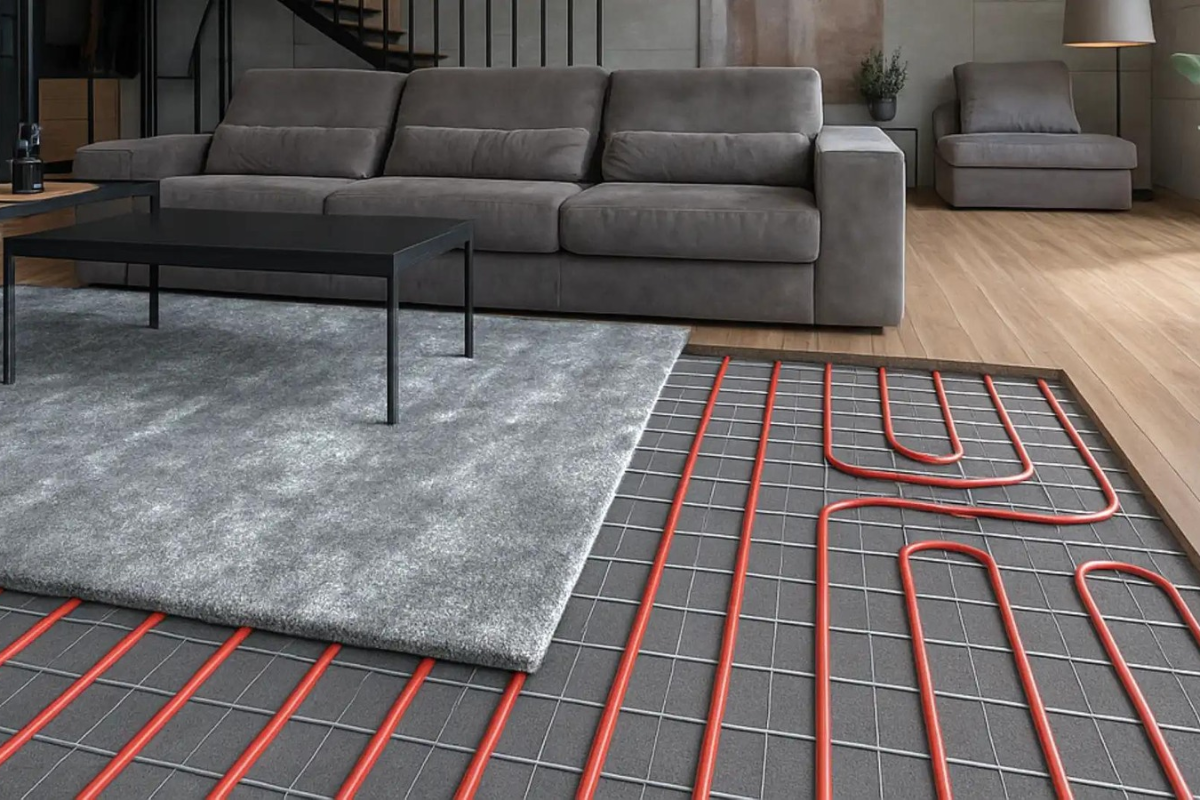
    Underfloor heating warms the floor, and the floor warms the room. Anything laid on top sits in the way. Nu-Heat, a UK underfloor heating supplier, puts it plainly in a guide to rugs on underfloor heating, dated February 3, 2021, which we read on September 24, 2026: "adding a rug on top of a heated floor can restrict the amount of heat that passes from the floor into the room." It adds that thick rugs "can trap heat and insulate rather than allowing it to be released into the room which will reduce the effectiveness of the UFH system."

    So the reader's question, "will this trap the heat or block it?", has an uncomfortable answer. It does both, and they are the same effect seen from two sides. Heat that cannot get through the rug stays in the floor underneath it. The room gets a little less, and the patch of floor under the rug runs a little warmer.

    How much depends on the rug's thermal resistance. Nu-Heat, Warmup's UK site and UK carpet makers such as Cormar express it in tog: the higher the number, the more the material insulates. Warmup's US site also gives an R-value for the same idea. The point to hold on to is that the rug and anything under it add together.

    What the heating manufacturers say

    The published limits do not match. We are not going to pick one, because the right figure is the one in your own system's documentation.

    Source (read September 24, 2026) What the limit covers Figure given
    Nu-Heat rug guide (February 3, 2021) A rug on a Nu-Heat system "Try to choose a rug with a tog of 2.5 or less"
    Warmup UK carpet page Everything above an electric heater, including underlay and overlays "does not exceed the 1.5" tog; floor "should not exceed 81°F (27 °C)"
    Warmup US blog (February 27, 2017) Everything above the heater, for carpet Tog "no more than 2.5"; R-value "no more than 1.42"; floor "should never exceed 80°F/27°C"
    Cormar carpet tog page (UK carpet maker, undated) Carpet plus underlay "less than 2.5" tog

    Three things stand out. First, Warmup's UK carpet page says its 1.5 figure is "for electric underfloor heating systems only" and that "water systems have a broader range of limits due to the variables of the specification." Electric and water systems are not interchangeable here. Second, the same company gives different figures on different national sites, so check the documentation that came with your system rather than a web page. Third, every figure counts the whole stack: the rug plus any pad or underlay beneath it.

    Wool rug underfloor heating: the Moroccan rug problem

    The limits above assume you know your rug's tog. Carpet makers such as Cormar say they pre-test their carpets and publish a tog value. A hand-woven Moroccan rug is a one-off made by a weaver, not a product line tested in a lab. Unless a seller can show you a thermal resistance test for that specific rug, its tog is unknown, and no one can honestly tell you it is under 1.5 or 2.5.

    What you can judge is construction. Nu-Heat's own warning is about "a thick, heavy rug with high thermal resistance," and thickness is something you can see and measure.

    Construction On a heated floor Notes
    Flatweave (kilim, hanbel) The better candidate: thin, no pile Can creep on a smooth floor; see the pad section below
    Low to medium pile A judgment call; ask for the pile height Thickness varies from rug to rug within one style
    Deep, dense pile (for example, many Beni Ourain-type rugs) The weakest match; the kind of rug Nu-Heat warns about Best kept to a room without underfloor heating, or to a small area
    Boucherouite (rag rug) Check the fibers first Often mixes cotton and wool with nylon or polyester

    Wool itself is not the problem. Nu-Heat says rugs suitable for underfloor heating "will be made from natural materials such as wool, which is more resistant to heat," and warns that "synthetic materials may not be designed to hold or transfer heat, and could even be damaged or melt if subjected to too much heat." That matters for a Boucherouite, because our guide to Boucherouite rag rugs explains that many are woven from recycled strips that include synthetic fabric. Our comparison of flatweave and pile Moroccan rugs explains the construction difference in more detail.

    One point in a hand-woven rug's favor: a traditionally hand-knotted or flat-woven Moroccan rug has no glued latex or foam backing. Its back is the weave itself. The backing question moves to whatever you put under it.

    Hot spots and the floor underneath

    The heating is only half the concern. The other half is the floor. Nu-Heat's guide warns that "a thick, heavy rug with high thermal resistance on top of a wooden floor could cause 'heat spots'. The wood may become warped and floorboards may lift, if the rug makes the temperature too hot." It adds that this is "more a problem with electric underfloor heating" than with its warm water systems.

    This is why floor temperature limits exist. Warmup's pages give 27°C (80°F on its US page, 81°F on its UK page) as the maximum floor temperature, and the UK page says that limit is secured by using a thermostat. Your floor's own manufacturer may set a separate limit, so check its guidance too, especially for wood or vinyl.

    What a rug owner can reasonably watch for:

    • The floor under the rug feels much hotter than the floor around it when you lift a corner.
    • Boards under the rug are cupping, gapping or lifting, or a vinyl floor is marking.
    • The room never seems to reach temperature since the rug went down.

    Any of these is a reason to lift the rug and talk to whoever installed the heating, not a reason to adjust the system yourself.

    Pads and underlays

    A pad adds its own thermal resistance, and on a heated floor it counts toward the limit. Warmup's UK and US pages both say "a felt underlay should not be used as it may create a thermal blocker hindering the performance of the system." Nu-Heat says felt and polyurethane underlays "are poor at conducting heat" and risk causing "hot spots," and that rugs with a hessian (burlap) underlay are preferable.

    That leaves a real trade-off for a thin flatweave. It is the best rug for a heated floor, and it is also the kind most likely to slide. Before choosing a pad, check whether its maker says it is suitable for underfloor heating, and prefer the thinnest option that stops the rug moving. Our guide to the best rug pad for a wool rug covers what to look for in a pad generally, and our guide on how to stop a rug from slipping covers other ways to keep a thin rug flat, which matters on a hard, heated floor where a creeping rug is a trip hazard.

    Where this stops being a rug question

    Choosing and placing a rug is yours to decide. Changing how the heating behaves is not, and this article stops at that line.

    • Electric underfloor heating is a mains electrical installation. Floor sensors, thermostat wiring and temperature limits are set by the installer. If a limit needs changing or a sensor needs adding, that is work for the installer or a qualified electrician. Do not open the thermostat or alter its settings beyond what its user manual describes.
    • Water-based systems are set up by a heating engineer. Flow temperatures and zone settings are their call, particularly with a heat pump.
    • Do not turn the heating up to compensate for a rug. A higher setting pushes more heat into a floor that is already holding extra heat under the rug.
    • If you notice a burning smell, scorching, or a thermostat fault or error message, switch the system off at the thermostat and contact the installer or a qualified electrician before using it again.

    A practical checklist

    1. Find your heating system's manual or installer paperwork and look for a tog, R-value or floor-covering limit.
    2. Note whether the system is electric or water-based, because the limits differ.
    3. Check whether your floor's manufacturer sets a maximum surface temperature.
    4. Prefer a flatweave or a low pile over a deep, dense pile.
    5. If the rug may contain synthetic fibers, ask the seller what it is made of before it goes on a heated floor.
    6. Choose the thinnest pad that stops slipping, and check the pad maker's guidance for heated floors.
    7. After the first few weeks, lift a corner and compare the floor under the rug with the floor beside it.

    What we cannot tell you

    We cannot tell you the tog of your rug; without a test on that rug, nobody can. We cannot tell you which manufacturer's figure applies to your floor; only your system's documentation or installer can. And we cannot judge an electrical or plumbing installation from a description. The figures in this article are the manufacturers' own, quoted from their pages on the date shown, and they may change. When the manual and this guide disagree, follow the manual.

    FAQ

    Can you put a wool rug on underfloor heating?

    Yes, within your system's limits. Heating makers publish a maximum tog for everything above the heater, and the figures we found range from 1.5 to 2.5 depending on the maker and system type. A thin wool flatweave is a safer choice than a thick, dense pile rug.

    What tog rating should a rug be for underfloor heating?

    It depends on your system. Nu-Heat suggests 2.5 tog or less for a rug. Warmup's UK guidance for electric systems sets 1.5 tog for everything above the heater, including underlay. Check your own system's manual.

    Do Moroccan rugs have a tog rating?

    Do not expect one. A tog value comes from testing a product, and each hand-woven rug is a one-off. Unless the seller can show a test result for that rug, treat the tog as unknown and judge by thickness and density instead.

    Can a rug damage a floor with underfloor heating?

    It can. Nu-Heat warns that a thick, heavy rug with high thermal resistance on a wooden floor can cause heat spots, and that the wood may warp or boards may lift. It says this is more of a concern with electric systems.

    Should I use a rug pad on underfloor heating?

    Only a thin one suited to heated floors. The pad counts toward the tog limit, and Warmup says felt underlay should not be used. Choose the thinnest pad that stops the rug slipping.

  • Professional Rug Cleaning: When to Stop and What to Ask

    Professional Rug Cleaning: When to Stop and What to Ask

    You came here for a number and you are not going to get one. That is not evasion, and the reason is worth two paragraphs because it is also the most useful thing on this page.

    Rug cleaning is priced on variables nobody can quote blind: the size, the fiber, the construction, whether the dyes are stable, what the damage is, whether the rug leaves your house, and above all which country and which city you are in. Every published figure we could find was either a single company's own rate or a range wide enough to be useless. We will not invent an average, and a site that gives you one has either made it up or has copied somebody who did.

    What we can do is tell you when the answer is "stop," what you are actually buying, and how to check the person you are about to hand a hand-knotted rug to. Get two or three quotes on your own rug and you will have a real number in a day. That number will be right and ours would not.

    The two words that decide everything: maintenance and cleaning

    The WoolSafe Organisation draws a line that most people never hear, and once you have it, half the decisions on this page make themselves:

    "Maintenance is a planned procedure, started on the day the carpet is installed… Cleaning is the removal of accumulated dirt not eliminated by regular maintenance."

    Maintenance is yours. Vacuuming, rotation, dealing with a spill in the first minutes, keeping it out of the wrong room.

    Cleaning is periodic, and past a certain point it is not a home job. It is not a failure of your maintenance. It is the thing maintenance postpones and does not replace.

    The reason the distinction matters: people call a cleaner when the rug looks dirty, which is usually late, and they skip the periodic clean when the rug looks fine, which is usually the moment it would do the most good.

    How often, according to somebody who is not selling it

    WoolSafe publishes intervals by how hard the floor is used. For restorative cleaning, the deep clean rather than the surface refresh, its recommended maintenance table gives:

    Soiling level Restorative cleaning
    Light every 18 to 24 months
    Medium every 12 to 18 months
    Heavy every 6 to 12 months
    Very heavy every 3 to 6 months

    Two things to note before you use that table.

    It is written for carpet in buildings, including commercial ones, so read your own room honestly. A rug in a spare bedroom is not on the same schedule as one inside a front door with three children and a dog.

    These are the numbers of an accreditation body, not of a cleaning company. That is the reason we are quoting them rather than the intervals on a cleaner's own site, and you should apply the same test to any frequency anybody gives you: who benefits if the number is smaller?

    The five situations that are not DIY

    Some of these are obvious and one of them is not.

    A dried urine stain. WoolSafe's own spot guide gives fresh urine a four-step home treatment and gives an old urine stain one line: "This type of stain may require treatment by a professional cleaner." The mark, the odor in the fiber, and whatever reached the foundation are three problems and home attempts usually address only the first.

    Anything involving dye that has already moved. Once color has traveled from one area into another, the window for flushing it has closed and the work is specialist. Adding water at this stage moves more dye.

    An active moth infestation. Working out whether the infestation is active is a home job. Treating a hand-knotted rug that has one is not, and the difference matters because a partial treatment leaves survivors.

    A flood, a burst pipe, or anything that soaked the rug. The clock here is short, the rug is heavier than you expect when wet, and the failure mode is mold rather than a mark.

    Any rug you would not replace. This is the one people skip. If the piece is old, if it carries natural dyes, or if it is simply the one you would be upset to lose, the calculation changes before the damage does. Everything that makes a wool rug hard to wash at home applies to every rug; on an irreplaceable one it applies with the stakes raised.

    What you are actually paying for

    Understanding this makes a quote legible.

    Dust removal before any water. WoolSafe describes two kinds of soil: "Type 1 coarse, dry, heavy soil" removed mechanically, and "Type 2 fine, sticky, lightweight soil" removed chemically. A hand-knotted rug can hold a startling quantity of Type 1 dry soil deep in the pile, and a proper job removes it before anything wet happens. A cleaner who goes straight to water is turning that dust into mud inside your rug. This is the single best question to ask.

    Controlled washing, with the right chemistry. WoolSafe's requirements for anything used on wool are "low alkalinity (buffering capacity), non-sticky residue on drying, good cleaning power, no added bleaches, dyes etc." Note "buffering capacity": it also observes that high alkalinity is "often, but by no means always, reflected in high pH," which is why a claim that a product is pH neutral is not on its own an answer. The consequences it lists for getting this wrong include "pigment bleeding in natural Berbers" and, in extreme cases, "yellowing and weakening of wool fibres." The categories that do this damage are the same ones sitting under most kitchen sinks.

    Controlled drying. Frequently the largest part of the job and the least visible on an invoice.

    Fringe and edge work, if the quote includes it. Ask, because it is often separate.

    How to check the cleaner

    You are handing over an object you cannot replace, to somebody whose work you cannot assess while it happens. Three checks.

    Look for accreditation, and know what it requires. WoolSafe's Approved Service Provider program publishes its bar: providers "have been in business continuously for a period of at least 5 years and have appropriate insurance cover," they "have completed the WoolSafe Fibre Care Specialist training course, have passed the exam and meet other requirements relating to their business and professional qualifications," and they "use WoolSafe-approved products whenever they clean or otherwise maintain wool carpets or rugs." That is a checkable standard rather than a logo. Whatever scheme operates in your country, ask what its members actually have to do.

    Ask what happens before the water. Covered above. The answer separates people who clean rugs from people who clean carpets.

    Ask about insurance, and about what happens if the rug is damaged. Get it in writing. This is the question that feels rude and is not.

    And be specific about what you have. Say it is hand-knotted, say it is wool, say whether you believe the dyes are natural, and say if you do not know. A cleaner who does not ask you these things has not started the job well.

    Cost, one last time, honestly

    A clean is cheap relative to the rug. That is the only comparison we will make, and it does not need a currency: whatever a competent clean costs where you are, it is a fraction of what the piece cost, and a much smaller fraction of what replacing it would cost. What actually drives the price of a Moroccan rug covers the other half of that comparison.

    The expensive outcome is not an expensive cleaner. It is a cheap one, or a home attempt, on a rug that needed a good one.

    The part worth remembering

    Do the maintenance, and let a professional do the cleaning, on a schedule rather than in an emergency.

    Get quotes on your own rug rather than trusting an average, ask what happens before the water, check the accreditation against what it actually requires, and treat a dried stain or a moved dye as somebody else's job from the start. Everything that keeps the gap between cleanings as long as possible is in the main care guide.

  • Wool Rug in a Basement: Why Humidity Is the Real Risk

    Wool Rug in a Basement: Why Humidity Is the Real Risk

    The question is usually "can I put this rug in the basement," and the honest answer needs one fact first, because the fact is what makes the answer counterintuitive.

    Wool holds a great deal of water without feeling wet. The Woolmark Company states it directly: "Wool can absorb up to 35% of its weight before feeling wet and clinging to the skin." The International Wool Textile Organisation gives the same figure independently, describing wool as absorbing up to 35% of its own weight in moisture.

    That property is why wool is comfortable to wear. On a floor, in a damp room, it is the whole problem. A hand-knotted rug in a humid basement can be a third of the way to soaked and feel perfectly normal underfoot, for months, while everything that goes wrong with damp wool goes wrong.

    What actually goes wrong, in order

    Four things, and they arrive in a sequence.

    Odor first. Mildew smell is the earliest signal and the one people notice. By the time a rug smells, moisture has been sitting in it for a while.

    Then mold. The US Environmental Protection Agency's guidance is blunt about what happens to absorbent things: "Absorbent or porous materials, such as ceiling tiles and carpet, may have to be thrown away if they become moldy." That sentence is about carpet in general and it applies with more force to a one-off hand-knotted piece, because there is no replacement to buy.

    Then moths, and this is the part that surprises people. A quiet, undisturbed, humid room is close to ideal conditions for carpet moth larvae, and a rug in a basement is by definition a rug nobody walks on or vacuums. How to tell whether an infestation is active is worth reading before a rug goes anywhere out of daily sight, not after.

    Then dye movement. The WoolSafe Organisation notes that high alkalinity can cause "pigment bleeding in natural Berbers" among other damage. Sustained damp is not the same as an alkaline cleaner, but the general rule holds: dye that stays wet for long enough eventually moves.

    The number worth writing down

    The EPA's recommendation for indoor humidity is specific and it is the one figure to act on: "keep indoor humidity below 60 percent (ideally between 30 and 50 percent) relative humidity."

    Measure it rather than judging it. A room can sit above 60 percent and feel fine, particularly a cool one, and the difference between a room at 45 percent and a room at 65 percent is invisible and decisive. This is the single check that answers the question on this page, and it costs almost nothing to make.

    We are not going to recommend a meter or a dehumidifier. We have tested none, and the reading matters far more than the instrument that produced it.

    The 24 to 48 hour rule

    If a rug does get wet, the EPA's window is the thing to remember: "It is important to dry water-damaged areas and items within 24-48 hours to prevent mold growth."

    That is a short window, and it is shorter than it sounds for a hand-knotted wool rug, because of the 35 percent problem at the top of this page. A rug whose surface is dry can have a wet foundation. Check the back, and check the floor underneath.

    Getting a large wool rug genuinely dry inside two days is difficult in a room that was damp enough to wet it in the first place. That is not a reason to hurry it with heat. Heat felts wool and sets stains, and the reasons washing a wool rug at home usually goes wrong are mostly reasons about water and drying rather than about soap.

    The rooms, ranked honestly

    Basements: no, unless you have measured the humidity and it sits in the EPA band year round, and the floor has never been wet. Most basements fail at least one of those. This is the room the question is usually about and the answer is usually no.

    Bathrooms: no. Repeated wetting plus poor ventilation, and the wetting is scheduled rather than accidental.

    Unheated conservatories and sunrooms: no, for humidity swings as much as for the sun, which is its own separate damage.

    Garages, sheds and lofts: not for storage. The instinct to roll a rug up and put it somewhere out of the way is exactly how rugs are lost, and it is lost to the same four failures above with nobody present to notice the first one. Storage has a right method and it is worth doing properly.

    Ground floors over a crawl space: check. These look like ordinary rooms and sometimes carry ordinary-room humidity and sometimes do not.

    Kitchens and hallways: a different question, about splashes and traffic rather than about ambient humidity, and not this page's subject.

    If the rug is already in a damp room

    Three moves, in order of how much they matter.

    Move it. Everything else is a mitigation of a decision you can simply reverse. A rug is not fixed to the floor.

    If it stays, lift it and look at the back. Monthly. The underside and the floor beneath it tell you the truth well before the surface does, and this is a two minute check that catches every failure on this page while it is still nothing.

    Keep air moving under it. A rug lying flat against a cool floor in a humid room is the worst version of the arrangement, because the moisture has nowhere to go.

    And do not respond to a musty rug by cleaning it. Adding water to a rug whose problem is water is the most common wrong move here. Dry it, move it, then decide about cleaning.

    What mildew smell means and what it does not

    A musty smell is not proof of mold, and its absence is not proof of no mold.

    What it does prove is that the rug has been damp for a while, which is the actionable part. Treat the smell as a reading on a meter rather than as the problem itself.

    Fresh wool has its own smell, particularly when it is new or when it gets warm, and it is not mildew. Why a new wool rug behaves the way it does in its first months covers the ordinary version of new-rug behavior that people sometimes mistake for a fault.

    The line this page does not cross

    Why a room is damp is a building problem, not a rug problem. Waterproofing, drainage, ventilation and subfloors are real work with real methods and none of it is our subject, so we are not going to improvise it here.

    Mold that is already growing is a health question, and the EPA guide linked above is written for exactly that situation by people whose job it is. Read theirs, not ours.

    The part worth remembering

    Wool hides water, and a damp room destroys a hand-knotted rug slowly enough that nobody intervenes in time.

    Measure the humidity, aim for the EPA's 30 to 50 percent, dry anything wet inside 24 to 48 hours, and lift the rug once a month to look underneath. If the room cannot hold that band, the rug belongs in a different room, and no product changes that. The rest of the routine is in the main care guide.

  • Wool Rug With Dogs and Cats: What Actually Goes Wrong

    Wool Rug With Dogs and Cats: What Actually Goes Wrong

    The short version is better news than most people expect. Wool is one of the better floor surfaces to own alongside an animal, and it fails in one specific, predictable way that almost nobody is warned about until it has already happened.

    This page is about the rug you already have. It recommends no product and no purchase.

    What wool is genuinely good at here

    Three things, and they are real rather than marketing.

    It hides hair and dirt. A mid-tone, variegated hand-knotted pile is close to the ideal surface for concealing what an animal deposits on it. That is a maintenance advantage every day of the year.

    It survives being walked on. A hand-knotted wool pile is built to take footfall for decades. Claws are a different question, covered below, but weight and traffic are what the construction is for.

    It does not shred into loops. Most Moroccan rugs are cut pile. A cat that hooks a claw into a cut pile pulls at individual tufts. The same cat on a looped carpet can pull a loop and run a line through it. This is a genuine structural advantage and it is the reason a hand-knotted rug often ages better around a cat than a fitted carpet does.

    The one way it fails, and it is the important part

    Here is the thing nobody says. A wool rug can be holding a large amount of liquid and still feel dry to your hand.

    The Woolmark Company puts it plainly: "Wool can absorb up to 35% of its weight before feeling wet and clinging to the skin." The International Wool Textile Organisation states the same figure independently, describing wool as able to absorb up to 35% of its own weight in moisture.

    Both of those are written about wool worn on a body, and the property is the same in a rug. It is why wool is comfortable to wear and why it fails quietly on the floor.

    A pet accident on wool does not look like a pet accident. On a hard floor it is a puddle. On a synthetic rug it beads. On wool it is absorbed, the surface reads as damp at worst, and a great deal of liquid can have reached the foundation and the floor beneath while the pile still feels like nothing much has happened.

    The consequence: the size of a wool accident is almost always underestimated, and the response is almost always too small. That is the mechanism behind most of the permanent pet damage that reaches professional cleaners.

    Fresh, and what to do about it

    The most useful thing on this page is that a genuine standards body publishes a step sequence for exactly this, and it is short.

    The WoolSafe Organisation's Spot Removal Guide lists Urine (fresh stain) as four steps in order:

    1. "Blot up as much of the spill as possible using a clean white cloth, tissue or paper towel."
    2. "Apply WoolSafe Approved Pet Stain Remover to a damp white cloth and blot."
    3. "Repeat the blotting with clean water again to remove any residues."
    4. "Dry the treated area with white cloth, tissue or paper towel and align the pile."

    Four things in that sequence are worth reading twice.

    Blotting comes first and it is most of the work. Given the 35% figure above, assume there is more liquid in the pile than you think and keep going after you believe you are done. Press down and change the cloth. Do not rub.

    The product goes on the cloth, not on the rug. WoolSafe's general instruction is the same for every stain on its chart. Applying liquid directly to the pile puts more water into a fiber that is already holding more than it appears to be.

    White cloth, every time. A colored cloth can transfer its own dye into wet wool.

    Align the pile at the end. A treated patch that dries with the pile pushed the wrong way stays visible as a mark even when the stain is gone.

    WoolSafe is an approval program, not a shop. It exists to test whether a product is safe on wool, and this site earns nothing from any product carrying its mark. Naming it is a way of saying check for an approval mark rather than trusting the label, which is the whole of the point.

    Dried, and the honest answer

    WoolSafe treats an old urine stain differently from a fresh one. It groups it with bleach and rust marks, and the treatment it gives is a single line: "This type of stain may require treatment by a professional cleaner."

    That is the correct answer and it is worth accepting quickly. A dried urine stain in wool is not one problem, it is three: the visible mark, the odor compounds that have set into the fiber, and whatever reached the foundation and the floor. Home attempts on the first of those routinely make the second and third worse by adding water without removing it.

    Why the standard pet cleaner is the wrong bottle

    This is the trap, and it is a well-designed one.

    The default recommendation for pet accidents on carpet is an enzyme cleaner, and it is good advice on synthetic carpet. Enzyme products work by breaking down protein.

    Wool is protein. That is the entire problem in four words. The full list of what quietly destroys wool covers the other categories, and enzymes are the one most likely to be recommended to you in good faith by somebody who has not thought about the fiber.

    The WoolSafe guidance above never reaches for an enzyme. It reaches for a product tested on wool. That difference is the difference between a stain and a bald patch.

    Claws, and what they actually do

    Two different problems that get treated as one.

    Scratching is a cat behavior with a purpose, and a rug that gets scratched is a rug the cat has chosen as a scratching site. Nothing you put on the rug changes the underlying preference. This is a behavior question rather than a rug question, and the useful move is to make a better site available in the same room.

    Ordinary walking damage is different and mostly benign on cut pile. Claws pass through it. The visible result over years is not holes, it is a slightly opened, slightly fluffier surface in the routes an animal habitually takes, which on a hand-knotted rug reads as wear rather than damage.

    The edges are the vulnerable part. Fringes and selvedges are the structure holding the rug together, and they are exactly what a playing animal grabs. A fringe pulled out of a hand-knotted rug is a repair, not a trim.

    Hair, and the vacuum question

    Animal hair works its way down into a wool pile and mats there, which is a different problem from hair sitting on the surface.

    The technique matters more than the machine, and it is not the one most people use: the full method for vacuuming a wool pile is slow overlapping passes with the beater bar off. On a rug carrying animal hair, the practical addition is more passes, and passes in more than one direction, because hair lies flat along the pile and only lifts when you come at it from the other side.

    Do not compensate for embedded hair with a more aggressive machine. A beater bar on a hand-knotted pile does its own damage, and the hair is still there afterward.

    Where the rug should and should not be

    Placement does more than any product.

    Not where an animal eats or drinks. A water bowl is a small, permanent, twice-daily spill onto a fiber that hides moisture. This is the single most avoidable cause of wool rug damage in a home with animals.

    Not in the doorway an animal comes in wet through. Wet paws carrying grit are Type 1 and Type 2 soiling arriving together, which is WoolSafe's way of describing the two kinds of dirt that need two different removal methods.

    Not where an unwell animal sleeps. A temporary move costs nothing and a set stain cannot be undone.

    And not the newly arrived animal's first room. House training and a hand-knotted rug can share a home. They should not share a floor in the first weeks.

    What this page will not tell you

    We have not tested any product, on wool or on anything else, and this site has handled no rug. Where a product category is named above it is because a named standards body named it, and the naming stops there.

    We will not tell you a rug is pet-proof. None is.

    An animal urinating indoors, repeatedly or suddenly, is a veterinary question before it is a cleaning question. That order matters and it is not our subject.

    The part worth remembering

    Wool is a good surface to live with an animal on, and it conceals liquid better than it should for your own good.

    Assume every accident is bigger than it looks, blot far longer than feels necessary, keep enzymes away from it, and treat a dried stain as a professional's job rather than a project. The rest of the routine that keeps a hand-knotted rug alive is in the main care guide, and the first five minutes of any spill, animal or otherwise, are covered in what to do the moment something goes on it.

  • How to Stop a Rug From Slipping (and Why It Matters)

    How to Stop a Rug From Slipping (and Why It Matters)

    A rug that shifts underfoot or curls at the edge is a documented fall hazard, not just a decor annoyance. Peer-reviewed research published in the Journal of Injury and Violence Research (Rosen, Mack and Noonan, 2013) estimated roughly 38,000 emergency-department visits a year in the United States among adults aged 65 and older for falls associated with rugs and carpets. A non-slip pad matched to your floor type is the first fix for a rug that shifts as a whole. Rug tape or corner grippers handle edges a pad alone doesn't stop. Silicone caulk anchors a rug close to permanently and can be hard to remove later. Which one is right depends on how often you plan to move the rug and what floor is underneath it, and this guide names no single product as the answer.

    Why this is a safety question, not a decor one

    It is worth stating the evidence plainly, because most pages that rank for this treat it as a mild inconvenience. The 2013 study, published in the Journal of Injury and Violence Research and affiliated with CDC injury-prevention research, put the annual figure at approximately 37,991 adults 65 and older treated in U.S. emergency departments for falls associated with rugs (45.8% of the cases) and carpets (54.2%). Women accounted for 80.2% of those injuries, and the most common home locations were the bathroom, at 35.7%, followed by the bedroom. The same research identified loose, unsecured rugs and curled carpet edges as recognized environmental hazards, and separately, the Consumer Product Safety Commission has reported that floors and flooring materials are involved in more than two million fall injuries a year across all age groups, not just older adults.

    None of this means every rug in every home is dangerous. It means a rug that visibly shifts, bunches, or has a curled corner is a specific, fixable hazard rather than a cosmetic quirk, and it is worth treating it that way rather than living with it because it hasn't caused a fall yet.

    What actually anchors a rug: options compared

    Method How it works Best for Watch for
    Non-slip rug pad Friction between pad and both surfaces resists sliding Most rugs, most floors, and reversible Cheap rubber or vinyl pads can damage a hardwood finish; see rug pads for a wool rug for the material question in full
    Rug tape or corner grippers Adhesive strips at edges and corners, not under the whole rug Curled corners and edges on a rug that otherwise sits still Can leave residue on some finishes when removed; test a hidden spot first
    Silicone caulk applied to the backing Bonds the rug's underside directly to the floor in dots or lines A rug that will stay in one place indefinitely Semi-permanent; removing it later can be difficult and can mark the floor
    Furniture anchoring Furniture weight on the rug's edges resists movement Rugs already positioned under a sofa, bed or table Doesn't help open sections of rug with nothing sitting on them
    Velcro-style strips Reusable hook-and-loop pieces on rug and floor A rug moved or lifted occasionally for cleaning Weaker hold than caulk; needs reapplication over time

    Reversible vs semi-permanent: matching the method to the rug

    The honest question to ask before choosing is how likely you are to move this specific rug again. A pad or tape is fully reversible and does nothing to the rug itself, which makes it the lower-risk starting point for a hand-knotted piece you might rotate, resize the room around, or eventually sell. Caulk is closer to a permanent decision: it holds extremely well, but it bonds to the rug's backing and to the floor, and undoing that later is genuinely difficult. For a rug you are confident will stay exactly where it is for years, that trade-off may be worth it. For a hand-knotted rug you intend to rotate for even wear, as covered in how to care for a Moroccan wool rug, a permanent adhesive is working against the maintenance routine, not with it.

    A rug that lies flat and stays anchored is also easier to vacuum correctly, since a machine can be run in one direction without catching a curled edge or a shifting corner. Vacuuming a wool pile rug without damaging it covers the technique itself, and it works best on a rug that isn't also fighting to slide out from under the machine.

    The edges matter as much as the middle

    A rug that lies flat and doesn't visibly slide can still curl at a corner or an edge, and the fall-injury research above names curled edges specifically as a recognized hazard, separate from a whole rug sliding across the floor. A pad under the center of a rug does very little for a corner that has started to lift. Corner grippers or a short length of rug tape at each curled point address this directly, and it's worth checking the edges even on a rug you've already anchored with a pad, since the two problems don't always travel together.

    What to avoid doing to a hand-knotted piece specifically

    Anchoring methods that permanently alter the rug's backing, primarily caulk applied in a heavy or continuous line, put a modification on an object that has no factory backing to begin with. A hand-knotted rug's underside is the reverse of the knots themselves, and a heavy adhesive layer there is harder to reverse than on a machine-made rug with a manufactured backing already covering that surface. If you're not certain the rug's position is permanent, start with a pad or corner tape, and treat caulk as the last option rather than the first, particularly on an older or naturally dyed piece where you cannot easily tell how it will respond to an adhesive until it's already applied.

    FAQ

    Why do rugs slip on hardwood floors specifically?
    Smooth, finished wood offers little friction against a rug's backing, especially a hand-knotted rug with no rubberized or textured underside of its own, which is why hardwood shows this problem more visibly than carpet does.

    Is a slipping rug actually dangerous, or is that overstated?
    It's a documented risk, not an exaggeration. Peer-reviewed research (Rosen, Mack and Noonan, 2013, Journal of Injury and Violence Research) estimated roughly 38,000 annual emergency-department visits among adults 65 and older for falls involving rugs and carpets, with loose rugs and curled edges named as specific hazards.

    What is the best way to stop a rug sliding without damaging the floor?
    A non-slip pad made of felt and plasticizer-free natural rubber is the option most consistently described as floor-safe. Rug pads for a wool rug covers the material question and what to check before buying one.

    Can I use double-sided tape under a whole rug instead of a pad?
    It's possible for small rugs, but tape under a large area is harder to apply evenly and can leave more residue across a bigger surface than a pad would. Corner and edge tape is generally the better use of it, alongside a pad for the rest of the rug.

    Do non-slip pads work on tile as well as hardwood?
    The friction mechanism works on most hard, smooth floors, though the material best suited to tile isn't always identical to the material best suited to a finished wood floor. Check a pad's own labeling for which floor types it's rated for.

  • Best Rug Pad for a Wool Rug: What to Look For

    Best Rug Pad for a Wool Rug: What to Look For

    A rug pad's job is to stop a wool rug from shifting, cushion foot traffic, and let air circulate underneath, but the wrong backing can strip a hardwood floor's finish or trap moisture against both the rug and the wood. Felt paired with natural rubber, free of the plasticizers found in cheap synthetic rubber and vinyl, is the material combination flooring and rug-pad sources describe as safe for a finished wood floor. This guide does not name a single winning product. Atlas Rug Guide sells nothing and has no reason to point you at one brand over another, so instead it explains what any pad has to get right, so you can check a specific one against that before you buy it.

    What a rug pad actually does, mechanically

    A pad sits between the rug's backing and the floor and does four separate jobs, and it's worth knowing which one you actually need before choosing a material.

    • Anchoring. Friction between the pad and both surfaces keeps the rug from creeping or bunching, which is a different mechanism from the slip-specific fixes covered in how to stop a rug from slipping.
    • Cushioning. A layer of give underfoot reduces the direct impact of foot traffic on the pile and knots.
    • Grit protection. Without a pad, dirt and small grit ground between a rug's backing and a hard floor act like sandpaper on both surfaces over time.
    • Airflow. A pad with an open or breathable structure lets air move under the rug rather than trapping moisture against the floor.

    What the wrong pad does to a hardwood floor's finish

    This is the part sellers gloss over, because it's an argument against the cheapest option they carry. As reported by rug-pad manufacturers and flooring-industry sources, the plasticizers used to keep some rubber and vinyl pads flexible can migrate out of the pad and into a wood floor's finish over time, leaving a permanent yellow or amber discoloration that some sources call "nicotining." The same sources describe an off-gassing mechanism, chemicals releasing from a plastic pad, especially under heat or sunlight, that reacts with a polyurethane finish and leaves it dull or hazy rather than sharply colored. A third mechanism is simpler: a solid, non-breathable rubber or vinyl backing traps moisture between the rug and the floor, which over time can warp the wood or, in humid climates, support mold growth underneath a rug that never gets to dry out.

    None of these three mechanisms is about the rug itself. They are about what a specific pad's material does to your specific floor's finish over months or years, which is exactly why this page will not tell you a single product is safe for every floor. Read on for how to actually check.

    Materials, described not ranked

    Material What it's good at What to watch for
    Felt (wool or synthetic felt) Cushioning and quiet underfoot; generally low chemical risk to a floor finish Little to no grip on its own; usually paired with another material for anti-slip
    Natural rubber Good grip, described by pad manufacturers as generally floor-safe when free of added plasticizers Solid sheets can trap moisture if not vented or perforated; quality varies a great deal between suppliers
    Synthetic rubber or PVC/vinyl Cheapest option, widely available The material most repeatedly linked to plasticizer migration and off-gassing damage on finished wood, per the sources above
    Felt-and-rubber hybrid Combines cushioning with grip; commonly described as the safer combination for hardwood when the rubber layer is plasticizer-free Still depends on the specific rubber used, not the category name alone
    Adhesive tape or dots Strong, targeted hold at edges and corners Can leave residue on some finishes; not a substitute for a full pad under a large rug

    For a hand-knotted wool rug specifically

    A hand-knotted rug is heavier than a printed or machine-tufted rug of the same size, which changes the calculation slightly. The weight itself provides some natural resistance to sliding that a thin machine-made rug lacks, a point covered in what makes rug wool worth paying for. But a hand-knotted rug also has no manufactured non-slip backing of its own, unlike some modern printed rugs that come with a rubberized underside built in, so anchoring still matters, particularly on a hard floor where the rug will see regular foot traffic.

    Because a hand-knotted piece is a one-off, irreplaceable object, this is also not the place to gamble on the cheapest pad available. A pad that damages a $50 machine-made rug's backing is an annoyance. A pad that discolors the floor under a rug you can never replace, or that traps moisture against a naturally dyed wool pile, is a worse outcome twice over.

    Testing before you commit

    There is no thickness or firmness figure this site can responsibly hand you, since the right choice depends on your specific floor, finish and how the rug will be used, and a number stated with false confidence here would be worse than no number at all. What you can actually do:

    • Check the finish, not just the pad. Some wood-floor finish manufacturers publish their own guidance on which pad materials are compatible with their product, and following that is more reliable than trusting a pad's own packaging claim.
    • Look for an explicit hardwood-safe or PVC-free label, and treat a pad with no material disclosure at all as a reason to keep looking rather than assume the best.
    • Test a small piece in an inconspicuous spot under a piece of furniture for a week or two before trusting a new pad under the whole rug, the same discipline this site recommends for any cleaning product on wool.
    • Check on it periodically once it's down. Lift a corner every few months for the first year, especially in a humid climate, and look for any change in the floor's sheen or color where the pad sits.

    When it's a flooring question, not a rug question

    If your hardwood is under a manufacturer's finish warranty, that warranty may specify which pad materials void it, and that is a question for the flooring manufacturer or the installer, not a rug site. The same goes for engineered wood, which can respond differently to trapped moisture than solid hardwood. When in doubt about your specific floor, ask the people who finished it before you ask a rug-care guide. For everything else in the routine around the pad, how to care for a Moroccan wool rug covers vacuuming, spills and rotation, all of which matter more to how long the rug itself lasts.

    FAQ

    Do wool rugs need a pad at all?
    Most benefit from one, for cushioning, grit protection and reduced shifting, but a heavy hand-knotted rug on a low-traffic floor is a lower-stakes case than a thin rug in a busy hallway. It's a genuine trade-off, not a universal yes.

    What rug pad material is safest for hardwood floors?
    Felt paired with natural rubber that is free of added plasticizers is what flooring and rug-pad sources most consistently describe as safe. This site does not name a specific product; check the material disclosure and, where possible, your floor finish manufacturer's own guidance.

    Can a rug pad ruin a hardwood floor?
    Yes, through three documented mechanisms: plasticizers migrating into the finish and leaving discoloration, off-gassing hazing the finish, and trapped moisture under a non-breathable backing warping the wood or supporting mold.

    How do I know if my current pad is damaging my floor?
    Lift a corner periodically and check the finish underneath for yellowing, haziness or a change in sheen compared to the rest of the floor. Catching it early is easier to address than finding it after months.

    Is a thicker pad always better?
    Not necessarily, and this site does not have a verified figure to recommend. Thickness affects cushioning and can affect how a rug's edges sit relative to adjoining flooring, but it does not by itself determine whether a pad is safe for your finish. Material matters more than thickness for the floor-damage question.

  • How to Get Smell Out of a Wool Rug

    How to Get Smell Out of a Wool Rug

    Wool holds odor because it holds moisture. The fiber absorbs both more readily than synthetic pile, so whatever produced the smell, a pet accident, mildew from a damp spill, or moisture picked up in storage, is usually still sitting in the fiber rather than gone. Full drying and airflow do more than any spray. Sunlight and fresh air outdoors help because ultraviolet light breaks down the bacteria and mold producing the smell, not because it "airs the smell away" in some vaguer sense. One popular home fix, baking soda, is mildly alkaline and works against the same wool chemistry this site's own care guide warns against, so it is not the safe default it's usually presented as, and this page explains why before it tells you what to do instead.

    Why wool holds a smell longer than it should

    Wool is a protein fiber, and that same absorbency that makes it comfortable underfoot and resistant to a quick spill also makes it good at holding onto moisture once it's actually soaked in. Odor itself is mostly a byproduct of bacteria and mold metabolizing whatever moisture and organic material is present, whether that's spilled liquid, pet residue, or just humidity that got trapped against the fiber. A synthetic rug with the same spill dries faster and gives bacteria a shorter window to establish themselves. Wool, done incorrectly, gives them longer. This is the same mechanism behind the pH-neutral cleaning rule on this site's care pillar: wool's protein structure and its natural lanolin coating both respond badly to the wrong chemistry, and getting a smell out means working with that structure, not against it.

    Where the smell usually comes from

    Diagnosis matters here more than most rug problems, because the right response is different depending on the source.

    A surface spill that was cleaned but not fully dried usually smells musty and localized to one area. A pet accident that reached the rug's foundation, not just the pile surface, tends to smell stronger, return after cleaning, and often needs professional attention rather than a home fix. Storage moisture, covered in storing a wool rug for a season or a year, produces a general musty smell across the whole rug rather than one spot. And a brand-new rug with an odd chemical or "off" smell is usually a different question entirely, tied to dyes, sizing or manufacturing residues rather than moisture; new rug chemical smell covers that case specifically and this page does not repeat it.

    The safe path: full drying and airflow first

    Before reaching for any product, address the moisture itself. A rug that is fully dry all the way through the pile, not just dry on the surface, stops feeding whatever bacteria or mold is producing the smell. Where practical, take the rug outside on a dry day and hang it over a fence, railing or clothesline rather than leaving it flat on the ground. Ultraviolet light's effect on bacteria and mold is well established in general terms: UV disrupts the organisms producing the odor, which is a different and more direct mechanism than simply "fresh air."

    Flip the rug partway through to expose the back as well as the front, and be aware this overlaps with a different concern covered in sun fading in sunlight: a short, occasional airing outdoors for odor control is not the same exposure as a rug living permanently in direct sun, but it's still worth limiting to what the smell actually needs rather than leaving it out longer than necessary.

    Why baking soda is not the safe default it looks like

    This is the point worth slowing down on, because it's repeated everywhere and rarely questioned. Baking soda, sodium bicarbonate, is mildly alkaline, commonly cited around pH 8.3, which sits at or above the upper end of the roughly pH 5.5 to 8.0 range that professional rug-cleaning sources describe as safe for wool. This site's own care guide already states the reason that range matters: push wool alkaline and the fiber felts, the lanolin that protects it is stripped, and dyes become unstable, all covered in cleaning products that quietly destroy wool.

    A light sprinkle, briefly applied and immediately vacuumed out, is a smaller and shorter exposure than the same product left to "sit overnight," which is exactly how it's recommended on most odor-removal pages sampled for this guide, almost none of which are written with wool specifically in mind. We could not find a wool-trade or extension source that recommends baking soda specifically for a wool rug, as distinct from carpet in general, which is a meaningful gap given how often the advice is repeated. If you use it at all, keep the contact time short, vacuum it out completely, and test a hidden corner first, the same discipline this site applies to every cleaning product on wool. On a valuable or naturally dyed hand-knotted piece, skipping it entirely and going straight to airflow, or to a product explicitly labeled safe for wool, is the more conservative choice.

    Vinegar sits closer to wool's comfortable range, being mildly acidic rather than alkaline, but it carries its own strong smell during use and should never be combined with an enzyme or soap-based product. As with anything else on this list, test it on a hidden corner before applying it to a visible area, and never mix cleaning products together.

    Moisture and mildew: the smell that means something is actually wrong

    A smell that persists after the rug is genuinely, fully dry and has had a few days of open air is a different situation from ordinary odor. That pattern usually means mildew or mold has already established itself in the fiber or the foundation, not just moisture sitting on the surface, and no amount of baking soda, vinegar or fabric spray addresses an active mold problem. Masking a mildew smell rather than treating its actual cause is also the scenario most likely to end with a rug that needs to be discarded rather than saved, because the damage keeps progressing underneath whatever's covering the smell.

    When to call a professional rug cleaner instead

    A specialist rug cleaner, not a general carpet cleaning service, is the right call once a smell has moved past "musty after a spill." Specifically: any pet accident that reached the rug's foundation rather than just the pile surface, any smell that persists after several days of full drying and open air, and any smell you associate with visible discoloration or a soft, damp-feeling patch in the pile, which points toward mold rather than surface odor. How to care for a Moroccan wool rug covers the wider routine this fits into, and a specialist can assess whether the rug is salvageable before you spend more time on it yourself.

    FAQ

    Does baking soda ruin a wool rug?
    Not necessarily in a single light application, but it is mildly alkaline and sits at the edge of or above the pH range professional sources describe as safe for wool. Left to sit for hours, as many general odor-removal guides suggest, it carries more risk than a brief, tested application vacuumed out promptly.

    Will airing a rug outside actually get rid of the smell?
    Often, yes, for surface-level moisture and mild bacterial odor. Sunlight and airflow address the moisture and the organisms causing the smell directly, rather than covering it. It won't resolve an established mildew problem.

    How do I know if the smell is mildew and not just soil?
    A smell that persists after the rug is fully, genuinely dry and has had several days of open air, especially alongside any discoloration or a damp feel in the pile, points toward mildew rather than ordinary soil or a one-off spill.

    Can I use fabric refresher spray on a wool rug?
    Test any spray product on a hidden corner first and check that it's labeled safe for wool specifically. A spray that masks a smell without addressing trapped moisture won't solve an underlying mildew problem.

    When should odor mean I call a professional instead of trying it myself?
    When a pet accident reached the rug's foundation, when the smell persists after full drying and airing, or when you notice discoloration or a soft, damp patch alongside the smell. Those signs point to a problem past what airflow or a light surface treatment can fix.

  • Rug Fading in Sunlight: Rotation and What Can’t Be Undone

    Rug Fading in Sunlight: Rotation and What Can’t Be Undone

    Sunlight fades a wool rug by breaking down the chemical bonds in its dye, not by warming or drying it, and that breakdown is permanent. Rotating the rug end to end every few months spreads the exposure evenly, so it ages as one piece instead of developing a bright strip by the window and a darker one under the sofa. UV-filtering window film or ordinary curtains cut the exposure that causes it in the first place. Nothing sold over the counter reverses fading that has already happened, whatever the label claims, so prevention and rotation are the whole strategy here, not a stopgap before a fix.

    What sunlight actually does to a rug's dye

    Sunlight is made up of visible light, infrared heat, and ultraviolet radiation, and it is specifically the UV component that does the damage. As reported by flooring-industry and window-treatment sources that study this closely, UV radiation breaks the chemical bonds that hold color to a fiber, which is a different mechanism from heat drying out a rug or foot traffic wearing down pile. That distinction matters because it explains why a rug can fade badly in a cool, air-conditioned room, and why a fading problem cannot be solved by anything that only manages temperature or humidity.

    This applies to both natural and synthetic dyes, though the chemistry differs between them. A hand-knotted Moroccan rug is usually dyed with plant sources such as madder root, indigo or henna, or with synthetic dyes depending on the piece, and both families of dye are made of the same kind of chemical bonds that UV light breaks down over time. Neither type of dye is UV-proof. Both simply degrade at different rates depending on the specific dye chemistry, how the wool itself was prepared, a factor covered in what makes rug wool worth paying for, and how much direct exposure the rug actually receives. No wool quality or dye type stops UV breakdown once a rug is genuinely exposed; it only changes the rate.

    Why rotation works, and how often to do it

    Rotation does not stop fading. It spreads it. A rug that is turned end to end every three to six months, a figure that appears consistently across rug-manufacturer care guidance, receives roughly the same cumulative light exposure across its whole surface instead of concentrating years of direct sun on one strip near a window. The result is a rug that gets gradually and evenly lighter over years rather than one with a sharply visible line between a bleached section and its original color.

    This is one of the four habits already covered in how to care for a Moroccan wool rug, and it costs nothing beyond remembering to do it. The same rotation habit matters even when a rug spends part of the year out of the room entirely; see storing a wool rug for a season or a year for what changes once light exposure isn't the immediate concern.

    Placement: the real prevention

    Rotation manages exposure you can't avoid. Placement reduces the exposure in the first place, and it is the more powerful lever of the two.

    • Furniture as a shield. A sofa, bookcase or table positioned between a window and the rug blocks direct beams during the hours they hit hardest, without touching the rug at all.
    • Curtains or blinds. A simple curtain closed during peak sun is one of the fastest ways to cut exposure, and side tracks or a bottom seal stop light sneaking in around the edges of a blind, which is where a rug near a window is most vulnerable.
    • UV-filtering window film. As reported by window-film manufacturers, a quality film can block a large majority of UV radiation while still letting visible light into the room. This is a permanent change to the window, not the rug, and it protects everything else in the room from the same damage, not just the floor.
    • Distance and orientation. Where the layout allows it, keeping a valuable rug out of a room's most direct light path, or accepting that a lighter, more replaceable rug goes in that spot instead, avoids the problem rather than managing it.

    Fading vs. dye bleed: the same rug, two different problems

    These two get confused constantly, and they are not the same failure. Fading is dye breaking down under light over months or years, and it happens whether the rug is ever wet or not. Dye bleed is color transferring between wet fibers during a spill or a wash, and it happens in minutes, not years. A pale patch by the window is fading. A pink stain spreading from a red section into a cream one after a spill is bleed. Dye bleed and color run: why natural dyes bleed too covers that second problem, including the common seller claim that only synthetic dyes bleed, which is not accurate. Knowing which one you are looking at changes what you do next: fading gets prevented going forward, bleed needs attention the moment it happens.

    What can't be undone at home, and what a specialist can sometimes do

    There is no product this site can verify that restores original dye chemistry once UV has broken it down. Anything marketed as a fading "repair" applied at home should be treated with the same skepticism this site applies to any uncited claim in this niche: test it on a hidden corner first if you try it at all, and do not expect it to reverse color loss that has already set in.

    What a rug restoration specialist can sometimes do is different, and it is a craft decision rather than a product application. On a valuable hand-knotted piece, a specialist may selectively redye a faded section to match the surrounding color, or in more extensive cases reweave the affected area entirely. Both are case-by-case judgments about a specific rug, its dyes and its condition, not a service this site can promise will be available or affordable for any given piece. If a faded area bothers you enough to consider this, the conversation to have is with a rug restoration specialist who works on hand-knotted pieces, not a general carpet cleaner, and the honest first question to ask them is whether the piece is worth the cost of the work.

    Telling sun fading apart from ordinary wear

    Sign Sun fading Ordinary wear
    Shape Follows the light, often a sharp line matching a window or door edge Follows foot traffic, usually a worn path or dulled center
    Speed Gradual, over months to years of exposure Gradual, tied to how much the rug is walked on
    Texture Pile texture usually unchanged; only color is affected Pile can flatten or thin along with any color change
    Reversible at home No Some evening-out is possible with grooming and rotation of traffic patterns

    FAQ

    Does rotating a rug really stop fading?
    It doesn't stop it, it spreads it evenly across the whole rug instead of concentrating years of exposure on one section, so the rug fades as a whole piece rather than developing an obvious two-tone patch.

    Can sun-faded wool rug color be restored at home?
    No. UV breaks the chemical bonds that hold dye to the fiber, and no product this site can verify reverses that. A rug restoration specialist can sometimes selectively redye or reweave a faded section on a valuable piece, but that is a craft judgment made rug by rug.

    Do UV window films actually help?
    As reported by window-film manufacturers, quality films block a large share of UV radiation while still letting visible light through, and they protect a whole room's contents, not just a rug directly under a window.

    Is a faded patch the same as a color-run stain?
    No. Fading is dye breaking down under light over months or years. Dye bleed is color transferring between wet fibers during a spill or wash, and it happens fast. They need different responses.

    How quickly does sun fading actually happen?
    It varies with dye type, wool quality and how much direct exposure a spot gets, and this site does not have a verified timeline to give. A rug in a sunroom with unfiltered south-facing windows will show it far sooner than one in a room with curtains and indirect light.