Tag: Boujad

  • Boujad Rug Guide: Colors, Patterns & How to Buy

    Boujad Rug Guide: Colors, Patterns & How to Buy

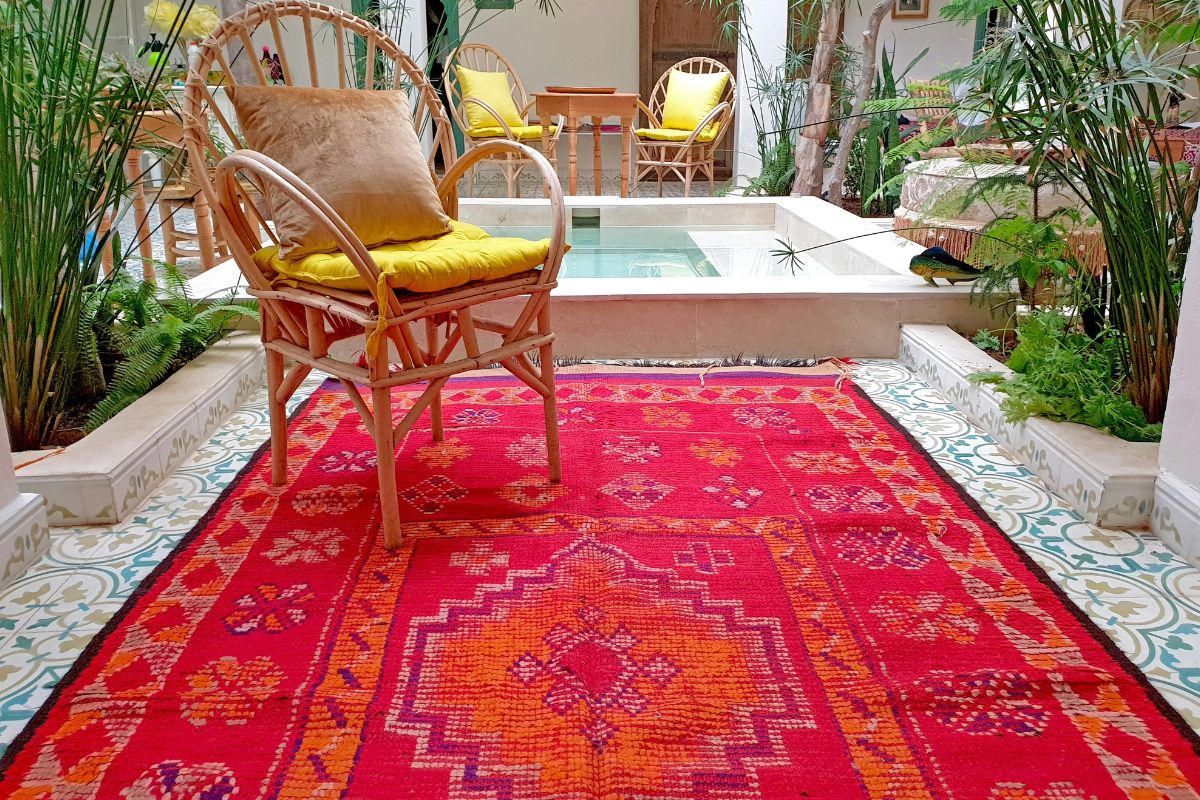
    A Boujad rug (also spelled Boujaad or Bejaad) is a handwoven Berber rug from central Morocco, best known for its warm palette of pinks, oranges, reds, and purples arranged in free, improvised abstract patterns. It comes from the plains around the market town of Boujaad, not the mountains, and it is woven in wool by Amazigh (Berber) women who design as they go rather than following a fixed grid. If you found a rug that glows in sunset colors with loose diamonds and zigzags floating across it, you are very likely looking at a Boujad.

    This guide covers where Boujad rugs come from, why their colors look the way they do, how they are made, how they differ from Beni Ourain and Azilal rugs, and what to actually check before you buy one. Where a fact is genuinely contested or unverifiable for an individual rug, we say so instead of guessing.

    What makes a rug a "Boujad"

    The name comes from the town of Boujaad in Khouribga Province, in Morocco's Beni Mellal-Khenifra region, roughly 90 kilometers southeast of Rabat. This is central Morocco, on the plains between the Atlantic coast and the Middle Atlas, not the high mountain country that many rug listings imply. You will often see Boujad described online as a "Haouz region" or "Atlas mountain" rug. That placement is inconsistent with the town's actual location, and it is one of the most repeated errors in Boujad descriptions.

    Boujaad functioned historically as a market hub. Surrounding tribes brought surplus rugs into town to trade, which is how a whole family of rugs from the wider area came to carry the single trade name "Boujad." So the label describes a regional weaving style and a market of origin more than one narrow tribe. The town still holds a moussem (a seasonal festival) that celebrates both horses and rugs, a sign of how central weaving is to local life.

    The short version: a Boujad is a central-Moroccan, plains-region Berber wool rug in warm colors with a loose, expressive design. Hold onto those three traits, warm palette, wool, and improvised pattern, because together they are what separate a Boujad from its more famous cousins.

    The warm color palette, and where the color comes from

    Color is the reason most people fall for a Boujad. The signature run of tones is pink, magenta, red, orange, and purple, frequently layered together in the same rug so the field reads like a faded sunset. Some pieces also work in warm neutrals, saffron yellows, or the occasional turquoise accent, but the warm reds-to-pinks range is the family signature.

    Here the honest part matters. Sources consistently say the colors come from natural, plant and vegetable-based dyes, and locally documented Berber dye plants include henna and indigo among others. The specific dye behind any one rug's pink or red is rarely recorded, however. Madder root, a classic red-yielding dye used widely across Moroccan and North African weaving, is often named as the source of these warm reds, but that attribution is applied loosely and is more firmly documented for other Moroccan rug types than for Boujad specifically. So it is fair to say Boujad's warm tones are traditionally natural-dyed, and fair to name madder as a likely red source in the broader tradition, but it is not fair to promise that a given rug's magenta is "madder root" unless the seller can actually show that.

    Two more things affect the color you see:

    • Age and light. Natural dyes soften over decades. A vintage Boujad's dusty, gone-to-seed pink is often faded color, not the shade it left the loom.
    • Modern production. Newer Boujad and "Boujad-style" pieces may use synthetic dyes, which can read brighter and more uniform. Synthetic dye does not make a rug fake, but it is a different thing from the natural-dye tradition, and it should be described accurately rather than sold as always-natural.

    Wool, weave, and pile

    Boujad rugs are woven in wool, typically hand-spun sheep's wool from the region's flocks. The pile is usually medium to plush and soft underfoot, warmer and denser than a flatweave kilim but generally not as deep and shaggy as a classic high-pile Beni Ourain.

    Because the weaver works freehand, the knotting and the pile height can vary within a single rug, and the shape itself is often slightly irregular rather than perfectly rectangular. Those small inconsistencies are normal for a genuine handwoven piece and are part of what a machine-made reproduction cannot convincingly fake.

    Pattern and motif: the free abstract aesthetic

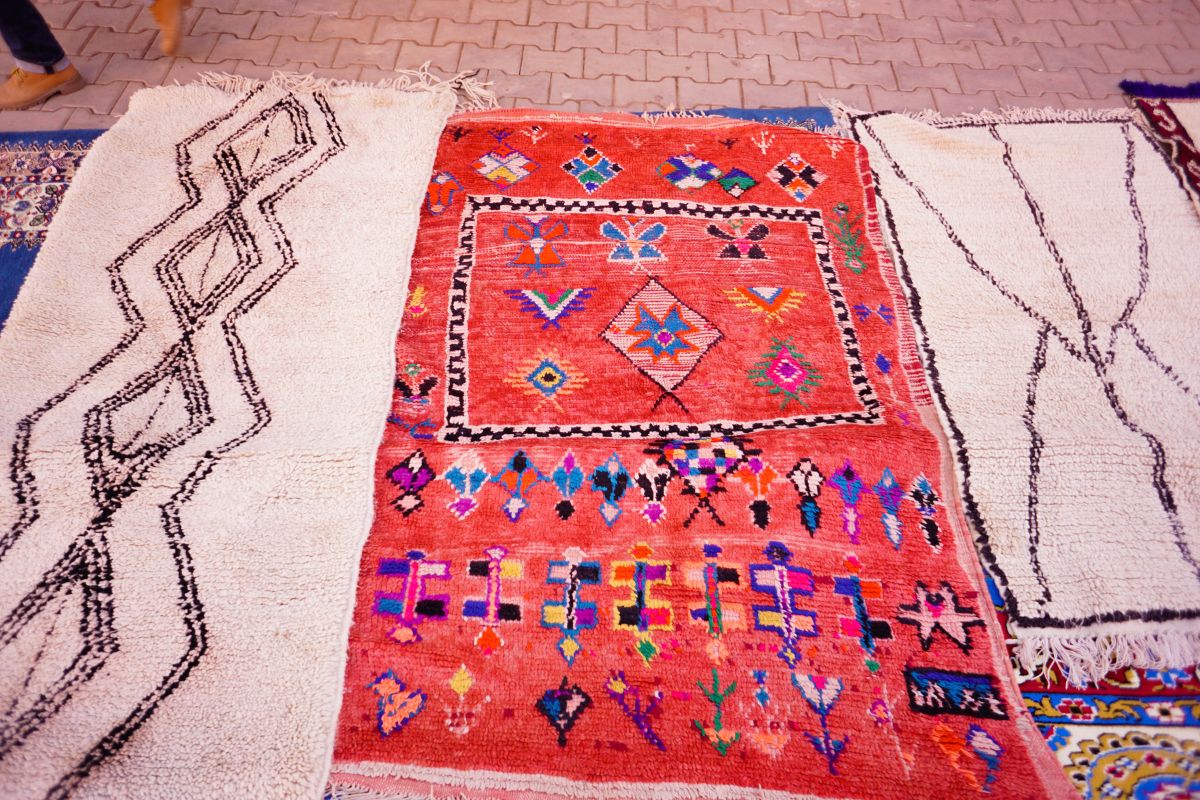
    If Beni Ourain is minimalism, Boujad is improvisation. The motifs are geometric and abstract: diamonds and lozenges, triangles, zigzags, chevrons, and freely drawn borders. Many of these shapes are commonly described as drawing on Amazigh (Berber) visual language, including tattoo and architectural motifs. You will also see them assigned fixed meanings tied to protection, fertility, and daily life. Treat that as interpretation rather than settled fact. This guide could not trace those readings to a named source, meanings vary by weaver, family, and region, and a great deal of it is undocumented or read into the rug after the fact.

    The key word is freely. A Boujad weaver typically works without a fixed cartoon or repeated template, letting the pattern evolve as the rug grows. That is why two Boujads are rarely alike and why the composition can shift partway up the rug, with a motif appearing once and never returning. Collectors read that spontaneity as the style's charm rather than a flaw.

    Boujad vs Beni Ourain vs Azilal

    Boujad is one of several Berber styles, and it is easy to mix them up from a photo. Here is the quick contrast:

    Style Colors Pattern Feel
    Boujad Warm pinks, reds, oranges, purples Free, all-over abstract; diamonds, zigzags Cozy, expressive, color-forward
    Beni Ourain Neutral cream or ivory with black or brown lines Sparse, minimal geometric Calm, modern, understated
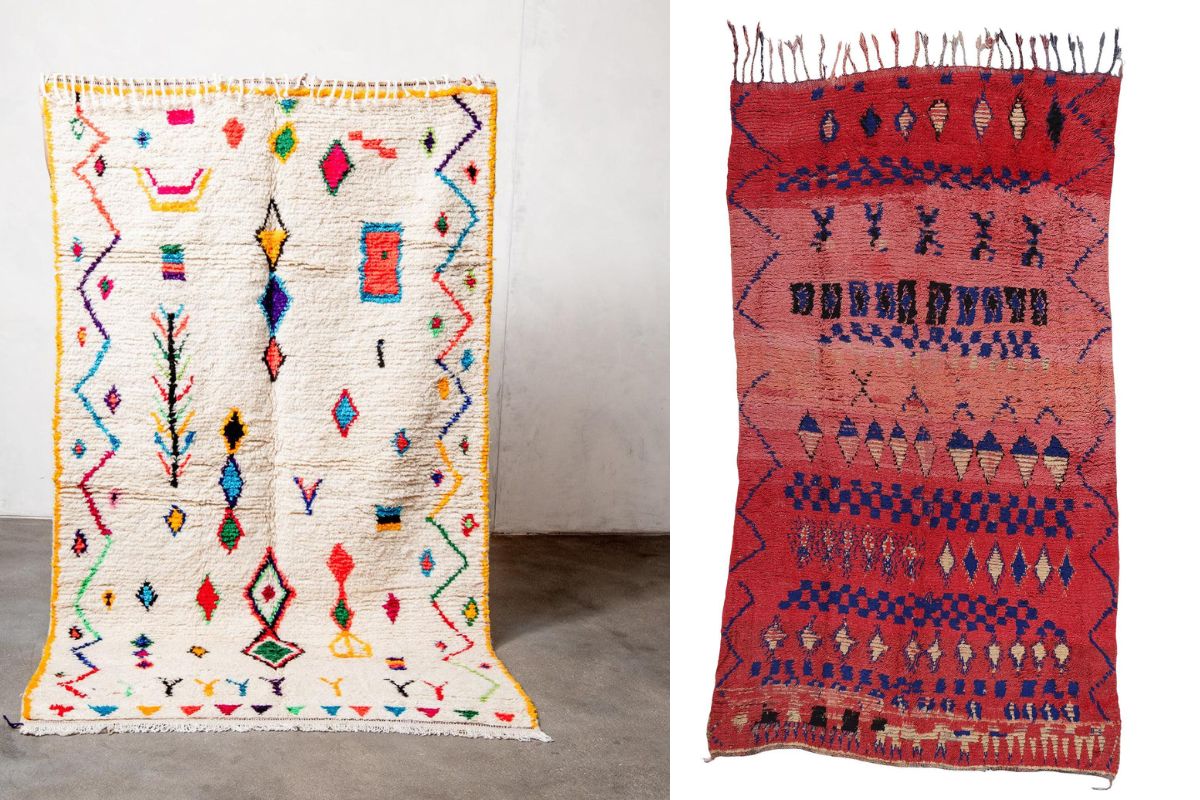
    Azilal Bright colors (reds, blues, yellows) on an ivory or natural ground Storytelling; single motifs on open field Playful, graphic

    The simplest way to tell them apart: Beni Ourain is neutral and quiet, Azilal is bright color on a pale background, and Boujad is warm color across the whole field. For a deeper look at the two color-forward styles, see our Azilal rug guide, and for the neutral end of the spectrum, our Beni Ourain rug guide. All of these sit inside the wider family covered in our complete guide to Moroccan rug styles.

    What "vintage Boujad" actually means

    "Vintage" is one of the most-used words in Boujad listings, and it is worth being clear-eyed about it. Vintage is not a regulated or certified term in the rug trade. When a seller calls a Boujad vintage, they usually mean it is an older, used piece, often implied to be several decades old, but the label on its own does not verify an exact age, and it is not a guarantee of natural dyes, hand-spinning, or any particular quality.

    That does not mean vintage is meaningless. Genuine older Boujads do tend to show softened colors, gentle wear, and the wool sheen that comes from years of use. But those are things you assess by looking at the rug, not by trusting the word in the title. Treat "vintage" as a starting description to verify, not as proof. The same caution applies to the other unregulated trade words that surround these rugs, including authentic and tribal.

    It is also worth naming that "Boujad style" reproductions exist. Some rugs are woven or manufactured elsewhere to imitate the Boujad look. A Boujad-inspired piece can be a perfectly nice rug, but it is a different thing from a rug woven in the Boujaad region tradition, and the two should not be described as if they were the same.

    What to check before buying one

    Atlas Rug Guide is a reference, not an appraisal service, so nothing here replaces hands-on inspection by a specialist for a high-value purchase. With that said, a few practical checks apply:

    • Ask about fiber. Confirm it is wool, and ask whether the wool is hand-spun. A quick, careful feel and a look at the yarn tells you more than the listing does.
    • Ask about dye. If a rug is described as naturally dyed, ask the seller how they know. An honest answer ("older piece, dyes look natural, but not lab-tested") is more trustworthy than a flat guarantee with no basis.
    • Read the shape and back. Handwoven Boujads are usually slightly irregular, and the back should show the pattern and hand-tied knots, not a printed or glued backing.
    • Take "vintage" as a claim to check. Look for the actual signs of age rather than relying on the word.
    • Match it to your room honestly. Boujad's warm tones are strong. They are a feature, not a neutral, so buy the color you genuinely want to live with.

    Where a Boujad fits in a home

    Because the palette is warm and the pattern is busy, a Boujad tends to act as the anchor of a room rather than a quiet backdrop. It sits comfortably against neutral walls, natural wood, and simple furniture that lets the color lead. In lower-traffic, cozy spaces like bedrooms, reading corners, and living rooms, the plush wool pile is part of the appeal.

    Frequently asked questions

    What is a Boujad rug?
    A Boujad rug is a handwoven Berber wool rug from the plains around Boujaad in central Morocco, known for warm pink, red, orange, and purple tones and free, improvised abstract patterns.

    Where do Boujad rugs come from?
    From the region around the town of Boujaad (also spelled Boujad or Bejaad) in Khouribga Province, central Morocco, roughly 90 kilometers southeast of Rabat. Despite common listings, it is a plains market region, not a high-mountain area.

    Why are Boujad rugs pink and red?
    The warm tones traditionally come from natural plant and vegetable dyes. Madder root is often named as a red source in the broader Moroccan tradition, but the exact dye in a specific rug is rarely documented, and newer pieces may use synthetic dyes.

    What is the difference between a Boujad and a Beni Ourain rug?
    Beni Ourain rugs are neutral, usually cream or ivory with sparse black or brown geometric lines. Boujad rugs are warm and color-forward, with pinks, reds, and oranges across the whole field and busier abstract patterns.

    Does "vintage Boujad" guarantee the rug is old or natural-dyed?
    No. Vintage is not a regulated term. It usually signals an older, used rug, but it does not by itself verify a specific age, natural dyes, or hand-spinning. Check the rug itself rather than relying on the label.
  • Moroccan Rug Styles: The Complete Guide to Every Type

    Moroccan Rug Styles: The Complete Guide to Every Type

    The four Moroccan rug styles you will run into most often are Beni Ourain, Boucherouite, Azilal, and Boujad, and each one comes from a different part of Morocco with its own look. Beni Ourain rugs are thick cream wool with simple black geometric lines. Boucherouite rugs are bright and busy, woven from recycled fabric scraps rather than pure wool. Azilal rugs have a natural wool background scattered with colorful, freehand motifs. Boujad rugs run warm, in pinks, reds, oranges, and purples. Sort them by material, pile height, and color palette, and the whole category stops feeling like one blurry "Moroccan rug" and starts making sense.

    Here is the fast version before we go deeper.

    Style Region reported Base material Palette Feel underfoot Best for
    Beni Ourain Middle Atlas Natural undyed wool Cream with black or brown lines Thick, plush, high pile Living rooms, bedrooms, cold floors
    Boucherouite Made across Morocco Recycled cloth, cotton, sometimes synthetic scraps Bold, mixed, no fixed palette Thin to medium, uneven Color accents, playrooms, low-traffic spots
    Azilal High Atlas Natural wool ground with dyed wool or cotton motifs Ivory base, bright abstract accents Medium pile Rooms that want art on the floor
    Boujad Central plains near Boujaad Sheep wool Pink, red, orange, purple Low to medium pile Warm, bohemian, layered interiors

    A note on how this guide is written: Atlas Rug Guide does not sell rugs. Almost every other page you will find on this topic is a rug seller's blog, which is fine, but it means the "best" style is usually the one that seller happens to stock. Here, no style is being sold to you. Where a fact is genuinely contested or thinly sourced, this guide says so instead of pretending it is settled.

    What "Moroccan rug" actually means

    "Moroccan rug" is not a single product or a certified category. It is a shorthand for a wide family of hand-weaving traditions practiced by the Indigenous Amazigh (Berber) peoples of Morocco, most of them in and around the Atlas Mountains, where each tribal area developed its own visual language over generations. Amazigh weaving is also found in Algeria and Tunisia, but the largest and most varied production comes from the Moroccan Atlas, as reported by Berber-rug specialists.

    That matters for one practical reason: the style names are descriptive, not regulated. "Beni Ourain," "Azilal," and "Boujad" point to a region or a group of tribes and the general weaving tradition there, not to a stamped, guaranteed grade. Two rugs sold under the same name can look quite different, and origin dates you see repeated online (everything from "a few centuries" to "thousands of years") are rarely sourced and rarely agree. Treat the names as a helpful map, not a certificate.

    Beni Ourain: the cream wool classic

    Beni Ourain is the style most people picture first: a thick, ivory or cream wool pile marked with thin black or dark brown geometric lines, often diamonds or loose lattice patterns. The rugs are made from natural, undyed sheep wool, which is where the soft off-white ground comes from.

    The name refers to the Beni Ourain (also written Beni Ouarain), described by rug specialists as a confederation of Amazigh tribes in the lower Middle Atlas Mountains, in the area between Fez and Taza. The plush, warm pile has a functional origin: these were floor and sleeping coverings made to insulate against hard mountain winters, not decorative objects first. Because the palette is so restrained, Beni Ourain reads as calm and modern, which is why it shows up constantly in minimalist interiors.

    Best use: high-traffic living rooms and bedrooms where you want warmth and a neutral base. For the full breakdown of knots, wool grades, and how vintage pieces differ from new production, see our deep-dive Beni Ourain rug guide.

    Boucherouite: color from recycled cloth

    Boucherouite is the outlier of the group, and the most misunderstood. Instead of wool pile, these rugs are woven from whatever fabric was on hand: strips of old clothing, cotton, fabric scraps, and sometimes nylon or plastic. The name itself comes from a Moroccan Arabic term for a scrap or torn piece of used cloth, which tells you exactly what they are made from.

    That origin is the opposite of luxury. Boucherouite rugs grew out of thrift, made in households where wool was scarce or too valuable to use on the floor, so weavers improvised with textile leftovers. The result is unpredictable: saturated, clashing color, loose or improvised patterns, and a texture that changes across the rug. No two are alike, and there is no "correct" Boucherouite palette.

    Best use: a jolt of color in an otherwise quiet room, kids' spaces, or as a layered accent. Keep them out of the highest-traffic paths, since mixed materials wear less evenly than dense wool. Our Boucherouite rug guide covers materials, washing cautions, and why condition varies so much piece to piece.

    Azilal: the painterly one

    Azilal rugs sit between Beni Ourain's restraint and Boucherouite's chaos. They usually start from a natural, undyed ivory wool ground, then add sparse, freehand motifs in dyed wool or cotton: diamonds, lines, hooks, and abstract shapes that look almost drawn on. The effect is closer to a canvas than a carpet.

    The name comes from the Azilal region, which specialists place in the High Atlas, northeast of Marrakech, on the seam between the High and Middle Atlas. One reported detail worth knowing: Azilal rugs stayed largely off the international market until the late 20th century, which is part of why they feel fresher and less formula-driven than the more commercialized styles. Weavers there are described as using a single knotted line worked between woven rows, a technique passed down among women in the region.

    Best use: a room that wants one expressive, art-like piece without going full rainbow. See the Azilal rug guide for how to read the motifs and tell older pieces from newer, brighter production.

    Boujad: warm tones from the central plains

    Boujad (also spelled Boujaad) rugs are the warm-blooded ones, built on pinks, magentas, reds, oranges, and purples, often layered over each other so the color feels sun-faded and lived-in. They are woven in sheep wool at a low to medium pile.

    The name comes from the town of Boujaad, and here is a genuinely contested point this guide will not paper over: many sources place Boujad production in the central plains at the foothills of the Middle Atlas, while some sellers loosely file these rugs under the Haouz region near Marrakech. The town of Boujaad sits in Morocco's central plains, not in Marrakech, so the "central plains" description is the more precise one. Rug specialists also note these rugs are made by Arab and Arabised Berber tribes, a reminder that Moroccan weaving traditions are not all strictly Amazigh.

    Best use: bohemian and maximalist rooms, or as a warm layer over a neutral floor. The Boujad rug guide goes deeper on the dye story and why mid-century pieces are collected.

    The part sellers skip: handmade versus machine-made imitation

    Here is the section most "types of Moroccan rugs" articles leave out, because most of them are trying to sell you a rug. A large share of "Moroccan rugs" sold online, especially the cheapest ones, are machine-made imitations produced in factories, often outside Morocco, from synthetic fibers designed to mimic the look. They can copy the pattern. They do not copy the construction.

    You do not need a "burn test" or any of the unsourced tricks that circulate online to see the difference. A few honest signals do most of the work:

    • The back. A handmade rug shows individual knots and slightly irregular rows on the reverse. A machine-made one looks mechanically uniform, sometimes with a grid backing or glued layer.
    • Regularity. Handwoven pieces have small imperfections: a line that wobbles, a motif that is not perfectly symmetrical. Flawless, ruler-straight repetition is a machine tell.
    • Edges and fringe. Authentic rugs have hand-finished edges and fringe that is part of the weave, not a separately sewn-on strip.
    • Material and weight. Real wool (or genuine recycled cloth, for Boucherouite) feels denser and warmer than thin synthetic pile.

    One honest limit: photos and words can only take you so far. Atlas Rug Guide is a reference, not an appraisal or authentication service, and no online guide can certify a specific rug you are looking at. For a high-stakes purchase, a hands-on inspection by a specialist beats any checklist, including this one. What this guide can do is stop you from mistaking a mass-produced copy for the tradition it is imitating.

    How to choose a Moroccan rug style for your room

    Skip the "which is best" question, because it depends entirely on your space. Choose by use instead:

    • Want warmth and a calm, neutral base? Beni Ourain. Thick wool, quiet palette, forgiving in busy rooms.
    • Want the floor to be the color? Azilal for an art-like, controlled pop, or Boucherouite if you want maximum, unpredictable energy.
    • Want warm, cozy, lived-in tones? Boujad, especially layered over a plain floor or a larger neutral rug.
    • High-traffic hallway or entry? Favor dense wool pile (Beni Ourain, some Boujad) over thinner recycled-cloth Boucherouite, which wears less evenly.

    Match the pile height to the room too. Thick pile feels great in a bedroom and reads busy in a small office; a lower pile is easier under doors and dining chairs.

    FAQ

    What are the main types of Moroccan rugs?
    The most common named styles are Beni Ourain (thick cream wool with black geometric lines), Boucherouite (bright rugs made from recycled cloth), Azilal (ivory wool grounds with colorful freehand motifs), and Boujad (warm pink, red, and purple tones). Other styles exist, but these four cover most of what people mean by "Moroccan rug."

    What is the difference between Beni Ourain and Azilal rugs?
    Beni Ourain rugs are minimalist: undyed cream wool with a few dark geometric lines. Azilal rugs keep a similar natural wool base but add bright, abstract colored motifs, so they read as more artistic and less neutral. Beni Ourain comes from the Middle Atlas; Azilal comes from the High Atlas region.

    Are Moroccan rugs always handmade?
    Traditionally yes, they are handwoven by Amazigh (Berber) weavers. But many rugs sold as "Moroccan" online are machine-made imitations in synthetic fibers. Check the back for irregular hand knots, look for small imperfections in the pattern, and feel the material to tell a genuine handmade rug from a factory copy.

    What is a Boucherouite rug made of?
    Recycled textiles: strips of old clothing, cotton, fabric scraps, and sometimes synthetic material. The style grew out of thrift, when wool was scarce or too valuable, so weavers used whatever cloth they had. The name itself comes from a Moroccan Arabic word for scrap or torn cloth.

    Why do Boujad rugs vary so much in color?
    Boujad rugs are built on warm dyed wool, and many are vintage pieces where the color has softened over decades, so pinks, reds, and purples layer and fade differently in each rug. Because they are one-of-a-kind handmade pieces, no two share the exact same palette.

  • Azilal vs Boujad Rug: How to Tell Them Apart

    Azilal vs Boujad Rug: How to Tell Them Apart

    Azilal and Boujad are the two Moroccan rug styles most likely to get swapped in a listing, because both break from the neutral cream-and-line look of Beni Ourain and lean into color. The fast test: look at the ground wool and the weight. Azilal starts from a natural, undyed ivory wool base with sparser, more graphic color added on top, and feels lighter. Boujad is fully dyed wool throughout, denser, and heavier in the hand, built on warm pinks, reds, and purples rather than Azilal's more varied palette.

    This guide is a comparison only, sitting alongside the complete guide to Moroccan rug styles. For the full profile of either style on its own, see our dedicated guides to Azilal rugs and Boujad rugs.

    Where each comes from, briefly

    Azilal rugs are associated with the Azilal region in the High Atlas, northeast of Marrakech. Boujad rugs take their name from the town of Boujaad, generally placed in Morocco's central plains at the foothills of the Middle Atlas, though some sellers loosely file them under the Haouz region near Marrakech instead; our Boujad guide covers that discrepancy in more depth. Both are made by Amazigh (Berber) weavers, though Boujad rugs are also attributed by rug specialists to Arab and Arabised Berber tribes in the region, a reminder that Moroccan weaving is not a single uniform tradition.

    Material and construction

    This is the most reliable, checkable difference between the two styles.

    • Azilal starts from a natural, undyed ivory or cream wool ground, with motifs added in dyed wool or cotton worked sparsely across that base. Some sellers describe certain Azilal production as including a synthetic fiber blended in to help stabilize the added color; this guide could not independently confirm how common that is, so treat it as a claim you may see on some listings, not a defining feature of the style as a whole.
    • Boujad is fully wool, dyed throughout rather than left in a natural ground, and is described consistently as denser and heavier than Azilal.

    Feel is the fastest real-world test: an Azilal rug feels lighter and airier, closer to a canvas with color drawn on top of a pale field, while a Boujad rug feels weightier and more saturated all the way through.

    Color and pattern

    Azilal's color sits on top of a mostly ivory field: diamonds, lines, hooks, and abstract shapes worked sparsely, so a lot of the natural undyed wool is still visible between the motifs. The overall effect reads closer to a sketch or a painting than a fully patterned textile.

    Boujad is built from warm, dyed wool throughout, in pinks, magentas, reds, oranges, and purples, often layered so the color reads as sun-faded and lived-in rather than flat. Geometric shapes, including diamonds and triangles, appear, but the ground itself carries color everywhere rather than staying mostly natural.

    Quick-look comparison

    Feature Azilal Boujad
    Region High Atlas Central plains, Middle Atlas foothills
    Ground Natural, undyed ivory wool Fully dyed wool
    Weight/feel Lighter, airier Heavier, denser
    Color placement Sparse motifs on a pale field Color throughout the ground
    Typical palette Ivory base with varied bright accents Pink, magenta, red, orange, purple

    How to tell them apart in a listing photo

    • Check how much natural, undyed wool is visible. If a lot of the pale ground shows through between motifs, that points to Azilal. If the whole surface is saturated with warm color, that points to Boujad.
    • Look at the palette family. Boujad stays specifically in pinks, reds, magentas, and purples. Azilal's color choices are more varied and less tied to one warm family.
    • Ask about weight if you can't feel it. A seller can tell you whether a piece feels light or substantial; Boujad tends to run heavier for a similar size.
    • Don't rely on the listing title alone. Because the styles are visually close and commercially confused, a mislabeled listing is not rare. Use the ground-and-weight test above rather than trusting the name a seller has attached.

    One honest limit: photos flatten texture and weight, the two most reliable signals here, so a photo-only judgment will always be softer than handling the actual rug. For a significant purchase, ask direct questions about the wool base and construction rather than relying on the style name in the title.

    Choosing between them for a room

    Since both styles bring color rather than neutrality, the choice usually comes down to how much of the floor you want that color to cover and how heavy you want the rug to feel. Azilal's lighter weight and pale visible ground make it a reasonable choice if you want a colorful accent that still reads as airy, more like a piece of graphic art on the floor than a dense block of color. Boujad's fuller, heavier saturation suits a room that wants genuine warmth and boldness, functioning closer to a design anchor than an accent. Neither is the more "authentic" choice; they simply solve different visual problems, and a room can reasonably use either depending on what else is already in it.

    FAQ

    What is the easiest way to tell an Azilal rug from a Boujad rug?
    Check the ground. Azilal keeps a lot of natural, undyed ivory wool visible with sparse color added on top. Boujad is fully dyed wool throughout, in warm pinks, reds, and purples, and feels noticeably heavier.

    Are Azilal and Boujad rugs from the same region?
    No. Azilal is associated with the High Atlas, northeast of Marrakech. Boujad is generally placed in the central plains at the foothills of the Middle Atlas, though some sellers describe it differently.

    Which is heavier, Azilal or Boujad?
    Boujad. It is fully wool and dyed throughout, and is consistently described as denser and heavier than Azilal, which keeps a lighter, more open feel from its undyed wool ground.

    Do Azilal rugs contain synthetic fiber?
    Some sellers describe certain Azilal pieces as including a small amount of synthetic fiber to help stabilize added color. This guide could not confirm how widespread that is, so it should be treated as a claim seen on some listings rather than a defining feature of the style.

    Can a listing be mislabeled between the two styles?
    Yes. Because both are colorful, non-neutral Moroccan styles and the names are used loosely in the market, mislabeling happens. Checking the ground wool and weight yourself is more reliable than trusting the title alone.