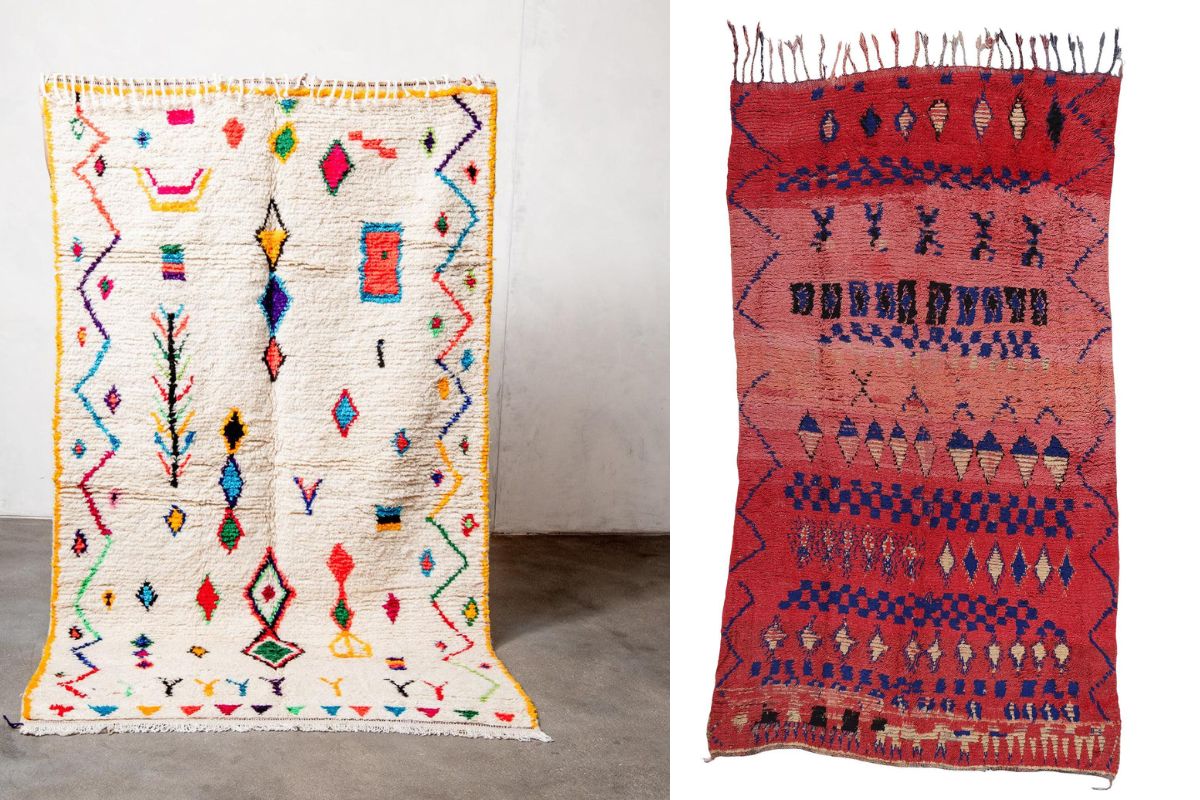
Azilal and Boujad are the two Moroccan rug styles most likely to get swapped in a listing, because both break from the neutral cream-and-line look of Beni Ourain and lean into color. The fast test: look at the ground wool and the weight. Azilal starts from a natural, undyed ivory wool base with sparser, more graphic color added on top, and feels lighter. Boujad is fully dyed wool throughout, denser, and heavier in the hand, built on warm pinks, reds, and purples rather than Azilal's more varied palette.
This guide is a comparison only, sitting alongside the complete guide to Moroccan rug styles. For the full profile of either style on its own, see our dedicated guides to Azilal rugs and Boujad rugs.
Where each comes from, briefly
Azilal rugs are associated with the Azilal region in the High Atlas, northeast of Marrakech. Boujad rugs take their name from the town of Boujaad, generally placed in Morocco's central plains at the foothills of the Middle Atlas, though some sellers loosely file them under the Haouz region near Marrakech instead; our Boujad guide covers that discrepancy in more depth. Both are made by Amazigh (Berber) weavers, though Boujad rugs are also attributed by rug specialists to Arab and Arabised Berber tribes in the region, a reminder that Moroccan weaving is not a single uniform tradition.
Material and construction
This is the most reliable, checkable difference between the two styles.
- Azilal starts from a natural, undyed ivory or cream wool ground, with motifs added in dyed wool or cotton worked sparsely across that base. Some sellers describe certain Azilal production as including a synthetic fiber blended in to help stabilize the added color; this guide could not independently confirm how common that is, so treat it as a claim you may see on some listings, not a defining feature of the style as a whole.
- Boujad is fully wool, dyed throughout rather than left in a natural ground, and is described consistently as denser and heavier than Azilal.
Feel is the fastest real-world test: an Azilal rug feels lighter and airier, closer to a canvas with color drawn on top of a pale field, while a Boujad rug feels weightier and more saturated all the way through.
Color and pattern
Azilal's color sits on top of a mostly ivory field: diamonds, lines, hooks, and abstract shapes worked sparsely, so a lot of the natural undyed wool is still visible between the motifs. The overall effect reads closer to a sketch or a painting than a fully patterned textile.
Boujad is built from warm, dyed wool throughout, in pinks, magentas, reds, oranges, and purples, often layered so the color reads as sun-faded and lived-in rather than flat. Geometric shapes, including diamonds and triangles, appear, but the ground itself carries color everywhere rather than staying mostly natural.
Quick-look comparison
| Feature | Azilal | Boujad |
|---|---|---|
| Region | High Atlas | Central plains, Middle Atlas foothills |
| Ground | Natural, undyed ivory wool | Fully dyed wool |
| Weight/feel | Lighter, airier | Heavier, denser |
| Color placement | Sparse motifs on a pale field | Color throughout the ground |
| Typical palette | Ivory base with varied bright accents | Pink, magenta, red, orange, purple |
How to tell them apart in a listing photo
- Check how much natural, undyed wool is visible. If a lot of the pale ground shows through between motifs, that points to Azilal. If the whole surface is saturated with warm color, that points to Boujad.
- Look at the palette family. Boujad stays specifically in pinks, reds, magentas, and purples. Azilal's color choices are more varied and less tied to one warm family.
- Ask about weight if you can't feel it. A seller can tell you whether a piece feels light or substantial; Boujad tends to run heavier for a similar size.
- Don't rely on the listing title alone. Because the styles are visually close and commercially confused, a mislabeled listing is not rare. Use the ground-and-weight test above rather than trusting the name a seller has attached.
One honest limit: photos flatten texture and weight, the two most reliable signals here, so a photo-only judgment will always be softer than handling the actual rug. For a significant purchase, ask direct questions about the wool base and construction rather than relying on the style name in the title.
Choosing between them for a room
Since both styles bring color rather than neutrality, the choice usually comes down to how much of the floor you want that color to cover and how heavy you want the rug to feel. Azilal's lighter weight and pale visible ground make it a reasonable choice if you want a colorful accent that still reads as airy, more like a piece of graphic art on the floor than a dense block of color. Boujad's fuller, heavier saturation suits a room that wants genuine warmth and boldness, functioning closer to a design anchor than an accent. Neither is the more "authentic" choice; they simply solve different visual problems, and a room can reasonably use either depending on what else is already in it.
FAQ
What is the easiest way to tell an Azilal rug from a Boujad rug?
Check the ground. Azilal keeps a lot of natural, undyed ivory wool visible with sparse color added on top. Boujad is fully dyed wool throughout, in warm pinks, reds, and purples, and feels noticeably heavier.
Are Azilal and Boujad rugs from the same region?
No. Azilal is associated with the High Atlas, northeast of Marrakech. Boujad is generally placed in the central plains at the foothills of the Middle Atlas, though some sellers describe it differently.
Which is heavier, Azilal or Boujad?
Boujad. It is fully wool and dyed throughout, and is consistently described as denser and heavier than Azilal, which keeps a lighter, more open feel from its undyed wool ground.
Do Azilal rugs contain synthetic fiber?
Some sellers describe certain Azilal pieces as including a small amount of synthetic fiber to help stabilize added color. This guide could not confirm how widespread that is, so it should be treated as a claim seen on some listings rather than a defining feature of the style.
Can a listing be mislabeled between the two styles?
Yes. Because both are colorful, non-neutral Moroccan styles and the names are used loosely in the market, mislabeling happens. Checking the ground wool and weight yourself is more reliable than trusting the title alone.
Leave a Reply