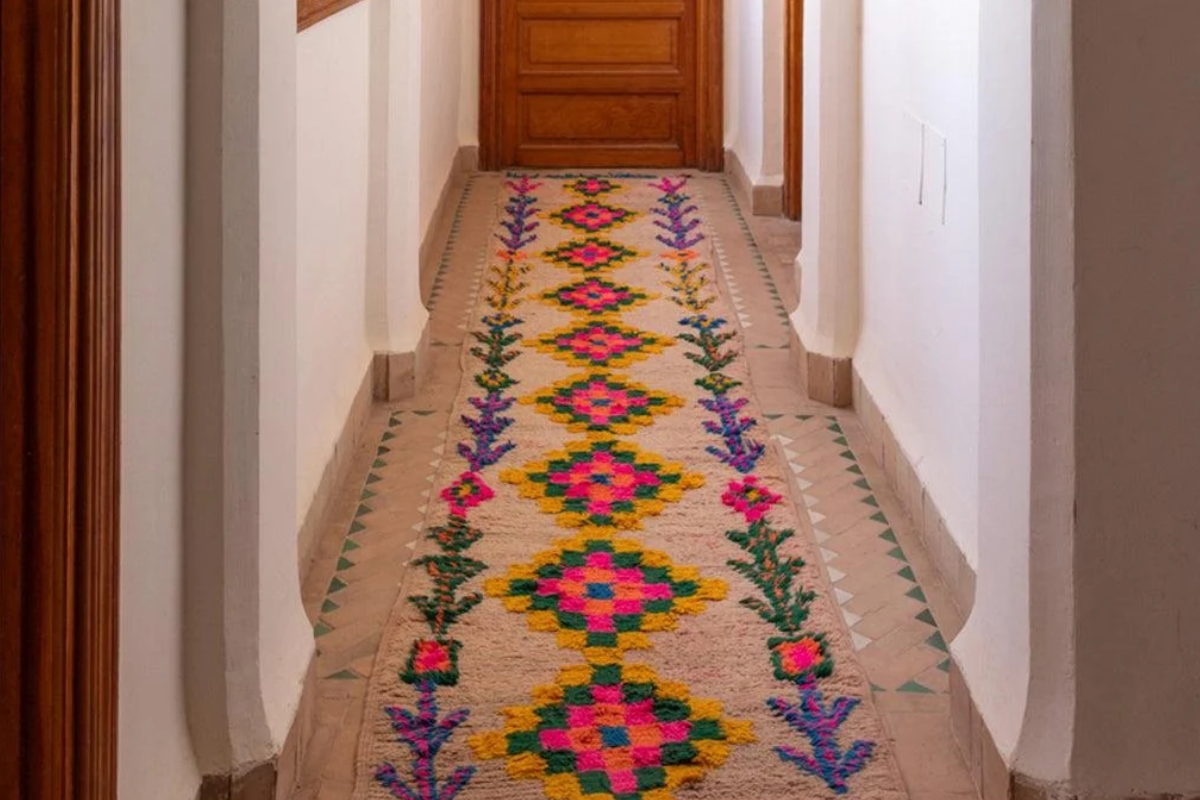
Short answer: A hand-woven Moroccan runner rug, hallway or kitchen, can live with daily foot traffic if it sits on a pad, lies flat at both ends and gets turned end to end from time to time so the wear lane moves. Stairs are different. A runner on stairs has to be fixed to every step by someone who installs stair runners, and a thick, busy-patterned pile is a poor match for a staircase. Laying a loose runner down a flight of stairs is the one placement this guide says no to outright.
When we checked this search on September 24, 2026, every result on the first page was a shop or a seller's own blog. They show runners in handsome corridors and say little about the second year underfoot. We have no runner to sell, and we have not seen yours, so this guide sticks to what can be checked: how traffic behaves in a narrow space, what a kitchen adds, and what published fall-prevention guidance says about stairs.
Moroccan runner rug hallway basics: what the traffic does to it
A hallway concentrates wear in a way a living room does not. Nearly everyone walks the same line down the middle, often in outdoor shoes, several times a day. On a pile runner, that line is where the pile flattens first and where grit settles down among the knots. On a flatweave, with no pile to crush, the same traffic rubs directly on the woven surface.
Neither construction is automatically right for a hall. They wear differently, and our comparison of flatweave and pile Moroccan rugs sets out the tradeoffs. In a hallway, three habits matter more than the construction:
- Get the grit out. Grit carried in on shoes is abrasive. A hallway runner needs vacuuming more often than a rug in a room people cross less.
- Turn it end to end. A hallway has a busy end, usually the one nearest the front door or the kitchen. Rotating the runner now and then spreads that wear along its length instead of wearing through one patch.
- Watch the ends. The two short ends are where feet, vacuum heads and doors meet the runner. They are the first place a problem shows.
It also helps to know what you are shopping for. A genuine hand-woven runner is not cut from a roll to a hallway's length. Its width is set by the loom and the weaver, and its length by where the weaving stopped. Our guide to Moroccan runners, rounds and odd shapes explains which formats genuinely exist and why a hand-woven piece rarely matches an exact measurement.
Fitting a runner to the hallway you actually have
Before looking at any listing, walk the hallway with a tape measure and note:
- The length of floor you want covered, stopping short of any doorway where the floor changes level or material.
- The narrowest width of the hall, including any radiator, cabinet or shoe rack that sticks out.
- Every door that swings over the floor, and the gap under each one.
- Floor vents or registers, which a runner should not cover.
The door gap is the check most people skip. A deep-pile runner, such as a Beni Ourain style, sits much higher off the floor than a flatweave, and a pad adds to that. A door that catches the pile will drag the runner every time it opens, push it into a ruck and leave a fold that someone will eventually catch a toe on. Ask the seller for the pile height, add the pad, and compare it with the gap under each door.
Then allow for the rug itself. Hand-woven edges are rarely perfectly straight, so a runner can be a little wider at one end than the other. Ask for the width at both ends and in the middle, and plan around the smallest figure. Leave bare floor visible along both sides as well. A runner squeezed against the baseboards has nowhere to go when it shifts, and that pressed edge is where it tends to buckle.
Keeping a hall runner flat and still
A long, narrow rug on a hard floor moves more than a large one. It has less weight per step and usually no furniture holding it down. Treat a runner that creeps, bunches or curls at a corner as a trip hazard, not a cosmetic quirk. The US government's Ready.gov page on preventing falls at home, which we read on September 24, 2026, puts the rule plainly: "Remove or tape down area rugs and if you have carpet on the stairs make sure it's firmly attached."
For a hallway, that usually means a pad cut slightly smaller than the runner, so no pad edge shows or forms a step at the sides. Corner grippers or rug tape can deal with an end that curls even when the middle stays put. Our guide on how to stop a rug from slipping compares pads, tape, grippers and adhesives, and explains which ones are hard to undo on a hand-knotted piece.
The fringe deserves its own mention. On most Moroccan rugs, the fringe is the ends of the warp threads the rug was woven on, so it is part of the structure, not a trim. In a hallway it sits exactly where feet and vacuum heads cross the end of the runner. Keep it combed flat, never pull at loose strands, and vacuum across the ends rather than sucking the fringe into the machine. A fringe that is tangling or thinning is a repair question for a rug restorer, not something to trim at home.
Hallway, kitchen and stairs at a glance
| Placement | Main risk | What handles it | Who decides |
|---|---|---|---|
| Hallway | Concentrated wear lane, curling ends, doors catching the pile | Pad, rotation, regular vacuuming, checking door gaps | You |
| Kitchen | Spills, drips and grease, a damp runner sliding on a hard floor | Pad, prompt blotting, accepting some staining | You |
| Top or bottom of stairs | A loose rug where a misstep has the worst outcome | Published fall-prevention guidance says remove it | You, following that guidance |
| On the stairs | A runner that shifts, bunches or hides the step edge | Fixed to every step, suitable pile and pattern | An experienced stair-runner installer |
A runner in the kitchen
A kitchen runner usually lies in front of the sink, the stove or the counter where food is prepared. That is where water drips, oil spits and food lands. Wool absorbs liquid, and a hand-woven wool runner cannot go through a washing machine the way the washable synthetic runners near the top of this search can. Choosing one for a kitchen is choosing to blot spills promptly and to accept that some marks will stay.
Construction matters here too. A flatweave lies thinner and has no pile for crumbs to settle into, while a pile runner is softer to stand on at the counter. Whichever you choose, the spot in front of a sink is often damp, and a wet runner on tile or stone can slide, so the pad matters as much here as in the hall. When something does land on the wool, the first minutes decide most of the outcome, and our guide to cleaning a spill on a wool rug covers what to do and what not to put on it.
If the kitchen is a place where oil splatters daily and the floor is often wet, it is fair to ask whether a hand-woven wool runner belongs there at all. That is a legitimate reason to put the rug elsewhere and choose something washable for the kitchen.
Stairs: the one placement where loose is not an option
A runner on stairs is not a larger version of a hall runner. On a flat floor, a runner that shifts causes a stumble. On a staircase, the same shift can cause a fall down several steps. Ready.gov's guidance quoted above is explicit that carpet on stairs must be firmly attached, and it also recommends handrails on both sides of stairways.
AARP's fall-prevention page, Simple Steps to Prevent Falls, which we read on September 24, 2026, adds three points that bear directly on Moroccan rugs. It recommends installing carpet with "short, dense pile." It advises choosing "a carpet pattern that doesn't hide step edges, making it look like steps have ended when they haven't." And it says to "remove any rugs at the top or bottom of stairways."
Set those against a typical Moroccan runner and the tension is clear:
- Pile height. Deep, soft pile is the whole appeal of several Moroccan styles, and it is the opposite of the short, dense pile that guidance recommends for stairs. A thick pile also wraps poorly over the edge of each step, which is where your foot needs a clear, firm edge.
- Pattern. Bold lattices, strong diagonals and busy, high-contrast fields are common in Moroccan design. Whether a particular pattern hides the step edge depends on your stairs and your lighting. Judge it from the top step, in the light you normally have, with the runner held against the stairs while nobody is using them.
- Irregular width. A width that wanders slightly along the length is invisible on a hallway floor. On a staircase, it shows step by step, and the installer has to decide how to center it.
- Length. A single runner may not reach the whole flight. Cutting or joining a hand-knotted rug is a permanent change, and the cut ends must be professionally secured or the knots can unravel.
This is installer work, and this guide does not describe how to do it. Fixing a runner to every step means fasteners through the rug and into the stairs, decisions about how it wraps each step edge, and judgment about whether a given piece is suitable at all. Tell the installer the runner is hand-woven wool. Ask how it will be fixed to each step, how the edges will be finished, what it will look like where it wraps each step edge, and how it would come out if you ever moved.
The stop condition: if the runner on any step moves, bunches or lifts under a foot, stop using that runner on the stairs until it is refixed, and use the handrail in the meantime.
What we cannot tell you, and who can
We have not seen your hallway, your stairs or your rug, so we cannot say whether a particular runner will work in your home. Here is where the honest limits sit:
- Whether a specific runner is safe on your stairs is a judgment for an experienced stair-runner installer who can see both the rug and the staircase.
- We give no clearance or margin numbers. Widely repeated hallway measurements mostly trace back to retailers, and your doors, vents and baseboards matter more than any rule of thumb.
- If someone in your home has fallen before or is at higher risk of falling, ask their doctor about a home safety assessment, which can include a visit from an occupational therapist. A general guide is not a substitute for someone who can see the stairs and the person using them.
FAQ
Is a Moroccan runner rug a good choice for a hallway?
It can be, provided it sits on a pad, lies flat at both ends, clears every door that swings over it and gets turned end to end now and then. Expect the busiest end to wear first. A hand-woven runner will not match your hallway to the inch, so measure first and plan around the narrowest width the seller gives you.
Does a hallway runner need a rug pad?
On a hard floor, yes. A long, narrow rug has little weight holding it in place and tends to creep and curl. A pad cut slightly smaller than the runner stops most movement, and corner grippers or rug tape can deal with an end that still curls.
Can I put a Moroccan rug on my stairs?
Only if it is fixed to every step by someone who installs stair runners, and only if the pile and pattern suit a staircase. Published fall-prevention guidance recommends short, dense pile and a pattern that does not hide step edges, which rules out many deep-pile Moroccan pieces. Never lay a runner loose on stairs.
Should a kitchen runner be a flatweave or a pile rug?
A flatweave lies thinner and holds fewer crumbs; a pile runner is softer to stand on. Neither is washable in a machine, so either one means blotting spills promptly. If the floor in front of your sink is often wet, a washable runner may simply be the better tool for that spot.
Leave a Reply