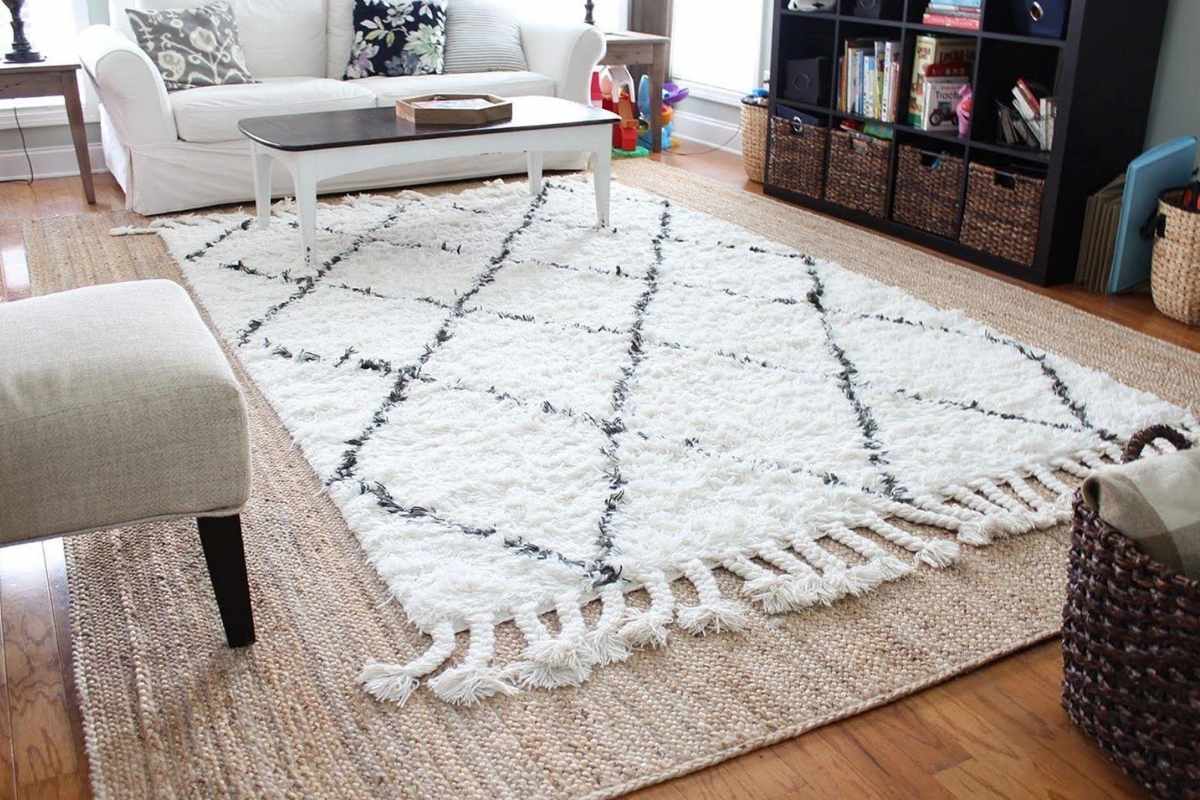
Short answer: Here is how to layer rugs when one of them is a Moroccan rug: put a larger, flatter and quieter rug underneath, and let the Moroccan rug sit on top where it can be seen. Size the base from the Moroccan piece, not the other way round, so a clear band of the base shows on every side. Then deal with the two things decor guides skip: stopping the top rug from creeping on a textile surface, and lifting it now and then, because the dark, undisturbed zone between two wool rugs is exactly where moth larvae like to feed.
Most guides that rank for this search are written by designers and retailers for someone choosing two new rugs at once. If you already own a hand-woven Moroccan rug, the situation is different. The top rug is fixed, it is probably not a standard size, and it is the one you care about. This guide starts there.
How to layer rugs: start from the rug you cannot change
The usual advice is to choose a large neutral base and then a smaller patterned rug to go on it. With a Moroccan rug, reverse the order. Measure the Moroccan piece first, on both long edges and both ends, and choose the base to suit it.
For proportion, a widely repeated rule of thumb comes from decor writers rather than any standard. The home-decor blog Bless'er House, in a layering guide dated February 24, 2026, which we read on September 24, 2026, suggests the top rug "should be about 2/3 the size of the base rug." Treat that as a starting point, not a measurement you must hit. What matters more is that a visible band of the base shows all the way around, wide enough to read as intentional rather than as a rug that slid off-center.
A few practical points follow from working backward:
- Base rugs come in retail sizes; your Moroccan rug does not. You will rarely find a base that frames it evenly on all four sides. Decide which sides matter most, usually the ones facing the room's entrance, and let the uneven margin fall where furniture hides it.
- Use the smallest measurements. Hand-woven rugs vary slightly along their length. Plan with the smallest length and width you measure, leaving the fringe out.
- Mark it on the floor first. Tape the outline of both rugs on the floor and leave it for a day. It shows the margin far more honestly than a photo on a product page.
Which base suits which kind of Moroccan rug
The top rug does most of the visual work, so the base should mostly stay out of its way. The pairing depends on what kind of Moroccan rug you have.
| Top rug | Base that tends to suit it | What to watch for |
|---|---|---|
| Deep-pile, mostly undyed pieces such as Beni Ourain styles | A flat, low base in a darker or contrasting tone, so the pale pile has an edge to show against | Total height. A thick top rug on a thick base makes a noticeable step at its edge. |
| Bold, colorful rugs such as Azilal or Boucherouite pieces | A plain, flat base in one quiet color | Two patterns competing. If both rugs are busy, the Moroccan rug loses. |
| Moroccan flatweaves (kilim or hanbel types) | A base with a little texture, since a flatweave adds pattern but little height | Creep. A thin, light flatweave moves on a textile surface more readily than a heavy pile rug. |
| A faded or vintage-washed piece | A base that does not out-color it; pale, soft tones | A strong base color can make gentle fading look like dirt. |
These are tendencies, not rules. A room with a lot of pattern elsewhere may want a plainer pairing than the table suggests.
The out-of-square problem layering exposes
Layering has one Moroccan-specific catch that general guides never meet. A machine-made base rug has crisp, straight edges. A hand-woven rug often does not: one end may be slightly wider than the other, or the sides may bow a little. On a bare floor, nobody notices. On a perfectly rectangular base, the base's edge becomes a ruler, and every wander in the Moroccan rug's edge shows against it.
There are three ways to handle this. A wider margin of base makes a small skew much harder to see, because the eye compares edges that sit close together. Turning the top rug at an angle to the base, which many decor guides suggest for style reasons anyway, removes the parallel lines entirely. And a base with its own soft or irregular edge, such as a hand-woven flat rug, shows less contrast than a crisp machine-made one. None of this is a flaw in the Moroccan rug; it is simply what hand weaving produces.
Stopping the top rug from creeping
A rug on a rug behaves differently from a rug on a floor. Most rug pads are designed to grip a hard floor, not another textile, so a pad under the top rug may hold poorly or not at all. With traffic, the top rug tends to creep, bunch at one edge or develop a ripple. A ripple is a trip hazard, and so is the raised edge where a thick top rug ends.
What helps:
- Test first. Lay the rugs, walk across them normally for a few days, and see whether the top one moves or ripples.
- Use a pad made for rug-on-rug or rug-on-carpet use if the top rug moves. Check the pad maker's own description of what surfaces it is for.
- Let furniture do some of the work. A sofa or chair with its front legs on both layers holds them together better than any pad on an open floor.
- Keep the raised edge out of the main walking line and out of any door swing.
Our guide on how to stop a rug from slipping compares pads, tape, grippers and adhesives, including which ones are hard to undo on a hand-knotted piece. Be cautious about putting tape or adhesive on the back of a hand-woven rug; the back of the knots is the rug's structure, and residue there is hard to remove cleanly.
What happens between the layers
Layering changes how both rugs age, and the effects are invisible from above.
Moths. The University of Kentucky's extension fact sheet on clothes moths, by entomologist Michael F. Potter, which we read on September 24, 2026, says the larvae "feed exclusively on animal fibers, especially wool," and that rugs "that get a normal amount of traffic, or are routinely vacuumed" are seldom infested. It also warns that "edges and undersides of rugs, or sections beneath furniture are more likely to be attacked." Two wool rugs layered together create a large, dark underside that nobody walks on directly and nobody vacuums. Lift the top rug from time to time, vacuum both the base and the back of the top rug, and look for the signs described in our guide to whether carpet moth damage is still active.
Spills. A spill on a layered pair can soak through the top rug into the base, and anything that stays damp between two dyed rugs can move color from one to the other. Natural dyes are not immune to this, as our piece on why wool rug colors bleed explains. After a spill, lift the top rug and let both dry separately.
Fading. Where sunlight reaches the room, the exposed border of the base fades while the covered middle does not. Move the top rug after a few years and you may find a clear outline of where it sat. Rotating the pair helps a little; our guide to rug fading in sunlight explains what rotation can and cannot undo.
Flattening. The top rug's weight, and any furniture on it, presses the base's pile. If the base is a pile rug, expect the covered area to look different from the border when you eventually separate them.
When layering is the wrong answer
Layering is a good way to make a smaller Moroccan rug hold a bigger room. It is not always the right call. Skip it, or keep the layers very flat, when:
- Both rugs are deep pile. The combined height makes a pronounced edge, and the top rug is harder to keep still on soft pile.
- The spot is a main walkway or doorway. Two layers where everyone walks means a creeping top rug and a raised edge in the busiest line.
- Someone in the home is at higher risk of falling. Every extra edge on the floor is one more thing to catch a foot on. One well-anchored rug may be the safer choice.
- The Moroccan rug is fragile or valuable. If a top rug shifts on a coarse base with every step, the two textiles rub against each other constantly. For a piece you want to last, a single rug on a good pad is the gentler arrangement.
What we cannot tell you
We have not seen your room or your rugs, so we cannot say whether a particular pairing will look right or stay put. Proportion rules such as the two-thirds guideline come from designers and decor writers, not from any standard, and reasonable designers disagree. An interior designer who can see the room can judge proportion better than a general guide. If you suspect moths are already active in either rug, a professional rug cleaner or restorer can assess the damage in person.
FAQ
How big should the base rug be when layering rugs?
Large enough that a clear band of it shows on every side of the top rug. One decor rule of thumb, from the blog Bless'er House, is that the top rug should be about two-thirds the size of the base. With a hand-woven Moroccan rug, choose the base to suit the rug you already own, using its smallest measurements.
Can I put a Moroccan rug on top of a jute or sisal rug?
Yes. A flat, neutral jute or sisal base is the pairing many layering guides recommend, and its plain texture suits most Moroccan rugs. Watch for creep. If the top rug shifts on the base with every step, the two surfaces rub constantly, which is worth stopping on a piece you care about.
Do I need a rug pad between layered rugs?
Often, yes, but it has to be the right kind. Most pads are made to grip hard floors, not another rug. If the top rug creeps, look for a pad whose maker says it is intended for use on carpet or on another rug, and let furniture help hold the layers.
Do layered wool rugs attract moths?
Layering does not attract moths, but it creates the conditions larvae prefer: a dark, undisturbed wool surface. University of Kentucky extension guidance notes that undersides of rugs and areas under furniture are more likely to be attacked. Lift the top rug now and then and vacuum both layers.
Leave a Reply