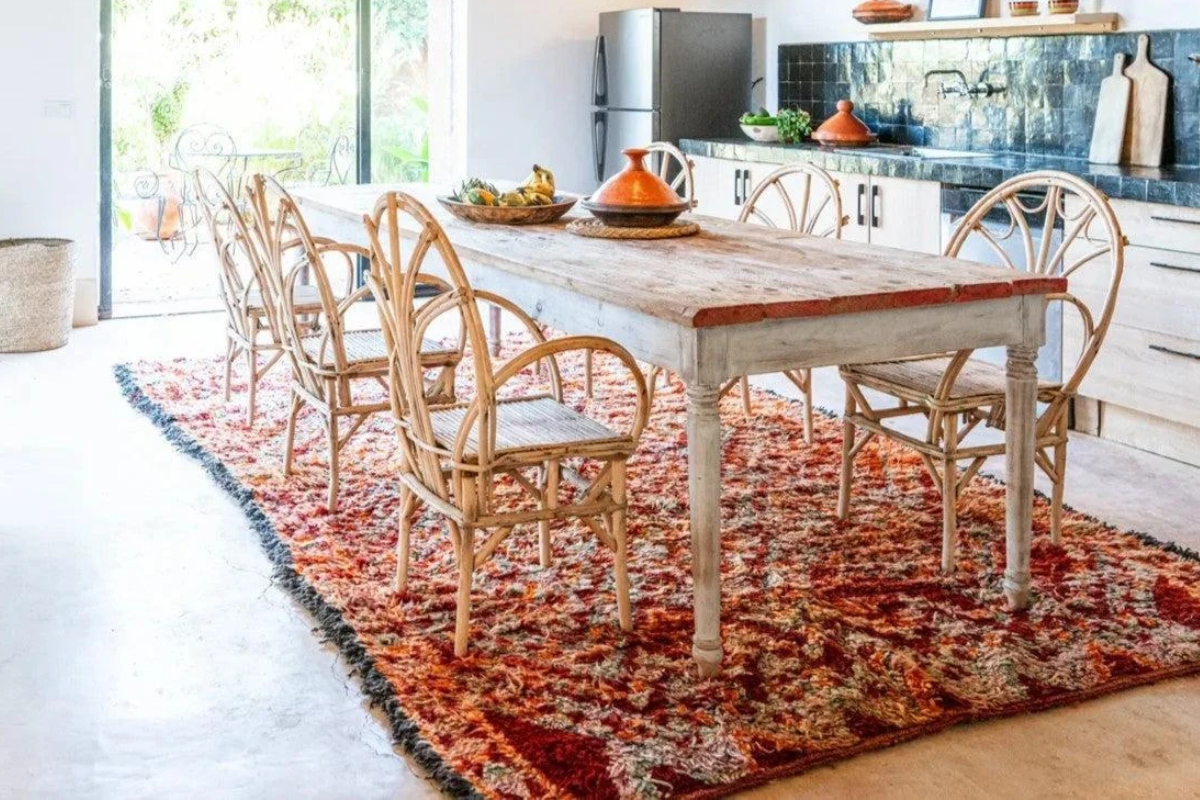
Short answer: The right rug under dining table size is one that still holds every chair when someone pushes back to stand up. Most guides turn that into a rule of about 24 inches of rug beyond each side of the table, which means adding roughly four feet to the table's length and width. That figure comes from rug sellers, not from any standard. With a Moroccan rug, size solves only half the problem: a deep pile still drags on chair legs, so under a table a low pile or a flatweave usually works better.
The worry behind this search is usually specific. Chairs are going to catch. They catch in two places: at the rug's edge, when the rug is too small, and in the pile itself, when the pile is too deep. Getting the size right fixes the first. Only the rug's construction fixes the second. This guide covers both, and we have no rug to sell you.
How to work out rug under dining table size
Start from the chairs, not the table. The table only tells you where the chairs begin.
- Measure the table at its largest. If it has a leaf or extends, measure it extended. A rug sized for the short table will leave the end chairs half off whenever guests come.
- Pull a chair back as if you were standing up. Mark where the back legs land, then measure from the table's edge to that mark.
- Add that distance to every side. Twice to the length, twice to the width.
- Check the room. Lay out the result with painter's tape and see how much bare floor is left between the rug and the walls.
Pottery Barn's guide to dining room rugs, which we read on September 24, 2026, describes the same marking method. It says that ideally the back of a pulled-out chair sits 24 to 30 inches from the table, with at least 8 to 12 inches left between the chair back and the wall. Ruggable, in a sizing guide dated February 17, 2026, states the rule most pages repeat: a dining room rug "should extend at least 24 inches beyond all sides of the table," and chairs should stay fully on it even when pulled out.
A worked example, and why a few inches matter
Take an illustrative rectangular table measuring 36 by 60 inches. This is our example, not a standard size.
- At 24 inches added on every side, the rug needs to be at least 84 by 108 inches, which is 7 by 9 feet.
- At 30 inches, the upper end of Pottery Barn's chair range, it needs 96 by 120 inches, which is 8 by 10 feet.
That is a full size step, and the difference comes entirely from the chairs. Deep upholstered chairs, armchairs at the head of the table, or people who push well back all move you toward the larger figure. Slim chairs that tuck neatly under the table move you toward the smaller one.
This is also why "what size rug for a six-seat table" has no single answer. Two six-seat tables can differ by a foot or more in length, and two sets of chairs can differ just as much in depth. Measure your own chair, pulled out the way your household actually pulls it out.
Why the size charts disagree
If you compare charts, you will find they do not agree, even for a small table.
| Source (read September 24, 2026) | Four-seat table | Six-seat table | Eight-seat table |
|---|---|---|---|
| IKEA rug size guide (PDF marked 2015) | 4'4" x 6'5" or 5'5" x 7'10" | 6'7" x 9'10" | 8'2" x 11'6" |
| Ruggable dining rug guide (February 17, 2026) | 8' x 10' | 9' x 12' | 10' x 14' |
IKEA's rug size guide gives the same principle as everyone else, "make sure that your rug will cover your dining area with the chairs pulled out," and then shows much smaller rugs than Ruggable for the same number of seats. The likeliest explanation is that the two are picturing different tables and chairs, which is exactly why a chart built around seat count is only a rough guide. Both are businesses that sell rugs. Neither figure is a standard, and we would not pick one over the other. Measure your chairs and let that decide.
Where chairs catch: the edge and the pile
The edge. If a chair's back legs cross the rug's edge every time someone sits down, the chair tips slightly, the legs snag on the border, and the edge takes the wear. On a hand-woven rug, the sides and ends are part of the structure, and fraying there is repair work rather than cleaning. The fix is size: the chair should never leave the rug during normal use.
The pile. This is the problem size cannot solve. Pottery Barn's guide says plush high-pile rugs "like shag or Moroccan styles" are "not always best-suited for use in the dining room," because "it can be a bit difficult to pull chairs in and out over these styles," and because "the higher piles may trap crumbs." It recommends a low pile or a flat weave instead.
That warning is fair, but "Moroccan" is not one texture. Some Moroccan rugs have a deep, soft pile. Others are medium or low pile. And a large part of the tradition is flat-woven, with no pile at all. Our comparison of flatweave and pile Moroccan rugs explains how the two constructions differ in feel, weight and wear.
Which Moroccan rugs suit a dining table
A rough guide by construction, not by name, because pile height varies from rug to rug even within one style. Ask the seller for the pile height of the specific piece.
| Construction | Under a dining table | What to watch |
|---|---|---|
| Deep pile (for example, many Beni Ourain-type rugs) | The hardest fit. Chairs drag, legs sink unevenly, crumbs settle deep. | Wobbly chairs on soft pile; dents where chair legs rest. |
| Low to medium pile | Workable if the rug is large enough that chairs never cross the edge. | Edge wear if the rug is undersized. |
| Flatweave (kilim, hanbel, zanafi) | Usually the easiest for chairs to slide over. | Thinner and lighter, so it can creep without a pad. |
| Boucherouite (rag rug) | Varies a great deal from piece to piece. | Knotted, uneven surfaces can catch; judge the specific rug. |
If you already own a deep-pile rug you love, the honest advice is that it will probably be happier in a living room or bedroom, where nobody drags a chair across it three times a day.
The hand-woven size problem
A hand-woven Moroccan rug is not cut from a roll, so its listed size is approximate. Before you buy one for a dining table:
- Ask for both lengths and both widths. A hand-woven rug can differ slightly from one side to the other.
- Ask whether the size includes the fringe. Chairs cannot sit on fringe, so plan with the woven body only.
- Plan with the smallest figure. If the rug is a few inches short at one end, that is the end where a chair will drop off.
Orientation matters too. On most hand-knotted rugs, the fringe is formed by the warp ends at the two short ends. Run the table's long side along the rug's length so the fringe sits beyond the end chairs rather than under their legs. Fringe that is repeatedly caught by chair legs can loosen or break.
A slight skew also shows more under a table than almost anywhere else, because the eye compares the table's straight edge with the rug's edge. Center the rug by eye, not by one corner.
Round tables
Ruggable's guide says that "for a rug size under a round dining table, add approximately 48 inches to the table's diameter," which is the same 24-inch rule applied all the way around. A round rug under a round table looks tidy, but round Moroccan rugs are much less common than rectangles. Our guide to Moroccan runners, rounds and odd shapes explains which formats genuinely exist. A square rug under a round table is a reasonable alternative, as long as the chairs still stay on it at the corners and the sides.
Pads, spills and the floor underneath
A dining rug takes sideways force every time a chair is pushed back, which is why a thin flatweave in particular tends to creep. A pad holds it in place and cushions the chair legs. Our guide to the best rug pad for a wool rug covers what to look for, including which materials are a poor match for wool.
A dining room also means food and drink. Crumbs are a vacuuming job, and a low pile makes that easier. Spills are more urgent, and what you do first matters more than what you use. Keep our guide to the first five minutes after a spill on a wool rug somewhere you can find it.
Check your chair feet, too. A cracked plastic glide or a bare metal edge can snag yarn every time the chair moves, which is easy to fix before it damages the rug.
When no rug is the better answer
Sometimes the room decides for you.
- The room is too small. If the table plus a chair's pull-back on every side leaves almost no floor before the walls, the rug either ends under the chairs or runs close to wall to wall. In a tight dining nook, bare floor is often the better look and the more practical one.
- The table sees daily messy meals. A valuable hand-woven rug under a table where small children eat every day is a trade-off, not a mistake, but go in knowing it.
- The rug you have is the wrong construction. A deep-pile rug under a well-used table will frustrate everyone who sits there.
What we cannot tell you
We have not seen your room, your table or your chairs, so we cannot tell you the size you need. The figures in this guide come from businesses that sell rugs, and they disagree with each other; there is no official standard for dining rug size. An interior designer who can see the room will judge proportion better than any chart. And no one can confirm a hand-woven rug's real dimensions from a listing; only a tape measure along each edge can.
FAQ
How much bigger than the table should a dining room rug be?
Most guides say at least 24 inches beyond every side of the table, which adds about four feet to its length and width. Pottery Barn suggests chairs sit 24 to 30 inches from the table when pulled out, so deeper chairs may need more. Measure your own chair pulled back and use that.
Is an 8 x 10 rug big enough for a six-seat table?
It depends on the table and the chairs, not the seat count. Ruggable recommends 9 x 12 feet for six seats, while IKEA's guide shows a smaller rug. Measure your table, add your chairs' pull-back distance to every side and compare the result with the rug.
Can you put a shag or Beni Ourain rug under a dining table?
You can, but it is the hardest fit. Deep pile makes chairs drag and wobble and traps crumbs, which is why design guides recommend a low pile or a flatweave for dining rooms. A flat-woven Moroccan rug gives you the look with far less friction.
Should a round table have a round rug?
It often looks best, and Ruggable suggests adding about 48 inches to the table's diameter. Round Moroccan rugs are uncommon, though, and a square rug can work under a round table as long as every chair stays on it when pulled out.
Should I measure a dining table with the leaf in?
Yes. Size the rug for the table at its largest, with every chair you use when the table is extended. Otherwise the end chairs will drop off the rug exactly when you have guests.
Leave a Reply