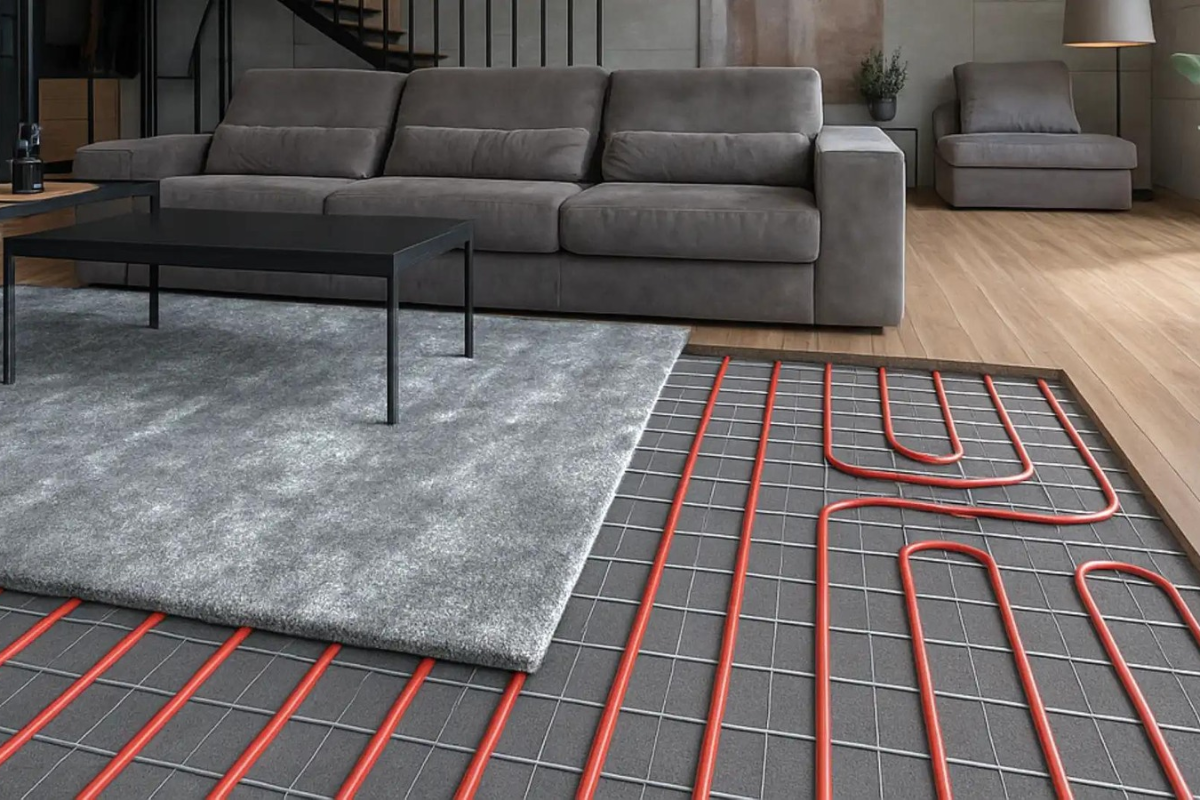
Short answer: The honest wool rug underfloor heating answer is that a rug does a little of both. It holds some heat in the floor beneath it and lets less of that heat into the room. You can use one, within limits. Heating manufacturers measure those limits in tog, a unit of thermal resistance, and they do not agree: Nu-Heat suggests a rug of 2.5 tog or less, while Warmup's UK guidance for electric systems caps everything above the heater at 1.5 tog. A hand-woven Moroccan rug does not come with a tested tog rating, so a thin flatweave is the safer choice than a deep pile.
The final word belongs to your heating system's manual and its installer, not to us or to any rug seller. This guide explains what the manufacturers actually say, where they disagree, and why a thick hand-knotted rug is a different proposition from a thin flat one. We sell no rugs and no heating.
What a rug does to a heated floor
Underfloor heating warms the floor, and the floor warms the room. Anything laid on top sits in the way. Nu-Heat, a UK underfloor heating supplier, puts it plainly in a guide to rugs on underfloor heating, dated February 3, 2021, which we read on September 24, 2026: "adding a rug on top of a heated floor can restrict the amount of heat that passes from the floor into the room." It adds that thick rugs "can trap heat and insulate rather than allowing it to be released into the room which will reduce the effectiveness of the UFH system."
So the reader's question, "will this trap the heat or block it?", has an uncomfortable answer. It does both, and they are the same effect seen from two sides. Heat that cannot get through the rug stays in the floor underneath it. The room gets a little less, and the patch of floor under the rug runs a little warmer.
How much depends on the rug's thermal resistance. Nu-Heat, Warmup's UK site and UK carpet makers such as Cormar express it in tog: the higher the number, the more the material insulates. Warmup's US site also gives an R-value for the same idea. The point to hold on to is that the rug and anything under it add together.
What the heating manufacturers say
The published limits do not match. We are not going to pick one, because the right figure is the one in your own system's documentation.
| Source (read September 24, 2026) | What the limit covers | Figure given |
|---|---|---|
| Nu-Heat rug guide (February 3, 2021) | A rug on a Nu-Heat system | "Try to choose a rug with a tog of 2.5 or less" |
| Warmup UK carpet page | Everything above an electric heater, including underlay and overlays | "does not exceed the 1.5" tog; floor "should not exceed 81°F (27 °C)" |
| Warmup US blog (February 27, 2017) | Everything above the heater, for carpet | Tog "no more than 2.5"; R-value "no more than 1.42"; floor "should never exceed 80°F/27°C" |
| Cormar carpet tog page (UK carpet maker, undated) | Carpet plus underlay | "less than 2.5" tog |
Three things stand out. First, Warmup's UK carpet page says its 1.5 figure is "for electric underfloor heating systems only" and that "water systems have a broader range of limits due to the variables of the specification." Electric and water systems are not interchangeable here. Second, the same company gives different figures on different national sites, so check the documentation that came with your system rather than a web page. Third, every figure counts the whole stack: the rug plus any pad or underlay beneath it.
Wool rug underfloor heating: the Moroccan rug problem
The limits above assume you know your rug's tog. Carpet makers such as Cormar say they pre-test their carpets and publish a tog value. A hand-woven Moroccan rug is a one-off made by a weaver, not a product line tested in a lab. Unless a seller can show you a thermal resistance test for that specific rug, its tog is unknown, and no one can honestly tell you it is under 1.5 or 2.5.
What you can judge is construction. Nu-Heat's own warning is about "a thick, heavy rug with high thermal resistance," and thickness is something you can see and measure.
| Construction | On a heated floor | Notes |
|---|---|---|
| Flatweave (kilim, hanbel) | The better candidate: thin, no pile | Can creep on a smooth floor; see the pad section below |
| Low to medium pile | A judgment call; ask for the pile height | Thickness varies from rug to rug within one style |
| Deep, dense pile (for example, many Beni Ourain-type rugs) | The weakest match; the kind of rug Nu-Heat warns about | Best kept to a room without underfloor heating, or to a small area |
| Boucherouite (rag rug) | Check the fibers first | Often mixes cotton and wool with nylon or polyester |
Wool itself is not the problem. Nu-Heat says rugs suitable for underfloor heating "will be made from natural materials such as wool, which is more resistant to heat," and warns that "synthetic materials may not be designed to hold or transfer heat, and could even be damaged or melt if subjected to too much heat." That matters for a Boucherouite, because our guide to Boucherouite rag rugs explains that many are woven from recycled strips that include synthetic fabric. Our comparison of flatweave and pile Moroccan rugs explains the construction difference in more detail.
One point in a hand-woven rug's favor: a traditionally hand-knotted or flat-woven Moroccan rug has no glued latex or foam backing. Its back is the weave itself. The backing question moves to whatever you put under it.
Hot spots and the floor underneath
The heating is only half the concern. The other half is the floor. Nu-Heat's guide warns that "a thick, heavy rug with high thermal resistance on top of a wooden floor could cause 'heat spots'. The wood may become warped and floorboards may lift, if the rug makes the temperature too hot." It adds that this is "more a problem with electric underfloor heating" than with its warm water systems.
This is why floor temperature limits exist. Warmup's pages give 27°C (80°F on its US page, 81°F on its UK page) as the maximum floor temperature, and the UK page says that limit is secured by using a thermostat. Your floor's own manufacturer may set a separate limit, so check its guidance too, especially for wood or vinyl.
What a rug owner can reasonably watch for:
- The floor under the rug feels much hotter than the floor around it when you lift a corner.
- Boards under the rug are cupping, gapping or lifting, or a vinyl floor is marking.
- The room never seems to reach temperature since the rug went down.
Any of these is a reason to lift the rug and talk to whoever installed the heating, not a reason to adjust the system yourself.
Pads and underlays
A pad adds its own thermal resistance, and on a heated floor it counts toward the limit. Warmup's UK and US pages both say "a felt underlay should not be used as it may create a thermal blocker hindering the performance of the system." Nu-Heat says felt and polyurethane underlays "are poor at conducting heat" and risk causing "hot spots," and that rugs with a hessian (burlap) underlay are preferable.
That leaves a real trade-off for a thin flatweave. It is the best rug for a heated floor, and it is also the kind most likely to slide. Before choosing a pad, check whether its maker says it is suitable for underfloor heating, and prefer the thinnest option that stops the rug moving. Our guide to the best rug pad for a wool rug covers what to look for in a pad generally, and our guide on how to stop a rug from slipping covers other ways to keep a thin rug flat, which matters on a hard, heated floor where a creeping rug is a trip hazard.
Where this stops being a rug question
Choosing and placing a rug is yours to decide. Changing how the heating behaves is not, and this article stops at that line.
- Electric underfloor heating is a mains electrical installation. Floor sensors, thermostat wiring and temperature limits are set by the installer. If a limit needs changing or a sensor needs adding, that is work for the installer or a qualified electrician. Do not open the thermostat or alter its settings beyond what its user manual describes.
- Water-based systems are set up by a heating engineer. Flow temperatures and zone settings are their call, particularly with a heat pump.
- Do not turn the heating up to compensate for a rug. A higher setting pushes more heat into a floor that is already holding extra heat under the rug.
- If you notice a burning smell, scorching, or a thermostat fault or error message, switch the system off at the thermostat and contact the installer or a qualified electrician before using it again.
A practical checklist
- Find your heating system's manual or installer paperwork and look for a tog, R-value or floor-covering limit.
- Note whether the system is electric or water-based, because the limits differ.
- Check whether your floor's manufacturer sets a maximum surface temperature.
- Prefer a flatweave or a low pile over a deep, dense pile.
- If the rug may contain synthetic fibers, ask the seller what it is made of before it goes on a heated floor.
- Choose the thinnest pad that stops slipping, and check the pad maker's guidance for heated floors.
- After the first few weeks, lift a corner and compare the floor under the rug with the floor beside it.
What we cannot tell you
We cannot tell you the tog of your rug; without a test on that rug, nobody can. We cannot tell you which manufacturer's figure applies to your floor; only your system's documentation or installer can. And we cannot judge an electrical or plumbing installation from a description. The figures in this article are the manufacturers' own, quoted from their pages on the date shown, and they may change. When the manual and this guide disagree, follow the manual.
FAQ
Can you put a wool rug on underfloor heating?
Yes, within your system's limits. Heating makers publish a maximum tog for everything above the heater, and the figures we found range from 1.5 to 2.5 depending on the maker and system type. A thin wool flatweave is a safer choice than a thick, dense pile rug.
What tog rating should a rug be for underfloor heating?
It depends on your system. Nu-Heat suggests 2.5 tog or less for a rug. Warmup's UK guidance for electric systems sets 1.5 tog for everything above the heater, including underlay. Check your own system's manual.
Do Moroccan rugs have a tog rating?
Do not expect one. A tog value comes from testing a product, and each hand-woven rug is a one-off. Unless the seller can show a test result for that rug, treat the tog as unknown and judge by thickness and density instead.
Can a rug damage a floor with underfloor heating?
It can. Nu-Heat warns that a thick, heavy rug with high thermal resistance on a wooden floor can cause heat spots, and that the wood may warp or boards may lift. It says this is more of a concern with electric systems.
Should I use a rug pad on underfloor heating?
Only a thin one suited to heated floors. The pad counts toward the tog limit, and Warmup says felt underlay should not be used. Choose the thinnest pad that stops the rug slipping.
Leave a Reply