Browsing a general "oriental rug" or "vintage rug" category and can't tell which broad tradition you're looking at? As a rough, non-absolute test: Moroccan rugs tend toward abstract or geometric motifs with a looser, more relaxed knot structure and an organic, slightly rustic texture; Persian rugs favor curvilinear, floral, or medallion-based designs with dense, small asymmetrical knots; Turkish rugs favor geometric medallions and repeating patterns using a symmetrical, double-wrapped knot. These are trade generalizations about three enormously varied traditions, not fixed rules every individual piece follows, but they're a genuinely useful starting orientation.
Design: geometric vs. floral vs. medallion
Moroccan rugs, the family this site covers in depth, from minimalist Beni Ourain to colorful Azilal and Boujad, lean toward abstract, geometric, or freehand tribal motifs, often with visible asymmetry that reads as intentional rather than a flaw. Persian rugs are generally associated with more intricate, curvilinear design work: florals, vines, and central medallions rendered with fine detail. Turkish rugs sit somewhere in between stylistically, more likely than Persian work to foreground geometric shapes (diamonds, stars, hexagons) but still frequently built around a central medallion or repeating floral border, rather than the freer, more abstract fields typical of Moroccan tribal weaving.
None of these design tendencies are absolute. Persian weaving traditions include plenty of tribal, geometric work (Gabbeh and various nomadic Persian traditions, for instance, look far more abstract than a fine Isfahan or Tabriz piece), and Moroccan weaving includes some more structured, symmetrical traditions alongside its freer tribal styles. Treat "geometric means Moroccan" as a starting heuristic, not a rule that overrides everything else you can see in a piece.
Knot technique: three different structures
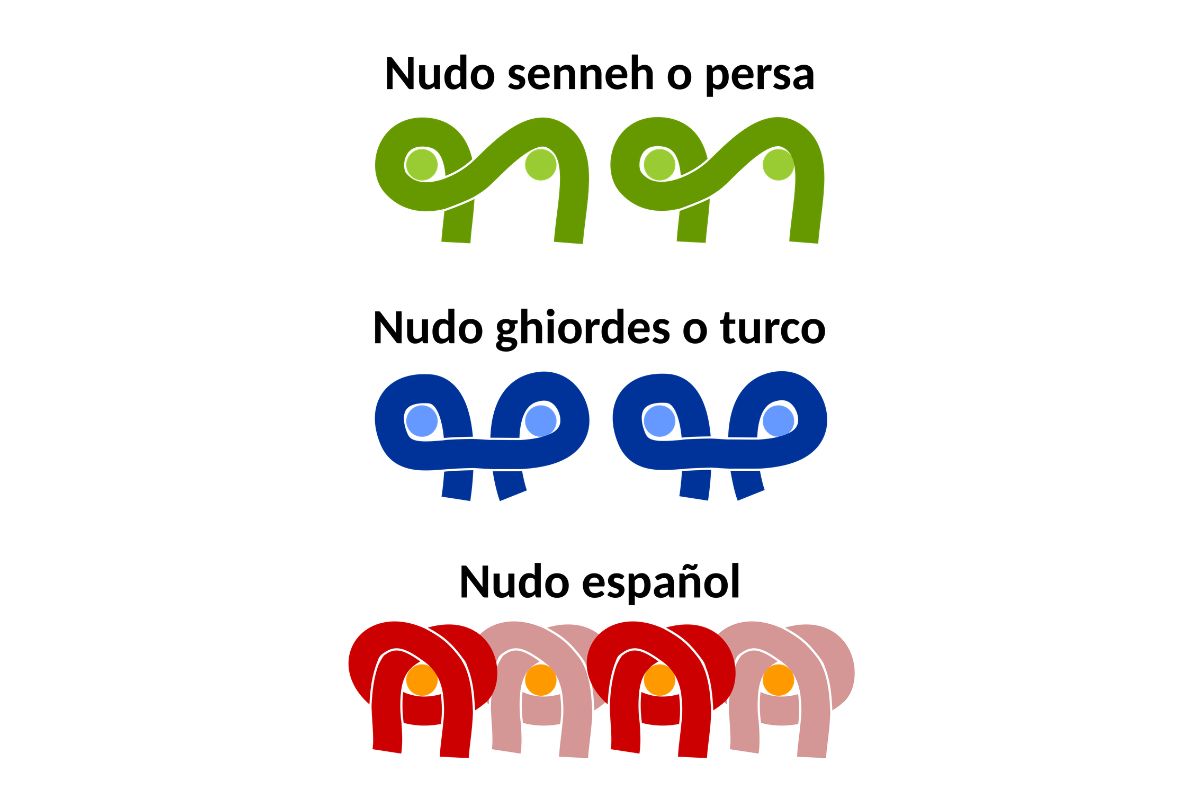
This is where the traditions genuinely diverge on a technical level, not just a stylistic one. Persian weaving is closely associated with the asymmetrical knot, sometimes called the Persian or Senneh knot, which wraps around one warp thread and loops loosely around the adjacent one, allowing weavers to pack knots more densely and produce finer detail. Turkish weaving is associated with the symmetrical, double-wrapped knot, the Turkish or Ghiordes knot, where the yarn wraps fully around two adjacent warp threads, producing a slightly bulkier, more secure knot. Moroccan tribal weaving, by contrast, is generally described as using a looser, less rigidly uniform knotting structure than either of those two traditions, which is part of what gives finished Moroccan rugs their characteristic soft, organic, slightly irregular texture rather than the tight uniformity of a fine Persian or Turkish piece.
None of this is something you can reliably verify from a listing photo alone. Knot structure is a back-of-the-rug, hands-on question, closer to what's covered in how to identify a Moroccan rug from a photo, but it's useful to know these are real, named, technically distinct construction methods, not just marketing language for three interchangeable products.
Material: correcting a claim that gets repeated wrong
Here's a specific inaccuracy worth naming directly, because it shows up across a lot of general rug-comparison content: several sources describe Persian rugs as "typically made from silk." That's not accurate. The overwhelming majority of Persian rugs, historically and today, are wool; silk is used in a specific minority of fine, high-end production (some Qum and Isfahan pieces, for example), not as the material baseline for the tradition as a whole. A buyer who assumes "Persian equals silk" is liable to either overpay for a wool piece expecting silk-level delicacy, or underestimate the fineness of a genuinely well-made wool Persian rug because it "isn't silk."
Turkish rugs are similarly primarily wool, with silk used in specific fine production. Moroccan tribal rugs, the family this site covers, are essentially always wool. This site has not found silk used as a base material in any of the named Moroccan traditions covered here, which is one more reason "which one is silk" is the wrong question to be asking when sorting these three broad traditions apart.
Why the general "oriental rug" label tells you less than it sounds like it does
"Oriental rug" is a retail catch-all covering Persian, Turkish, Caucasian, Central Asian, and various other hand-knotted traditions, in the same loose way that "Berber rug" is a catch-all for several distinct Moroccan and Amazigh traditions (see what "Berber rug" actually means for that specific confusion). A listing that says only "vintage oriental rug" is telling you almost nothing about the actual origin, technique, or material of the piece. If a Moroccan rug ends up filed under a general "oriental rug" category, which happens on some marketplaces, the design and knot-structure signals above are what will actually help you sort it out, more than the category label itself.
What to check on the specific listing in front of you
- Design first. Abstract/geometric with visible asymmetry points toward Moroccan; fine curvilinear floral or medallion work points toward Persian; geometric medallion work with repeating borders points toward Turkish, as a starting orientation, not a verdict.
- Ask about material specifically, rather than assuming from the region named. Don't assume "Persian" means silk, or that a wool Persian rug is somehow lesser for being wool.
- Ask for a photo of the back, if construction detail matters to your decision: that's the more reliable way to assess knot density and structure than a front-facing listing photo alone.
- Treat regional and tradition names as a starting point, not a certainty, especially on older or unlabeled pieces where several traditions' visual and technical features can genuinely overlap.
FAQ
What's the main visual difference between Moroccan, Persian, and Turkish rugs?
Moroccan rugs generally favor abstract, geometric tribal motifs; Persian rugs favor curvilinear floral and medallion designs; Turkish rugs favor geometric medallions and repeating patterns. These are general tendencies, not fixed rules for every piece.
Are Persian rugs made of silk?
Mostly no. The large majority of Persian rugs are wool. Silk is used in a specific minority of fine, high-end production and should be treated as a premium exception, not the material baseline for the tradition.
What's the knot difference between Persian and Turkish rugs?
Persian weaving is generally associated with the asymmetrical (Senneh) knot, which allows denser packing and finer detail. Turkish weaving is generally associated with the symmetrical, double-wrapped (Ghiordes) knot, which is slightly bulkier and more secure.
Are Moroccan rugs the same as "oriental rugs"?
"Oriental rug" is a broad retail category that can include Moroccan pieces alongside Persian, Turkish, Caucasian, and other traditions. It isn't a specific style, in the same way "Berber rug" isn't one specific Moroccan style either.
Can I tell these three traditions apart from a listing photo alone?
Design tendency is often visible in a photo. Knot structure generally isn't, without a clear photo of the rug's back. Neither check substitutes for asking the seller directly about origin and material.
Is one of these three traditions better quality than the others?
Not as a blanket rule. Each tradition spans a wide range of quality, from coarse everyday pieces to museum-grade work. A fine Persian rug and a well-made Moroccan tribal rug are excellent in different, tradition-specific ways rather than ranked against a single quality scale, and this guide won't manufacture a ranking that doesn't reflect that variation.
Leave a Reply