Tag: rug identification

  • Moroccan Style Rug Made in Turkey, India or China?

    Moroccan Style Rug Made in Turkey, India or China?

    No, a "Moroccan style" rug is usually not Moroccan. The phrase describes a look, and rugs sold that way are commonly machine-made in Turkey, or woven or tufted in India or China. In the US you do not have to guess: under Federal Trade Commission rules, rugs are covered textile products, an imported rug must be labeled with the country where it was made, and catalog and mail-order advertising must say whether a product is imported or made in the USA. The country is on the label. The style name is not a country.

    This guide explains what "style" is doing in a listing, why Turkey, India and China come up, what US labeling rules require, and how to find the real country of origin before you buy.

    What "Moroccan style" means, and does not

    "Moroccan style" is a design description. It tells you the rug resembles a Moroccan type, most often the cream-and-black diamond grid associated with Beni Ourain, or the bright abstract motifs associated with Azilal. It makes no claim about who made the rug, where, or how.

    That is not dishonest in itself. A machine-made rug in a Beni Ourain design, clearly labeled with its country of origin and sold at a price that reflects what it is, is a legitimate product that many people are happy to own. The problem starts when a listing lets "Moroccan" do the work of a country and "style" slip out of view, or when the price assumes a hand-knotted Moroccan rug and the product is something else.

    Why Turkey, India and China come up

    These three countries appear because they make a very large share of the world's rugs, in every construction and at every price.

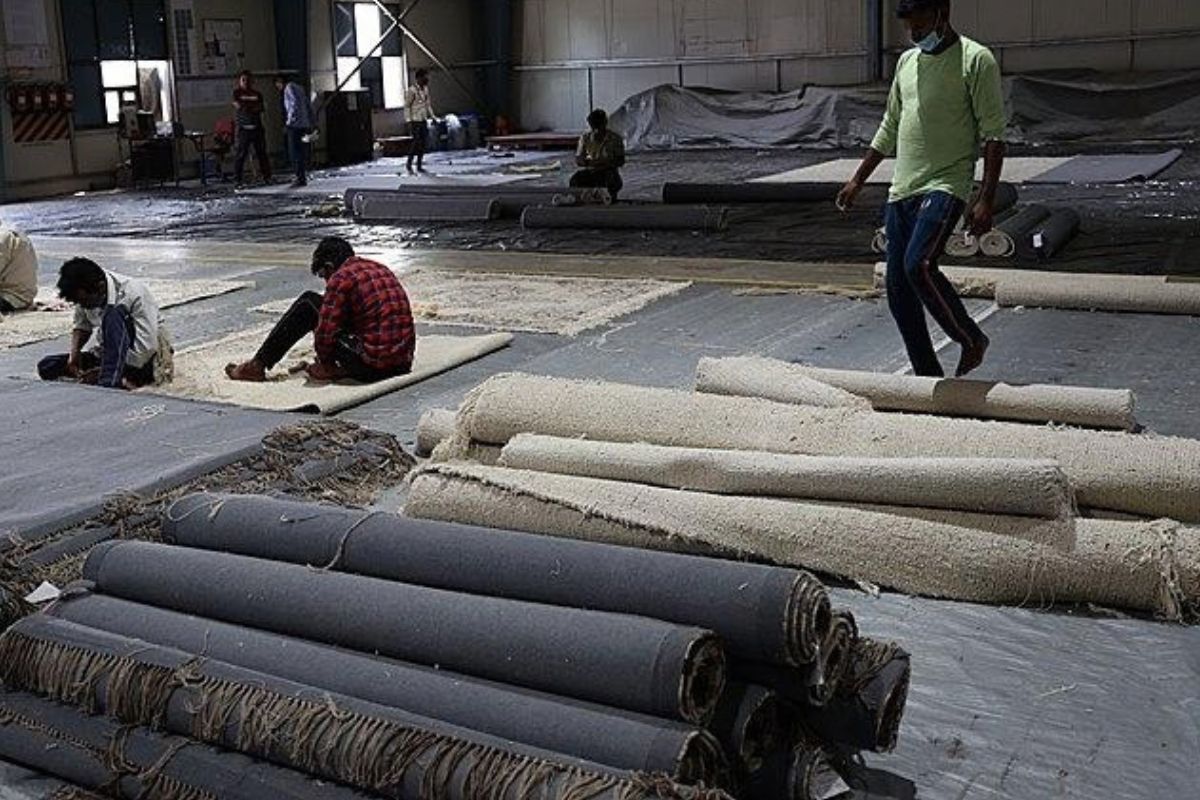
    Turkey and machine-made rugs. Daily Sabah reported on 23 October 2019, quoting Ahmet Kaplan, chairman of the Southeastern Anatolia Carpet Exporters' Association, that Turkey accounts for more than 67% of the world's machine-made carpet production, and that more than 60% of those are produced in the southern province of Gaziantep. The same report put China first in carpet exports overall, at $2.9 billion, with Turkey second. Those are 2019 figures from an industry association and will have moved since, but the shape is clear: a machine-made rug in a Moroccan design is very often Turkish.

    Turkey also has its own hand-weaving tradition, which is a separate thing entirely. Moroccan, Persian and Turkish rugs compared covers the handmade traditions side by side.

    India and hand-knotted or hand-tufted copies. Exporters in India's carpet belt, around Bhadohi, openly list hand-knotted and hand-tufted rugs in "Beni Ourain" and "Moroccan" designs, as the results for this topic showed on 11 September 2026. Some of these are well made by hand. They are handmade rugs in a Moroccan design, made in India, and an honest listing says so.

    China. China makes rugs across the range, from machine-made to hand-tufted. A listing that describes "Moroccan patterning" in the title and gives China as the country in the specifications is common in mass retail.

    None of this is an accusation against any country's makers. It is a description of where the world's rugs come from. The only thing that matters to a buyer is whether the listing tells the truth about which one they are getting.

    What US rules require, in plain terms

    This section describes US federal rules as published and read on 11 September 2026. It is general information, not legal advice. Rules outside the US differ, so check your own country's consumer and customs authority.

    Rugs are covered textile products. The FTC's business guide, Threading Your Way Through the Labeling Requirements Under the Textile and Wool Acts, lists "floor coverings: rugs, carpets and mats" as products covered by the Textile Act. The same guide notes that rugs are excluded from the separate Wool Act rules because they are covered by the Textile Act instead.

    Imported rugs must name the country. The regulation at 16 CFR 303.33 states that "each imported textile fiber product shall be labeled with the name of the country where such imported product was processed or manufactured." For floor coverings, the FTC guide says the required information must appear on a conspicuous and readily accessible label on the inside or outside of the product.

    Mail-order advertising must say where it is from. Under 16 CFR 303.34, when a textile product is advertised in a mail order catalog or mail order promotional material, the description must contain "a clear and conspicuous statement that the product was either made in U.S.A., imported, or both." The FTC's guide applies the same origin disclosure to internet sales.

    Customs marking applies at the border. Separately, 19 CFR 134.11 requires that every article of foreign origin imported into the United States be marked "in such manner as to indicate to an ultimate purchaser in the United States the English name of the country of origin," unless an exception applies.

    Put together: a rug sold in the US should carry its country of origin on a label, and an online listing should at least say it is imported. Neither requires the listing to put the country in the title, which is why the title is the last place to look.

    How to find the real country before you buy

    1. Skip the title and read the specifications. The country of origin is usually in a specifications or details section, often lower on the page than the photographs.
    2. Look for "imported." If a listing says only "imported," ask which country. A seller of a genuine Moroccan rug has every reason to name Morocco.
    3. Ask for a photograph of the label. The country of origin label is attached to the rug itself. A seller who cannot photograph it is telling you something.
    4. Ask for a photograph of the back. Country answers where. Construction answers how. Handmade vs machine-made: read the back shows what hand-knotted, hand-tufted and machine-made backs look like.
    5. Keep the listing. Screenshot the description and specifications before you pay. If the rug arrives labeled differently from how it was described, that record matters.

    If the label on the rug names a different country from the one the listing implied, that is a misdescription, and buying a Moroccan rug online covers what to establish about returns and recourse before you pay.

    What a "Made in Morocco" label does not settle

    A correct label settles one question and leaves others open.

    "Made in Morocco" tells you the country. It does not tell you the rug was hand-knotted, which region it came from, how old it is, or whether the style name is accurate. Machine-made and tufted rugs are sold in Morocco too, and a Moroccan origin does not make a rug handmade. Is my Moroccan rug authentic covers the four questions that are worth separating: country, construction, age and style.

    If you are bringing a rug home from Morocco yourself, the marking and duty questions work differently, and customs and duty on a rug imported from Morocco covers that route.

    FAQ

    Is a "Moroccan style" rug made in Morocco?
    Usually not. "Moroccan style" describes a design. Many rugs sold that way are machine-made in Turkey or made in India or China. The country of origin is on the label and in the listing's specifications, not in the style name.

    Where are most machine-made Moroccan style rugs made?
    Often in Turkey. Daily Sabah reported in 2019, quoting a Turkish carpet exporters' association, that Turkey produced more than 67% of the world's machine-made carpets, mostly in Gaziantep. China and India also produce rugs in Moroccan designs.

    Does a rug sold in the US have to show its country of origin?
    Yes. FTC rules at 16 CFR 303.33 require imported textile products, which include rugs, to be labeled with the country where they were processed or manufactured. Mail-order advertising must state whether a product is imported or made in the USA.

    Is a Moroccan style rug from India or Turkey a fake?
    Not if it is described honestly. A rug in a Moroccan design, labeled with its real country and priced for what it is, is a legitimate product. It becomes a problem when the listing implies Moroccan origin or hand-knotting that the rug does not have.
  • Moroccan Rug Regions Map: Where Each Style Comes From

    Moroccan Rug Regions Map: Where Each Style Comes From

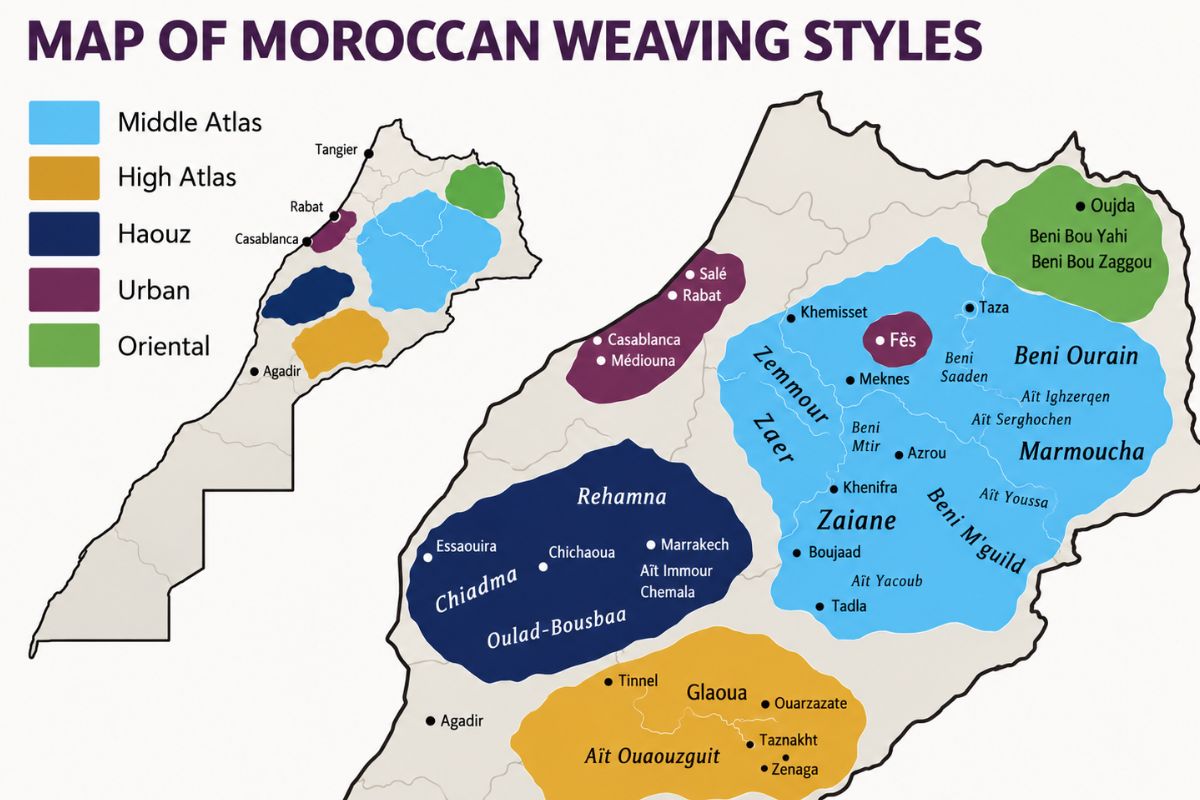
    Most named Moroccan rug styles sit in four broad zones. The Middle Atlas holds Beni Ourain, Beni Mrirt, Beni Mguild and Marmoucha, with Zemmour on its northern edge between Rabat and Meknès. The High Atlas holds Azilal and Glaoui, with Ait Bou Ichaouen at its far eastern end. The western plains hold Boujad and Rehamna. The south holds Taznakht, near the Anti-Atlas and Jbel Sirwa. Those are placements, not borders, and a region name on a listing is a style description rather than proof of where a rug was woven.

    This guide lays out that map in words and tables, shows how Morocco's own museums group the country's weaving, and explains the three different kinds of names hiding in the style list.

    The map, zone by zone

    Read this from north to south. Each placement matches this site's individual style guide, where the evidence for it is set out.

    The Middle Atlas: the pile rugs most buyers picture

    The Middle Atlas is the mountain range running roughly southwest to northeast across the middle of the country. It is where the thick, high-pile rugs best known abroad are placed.

    • Beni Ourain: undyed cream wool with dark lines, from the Middle Atlas. The Beni Ourain guide covers the tribal name and how loosely it is now used.
    • Beni Mrirt: a denser, heavier Middle Atlas pile rug, often confused with Beni Ourain.
    • Beni Mguild: a Middle Atlas style known for indigo and deep colors.
    • Marmoucha: from the eastern Middle Atlas, a quieter relative of Beni Ourain.
    • Zemmour: from the area between Rabat and Meknès, further north than most Middle Atlas styles, and best known as a red flatweave. The Zemmour guide explains why it sits apart from its pile-rug neighbors.

    The High Atlas: color and mixed technique

    The High Atlas lies south of the Middle Atlas and runs toward the Algerian border in the east.

    • Azilal: from Azilal province in the High Atlas, with a natural wool ground and bright motifs. The Azilal guide covers how older and newer pieces differ.
    • Glaoui: associated with the Glaoua, a documented tribal confederation of the High Atlas, and known for combining pile and flatweave techniques in one rug.
    • Ait Bou Ichaouen: from the far eastern edge of the High Atlas near Algeria, sold under the market-town name Talsint. The Ait Bou Ichaouen guide covers this eastern outlier.

    The western plains: lower country, warmer palettes

    West of the mountains, the land drops toward the Atlantic plains.

    • Boujad: from the plains around the market town of Boujaad, in Khouribga Province, between the Atlantic coast and the Middle Atlas. Known for pinks, reds and purples.
    • Rehamna: from the Haouz plains north of Marrakech.
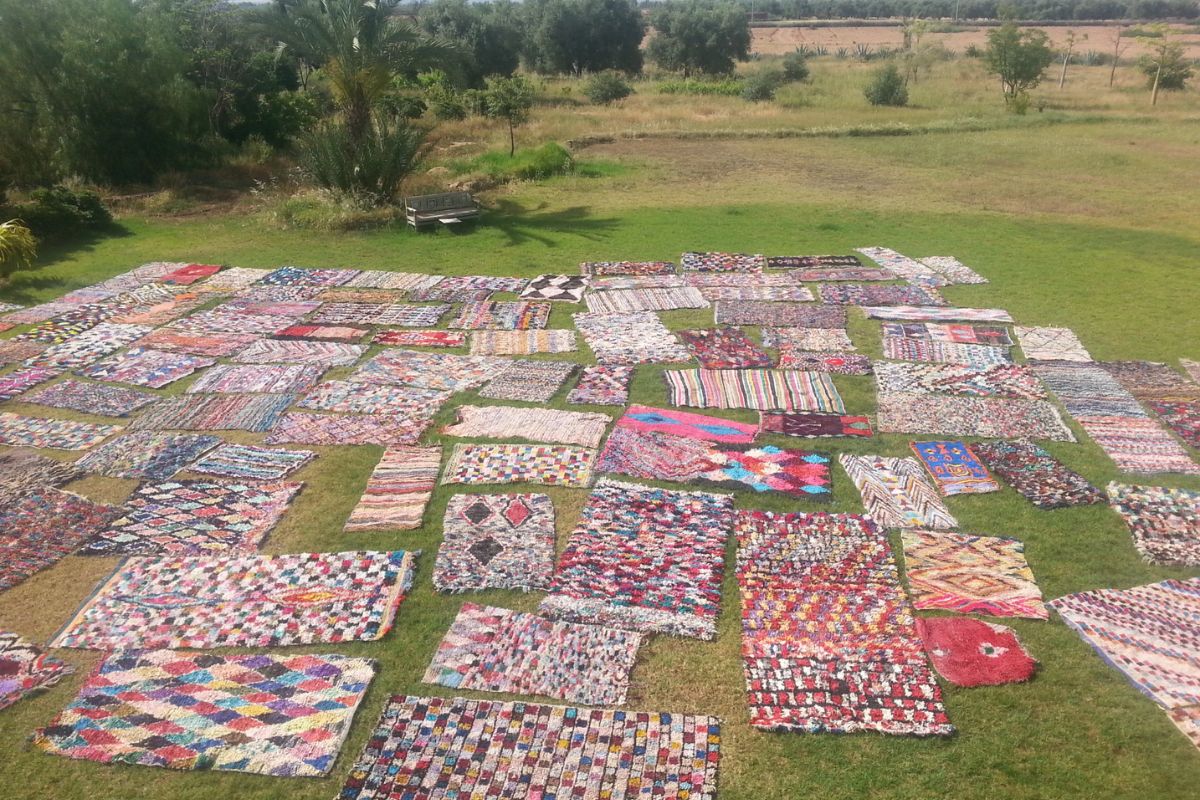
    • Boucherouite: rag rugs whose practice this site's guide places first in the plains around Beni Mellal and Boujad, later spreading into the mountains.

    The south: Taznakht and Jbel Sirwa

    • Taznakht: a town near the edge of the Anti-Atlas and the Sirwa massif, known for rugs from its weaving cooperatives. Independent reporting names wool from the Sirwa mountains.

    Summary table

    Zone Styles placed there Typical construction
    Middle Atlas Beni Ourain, Beni Mrirt, Beni Mguild, Marmoucha Mostly pile
    Northern Middle Atlas edge Zemmour Mostly flatweave
    High Atlas Azilal, Glaoui Pile, and mixed pile and flatweave
    Far eastern High Atlas Ait Bou Ichaouen (Talsint) Pile
    Western plains Boujad, Rehamna, Boucherouite Pile, and rag weaving
    South, Anti-Atlas edge Taznakht Pile and flatweave

    "Typical" is doing real work in that last column. Weavers in every zone use more than one technique, and the complete guide to Moroccan rug styles covers each style's range in more detail.

    How Morocco's own museums group the map

    The seller version of this map is a list of tribal names. Morocco's museums group the same material more broadly, by region.

    The National Museum of Weaving and Carpets at Dar Si Saïd in Marrakech, run by the Fondation Nationale des Musées and checked on 11 September 2026, describes a collection of urban and rural carpets, including pile carpets and hanbel flatweaves, "from all regions." It names the Marrakech region in particular, with Tensift, the Sous, the High Atlas, the Anti-Atlas, the Bani and the Tafilalet.

    The Maison Culturelle du Tapis, a carpet museum in Marrakech directed by Nasser Ksikes and described by the city's official tourism guide, Visit Marrakech (read on 11 September 2026), organizes its rooms around four weaving regions: the High Atlas, the Middle Atlas, Rabat and the Haouz. It states that its oldest pieces date to the 1850s.

    Two things stand out. Both institutions use regions rather than dozens of tribal names. And both include traditions that rarely appear on seller maps at all: the urban carpets of Rabat, and the southern and eastern regions such as the Sous, the Bani and the Tafilalet. A map made only from the styles that sell well abroad leaves out much of the country's weaving.

    Three kinds of names on one list

    The style names above are not all the same kind of name, and knowing which kind you are looking at changes what it can tell you.

    Tribal or confederation names. Beni Ourain, Beni Mguild, Zemmour and Glaoui refer to groups of people. They describe a weaving tradition associated with those communities. They do not certify that a particular rug was woven by a member of that group.

    Town and market names. Boujad, Taznakht and Talsint are places. Some of these names attach to rugs because of where they were traded, not only where they were woven. Ait Bou Ichaouen rugs are sold as "Talsint" after the market town, for example.

    Administrative names. Azilal is a province. The name covers a large mountainous area and many communities, which is one reason "Azilal" is applied so broadly in listings.

    Most of these communities are Amazigh. "Berber," the more common word in the trade, comes from an outside name that some communities reject, which is why this site uses Amazigh alongside it.

    Why a region name is not a provenance

    A style name on a listing tells you what a rug looks like. It does not tell you where that rug was woven.

    Style names travel. A popular look is copied by weavers in other areas, commissioned by middlemen from wherever there is capacity, and sometimes made outside Morocco entirely. This site's style guides note regional blends being sold under the best-known name, and the pattern is common across the category.

    A seller who says "Beni Ourain" is naming a style. A seller who says "woven by a cooperative in a named town, and here is how I know" is making a provenance claim, and that is the one worth weighing. Where no one can say where a rug was woven, the honest description is the style, with no place attached.

    FAQ

    Where do Moroccan rugs come from?
    Most named styles are placed in four zones: the Middle Atlas (Beni Ourain, Beni Mrirt, Beni Mguild, Marmoucha, and Zemmour to the north), the High Atlas (Azilal, Glaoui, Ait Bou Ichaouen), the western plains (Boujad, Rehamna) and the south around Taznakht. Morocco's museums also include urban Rabat carpets and southern and eastern regions.

    What is the difference between Middle Atlas and High Atlas rugs?
    In broad terms, the best-known Middle Atlas styles are thick pile rugs, many in undyed or deep-dyed wool, while High Atlas styles such as Azilal and Glaoui are known for color and mixed techniques. Both regions produce more than one kind of rug.

    Does a style name tell me where my rug was made?
    No. A style name describes a look. Popular styles are woven in other areas and sometimes outside Morocco. Only a seller who can say where and by whom a rug was woven is making a provenance claim.

    Is there an official map of Moroccan rug regions?
    This guide found no single official map. The National Museum of Weaving and Carpets at Dar Si Saïd and the Maison Culturelle du Tapis in Marrakech both group Moroccan weaving by region rather than by tribal style name.

  • The Berber Knot: How a Moroccan Rug Is Tied

    The Berber Knot: How a Moroccan Rug Is Tied

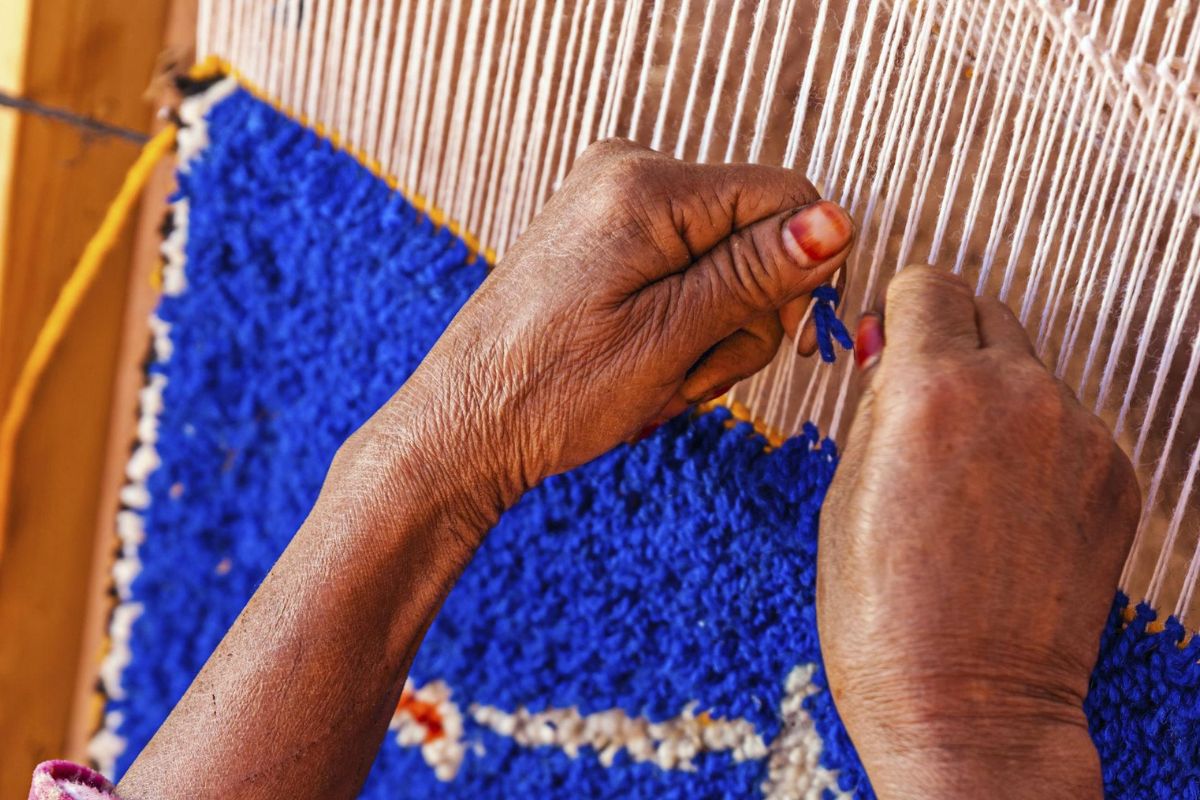
    A pile knot is tied by hand, one at a time, around the vertical warp threads on the loom. In the symmetrical knot, the one most often described for Moroccan pile rugs, a short length of yarn is passed between two adjacent warp threads, brought back under one of them, wrapped around both to form a collar, and pulled through so both ends come up together on the surface. That pair of ends is the pile. A row of these is tied, then one or more plain weft threads are passed through and the whole row is beaten down hard with a comb. Repeat, upward, until the rug is finished.

    This page publishes no knot counts, no weaving durations and no wool weights. The reasons are set out at the end.

    The two standard knots, and the vocabulary that goes with them

    The structural convention is not controversial and is the same in every reference account of knotted pile:

    Symmetrical knot Asymmetrical knot
    Also called Turkish knot, Ghiordes knot Persian knot, Senneh knot
    Warps used Wrapped around two adjacent warps Wrapped around one warp, passed behind the next
    Ends emerge Both together, between the two warps Divided, one on each side
    Associated with Anatolia, the Caucasus, western Iran, and generally described for Moroccan pile Much of Iran, and finer curvilinear design work

    There is also a family of single-warp knots, tied around one warp thread only, documented in early Spanish and Coptic Egyptian pile weaving. That category matters here only because it is the shape of the claim some sources make about Morocco, which is the next section.

    Note what none of these terms is: a quality grade. A knot type is a structure, not a ranking, and it does not tell you where a rug was made either, since the same knot is used across enormous distances.

    Is there a distinct "Berber knot"? The sources disagree

    You will meet the phrase constantly, and it is not used consistently.

    One group of sources treats "Berber knot" as simply the local name for the symmetrical Turkish or Ghiordes knot, and describes Moroccan pile rugs, including the Middle Atlas styles, as symmetrically knotted. Another group describes the Berber knot as something structurally different, a looping knot that produces a high, lofty pile. The International Folk Art Market's profile of the Moroccan women's cooperative Atelier Talasin, published 11 April 2024, refers to "the Berber knot" as the group's traditional technique without defining its structure.

    What this guide could not find is a museum or academic source, readable in English today, that settles the question with a structural analysis of Moroccan pile rugs. Nearly every page asserting a definition is a rug seller's. So the honest position is: the symmetrical knot is what most accounts describe for Moroccan pile, the phrase "Berber knot" is used both as a synonym for it and as a claim about something different, and a seller using the phrase may mean either. It is worth asking which they mean, because the answer tells you how much they know.

    The weft is doing more work than you think

    Knots alone do not hold a rug together. Between each row of knots, one or more plain weft threads are passed straight through the warp, and the beating drives everything down into a compact structure. Warp and weft form the foundation; the knots ride on it.

    That is why the weave, rather than the knot, is what governs how a rug behaves. How many weft passes are used, how firmly each row is beaten, how even the warp tension was: those set the density, the stiffness and the way the rug lies. It is also why the back of a rug is the informative side. The knot structure, the weft rows and the regularity of the whole thing are visible there in a way they are not from the pile side, which is the basis of the checks in handmade versus machine-made.

    Flatweave is a different technique, not a lesser one

    A flatweave has no knots at all. The pattern is made entirely by the weft threads passing through the warp, packed down so the warp is hidden, so the surface is flat and the design frequently reads on both faces. This is the technique behind Moroccan kilim and hanbel weaving, and it demands a different kind of skill rather than less of it: with no pile to hide behind, tension errors and pattern mistakes show.

    Some traditions run both techniques in one piece, alternating flatwoven bands with knotted sections and sometimes adding fringing or sequins within the same object. Treating pile as the real thing and flatweave as a simpler substitute is a habit of the retail market, not of the craft. The practical differences between the two, in a room rather than on a loom, are covered in flatweave versus pile.

    Pattern without a pattern

    One more technical point that changes how you read a rug: in these traditions the design is generally not drawn out first. There is no cartoon pinned beside the loom of the kind used in workshop production of fine curvilinear carpets. The pattern is held in memory and worked out as the rug rises, which is why motifs shift scale partway up a field, why a border can change its mind, and why two rugs from one weaver are related rather than identical.

    That is a structural fact about the method, and it is worth separating from the much larger body of claims about what the resulting motifs mean. Symbolic readings of Moroccan rug patterns are asserted with great confidence online, mostly by people selling rugs, and the academic literature on the subject is contested rather than settled. This page describes how a rug is built, not what it says.

    Why there are no numbers on this page

    The map row for this article carries an explicit instruction against fabricated figures, and the reason is visible in the market.

    Knot counts per square inch are quoted for Moroccan styles as if they were specifications. They are not: knot density measures how fine a pattern a weave can resolve, which barely applies to open geometric designs, and it does not measure quality or durability. What knots per square inch does and does not tell you sets out the whole argument, and the specific pair of figures that circulates for Beni Ourain and Beni Mrirt traces those numbers back and finds nothing cited behind them.

    Weaving durations are in the same position. Reported figures from Taznakht differ between two named news agencies less than a year apart, so a single "a Moroccan rug takes X weeks" claim is a choice between sources rather than a fact. This guide also encountered pages supporting technical claims about Moroccan knotting with academic-looking author-and-year citations that could not be matched to any traceable publication. Where the wool itself is the question rather than the knot, the Beni Ourain guide covers the style whose reputation rests on fiber rather than fineness.

    FAQ

    What is the Berber knot?
    The phrase is used two ways. Most accounts treat it as the local name for the symmetrical Turkish or Ghiordes knot, tied around two warp threads. Others describe it as a distinct looping knot producing a high pile. This guide found no museum or academic source that settles it, so it reports the disagreement.

    What knot do Moroccan rugs use?
    The symmetrical knot is what most descriptions give for Moroccan pile weaving. The asymmetrical Persian knot is associated with finer curvilinear traditions elsewhere. Knot type is a structure, not a quality grade or a proof of origin.

    How is a rug knot actually tied?
    Yarn is passed between two adjacent warp threads, taken back under one, wrapped around both, and pulled through so both ends emerge on the surface as pile. Rows of knots are separated by plain weft passes and beaten down with a comb.

    Do Moroccan flatweaves use knots?
    No. A flatweave is built from weft passing through warp, with no pile knots at all. It is a different technique, not an easier one, and some traditions combine flatweave and knotted sections in a single piece.

    Does a knot count tell me how good a Moroccan rug is?
    No. Knot density describes how fine a pattern the weave can carry, which is largely beside the point on open geometric designs, and it says nothing about wool quality or durability. This guide publishes no knot-count figures for Moroccan styles.

  • The Moroccan Vertical Loom, and What It Decides

    The Moroccan Vertical Loom, and What It Decides

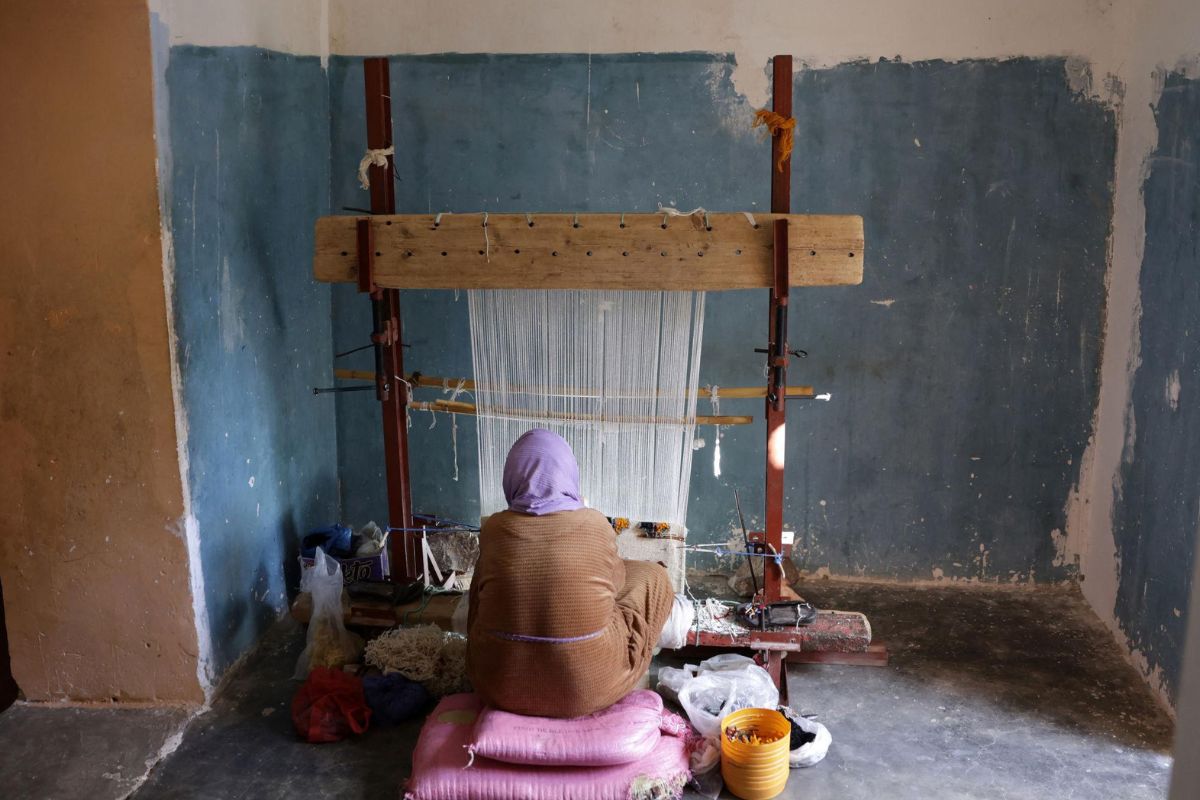
    The machine, if you want to call it that, is a vertical wooden loom: two horizontal beams held apart in an upright frame, with the warp threads wound between them under tension, worked from the bottom upward. There is no motor, no shuttle mechanism and no punch card. Africanews, reporting from Taznakht in July 2025, described the weavers there working on traditional wooden looms of exactly this kind, and AFP photographed a weaver in the same town at a wooden loom set up outside her house. The loom is simple enough to be built, dismantled and moved, and that simplicity decides more about the finished rug than most buyers realize.

    The parts, and what each one does

    • The frame and the two beams. The upper and lower beams carry the warp. As weaving progresses, finished work can be wound down and fresh warp brought up, so the rug can be longer than the loom is tall.
    • The warp. The vertical threads, tensioned between the beams. They are the skeleton of the rug and the thing every knot is tied onto.
    • The weft. The horizontal threads passed through the warp. In a flatweave the weft is the whole design. In a pile rug it locks the knot rows in place.
    • A heddle rod and shed stick. Simple devices that lift alternate warp threads so the weft can pass through in one movement instead of being threaded over and under by hand.
    • The comb, or beater. A heavy toothed tool used to drive each new row down hard against the last. How firmly this is done sets how dense and how stiff the finished rug is.
    • A knife or shears. For cutting pile knots to length and, at the end, cutting the rug free.

    None of this is exotic and none of it is recent. It is a frame, string under tension, and a person.

    Why a loom that can be dismantled matters

    A vertical loom of this construction comes apart into poles and beams that can be carried. In a pastoral and semi-nomadic setting, that is not a design detail, it is the whole reason the object works: the loom goes where the household goes, and it is put up again inside or beside the home rather than in a workshop built for it.

    That portability also explains something about the geography of the craft. Related loom types and related patterns run across North Africa rather than stopping at a regional boundary, which is one reason attributing a rug to one named group by pattern alone is unsafe, and why the term "Berber rug" covers so much ground so loosely. Where the loom lives has been changing, though. Africanews describes weaving in Taznakht moving from homes into cooperative workshops, which is a real shift in working conditions and in who is present while a rug is made.

    What the loom decides about the finished rug

    This is the part worth carrying into a listing.

    Width. The warp can only be as wide as the loom, so the loom sets the maximum width of the rug. Length is much less constrained, because finished work can be wound on. That asymmetry is one straightforward reason long narrow pieces are so common in Moroccan weaving, a point that sits behind the Moroccan runner as a format rather than a fashion.

    Dimensions that are not quite true. Warp tension is set by hand and varies across the width. Beating the weft down is done by arm. A handwoven rug therefore tends to come off the loom slightly irregular, a few centimetres wider at one end, edges not perfectly parallel, corners not exactly square. That is normal and is not a defect, and it is why hand-knotted pieces are so often listed at odd measurements rather than at standard retail sizes.

    Density and stiffness. How hard each row is beaten down changes how tightly packed the finished weave is. Two rugs with the same knot structure can feel very different underfoot because of it.

    Pile and flatweave on the same loom

    The loom does not distinguish between the two main construction families. The same vertical frame produces both.

    For a flatweave there are no knots: the pattern is built entirely from weft passing through warp, which is how Moroccan kilim and hanbel weaving is made. For a pile rug, rows of knots are tied onto the warp and beaten down, with plain weft passes between them holding everything together. Some traditions combine the two within one piece, which is what makes Glaoui weaving behave differently in different sections of the same object. If you are choosing between the two families on practical grounds, flatweave versus pile is the comparison, and the loom is the reason a single weaver can produce either.

    Reading the loom from the finished rug

    You cannot see a loom in a listing photograph, but you can see what it left behind. The direction of the warp tells you the direction the rug was woven. The selvedges, the finished side edges, are formed as the weaving proceeds and are a different structure from the ends, where the warp is cut and secured. Slight waviness along an edge, a small difference between the two ends, gentle banding across the field where a new batch of handspun yarn came in: all of these are the traces of a hand-tensioned warp and a human arm on the beater.

    Machine production leaves the opposite signature, because it is built to eliminate exactly this variation. That contrast is the most reliable check available from photographs, and it is set out in full in handmade versus machine-made.

    An honest note on the sources for this page

    The loom is the least well documented part of this subject in English, which is worth saying out loud. Museums exhibit Moroccan looms as objects, including the loom installed in the gallery for The Fabric of Moroccan Life at the Indianapolis Museum of Art in 2002 and at the Smithsonian's National Museum of African Art in 2003, and news reporting describes them in passing as traditional wooden looms. What is thin online is a technical account of the Moroccan loom written by anyone other than a rug seller.

    The descriptions above are therefore the uncontested structural basics of a two-beam vertical loom, supported by what the reporting from Taznakht actually says, and this guide has not filled the remaining gaps. In Amazigh usage the loom and the act of weaving are commonly given the same word, usually written azetta, a term that appears in Amazigh studies scholarship; the underlying academic work was not accessible to this guide, so the term is flagged as one you will meet rather than translated with confidence here. Where you see a page giving elaborate ritual specifics about how a loom is raised, ask where that came from, because the sourced English-language record is much smaller than the confident material suggests.

    FAQ

    What kind of loom is used for Moroccan rugs?
    A vertical wooden loom: two horizontal beams in an upright frame with the warp tensioned between them. Reporting from Taznakht in 2024 and 2025 describes traditional wooden looms of this type in home and cooperative settings.

    Is a Moroccan rug loom powered?
    No. It is a hand loom. The weaver passes the weft, ties any knots, and beats each row down with a hand comb. There is no motor and no mechanized shuttle.

    Why are handwoven Moroccan rugs not perfectly rectangular?
    Because warp tension is set by hand and beating is done by arm. Small variations across the width produce edges that are not exactly parallel and corners that are not exactly square. It is a normal outcome of loom weaving, not a fault.

    Does the loom limit how big a rug can be?
    It limits the width, since the warp cannot be wider than the loom. Length is far less limited, because finished weaving can be wound onto the lower beam as work continues.

    Can the same loom make both flatweave and pile rugs?
    Yes. The difference is technique, not equipment. A flatweave uses weft alone for the pattern; a pile rug adds rows of knots tied to the warp, beaten down between weft passes.

  • Moroccan Rug Repair: Fringe, Edges and Holes Explained

    Moroccan Rug Repair: Fringe, Edges and Holes Explained

    Most damage on a hand-woven Moroccan rug is not a hole in the middle. It starts at an edge, and it starts because the parts that look like decoration are actually the parts holding the rug together. Understanding that one thing changes what counts as a repair and what counts as covering the problem up.

    This guide explains what each kind of damage is, structurally, and what a restorer is actually doing when they fix it. It does not price the work, it does not name a workshop, and it does not tell you whether your particular rug is worth restoring. We have not handled your rug, and this site does not appraise, authenticate or value anything.

    The fringe is the warp, and that is the whole point

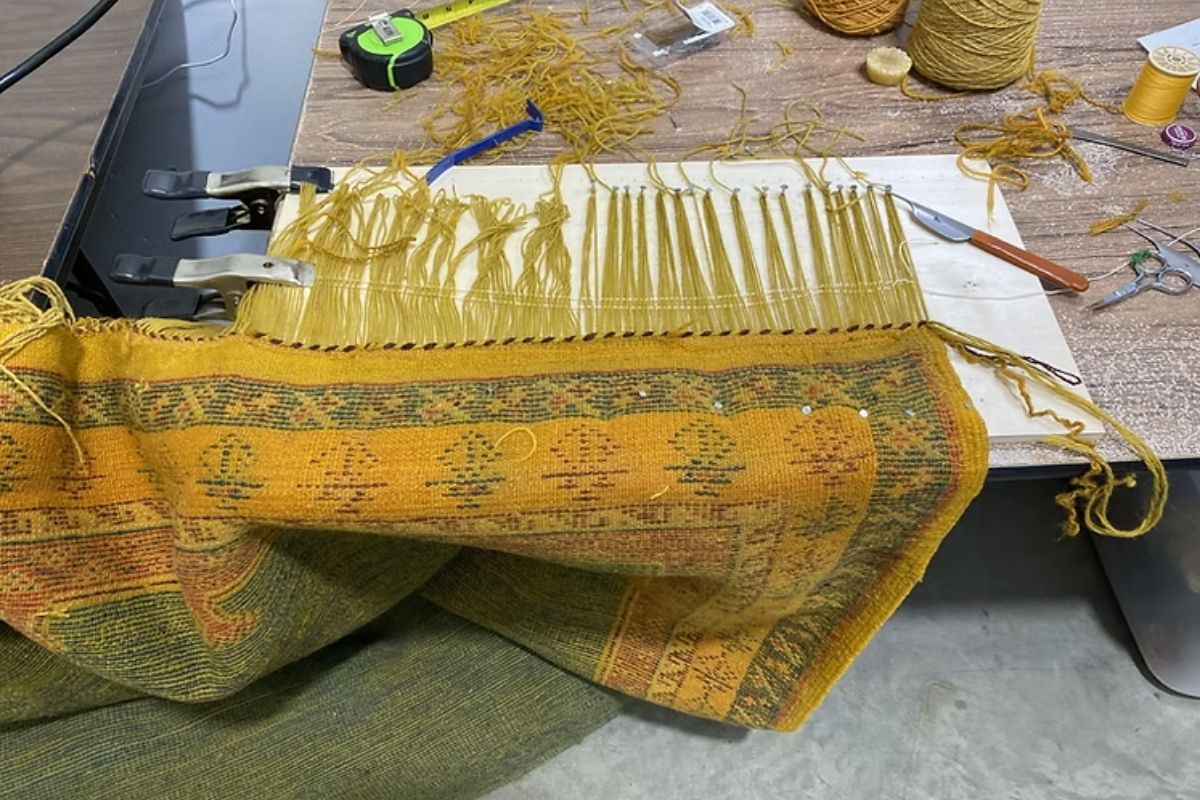
    On a hand-knotted or hand-woven rug, the fringe is not sewn on. It is the ends of the warp, the set of long threads that were strung on the loom before a single knot was tied. Every knot in the rug is tied around those threads. Every weft pass runs between them. The fringe you can see is the last few inches of the structural skeleton, left loose where the rug came off the loom and usually secured with a knotted or braided finish.

    Two consequences follow, and they are the reason this page exists.

    First, losing fringe is not a cosmetic event. A rug shedding fringe is a rug losing the ends of its warp, and once the securing finish at the end of the field goes, the wefts at that end have nothing holding them in place. They start to slide out. Behind them, the end rows of knots lose their anchoring and come away too. The rug does not stop at "no fringe." It carries on unraveling into the field, one row at a time, from the end inward.

    Second, a fringe that has been sewn on is a decoration and not a repair. A machine-made fringe tape stitched across the end of a rug replaces the look of the fringe and does nothing for the warp behind it. That may be exactly what a rug's owner wants, and there is no dishonesty in choosing it, but it should be chosen knowingly. If the end of the rug is unraveling, a stitched-on fringe hides the symptom while the cause continues.

    The honest repair at that end of the rug is to secure the warp ends again: to re-form the knotted or overcast finish that stops the wefts from migrating. A restorer may also rebuild a short band of the field where knots have already been lost, working new wefts and knots into the existing warp. That is real reweaving, it is slow, and it is priced accordingly.

    If you are not sure whether what you are looking at is a knotted pile rug, a flatweave, or a piece that mixes both techniques, that distinction changes what a repair even means, and our guide to flatweave and pile construction is the place to settle it before you get a quote.

    Side edges: the selvage, and why it goes first on one side

    The long sides of a rug are finished differently from the ends. Rather than loose warp ends, the sides carry a selvage: the outermost warp threads, usually bundled and wrapped or overcast with yarn so the edge is solid rather than raw.

    Selvage wear is the most common damage a Moroccan rug in daily use will show, and it is often worse on one side than the other. That asymmetry is usually explained by where the rug sits: the side nearest a doorway, a chair that gets pushed back, or a vacuum's turning point takes more abrasion than the side against a wall.

    When the wrapping yarn wears through, the bundled warps underneath are exposed. They abrade, then break, and the edge starts to open. A restorer's response is to re-wrap the selvage with new yarn over the existing warps, matching color as closely as the available wool allows, and to replace any broken warps in the bundle before wrapping over them. A rug that has been re-wrapped well shows a slight difference in tone along the repaired stretch. That is normal and it is not a sign of a bad job.

    What to avoid is the improvised version: sewing the opening edge shut with a household needle and thread, or running a bead of adhesive along it. Both pull the edge out of line, both are hard for a restorer to undo later, and adhesive in particular stiffens the wool and can discolor it.

    Holes: what caused it decides what is done about it

    A hole in the field of a rug is a symptom with several possible causes, and a restorer will want to know which one before touching it.

    Wear-through happens where the pile has been walked down to the foundation over years, usually in a traffic line or under a chair leg. The knots are gone, the warp and weft are exposed, and eventually they break.

    Moth damage looks different. Carpet moth larvae eat the wool pile, and they do it where they are undisturbed: under furniture, along the edge against a wall, on the underside of a folded rug. Moth damage is often a patch of bare foundation with the pile grazed away around it rather than a clean hole, and it is frequently accompanied by fine debris and silken casings. If that is what you have, the repair is the second job, not the first: an active infestation will eat the new wool as happily as the old.

    Burns, tears and pet damage are localized and usually obvious from their shape.

    For any of these, a restorer has two broad options.

    • Reweaving rebuilds the missing structure in place: new warps where warps are broken, new wefts, and new knots tied in the original technique, then the new pile trimmed to the height of the surrounding rug. Done well it is close to invisible from above and visible from the back, which is where a restorer's work usually shows.
    • Patching cuts a piece from a donor rug of similar construction and stitches it into the opening. It is faster and cheaper. It is also a compromise, because the patch's own warp does not continue into the rug's warp, so the join is a line of stress rather than a continuation of the structure.

    Neither is wrong. Which one is appropriate depends on the rug, on where the damage sits, and on what the owner wants from the piece. What we will not do here is tell you which one your rug deserves, or what either should cost. Rug restoration is priced by the hour and by the area, it varies enormously between workshops and between countries, and any figure published on a page like this one would be a number you could take to a workshop and find wrong.

    The flatwoven end bands are a separate problem

    Many Moroccan rugs, including a great many pile rugs, finish at each end with a band of flatweave before the fringe begins. On a piece that is flatwoven throughout, the whole rug is that structure. Flatweave has no pile to wear down, so it fails differently: the weft yarns abrade and part, and where two color blocks meet you can find slits along the join, which in some flatweaving traditions are structural rather than damage.

    That last point matters before you ask for a repair. A slit at a color boundary may be how the piece was made. Our guide to Moroccan kilims and hanbels covers the flatwoven end of the tradition and what its normal construction looks like, and it is worth reading before you describe something to a restorer as a fault.

    What to do before you call anyone

    Four things, in order, and none of them costs anything.

    1. Stop the damage spreading. If an end is unraveling, keep the rug off that end's traffic line and stop vacuuming over it with a rotating brush. If wefts are visibly sliding out, that end can be temporarily secured by a restorer far more cheaply than it can be rebuilt later.
    2. Rule out moths before you rule out wear. Check the underside, the parts under furniture and the edge against the wall. Moth treatment comes before repair, always, and it is a separate job.
    3. Photograph the front and the back of the damage. The back is where a restorer reads the construction, and most of the questions you will be asked over email are answerable from a back photograph.
    4. Ask the workshop what they will actually do, in the terms above: re-wrapping, re-securing warp ends, reweaving, patching, or a sewn-on fringe. If the answer is "we will fix the fringe" and no further detail is offered, ask which of those two fringe jobs is meant. It is a fair question and a good workshop will answer it plainly.

    What this guide deliberately does not tell you

    There is no cost figure anywhere on this page, no square-inch rate and no per-knot rate. There is no recommendation of a workshop, a country to send the rug to, or a shipping method. And there is no judgment on whether a given piece is "worth" restoring, because that depends on what the rug means to the person who owns it as much as on what it would sell for.

    What is worth saying plainly, and what most of this niche will not say, is that the vocabulary is loose. "Restoration," "conservation," "repair" and "re-fringing" are not defined or certified terms in this trade. Nobody regulates them. Two workshops can use the same word for different work at different prices, which is why the useful question is never "do you do restoration" but "what exactly will you do to this edge." That is the same problem that runs through the rest of this site's buying material, and if you have not read our explanation of what the trade's descriptive words do and do not mean, what a Berber rug actually is is the place that starts.

  • Twelve Questions Worth Asking Any Rug Seller

    Twelve Questions Worth Asking Any Rug Seller

    Here are twelve questions, grouped by whether they can actually be answered. Four are about construction and material and a competent seller will answer them precisely. Three are about treatment and condition and are answerable but rarely volunteered. Three are about provenance and usually cannot be answered honestly at all, which is exactly why they are worth asking: the manner of the answer tells you more than the content. Two are commercial and matter more than any of the romantic ones. Pay attention to how a seller handles the questions they cannot answer.

    How to use this list

    You are not interrogating anybody. Most rug sellers are ordinary businesspeople and most will be glad to talk about their stock in detail.

    The reason to ask in this order is that the answerable questions establish whether the seller knows their material, and the unanswerable ones establish whether they will admit a limit. A seller who is precise about construction and says "honestly, I don't know how old it is" has told you they are reliable. A seller who is vague about construction and certain about the tribe has told you the opposite.

    Take notes, or ask for the important answers in writing on the invoice.

    The four about construction and material

    1. Is this hand-knotted, hand-tufted or machine-made?
    A good answer is immediate and specific, and the seller will happily show you the back to prove it. A weak answer is "handmade," which covers all three and settles nothing. Check it yourself regardless: what the back of the rug shows takes five minutes to learn and is the one thing here you never have to take on trust.

    2. What is the pile, and what is the foundation?
    Wool pile on a cotton or wool foundation is the common answer for Moroccan rugs. A seller who does not know what the warp and weft are made of does not know their stock.

    3. Is the wool hand-spun or machine-spun?
    Answerable, and it should match what your hand tells you. Judging wool quality without a lab covers the feel.

    4. Can you show me the back and a folded corner?
    Not really a question, and the most useful thing on this list. Any hesitation here is information.

    The three about treatment and condition

    5. Has this rug been washed or chemically treated, and how?
    Chemical washing is normal in this trade, so a straight seller will simply say yes and describe it. This matters because it affects how the wool feels, how the colour will age, and whether the rug smells. How new rugs are made to look old covers what the processes involve.

    6. Are there any repairs, reweaves or replaced fringes?
    Answerable by anyone who has handled the rug. Repairs are not disqualifying; undisclosed repairs are a description problem.

    7. Do the dyes run?
    A seller who has washed or tested the rug knows. If they do not know, assume they might, and read natural or synthetic dye, because a colour run is a cleaning constraint rather than proof of anything.

    The three about provenance, which usually cannot be answered

    8. How old is this rug, and how do you know?
    The second half is the whole question. "I bought it from a dealer who said 1970s" is an honest answer and tells you the claim is second-hand. A confident decade with no basis is not better, it is worse.

    9. Where was it made, and can you name the town, region or cooperative?
    Sometimes genuinely answerable, and specificity is the signal. "The Middle Atlas" is plausible. A named town or cooperative is stronger. A general appeal to tribal tradition is not an answer.

    10. Do you know who wove it, or what the seller before you was told?
    Almost never answerable, and asking it politely maps the chain. A seller several steps from the loom will say so if they are straight with you.

    On all three: "I don't know" is a good answer. These claims are usually inferences from appearance rather than documented facts, and a seller willing to say so is more trustworthy than one who is certain. Use Amazigh alongside Berber when you ask, and notice whether the seller distinguishes a style name from a claim about who made the rug. Is my Moroccan rug authentic covers what can actually be established.

    The two commercial ones, which matter most

    11. Will you put the description in writing on the invoice, with measured dimensions?
    Construction, materials, any treatment, any repair, and any age or origin claim, with the rug's actual measurements at both ends and both sides. This single question converts every answer above into something you can act on later, and a refusal tells you how much the seller believes their own description.

    12. What is your returns policy, who pays return shipping, and what happens if it arrives damaged?
    The least romantic question here and statistically the one most likely to matter. On a shipped or online purchase it is the term that decides your outcome. Returns and recourse covers why.

    How to read the answers as a whole

    Look at the pattern rather than any single answer.

    Reassuring: precise on construction, relaxed about admitting what they do not know, willing to put it in writing, clear on returns.

    Worth pausing over: vague on construction but certain about age and tribe. That combination is the classic shape of a seller who is repeating inherited copy rather than describing an object they understand.

    A reason to walk: unwilling to show the back, or unwilling to write the description down. Neither costs an honest seller anything.

    And decide separately what you would pay if the provenance story turned out to be unverifiable, because it usually is. If that number is far below the asking price, the story is what you are buying. How to buy a Moroccan rug without getting taken covers the whole set of risks these twelve questions are designed to surface.

    FAQ

    What is the most important question to ask a rug seller?
    Whether the rug is hand-knotted, hand-tufted or machine-made, and then asking to see the back. It is the answer with the biggest financial consequence and the only one you can verify yourself.

    What if the seller does not know how old the rug is?
    That is a good answer. Age is rarely documented in this market, and a seller who admits the limit is more reliable than one who states a confident decade with nothing behind it.

    Should I ask for things in writing?
    Yes. A description on the invoice covering construction, materials, treatment, repairs, measured dimensions and any age claim is what turns a conversation into something you can act on if the rug is wrong.

    Is it rude to ask this many questions?
    No. Most sellers enjoy talking about their stock, and a serious buyer asking specific questions is treated as a serious buyer.

    What question do buyers most often skip?
    The returns policy, including who pays return shipping. On a shipped or online purchase it is the term most likely to decide the outcome.

  • Moroccan Runner Rugs, Rounds and Odd Shapes

    Moroccan Runner Rugs, Rounds and Odd Shapes

    Genuine hand-knotted and handwoven Moroccan rugs do exist as runners (long, narrow pieces suited to hallways and stairs), particularly among flatweave traditions. Rounds are a different matter: they're mostly a modern reproduction-rug format rather than a traditional Moroccan output. And whatever shape you're after, a genuinely hand-knotted piece won't come in a fixed factory size the way a mass-produced rug does; it comes in whatever size the loom and the weaver actually produced.

    Two very different markets are hiding behind the same search term

    Search "Moroccan runner rug" or "Moroccan round rug" and most of what comes back is machine-made reproduction product from mainstream rug retailers (Amazon, big-box rug sites, and decor-focused online stores), sold in standard factory sizes: runners commonly listed from around 2×3 feet up through 8×10, 9×12, and larger, rounds commonly listed in fixed diameters like a 5-foot round. That's a real, legitimate product category, and there's nothing wrong with buying one if a consistent factory size and a lower price point matter more to you than a hand-knotted piece. But it's a different product from what the rest of this site covers, and conflating the two leads to mismatched expectations: someone expecting to shop a genuine hand-knotted runner the way they'd shop a standard-size reproduction rug is going to be looking for something that, by its nature, mostly doesn't exist that way.

    Runners: where they show up in genuine Moroccan weaving

    Long, narrow formats are a real, traditional output in some Moroccan weaving, particularly among flatweave traditions like Zanafi and the broader Moroccan kilim and hanbel family, where the flat construction lends itself naturally to a longer, narrower piece without the bulk a pile weave would add over the same length. A genuine hand-knotted pile runner also exists, but tends to be less common than a flatwoven one, since building a long, narrow, plush pile piece is a more demanding, time-intensive undertaking on the loom than a flatweave of the same dimensions.

    Whatever the construction, a genuine runner's exact length and width are a function of that specific loom and that specific piece, not a menu of standard options. If you need a very specific length, filling an exact hallway measurement, for instance, expect that to be the harder ask, not the easier one, when shopping genuine hand-knotted pieces rather than mass-produced reproductions.

    Rounds and other shapes: mostly a modern reproduction-rug format

    Round rugs are heavily marketed in the general decor-retail space, but this guide did not find evidence that round is a traditional Moroccan hand-weaving output the way rectangular and runner formats are. Most round "Moroccan-style" rugs on the market are machine-made reproductions manufactured specifically in that shape for the modern decor market, not a hand-knotted piece originally woven round. That doesn't make a round reproduction rug a bad purchase on its own terms. It's simply a different category from the hand-knotted traditions this site covers, and calling it "Moroccan" describes its design influence, not necessarily its origin or construction.

    Other irregular shapes (oval, hexagonal, custom-cut pieces) fall into the same bucket: they exist in the market, but predominantly as manufactured decor product cut or woven specifically to that shape for a modern retail audience, not as a traditional Moroccan weaving format this guide can document.

    Machine-made reproduction rugs vs. genuine hand-knotted pieces: why the size charts differ

    A machine-made rug is produced on equipment that can output a consistent size on demand: that's precisely the appeal of a standard size chart, and why reproduction retailers can confidently list 2×3, 5×8, 9×12, and every size in between. A genuinely hand-knotted or handwoven rug is produced by one person (or a small group) on a specific loom, over weeks or months, and its finished dimensions are the result of that particular weaving process, not a target size dialed in beforehand the way a factory setting is. That's precisely why hand-woven Moroccan rugs are widely described in the trade as irregular in size: a piece sold as "roughly 6×9" may run somewhat larger or smaller than that in either dimension, because it was never built to a fixed spec in the first place.

    This matters directly for anyone shopping by exact room measurements. See the complete guide to Moroccan rug styles for the wider identification context, but the size question specifically is worth internalizing on its own: a hand-knotted piece's dimensions are a description of what exists, not an order specification for what will be produced.

    What to expect if you want a specific size or shape in a genuine piece

    • Expect "roughly," not "exactly." A listed dimension on a genuine hand-woven piece is a description, with normal handmade variation built in, not a guaranteed precise measurement.
    • A specific exact length is a harder ask than a general size range. If a hallway genuinely needs an exact 27-inch width, that's a much narrower search than "a runner, roughly 2 to 3 feet wide."
    • Rounds and unusual shapes in genuine hand-knotted construction are rare enough that "Moroccan-style round rug" almost always means reproduction, not traditional weaving, worth knowing going in, rather than assuming a round piece is automatically a hand-knotted antique.
    • If exact dimensions matter more than authenticity, a reproduction rug is a legitimate, honest option. This guide isn't arguing everyone should only buy hand-knotted pieces, only that the two categories shouldn't be confused with each other while shopping.

    Measuring your space against an irregular piece

    Because a genuine hand-woven piece's dimensions are fixed by what was actually made rather than a size you select, the practical approach is to measure your space first and then shop within a range, rather than deciding on an exact number and searching for that precise figure. For a hallway runner, that usually means noting the minimum and maximum width the space can accommodate, and treating anything within that range as a candidate, rather than ruling out a piece that's an inch or two off a single target number. For a room where you're considering an unusual shape, the more useful question is often whether a standard rectangular piece (this site covers many genuine, well-documented styles) would actually serve the space just as well as the odd shape you originally had in mind.

    FAQ

    Do genuine Moroccan runner rugs exist?
    Yes, particularly among flatweave traditions like Zanafi and Moroccan kilim/hanbel, where the construction naturally suits a longer, narrower format.

    Are round Moroccan rugs traditional?
    This guide did not find evidence that round is a traditional hand-woven Moroccan output. Most round "Moroccan-style" rugs on the market are modern reproductions manufactured specifically in that shape.

    Why don't hand-knotted Moroccan rugs come in standard sizes like 5×8 or 9×12?
    Because they're produced by a person on a specific loom over an extended period, not manufactured to a fixed factory spec. Dimensions reflect what was actually woven, with normal handmade variation.

    Can I order a genuine Moroccan rug in an exact custom size?
    This is a much narrower, harder request than shopping standard reproduction sizes, since it depends on finding or commissioning a specific piece rather than selecting from a size chart. This guide cannot promise availability for any specific custom size.

    Is a machine-made reproduction "Moroccan-style" rug a bad choice?
    Not inherently. It's a legitimate, different product category with its own honest use case, particularly where an exact size, shape, or lower price point matters more than hand-knotted construction. The problem is only in confusing the two categories while shopping.

  • Moroccan Rug Colors: Where the Palette Comes From

    Moroccan Rug Colors: Where the Palette Comes From

    Moroccan rug color comes from three things: the natural tone of undyed wool, plant-based natural dyes, and, increasingly in modern production, synthetic dyes, not from a fixed symbolic code where a given color always "means" something specific. Across the styles already covered on this site, you'll have seen the undyed cream of a Beni Ourain, the deep indigo of a Beni Mguild, the warm magenta of a Boujad, and the plant-dyed range documented at Taznakht. This page pulls that pattern together in one place, and explains what determines it.

    The undyed base: cream, ivory, brown, black

    Sheep's wool in its natural, undyed state already spans a real range: cream, ivory, light brown, darker grey-brown, and black, depending on the specific fleece. Several Middle Atlas styles, most famously Beni Ourain, lean heavily on this undyed range, using dark natural wool sparingly for outline motifs against a light, undyed field rather than relying on any dye process at all. This is the simplest, most direct source of a Moroccan rug's color: no dye, just the wool itself, sorted and used as it comes off the animal.

    Natural dyes and what they actually produce

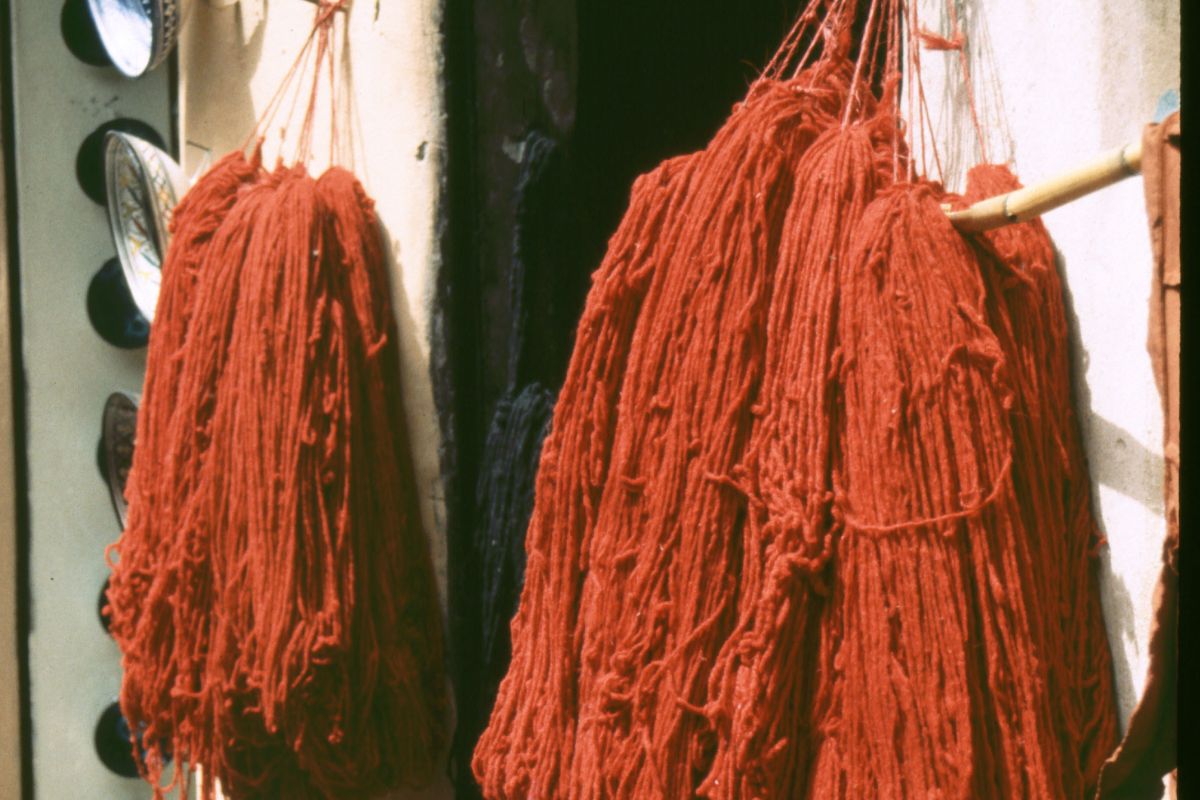
    Where color is added, historical and traditional practice draws on a specific, recurring set of plant materials, documented consistently across multiple independent sources: madder root, producing reds and terracottas; indigo, producing blues; saffron and pomegranate rind, producing yellows and golds; henna, producing reddish-browns; and walnut shell or hull, producing dark browns and blacks. This is the same palette named directly, with sources attributed, in this site's own Taznakht guide, where Africanews's reporting specifically named henna, pomegranate peel, saffron, and indigo leaves as the cooperative's dye materials.

    Natural dyes produce color with real variation built in: no two dye batches land on exactly the same shade, since the result depends on the specific plant material, water, mordant, and even the season it was prepared in. That's part of why natural-dyed pieces develop the muted, complex, slightly uneven color character collectors associate with older or traditionally made rugs, as opposed to the flatter uniformity of a modern synthetic-dye batch.

    Synthetic dyes and why modern production leans on them

    Modern Moroccan rug production increasingly uses synthetic dyes, which produce brighter, more saturated, and more consistent color than natural dyeing allows, a real practical advantage for a producer trying to match a specific shade reliably across a production run. Some of the brighter, more electric colors seen in contemporary Azilal and Boujad production reflect this shift toward synthetic dye availability, alongside older natural-dye traditions that continue in parallel rather than having been fully replaced by it.

    Neither natural nor synthetic dye is inherently "more authentic" on its own. Synthetic dyes have been in use in various forms for well over a century in many textile traditions worldwide, and a rug's genuine hand-knotted or handwoven construction is a separate question from which dye technology colored its yarn. Treating synthetic dye as automatic proof of a fake, or natural dye as automatic proof of authenticity, is exactly the kind of oversimplified claim this site avoids making.

    Quick reference: common natural dye sources

    Dye source Color produced
    Madder root Red, terracotta
    Indigo Blue
    Saffron Yellow, gold
    Pomegranate rind Yellow, gold, tan
    Henna Reddish-brown
    Walnut shell/hull Dark brown, black

    This table reflects what plant material is documented to produce which color family in traditional dyeing practice generally. It is not a claim about the specific dye used on any individual rug, which would require asking the seller or, ideally, having documentation from the maker.

    Color also changes over time, and that's not a defect

    A rug's color the day it's finished is not necessarily its color a decade later. Natural dyes in particular are more light-reactive than most synthetic equivalents, and gradual fading or mellowing with sun exposure and handling is part of how a natural-dyed piece is expected to age, contributing to the muted "vintage" look collectors often prize. That's a genuinely different situation from a colorfastness defect or damage, though telling the two apart in a specific piece is a hands-on question this guide won't attempt to settle from a description alone.

    Why this guide won't tell you what a color "means"

    You will find plenty of content elsewhere asserting that a specific color carries a fixed symbolic meaning, that yellow "symbolizes joy," or red "symbolizes life," stated as settled fact with no source attached. This guide won't repeat those claims here. Symbol and color meaning in Amazigh weaving is a genuinely contested area: the same seller pages that assert confident color meanings are, in this site's own research for its symbolism cluster, often the only pages making the claim at all, with no museum, academic, or named cultural source behind it.

    Where a specific source can support a specific claim, as with the akhnif's documented motif, discussed in the akhnif guide, this site states it and names the source. For general color-in-rugs claims of the kind repeated across seller sites, no comparable sourcing was found in this guide's research, so none is asserted here as settled fact. If you've read elsewhere that a color in your rug "means" something specific, treat that as a claim from whoever told you, not a documented fact this site can confirm.

    How color connects to the styles already covered on this site

    Color is one of the fastest ways to narrow down which named style you're looking at, alongside pattern and density covered in how to identify a Moroccan rug from a photo. An undyed cream-and-black field points toward the Middle Atlas pile styles; warm plant-dyed reds and golds point toward southern traditions like Taznakht; bright, saturated color in a dense field points toward Azilal or Boujad; and an unusual palette of aubergine, mauve, and ochre points toward the underserved Aït Bou Ichaouen / Talsint tradition. Color alone won't settle an identification, but combined with pattern and construction, it's a genuinely useful signal.

    FAQ

    What determines a Moroccan rug's color?
    Three things: the natural tone of undyed wool, traditional plant-based dyes, and modern synthetic dyes. There's no single fixed factor, and no fixed symbolic code behind it.

    What plant materials were traditionally used to dye Moroccan rugs?
    Documented sources name madder root (red/terracotta), indigo (blue), saffron and pomegranate rind (yellow/gold), henna (reddish-brown), and walnut shell (dark brown/black).

    Does a specific color mean something in Moroccan rug weaving?
    This guide could not find a credible, named non-commercial source confirming fixed color meanings and will not repeat unsourced claims found on seller sites as settled fact. Where a specific documented meaning exists, as with the akhnif's motif, it is attributed to its actual source.

    Are natural-dyed rugs more authentic than synthetic-dyed ones?
    No. Dye type is a separate question from whether a rug is genuinely hand-knotted or handwoven. Both natural and synthetic dyes appear in genuine traditional production, and neither one alone proves or disproves authenticity.

    Can I tell which named style a rug is just from its color?
    Color is a useful clue, especially combined with pattern density and construction, but it isn't decisive on its own. See how to identify a Moroccan rug from a photo for the fuller identification approach.

  • How to Identify a Moroccan Rug From a Photo

    How to Identify a Moroccan Rug From a Photo

    A photo can narrow down which named Moroccan style you're likely looking at, and can flag some obvious signs a rug isn't hand-knotted at all. What a photo cannot do is authenticate a specific rug: confirm its exact age, region, or maker with certainty. This site's own Disclaimer says the same thing about hands-on inspection: individual-rug authentication isn't something a guide can do from a distance, and a photo is an even thinner basis than an in-person look. What follows is what to actually check in the photos you have, or can request, without pretending a checklist settles more than it does.

    What the back of the rug shows, if you can get a photo of it

    If a listing includes a photo of the reverse side, look there first. Hand-knotted rugs show individual knots on the back, with natural, small irregularities in spacing and tension. No two knots are perfectly identical, because a person tied each one by hand. A machine-made rug, by contrast, typically shows a uniform, mesh-like backing with none of that hand-tied variation, since it was produced by a loom running a repeating mechanical pattern rather than a weaver's hands.

    Requesting a back-of-rug photo is a reasonable, low-friction ask of any seller. A seller who has nothing to hide about a piece's construction should be able to provide one without objection; one who resists or has only front-facing photos available is giving you less to work with, which is itself useful information.

    Wool, patina, and asymmetry: what a photo can and can't tell you

    Genuine Moroccan tribal rugs are overwhelmingly wool, sometimes with cotton in the warp threads specifically. In a photo, wool tends to show a certain depth and slight sheen that's hard to fake convincingly, though this is a soft, experience-based read rather than a definitive test. It gets easier to judge the more genuine pieces you've actually seen, and harder to trust from a single low-resolution photo of an unfamiliar piece.

    Vintage pieces often show a natural patina: a soft, uneven sheen and slightly muted coloring that develops from age and handling, rather than the flat, uniform coloring of a new synthetic-dye reproduction. Genuine handmade rugs also typically show slight asymmetry: a border that isn't perfectly even, a motif that shifts slightly across the field, which is a normal, expected feature of hand weaving, not a flaw. A rug that looks suspiciously perfect, with mechanically even borders and identical repeating motifs, is worth a second look, though "looks a little too perfect" is a prompt to ask more questions, not proof of anything on its own.

    Matching the pattern to a named style

    Once you've ruled out the more obvious "not handmade at all" signals, the next useful step is pattern-matching against the named styles this site already covers. An undyed ivory ground with sparse, dark geometric motifs points toward Beni Ourain or its denser relative Beni Mrirt. Bright, freehand, almost sketch-like patterns on a lighter ground point toward Azilal. Warm pinks, magentas, and reds in a denser weave point toward Boujad. A flat, patterned rug with the design visible on both sides points toward Zanafi or Moroccan kilim/hanbel. If none of those match and you're seeing an unusual, saturated palette of aubergine, mauve, tangerine, and ochre in a dense pattern, check Aït Bou Ichaouen or Talsint instead. Working through this site's own style pages this way will get you closer to a likely match than a generic "Moroccan rug" search will.

    Other signs a listing photo can reveal

    A few additional checks are worth running through before you get to the point of asking the seller anything:

    • Fringe. Genuine hand-knotted rugs usually have fringe that is a continuation of the warp threads running through the body of the rug, not a separate strip stitched onto the edge afterward. A fringe that looks glued, serged, or obviously sewn on as a distinct trim is a stronger giveaway of a machine-made reproduction than almost anything else visible in a photo.
    • Print versus weave. A genuinely woven pattern has texture and slight color variation within each motif, visible even at a moderate zoom. A printed pattern on a flat or minimally textured backing (common in cheaper decorative "Moroccan-style" rugs sold by mainstream furniture and decor retailers) tends to look flatter and more uniformly colored than a woven equivalent.
    • The listing's own language. Terms like "Moroccan-inspired," "Moroccan-style," or "Beni Ourain-style" are often used honestly by retailers selling machine-made reproductions, and are worth reading carefully rather than skimming past. They're a different product category from a hand-knotted piece attributed to an actual weaving tradition, priced and made very differently.

    None of these checks is definitive alone, and a confident answer on all three still isn't the same as an expert appraisal. But together they narrow the range meaningfully before you ever have to ask the seller a direct question.

    What to ask the seller for, if the photo alone isn't enough

    • A photo of the back, for the knot-versus-mesh check above.
    • Origin information, even if it's general: region, cooperative, or dealer source, rather than just "Morocco."
    • Material confirmation: wool content specifically, and whether any synthetic fiber is blended in.
    • A close-up of the pile or weave texture, if the listing photo is low-resolution or heavily filtered, since both can obscure the details above.

    A seller who can answer these specifically is giving you real information to work with. A listing that stays vague on all of them after being asked isn't necessarily dishonest, but it is offering you less than what a well-documented piece could provide.

    What this guide cannot do

    This guide, and any photo-based checklist, has real limits. It cannot confirm a specific rug's age. No photo-based method reliably does that, and this site does not publish age estimates it cannot support with a named source. It cannot confirm which specific tribe or cooperative made an individual piece, even when a general style is identifiable, since named attribution requires documentation this site has repeatedly noted is often missing even from sellers themselves. And it cannot substitute for an in-person, expert appraisal on a purchase where that level of certainty genuinely matters to you. Photos and questions narrow the range of likely answers; they don't settle them.

    FAQ

    Can I tell if a Moroccan rug is real from a photo alone?
    Partially. A photo can flag some signs a rug is machine-made rather than hand-knotted, and can help match it to a likely named style. It cannot authenticate a specific piece's age, region, or maker with certainty.

    What's the single most useful photo to ask a seller for?
    A clear photo of the back of the rug. It's the most reliable way to check for individual hand-tied knots versus a uniform machine-made mesh backing.

    Does asymmetry in the pattern mean a rug is fake?
    No, the opposite, generally. Slight asymmetry is a normal, expected feature of genuine hand weaving. A pattern that's mechanically perfect and identically repeating is more worth questioning than one with natural variation.

    How do I know which named style I'm looking at?
    Compare the palette and pattern density against this site's style pages, undyed and sparse points toward Beni Ourain, bright and freehand points toward Azilal, pink and dense points toward Boujad, and so on. See the full Moroccan rug styles guide for the complete list.

    Should I buy a rug based on photos alone, without an in-person look or expert opinion?
    For a significant purchase, that's a real risk this guide won't talk you out of taking seriously. Photos and seller questions reduce uncertainty; they don't eliminate it, and this site's own Disclaimer is explicit that it does not offer individual-rug authentication.

  • Flatweave vs Pile Rug: Which Moroccan Style Fits

    Flatweave vs Pile Rug: Which Moroccan Style Fits

    If you're choosing between a plush style like Beni Ourain and a flat one like Zanafi or a Moroccan kilim, the underlying question is construction, not just look. Flatweave rugs are thin, firm, and low-shedding, which suits high-traffic areas, hallways, dining rooms, and anywhere furniture needs to move freely or a door needs clearance. Pile rugs are thicker and softer, with vertical yarn that adds cushioning and sound absorption, which suits living rooms, bedrooms, and spaces where comfort underfoot matters more than low-profile practicality. Moroccan weaving produces genuine, distinct styles in both categories. This isn't a compromise choice.

    Quick comparison

    Flatweave Pile
    Thickness Thin, flat Thick, raised surface
    Feel underfoot Firm Soft, cushioned
    Shedding Minimal Noticeable, especially when new
    Best rooms Hallways, kitchens, dining rooms, stairs Living rooms, bedrooms
    Example Moroccan styles Zanafi, Moroccan kilim/hanbel, Boucherouite Beni Ourain, Beni Mrirt, Beni Mguild, Azilal, Boujad
    Reads on both sides? Often, yes No, pile faces one direction

    What "pile" actually means, and which Moroccan styles are pile

    A pile rug is built with vertical yarn, the pile, standing up from a woven backing, either left as loops or cut, giving the surface height, softness, and texture you can run a hand through. That construction is what makes a pile rug feel warm and cushioned underfoot, but it also means more surface area to trap dust and shed loose fiber, especially when new.

    On this site, the pile family includes the Middle Atlas styles built around plush wool: Beni Ourain, Beni Mrirt, and Beni Mguild, along with the denser, more colorful pile traditions like Azilal and Boujad. These are the rugs people picture when they imagine a thick, soft Moroccan rug underfoot in a photo, the ones that read as substantial the moment you step on them.

    What "flatweave" actually means, and which Moroccan styles are flatweave

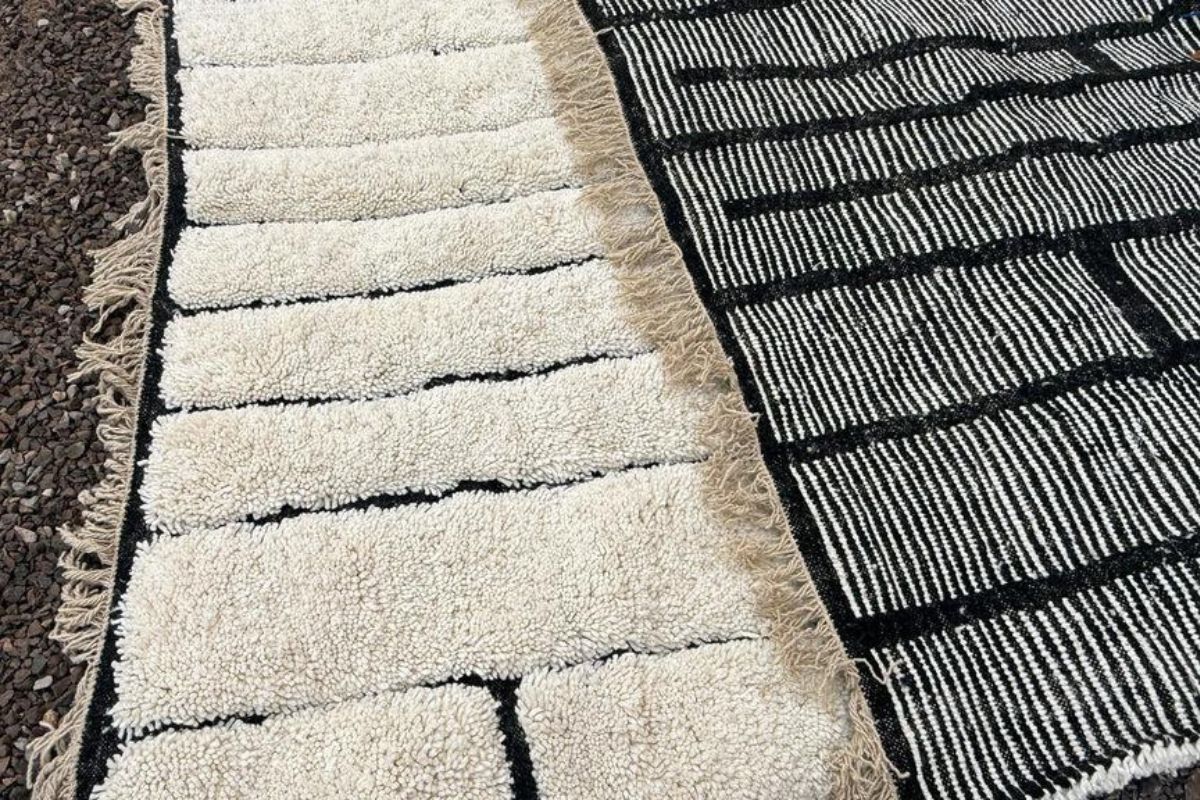
    A flatweave rug has no raised pile at all. The warp and weft yarns are woven tightly together into a flat, thin surface, with the pattern visible on both the front and often the back of the piece. That construction produces a thinner, firmer, more durable-underfoot rug that lies flatter, wears differently than a pile rug, and generally sheds far less because there's no loose vertical fiber to begin with.

    Zanafi rugs, reversible flatweaves with a finished look on both sides, sit squarely in this category, as does the broader Moroccan kilim and hanbel family. Boucherouite rugs, the rag-weave style made from recycled textile scraps, are also generally flatwoven, which is part of why they can incorporate such varied, reused materials in the first place. A knotted pile construction would demand a much more uniform yarn supply than a rag weave does.

    Room-by-room fit

    Hallways, entryways, and stairs. A flatweave's low profile and durability make it the more practical choice anywhere a rug needs to withstand frequent foot traffic without bunching under a door or catching a shoe. A thick pile rug in a narrow, high-traffic hallway will show wear faster and can become a trip hazard if it isn't properly secured.

    Kitchens and dining rooms. Flatweave again, for the same reasons: easier to keep clean underfoot, and chair legs move across a flat surface more easily than across a deep pile, which matters directly under a dining table.

    Living rooms and bedrooms. This is where pile earns its keep: the comfort, warmth, and sound-dampening qualities of a plush Middle Atlas style are exactly what these rooms are for. A living room built around lounging on or near the floor, or a bedroom where bare feet hit the rug first thing in the morning, is the natural home for a Beni Ourain or Beni Mguild.

    Home offices and casual spaces. Either can work, depending on whether a rolling chair is involved. A flatweave handles a desk chair's wheels far better than a deep pile does; a low-pile option is a reasonable middle ground if comfort matters more than chair mobility.

    The middle ground: mixed-technique weaves

    Not every Moroccan weaving fits neatly into one category. Glaoui rugs combine flat, pile, and fringe techniques within a single piece, which is worth knowing if you've found one and are trying to judge how it will behave underfoot: parts of it will perform more like a flatweave, and parts more like a pile rug, within the same physical object. That's a genuinely different profile from either pure category, and one more reason "flatweave or pile" is a useful starting question rather than a rigid binary once you're looking at a specific named tradition.

    Spotting the difference in a photo

    Even without touching the rug, construction is often visible in a decent listing photo. A pile rug shows visible height and shadow along the surface, with individual tufts or a clearly textured field; a flatweave reads as flat and graphic in a photo, with the pattern rendered in solid blocks of color rather than a soft, textured surface. If a listing shows the back of the rug, that's an even stronger tell: a flatweave's pattern is usually visible, mirrored or near-identical, on the reverse side, while a pile rug's back shows the knot structure rather than the front-facing pattern itself. This is one of the more reliable checks available from a photo alone, compared to some of the harder authenticity questions covered in how to identify a Moroccan rug from a photo.

    What this doesn't determine

    Construction type says nothing about a rug's age, origin, or authenticity: those are separate questions covered on the individual style pages. A flatweave isn't automatically older or newer, more or less authentic, than a pile rug; it's a different, equally legitimate construction technique with its own named traditions behind it. Nor does construction type tell you whether a specific piece is hand-knotted or hand-woven at all. A machine-made reproduction can imitate the look of either category, which is a separate check covered elsewhere on this site.

    FAQ

    Is a flatweave rug lower quality than a pile rug?
    No. They're different constructions with different strengths, not a quality hierarchy. A well-made flatweave and a well-made pile rug are both genuine, skilled hand-weaving, suited to different practical uses.

    Which is better for a room with pets or kids?
    Flatweave generally holds up better to heavy, frequent use and sheds less, which matters in high-activity rooms. Pile rugs can still work in these spaces; they just need more maintenance and are more forgiving in lower-traffic rooms.

    Do flatweave Moroccan rugs shed less than pile ones?
    Generally yes, because there's no loose vertical pile fiber to shed in the first place. New pile rugs in particular can shed noticeably at first.

    Can a Moroccan rug be both pile and flatweave?
    Yes, Glaoui rugs are a documented mixed-technique tradition combining flat, pile, and fringe sections within one piece.

    Does construction type tell me anything about a rug's age or authenticity?
    No. Pile and flatweave are both long-standing, legitimate construction techniques across Moroccan weaving traditions. Neither one is inherently older, newer, more, or less authentic than the other.