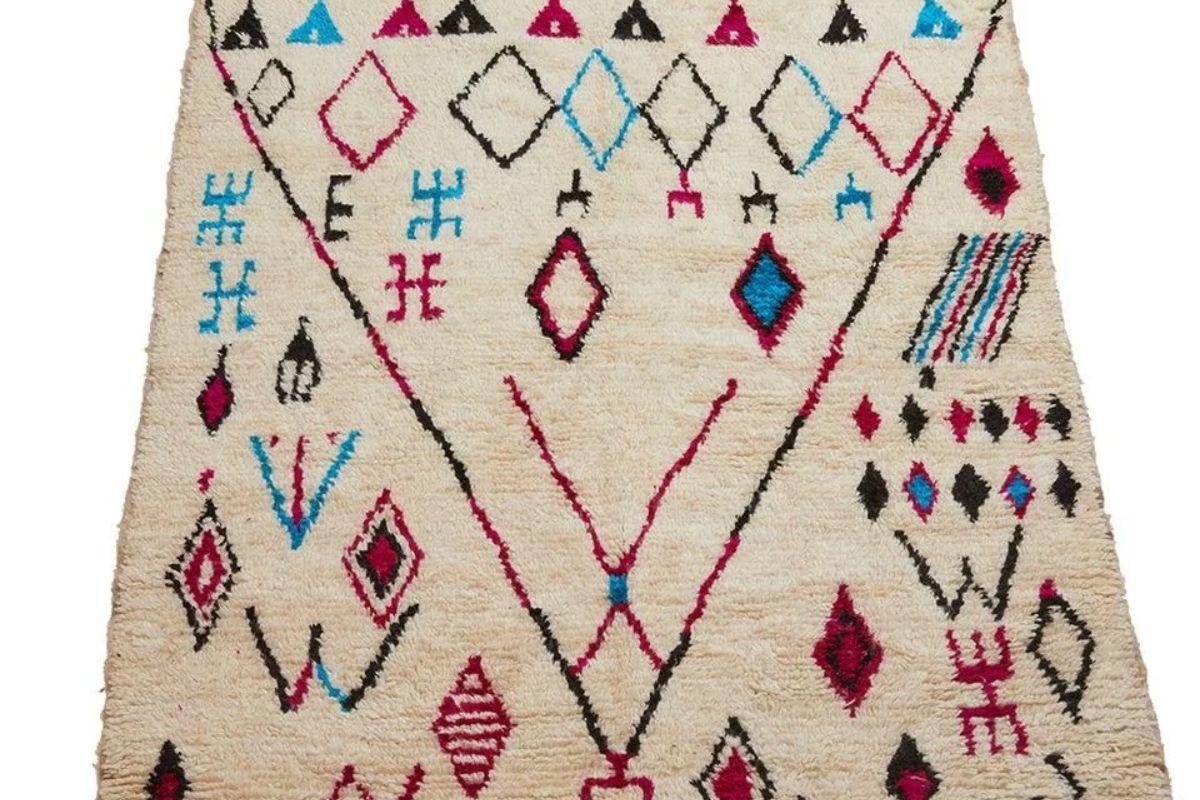
Sometimes there are letters in the weave, but less often than rug listings suggest. A tifinagh symbols rug usually means one of two things. The first is a rug that deliberately carries a letter from Tifinagh, the script used to write the Amazigh (Berber) languages. Most often that letter is the yaz (ⵣ), a modern emblem of Amazigh identity. The second is a rug whose diamonds, crosses and lines are described as letters. The first is documented. The second is a claim, and a Moroccan heritage scholar quoted below warns against reading every motif as a hidden letter.
This guide explains what Tifinagh is, how its letters are built, and how to tell the two situations apart before you accept a meaning from a product page.
What Tifinagh Is
Tifinagh is the alphabet of the Amazigh peoples of North Africa. A word on names first: "Berber" is the familiar market term, but it came from outsiders, and many people prefer Amazigh (plural Imazighen). This site uses both, because readers search with one and the weavers' communities often use the other.
The script has a long and only partly understood history. Its ancestor, usually called Libyco-Berber, survives in stone inscriptions found across Morocco, Algeria, Tunisia, Libya and the Canary Islands. How old the oldest of them are is debated. Common scholarly summaries place the script in the first millennium BCE, with the earliest remains possibly from the sixth century BCE, while other summaries only commit to active use by the third century BCE. We are not going to pick a winner. The honest position is that nobody has a single agreed date.
Even the name is disputed. Some scholars read "tifinagh" as a Berber adaptation of the Latin Punicus, making it "the Phoenician letters." Others connect it to a Tuareg verb meaning "to write." The two ideas are not mutually exclusive.
After the Arab conquest of North Africa, the script largely dropped out of use in the north. The Tuareg of the Sahara kept it. Even there, its role was modest. The epigraphist M. C. A. MacDonald describes Tuareg society as largely oral and says Tifinagh is used "primarily for games and puzzles, short graffiti and brief messages." That matters for rugs: Tifinagh was never a script of long texts that a weaver would transcribe.
How Tifinagh Became Morocco's Official Script
The Tifinagh you see on Moroccan road signs today is a modern standard, not the ancient form. Activists linked to the Berber Academy in Paris developed a fully alphabetic "Neo-Tifinagh" in the 1970s. In Morocco, the Royal Institute of Amazigh Culture (IRCAM) was created in 2001, and in 2003 its version of the script, often called Tifinagh-IRCAM, was adopted for teaching Amazigh. Tamazight became an official language in Morocco's 2011 constitution, and an organic law in 2019 set out how it would be used, including in education.
The script also has a standard digital form. The Unicode Consortium's Tifinagh code chart, which we consulted on 2026-09-23, lists the letters with names such as TIFINAGH LETTER YAZ. The block was first added to Unicode in version 4.1. If a seller tells you a woven shape "is" a particular letter, that chart is a neutral place to compare the forms yourself.
This history is why a rug with a clear, deliberate Tifinagh letter reads as contemporary. It belongs to the period when the script became a public, political and educational symbol, not to an unbroken weaving tradition.
How the Letterforms Are Built
Tifinagh letters are made from very few elements: straight strokes, circles, dots and crosses. A few IRCAM letters show the pattern:
| Letter | Sound | Shape |
|---|---|---|
| ⵣ (yaz) | z | A vertical stroke with two bracket-like arms, often compared to a standing figure |
| ⵜ (yat) | t | A plus-shaped cross |
| ⵏ (yan) | n | A single vertical stroke |
| ⵔ (yar) | r | A circle |
Now think about how a rug is made. On a vertical loom, knots and wefts build a design row by row on a grid, which makes straight lines, stepped diagonals and crosses easy to produce. Our explainer on how the Moroccan vertical loom shapes a design covers that in detail. Put the two together and the problem becomes clear. A cross, a vertical bar or a diamond will appear in countless rugs whether or not the weaver had any letter in mind. A resemblance between a rug motif and a Tifinagh letter is expected, so on its own it proves nothing.
Tifinagh Symbols in a Rug: Three Different Situations
Most confusion comes from treating three different things as one. Here they are side by side.
| Situation | What you see | How well documented | What it can tell you |
|---|---|---|---|
| A deliberate letter or word | A clear, isolated ⵣ, or a legible word such as a name or greeting, usually centered and set apart from the field | Well documented as a modern identity symbol | That the maker or commissioner chose to state Amazigh identity. It says little about the rug's age, except that it is likely recent. |
| A geometric motif sold as a letter | Diamonds, crosses, bars and lozenges repeated across the field, described in a listing as "Tifinagh" | Weakly documented; mostly seller copy | Very little. The shape exists; the reading is an interpretation. |
| Script on other Amazigh objects | Tifinagh-derived designs on Tuareg jewelry, amulets and leatherwork | Documented by museums | That the script lives in adornment, mostly in the Sahara, not in Moroccan pile rugs specifically. |
The first row is the only one where "those are letters" is a plain fact. The yaz is the Tifinagh letter for the sound z, and it is the letter that appears on the Amazigh flag, where it stands for the root of the word Amazigh itself. On a rug, it works the way it works on a flag or a T-shirt: as a statement. That is a real and respectable meaning. It is simply a modern one.
What the Documented Sources Actually Say
The strongest non-commercial evidence for Tifinagh in craft comes from the Sahara, not the Atlas.
The Spurlock Museum at the University of Illinois, in a collection post on Tuareg beauty and adornment (published November 11, 2024, read by us on 2026-09-23), states that "Tuareg women are the teachers of the Tifinagh alphabet" and that it has been passed down through female relatives for generations. The same post says the geometric features of Tuareg bracelets and rings reflect symbolic meanings from the alphabet, and that amulets can carry Tifinagh letters and sometimes messages or blessings. That is a museum speaking about jewelry, which is a narrower claim than the one rug sellers make.
For Morocco, the most useful voice is anthropologist Ahmed Skounti, a heritage specialist at the National Institute of Archaeology and Heritage Sciences in Rabat. In a 2026 article by Eric Anglade for the regional site Sud-Est Maroc, drawing on Skounti's work, the argument is that the symbolic world from which Tifinagh grew still runs through weaving, pottery and jewelry. The same article then adds the caution in plain terms: this "does not mean that every geometric motif on a rug, piece of pottery or fibula is a hidden Tifinagh letter," because "such an interpretation would be too quick."
Put side by side, the position is careful. There is a shared visual world of lines, marks and abstract shapes in which writing, symbol and ornament overlap. There is no evidence we could find that Moroccan weavers routinely spelled words into the field of a traditional rug.
Why Rug Listings Say Otherwise
Search the phrase and nearly every result is a rug seller. Several say Tifinagh characters were abstracted into rug patterns, or that a specific cross or diamond "is" a named letter. We could not find a museum, university or Amazigh cultural organization making that claim about individual Moroccan rugs.
There are understandable reasons it spreads. A letter-meaning gives a buyer a story, and a story helps a rug sell. The shapes genuinely overlap, as the table above shows. The part the listings leave out is that weaving knowledge has passed mainly from woman to woman inside households and villages, not through written pattern books. Our piece on the women who weave Moroccan rugs explains why that matters. A fixed "this shape equals this letter" chart turns a living, spoken practice into something tidier than it ever was.
None of this means a weaver never wove a letter she knew. It means the listing is not evidence that she did.
Where Tifinagh Fits, and Where It Does Not
It helps to keep geography straight. The Tuareg Tifinagh tradition documented by museums sits in the Sahara, across parts of Niger, Mali, Algeria and Libya. Most rugs sold as Moroccan come from the Middle Atlas, the High Atlas, the Anti-Atlas and the plains, each with its own weaving conventions. Our Moroccan rug regions map shows where each named style comes from.
So a "Tuareg Tifinagh" story attached to a Middle Atlas pile rug is mixing two regions and two craft traditions. It could still be a genuine Amazigh rug. The script story just does not come with it automatically.
The one place Tifinagh clearly does fit Moroccan weaving today is the deliberate, modern use: a cooperative or a weaver choosing to put ⵣ, a name or a word into a rug as a statement of identity. That is worth valuing on its own terms rather than dressing up as ancient.
How to Ask a Seller About a Tifinagh Rug
If a listing says the rug contains Tifinagh, a few questions separate a documented claim from a sales line:
- Which letter, exactly? Ask the seller to name it and compare the shape against the Unicode chart yourself.
- Does it spell anything? A single isolated yaz is common and meaningful. A claimed "word" should be something the seller can read out.
- Who says so? Ask whether the weaver or cooperative described the meaning, or whether it came from a general symbol list.
- Is the rug described as old? A clearly legible Tifinagh letter on a rug sold as antique is worth questioning, given the script's modern revival.
- Where was it woven? A regional attribution should be consistent with the story being told.
Our list of questions worth asking any rug seller covers provenance, construction and return terms beyond symbols.
What This Site Cannot Tell You
Atlas Rug Guide cannot tell you whether a motif on your particular rug was meant as a letter. We have not examined your rug, and nobody can read a weaver's intention from a photograph. We also cannot date a rug from its symbols. If the meaning matters to you, the best source is the weaver or the cooperative that made it, where that link still exists. For questions of age or value, an independent appraiser or a textile conservator who examines the piece in person is the right person to ask, not a product page and not this site.
FAQ
Are Tifinagh letters woven into Moroccan rugs?
Sometimes, deliberately. The yaz (ⵣ) and occasionally a name or word appear in contemporary rugs as a statement of Amazigh identity. For older-style geometric designs, the claim that motifs are letters rests mostly on seller copy, and scholars caution against reading every motif as a hidden letter.
What does the ⵣ symbol on a rug mean?
It is yaz, the Tifinagh letter for the sound z. It is the letter on the Amazigh flag and stands for the root of the word Amazigh. On a rug it signals Amazigh identity. It does not by itself tell you the rug's age or region.
Is a rug with Tifinagh symbols more authentic?
No. A letter tells you what the maker chose to display, not who made the rug, where, or when. A machine-made rug can carry a yaz as easily as a hand-knotted one. Construction and provenance answer the authenticity question; symbols do not.
Why do so many rug motifs look like Tifinagh letters?
Both draw on a small set of shapes: straight strokes, crosses, circles and diagonals. A loom's grid makes those shapes easy to weave, so overlap is expected. A match in shape is not proof that a weaver intended a letter.
Leave a Reply