Category: Weavers & Craft

  • Tifinagh Symbols Rug Guide: Letters or Just Lookalikes?

    Tifinagh Symbols Rug Guide: Letters or Just Lookalikes?

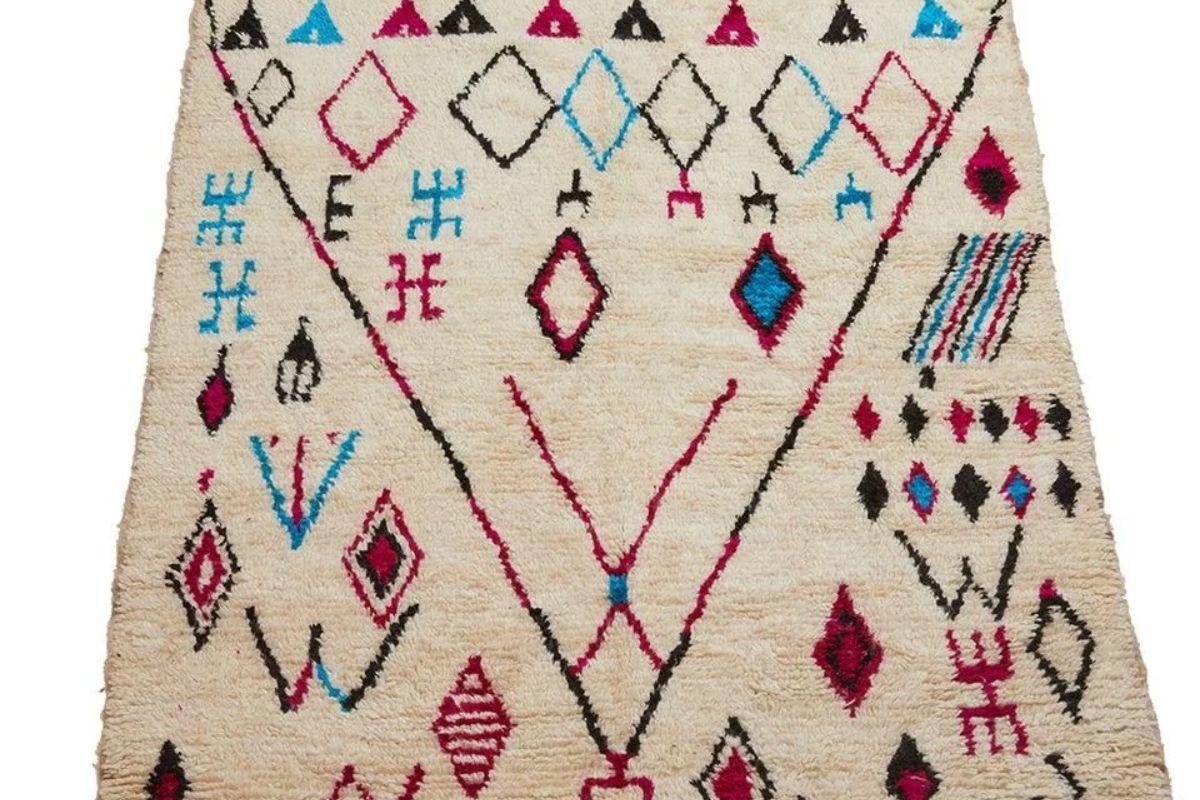
    Sometimes there are letters in the weave, but less often than rug listings suggest. A tifinagh symbols rug usually means one of two things. The first is a rug that deliberately carries a letter from Tifinagh, the script used to write the Amazigh (Berber) languages. Most often that letter is the yaz (ⵣ), a modern emblem of Amazigh identity. The second is a rug whose diamonds, crosses and lines are described as letters. The first is documented. The second is a claim, and a Moroccan heritage scholar quoted below warns against reading every motif as a hidden letter.

    This guide explains what Tifinagh is, how its letters are built, and how to tell the two situations apart before you accept a meaning from a product page.

    What Tifinagh Is

    Tifinagh is the alphabet of the Amazigh peoples of North Africa. A word on names first: "Berber" is the familiar market term, but it came from outsiders, and many people prefer Amazigh (plural Imazighen). This site uses both, because readers search with one and the weavers' communities often use the other.

    The script has a long and only partly understood history. Its ancestor, usually called Libyco-Berber, survives in stone inscriptions found across Morocco, Algeria, Tunisia, Libya and the Canary Islands. How old the oldest of them are is debated. Common scholarly summaries place the script in the first millennium BCE, with the earliest remains possibly from the sixth century BCE, while other summaries only commit to active use by the third century BCE. We are not going to pick a winner. The honest position is that nobody has a single agreed date.

    Even the name is disputed. Some scholars read "tifinagh" as a Berber adaptation of the Latin Punicus, making it "the Phoenician letters." Others connect it to a Tuareg verb meaning "to write." The two ideas are not mutually exclusive.

    After the Arab conquest of North Africa, the script largely dropped out of use in the north. The Tuareg of the Sahara kept it. Even there, its role was modest. The epigraphist M. C. A. MacDonald describes Tuareg society as largely oral and says Tifinagh is used "primarily for games and puzzles, short graffiti and brief messages." That matters for rugs: Tifinagh was never a script of long texts that a weaver would transcribe.

    How Tifinagh Became Morocco's Official Script

    The Tifinagh you see on Moroccan road signs today is a modern standard, not the ancient form. Activists linked to the Berber Academy in Paris developed a fully alphabetic "Neo-Tifinagh" in the 1970s. In Morocco, the Royal Institute of Amazigh Culture (IRCAM) was created in 2001, and in 2003 its version of the script, often called Tifinagh-IRCAM, was adopted for teaching Amazigh. Tamazight became an official language in Morocco's 2011 constitution, and an organic law in 2019 set out how it would be used, including in education.

    The script also has a standard digital form. The Unicode Consortium's Tifinagh code chart, which we consulted on 2026-09-23, lists the letters with names such as TIFINAGH LETTER YAZ. The block was first added to Unicode in version 4.1. If a seller tells you a woven shape "is" a particular letter, that chart is a neutral place to compare the forms yourself.

    This history is why a rug with a clear, deliberate Tifinagh letter reads as contemporary. It belongs to the period when the script became a public, political and educational symbol, not to an unbroken weaving tradition.

    How the Letterforms Are Built

    Tifinagh letters are made from very few elements: straight strokes, circles, dots and crosses. A few IRCAM letters show the pattern:

    Letter Sound Shape
    ⵣ (yaz) z A vertical stroke with two bracket-like arms, often compared to a standing figure
    ⵜ (yat) t A plus-shaped cross
    ⵏ (yan) n A single vertical stroke
    ⵔ (yar) r A circle

    Now think about how a rug is made. On a vertical loom, knots and wefts build a design row by row on a grid, which makes straight lines, stepped diagonals and crosses easy to produce. Our explainer on how the Moroccan vertical loom shapes a design covers that in detail. Put the two together and the problem becomes clear. A cross, a vertical bar or a diamond will appear in countless rugs whether or not the weaver had any letter in mind. A resemblance between a rug motif and a Tifinagh letter is expected, so on its own it proves nothing.

    Tifinagh Symbols in a Rug: Three Different Situations

    Most confusion comes from treating three different things as one. Here they are side by side.

    Situation What you see How well documented What it can tell you
    A deliberate letter or word A clear, isolated ⵣ, or a legible word such as a name or greeting, usually centered and set apart from the field Well documented as a modern identity symbol That the maker or commissioner chose to state Amazigh identity. It says little about the rug's age, except that it is likely recent.
    A geometric motif sold as a letter Diamonds, crosses, bars and lozenges repeated across the field, described in a listing as "Tifinagh" Weakly documented; mostly seller copy Very little. The shape exists; the reading is an interpretation.
    Script on other Amazigh objects Tifinagh-derived designs on Tuareg jewelry, amulets and leatherwork Documented by museums That the script lives in adornment, mostly in the Sahara, not in Moroccan pile rugs specifically.

    The first row is the only one where "those are letters" is a plain fact. The yaz is the Tifinagh letter for the sound z, and it is the letter that appears on the Amazigh flag, where it stands for the root of the word Amazigh itself. On a rug, it works the way it works on a flag or a T-shirt: as a statement. That is a real and respectable meaning. It is simply a modern one.

    What the Documented Sources Actually Say

    The strongest non-commercial evidence for Tifinagh in craft comes from the Sahara, not the Atlas.

    The Spurlock Museum at the University of Illinois, in a collection post on Tuareg beauty and adornment (published November 11, 2024, read by us on 2026-09-23), states that "Tuareg women are the teachers of the Tifinagh alphabet" and that it has been passed down through female relatives for generations. The same post says the geometric features of Tuareg bracelets and rings reflect symbolic meanings from the alphabet, and that amulets can carry Tifinagh letters and sometimes messages or blessings. That is a museum speaking about jewelry, which is a narrower claim than the one rug sellers make.

    For Morocco, the most useful voice is anthropologist Ahmed Skounti, a heritage specialist at the National Institute of Archaeology and Heritage Sciences in Rabat. In a 2026 article by Eric Anglade for the regional site Sud-Est Maroc, drawing on Skounti's work, the argument is that the symbolic world from which Tifinagh grew still runs through weaving, pottery and jewelry. The same article then adds the caution in plain terms: this "does not mean that every geometric motif on a rug, piece of pottery or fibula is a hidden Tifinagh letter," because "such an interpretation would be too quick."

    Put side by side, the position is careful. There is a shared visual world of lines, marks and abstract shapes in which writing, symbol and ornament overlap. There is no evidence we could find that Moroccan weavers routinely spelled words into the field of a traditional rug.

    Why Rug Listings Say Otherwise

    Search the phrase and nearly every result is a rug seller. Several say Tifinagh characters were abstracted into rug patterns, or that a specific cross or diamond "is" a named letter. We could not find a museum, university or Amazigh cultural organization making that claim about individual Moroccan rugs.

    There are understandable reasons it spreads. A letter-meaning gives a buyer a story, and a story helps a rug sell. The shapes genuinely overlap, as the table above shows. The part the listings leave out is that weaving knowledge has passed mainly from woman to woman inside households and villages, not through written pattern books. Our piece on the women who weave Moroccan rugs explains why that matters. A fixed "this shape equals this letter" chart turns a living, spoken practice into something tidier than it ever was.

    None of this means a weaver never wove a letter she knew. It means the listing is not evidence that she did.

    Where Tifinagh Fits, and Where It Does Not

    It helps to keep geography straight. The Tuareg Tifinagh tradition documented by museums sits in the Sahara, across parts of Niger, Mali, Algeria and Libya. Most rugs sold as Moroccan come from the Middle Atlas, the High Atlas, the Anti-Atlas and the plains, each with its own weaving conventions. Our Moroccan rug regions map shows where each named style comes from.

    So a "Tuareg Tifinagh" story attached to a Middle Atlas pile rug is mixing two regions and two craft traditions. It could still be a genuine Amazigh rug. The script story just does not come with it automatically.

    The one place Tifinagh clearly does fit Moroccan weaving today is the deliberate, modern use: a cooperative or a weaver choosing to put ⵣ, a name or a word into a rug as a statement of identity. That is worth valuing on its own terms rather than dressing up as ancient.

    How to Ask a Seller About a Tifinagh Rug

    If a listing says the rug contains Tifinagh, a few questions separate a documented claim from a sales line:

    1. Which letter, exactly? Ask the seller to name it and compare the shape against the Unicode chart yourself.
    2. Does it spell anything? A single isolated yaz is common and meaningful. A claimed "word" should be something the seller can read out.
    3. Who says so? Ask whether the weaver or cooperative described the meaning, or whether it came from a general symbol list.
    4. Is the rug described as old? A clearly legible Tifinagh letter on a rug sold as antique is worth questioning, given the script's modern revival.
    5. Where was it woven? A regional attribution should be consistent with the story being told.

    Our list of questions worth asking any rug seller covers provenance, construction and return terms beyond symbols.

    What This Site Cannot Tell You

    Atlas Rug Guide cannot tell you whether a motif on your particular rug was meant as a letter. We have not examined your rug, and nobody can read a weaver's intention from a photograph. We also cannot date a rug from its symbols. If the meaning matters to you, the best source is the weaver or the cooperative that made it, where that link still exists. For questions of age or value, an independent appraiser or a textile conservator who examines the piece in person is the right person to ask, not a product page and not this site.

    FAQ

    Are Tifinagh letters woven into Moroccan rugs?

    Sometimes, deliberately. The yaz (ⵣ) and occasionally a name or word appear in contemporary rugs as a statement of Amazigh identity. For older-style geometric designs, the claim that motifs are letters rests mostly on seller copy, and scholars caution against reading every motif as a hidden letter.

    What does the ⵣ symbol on a rug mean?

    It is yaz, the Tifinagh letter for the sound z. It is the letter on the Amazigh flag and stands for the root of the word Amazigh. On a rug it signals Amazigh identity. It does not by itself tell you the rug's age or region.

    Is a rug with Tifinagh symbols more authentic?

    No. A letter tells you what the maker chose to display, not who made the rug, where, or when. A machine-made rug can carry a yaz as easily as a hand-knotted one. Construction and provenance answer the authenticity question; symbols do not.

    Why do so many rug motifs look like Tifinagh letters?

    Both draw on a small set of shapes: straight strokes, crosses, circles and diagonals. A loom's grid makes those shapes easy to weave, so overlap is expected. A match in shape is not proof that a weaver intended a letter.
  • How Old Is Berber Weaving? Why the Sources Disagree

    How Old Is Berber Weaving? Why the Sources Disagree

    Short answer: Nobody can put a single documented age on Berber weaving. The figures you will read, from "since the Paleolithic" to "2,000 years" to "several millennia," are mostly uncited, or they rest on reading ancient symbols rather than on surviving cloth. The firmest date is far more recent: the oldest carpet known in Morocco carries a woven inscription for the year 1202 of the Islamic calendar, which is 1787. Amazigh weaving is certainly older than that carpet. How much older is an open question.

    That gap between confident claims and thin evidence is the whole story, and it is worth understanding before you believe a listing that calls a rug part of an "ancient, unbroken tradition."

    A note on words first. "Berber" is the older outside name for the Amazigh peoples of North Africa, and some communities reject it. We use Amazigh as our main term and Berber alongside it because that is what most readers search for. Our guide to what the word Berber rug actually means covers the naming history in more detail.

    How old is Berber weaving? Four answers and what each rests on

    Most of the confusion goes away once you sort the claims by the kind of evidence behind them. They are not four estimates of the same thing. They are answers to slightly different questions, backed by very different material.

    Claim you will read Where it usually appears What it rests on What it can actually show
    "Since the Paleolithic" Seller blogs; one uncited line in a popular encyclopedia entry Resemblance between rug motifs and prehistoric rock art That shapes look alike, not that a woven object existed
    "Several millennia" or "2,000+ years" Seller blogs, travel sites, a museum exhibition catalogue General reasoning about herding life and wool; rarely a named find A plausible range, not a measurement
    "Older than the Arab arrival" Seller and culture blogs The long presence of Amazigh peoples in North Africa That the people are old, not that the pile rug is
    1787 A 2025 peer-reviewed study A date woven into a surviving carpet The age of one carpet, and a floor for the tradition

    Read the table from the bottom up and the confidence drops as the claimed age rises. That is not a coincidence. The older the claim, the less physical evidence stands behind it.

    Where each number comes from

    "Since the Paleolithic"

    This is the most repeated big claim, and it has an unexpected source. When we read Wikipedia's "Moroccan rugs" article on 2026-09-23, it stated that rugs have been woven by the indigenous people of Morocco since the Paleolithic Era. That sentence carried no citation, and the article as a whole carried a notice that its sources were unclear for lack of inline citations. Many seller pages say the same thing in nearly the same words.

    The Paleolithic is the Old Stone Age, the long era before farming. No surviving Moroccan textile from that period is cited anywhere we looked. When the claim is defended at all, it is defended through symbols, which we come to below.

    "Several millennia" and "2,000 years"

    Wikipedia's separate "Berber carpet" article, read the same day, says carpet weaving by Berber populations goes back several millennia. Unlike the Paleolithic line, this one is cited: to a catalogue essay by Gebhart Blazek for an exhibition held from July 2005 to April 2006 at the L.A. Mayer Museum for Islamic Art in Jerusalem. We have not been able to read that catalogue, so we cannot tell you what evidence the essay gives. "Several millennia" is also a range, not a date.

    "2,000 years" and "2,200 years" appear across seller and travel pages. In the live search results we reviewed on 2026-09-23, none of those pages named the find, text or study the figure came from.

    "Older than the Arab arrival"

    Arab armies reached North Africa in the seventh century, and Amazigh peoples had lived there long before that. Both statements are standard history. What they do not establish is that the knotted pile rug, the thing most buyers mean by "Berber rug," existed in that earlier period. The claim quietly moves from the age of a people to the age of a particular object.

    1787: the one hard date

    The strongest evidence comes from a single carpet. In July 2025, The European Physical Journal Plus published a peer-reviewed study of the Chiadma carpet by Bensalem El Jeddaoui, Imane Fikri, Yacine Oubelkacem and colleagues, which we read on 2026-09-23. The authors describe it as the most ancient carpet known in Morocco. It carries Arabic script giving the year 1202 of the Hegira, which corresponds to 1787, and it is on display at the Dar Si Said Museum in Marrakech.

    The same study tested the dyes without damaging the rug. It identified cochineal in the pinkish reds, weld or Daphne gnidium in the yellows, and natural indigo in the blues, with mixtures for oranges and greens. If you want to know what those plant and insect sources are, our piece on what the sources say about Moroccan natural dyes goes through them.

    Two cautions keep this date honest. "Most ancient known" means the oldest surviving and identified carpet, not the first one ever made. And this is a single carpet, not a representative sample of Middle Atlas tribal rugs. We have not found a published, dated Middle Atlas pile rug older than it.

    Why the evidence runs out: wool does not keep

    Wool is organic. Moths, damp, sunlight and ordinary use destroy it, and a rug that is slept on, sat on and walked on for decades wears out long before anyone thinks to preserve it. Old textiles survive mainly in unusual conditions: frozen, very dry, or sealed away.

    The best-known example makes the point. A 2021 paper in Scientific Reports by Andreas Späth and colleagues, an X-ray microscopy study of the Pazyryk carpet's dyes that we read on 2026-09-23, describes it as the oldest known pile carpet, dated to about 400 BC, and exceeding the next dated specimens by at least six centuries. It was found in a burial mound in the Altai mountains of Siberia and is held by the State Hermitage Museum in Saint Petersburg.

    The Pazyryk carpet is not Moroccan and tells us nothing directly about Amazigh weaving. What it does show is how the record works everywhere: one lucky survival, then a gap of centuries. A missing ancient rug is not evidence that none existed. It is also not evidence that one did.

    North Africa has an extra problem. Archaeologist Andrew Wilson, in a paper on textile production and dyeing in Roman North Africa, notes that small finds such as spindle whorls, loom weights and needles from North African sites have been rarely and poorly published. The indirect evidence that would help, the tools rather than the cloth, has had comparatively little attention. One seller blog we read cites a 2010 journal article on early Maghreb fiber production to support a Neolithic date. We could not locate that article, so we do not repeat its claims here.

    Three questions hiding inside one

    "How old is Berber weaving" bundles three separate questions. Pulling them apart explains most of the disagreement.

    1. How old is weaving in North Africa? Making cloth from spun fiber is ancient across the Mediterranean world, and it would be surprising if North Africa were an exception. But the specific published evidence for Morocco is thin, for the reasons above.
    2. How old is knotted pile weaving in Morocco? This is a narrower technique, and the dated physical evidence begins with the 1787 carpet. Written references earlier than that circulate on seller blogs; one widely repeated line attributes an account of carpets as wedding gifts in Fez to the sixteenth-century writer known as Leo Africanus. We have not checked that line against his text, so treat it as unverified.
    3. How old are the regional styles sold today? Beni Ourain, Azilal and the rest are named traditions with their own histories. Their ages depend on dated examples in collections, which is its own subject, and should not be borrowed from claims about weaving in general.

    The loom itself also shapes what can be made and how, which is covered in our piece on the Moroccan vertical loom and what it decides.

    The word "Berber" adds a fourth layer. Historian Ramzi Rouighi, in Inventing the Berbers (University of Pennsylvania Press, 2019), argues that "Berber" as a single category took shape in medieval Arabic writing. Whatever you conclude from that argument, it is a good reason to be careful when a modern label is projected back into prehistory.

    What the symbol argument can and cannot prove

    The case for very deep roots is usually made through motifs. The fullest version is Bruno Barbatti's book Berber Carpets of Morocco: The Symbols, Origin and Meaning, translated from German by Alan J. Bridgeman. Barbatti compares rug motifs such as lozenges, chevrons and zigzags with signs in Stone Age cave art, rock carvings and early Anatolian sites, and reads them as a very old system of meaning.

    It is a serious, heavily illustrated argument, and some collectors treat it as foundational. It is also an argument from resemblance. Simple geometric shapes, such as diamonds, triangles and zigzags, turn up in many unrelated cultures, partly because a grid of knots or wefts makes them easy to produce. Two shapes looking alike across thousands of years is a hypothesis about continuity. It is not a dated textile.

    So the fair summary is this. Barbatti and writers who follow him argue for Neolithic or older origins of the visual language. Physical, dated evidence for Moroccan pile rugs begins much later. Both statements can be true at the same time, and neither settles the other.

    What this means if you own a rug or are about to buy one

    The age of a tradition and the age of your rug are two different facts, and listings often blur them.

    • "Ancient tradition" describes the craft, not the object. A new rug woven last year can honestly belong to an old tradition. That phrase says nothing about when your rug was made.
    • A motif cannot date a rug. The same shapes are woven today. Treat any claim that a symbol proves age as a sales line.
    • Ask what the seller's age claim rests on. A provenance record, a collection history, or a dated reference is evidence. "It looks old" is not. Our list of questions worth asking any rug seller includes the ones that matter here.

    What we cannot do is date or authenticate an individual rug. That takes hands-on examination by someone qualified: a textile conservator, a museum textile department, or an independent appraiser who is not selling the piece. Scientific dye analysis of the kind used on the 1787 carpet is laboratory work, not something a photo can replace.

    How we treat age claims on Atlas Rug Guide

    We give a date only when we can name where it comes from and when we checked it. Where scholars and sources disagree, we show the disagreement instead of picking a winner. On this question, the honest position is short: Amazigh weaving is old, the oldest dated Moroccan carpet is from 1787, and every larger number you see is either a range, an argument from symbols, or uncited.

    FAQ

    Is Berber weaving really from the Paleolithic?

    No surviving textile supports that claim. The "Paleolithic" line appears in an uncited encyclopedia sentence and on many seller pages. Where it is argued, it rests on similarities between rug motifs and prehistoric art, which is a hypothesis about shapes, not proof of weaving.

    What is the oldest known Moroccan rug?

    A 2025 peer-reviewed study describes the Chiadma carpet, dated by its woven inscription to 1787, as the most ancient carpet known in Morocco. It is on display at the Dar Si Said Museum in Marrakech.

    Did Amazigh people weave before the Arab arrival in North Africa?

    Amazigh peoples lived in North Africa long before the seventh-century Arab arrival, and weaving cloth is an ancient craft across the region. What is not documented is the existence of knotted pile rugs like today's in that earlier period. The published dated evidence for Moroccan pile carpets starts much later.

    Can the symbols on a rug tell me how old it is?

    No. The same motifs are woven today, and resemblance to ancient art does not date a textile. To learn a specific rug's age, you need a provenance record or examination by a textile conservator or independent appraiser.

  • Moroccan Rugs Museum Collection: Where to See Real Ones

    Moroccan Rugs Museum Collection: Where to See Real Ones

    Short answer: The largest public Moroccan rugs museum collection is in Morocco itself, at Dar Si Saïd in Marrakech, the National Museum of Weaving and Carpets, which has been closed for restoration since the 2023 earthquake. Outside Morocco, you can look up documented pieces online. The Victoria and Albert Museum in London holds Moroccan carpets you can see by appointment, and The Metropolitan Museum of Art in New York catalogs a 19th-century carpet attributed to Rabat. Each record tells you what the museum knows about a rug, which is often less than a dealer's description claims.

    This guide covers where those collections are, what their records actually say, and what a museum can and cannot tell you about a rug you own.

    Where Moroccan rugs sit in public collections

    Most people meet Moroccan rugs in shops and interiors, not museums. The museum side is smaller and more careful. The table below lists only holdings we confirmed on each institution's own website on September 23, 2026.

    Institution What its own records show How to see it Status to check
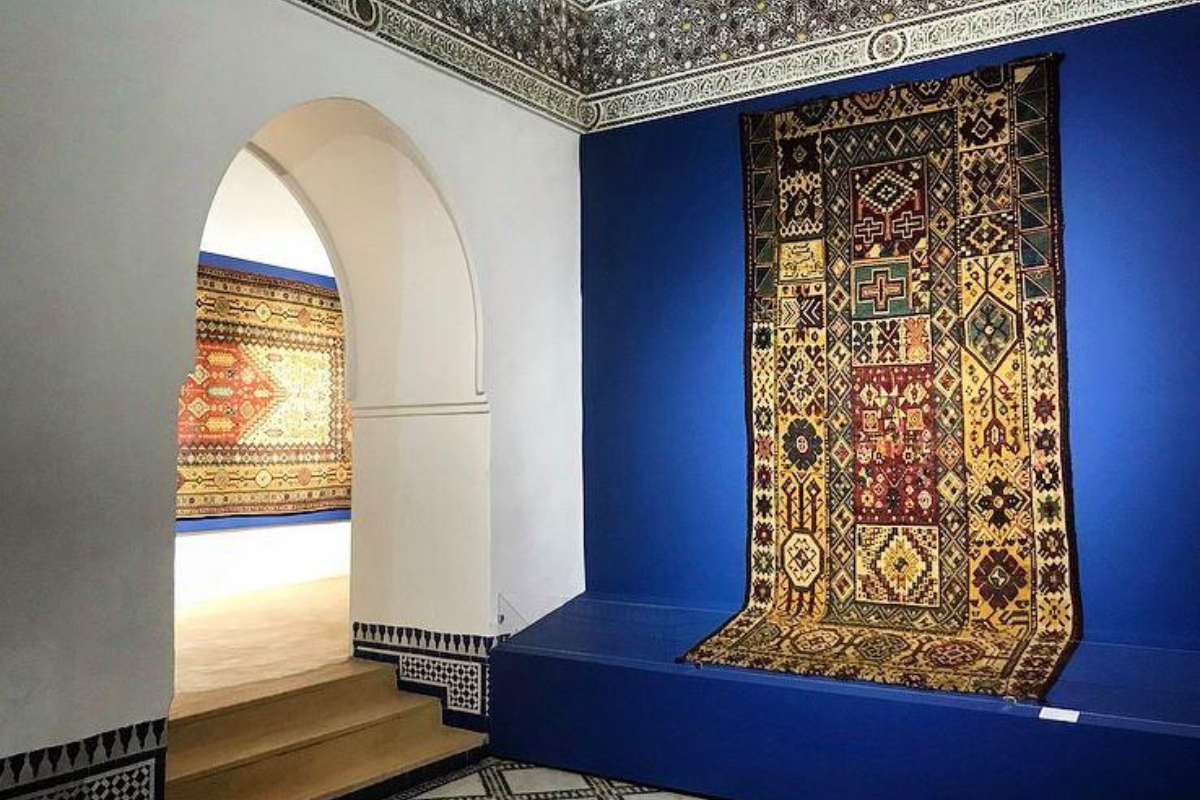
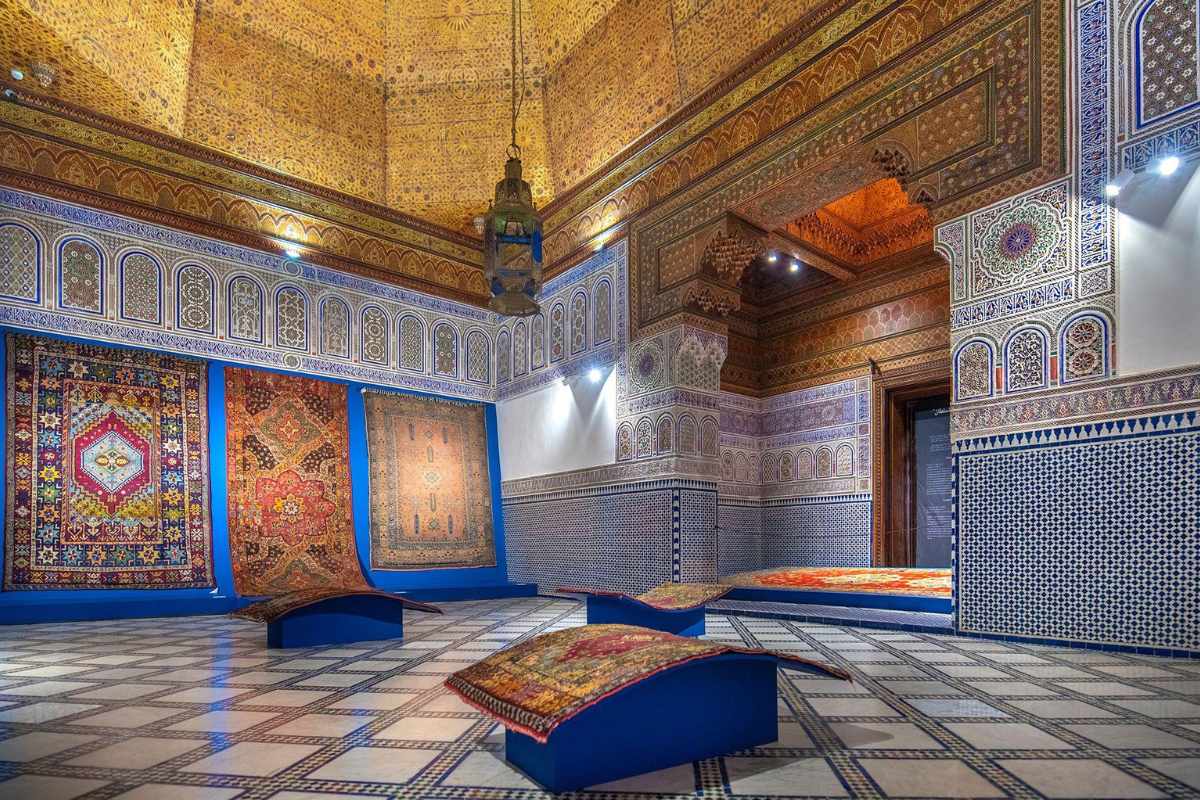
    Dar Si Saïd, Marrakech (Fondation Nationale des Musées) Carpets and weavings from across Morocco, including the Tensift, Sous, High Atlas, Anti Atlas, Bani and Tafilalet Visit in person once it reopens Closed for restoration after the September 2023 earthquake, per news reports
    Victoria and Albert Museum, London Moroccan carpets including T.18-1914 (dated 1860 to 1900) and T.139-1993 (High Atlas, probably 1950s) View by appointment at V&A East Storehouse Check each record for the ordering option
    The Metropolitan Museum of Art, New York A 19th-century knotted carpet attributed to Rabat, accession 45.114.16 Online record in the Department of Islamic Art Check the record for gallery status

    That is not a complete list. Other museums hold Moroccan textiles, and temporary exhibitions come and go. It is a list of places where we could read the record ourselves, which is the standard this guide keeps to.

    Dar Si Saïd: Morocco's national museum of weaving and carpets

    Dar Si Saïd is a 19th-century palace in the Riad Zitoun Jdid area of the Marrakech medina. The Fondation Nationale des Musées (FNM), which runs Morocco's national museums, restored it and reopened it on June 28, 2018 under a new name: the Musée National du Tissage et du Tapis, or National Museum of Weaving and Carpets.

    The FNM's page for the museum describes a rich and varied collection of Moroccan carpets and weavings from every region, covering both urban and rural carpets, along with woven textiles and traditional garments. It names pieces from the Tensift, the Sous, the High Atlas, the Anti Atlas, the Bani and the Tafilalet. That regional spread matters. It is one of the few places where you can compare rugs from very different parts of the country in one building, which is the best way to see why a single label like "Berber rug" covers so much. If the regions are unfamiliar, our map of Moroccan rug regions and the styles tied to each is a useful companion before a visit.

    Check before you travel. The September 2023 Al Haouz earthquake damaged the building, and Moroccan news outlets have reported it closed for restoration since then, with a restoration contract awarded in 2025. The FNM page still lists opening hours, so the page and the building may not match. Confirm the current status with the FNM directly before planning a trip around it.

    The Victoria and Albert Museum: two records worth reading

    The V&A in London is a good example of a museum whose online records reward slow reading. Two Moroccan carpets stand out.

    Carpet, 1860 to 1900, Morocco (T.18-1914). The record describes hand-knotted wool pile on a wool warp and weft, with a symmetrical knot and a stated density of 32 knots per square inch. It measures roughly 4.4 meters long. The catalog note points out that each element of the design is simple and only eight colors were used, yet so many patterns are combined that the effect is complex. The photograph shows almost half of this very long carpet. Notice what the record does not do: it names no region more precise than Morocco and no maker.

    Carpet, High Atlas, probably 1950s (T.139-1993). The V&A's collection record for carpet T.139-1993, which we read on September 23, 2026, describes knotted wool pile, two panels separated by a band with three crosses, diamonds in solid colors and with blossom motifs, and a weaving error in the lower panel. It also notes synthetic dyes, several yarn types and a trader's label from Marrakesh. The date is hedged with "probably," and the maker is listed as unknown.

    Both carpets are listed as viewable by appointment at V&A East Storehouse. The V&A's Order an Object service, which we checked on September 23, 2026, lets members of the public book a free appointment to see stored objects. Not every item marked "view by appointment" can be ordered that way, so check each record for the ordering option, and bear in mind that large carpets may be handled differently from small objects.

    The Metropolitan Museum of Art: an urban carpet attributed to Rabat

    The Met's collection data lists a carpet, accession number 45.114.16, in its Department of Islamic Art. It is dated to the 19th century, described as wool with symmetrically knotted pile, and measures 363.2 by 178.4 centimeters. Its place is given as Rabat, Morocco, with the attribution type "attributed to."

    This one is worth knowing because it is not the kind of rug most shoppers picture. Rabat is one of Morocco's urban carpet traditions. Urban carpets and rural Amazigh rugs developed along different lines, and a collection that includes both corrects the common idea that every Moroccan rug is a shaggy cream rug from the Middle Atlas. For the rural style that idea usually comes from, see our guide to the Beni Ourain rug and how to buy one.

    Why museum rugs don't look like shop rugs

    If you arrive at a Moroccan rugs museum collection expecting the pieces you see in design magazines, the difference can be a surprise. A few reasons explain it.

    • Collecting history. Many museum pieces were acquired generations ago. The V&A's T.18-1914 carries its acquisition year, 1914, in its accession number. A collection reflects what curators chose to buy at the time, which was not always the rural pile rugs now popular in interiors.
    • Urban and rural traditions sit side by side. Dar Si Saïd deliberately shows both. Shops mostly sell rural styles.
    • Materials change over time. The V&A's High Atlas carpet uses synthetic dyes, which its record states plainly. Museum records are one of the few places you will see dye and yarn noted as a matter of routine.
    • Broad labels give way to specifics. Museums usually prefer a place and a date range over a sweeping label like "Berber," and they say how confident they are in each.

    How to read a Moroccan rugs museum collection record

    This is the part most rug articles skip, and it is the most useful skill a buyer or owner can pick up from museums. A good catalog record is careful about what it knows. Learning its language helps you read dealer descriptions with the same care.

    Dates are ranges or hedges. "1860 to 1900," "19th century" and "probably 1950s" are all normal. A museum with the object in hand, and staff to study it, still gives a range. A dealer who dates a similar rug to a single year should be able to explain how.

    "Attributed to" is a real qualifier. The Met's carpet is attributed to Rabat. That means the place is the museum's best judgment, not a documented fact. Compare that with the confident tribe names in many sales listings.

    The maker is usually unknown. Both V&A carpets list an unknown maker. Moroccan rugs have largely been woven by women whose names were rarely recorded by the people who bought and exported their work. Our piece on the women who weave Moroccan rugs looks at that history.

    Technique fields are the most reliable. Knot type, pile, warp and weft materials, and knot density are observed facts rather than judgments. If you want to understand what those words describe, our guide to how Moroccan rugs are made, from fleece to finished rug walks through each stage.

    Description is not interpretation. The V&A's High Atlas record describes crosses, diamonds and blossom motifs. It does not tell you what they mean. That restraint is deliberate. Writers on Moroccan rug symbolism disagree, and the meaning of a motif can differ between weavers, families and regions, or be purely decorative. A record that names shapes without decoding them is being honest about the evidence.

    Object history tells you how it arrived. "Purchased," a donor's name, or a trader's label are clues to where a rug passed through, not where it was woven. The Marrakesh trader's label on T.139-1993 is an example: it records a sale, not an origin.

    What a museum can and cannot do for your rug

    Seeing documented pieces is the best training for your eye. It is not a way to authenticate your own rug, and we cannot do that from a description or photo either.

    What museums are good for:

    • Seeing real construction up close: knot density, edge finishes, how panels and borders are built.
    • Learning how careful professionals phrase dates, places and attributions.
    • Comparing regional styles side by side, especially at Dar Si Saïd once it reopens.

    What museums generally will not do:

    • Give a valuation. Curators generally do not appraise privately owned objects. For value, you need a qualified independent appraiser who specializes in rugs and textiles.
    • Confirm that your rug "matches" a museum piece. A similar look does not mean a similar date or origin, because many styles have been woven for generations and reproduced widely.
    • Assign a meaning to your rug's symbols.

    If you are buying, treat a museum comparison as a starting question for the seller, not as proof. Ask what evidence supports their stated date, region and materials, and see whether their answer is as careful as a catalog record.

    How to search museum collections yourself

    You do not need to travel to use these collections. A simple routine:

    1. Search the museum's own collection site, not a general search engine. Try "Morocco carpet," "Morocco rug" and "High Atlas," since museums catalog under different words.
    2. Filter by place and object type where the site allows it. Some records sit under Islamic art departments, others under textiles.
    3. Read the full record, not just the image. Date, place, attribution, technique, dimensions and object history are where the knowledge is.
    4. Note the accession number. It is the permanent way to refer to that object, and it often shows the year of acquisition.
    5. Check the display status. Many textiles are kept in storage because light damages them. Look for appointment or study-room options before you visit.

    FAQ

    Where is the largest Moroccan rugs museum collection?

    Dar Si Saïd in Marrakech, the National Museum of Weaving and Carpets run by the Fondation Nationale des Musées, is dedicated to Moroccan carpets and weavings from every region. It was damaged in the 2023 earthquake and has been reported closed for restoration, so confirm with the FNM before visiting.

    Can I see Moroccan rugs at the V&A in London?

    The V&A holds Moroccan carpets, including T.18-1914 and T.139-1993, which its records list as viewable by appointment at V&A East Storehouse. Check each record for an ordering option, because not every appointment item can be booked through Order an Object.

    Do museums explain what Moroccan rug symbols mean?

    Usually not. Catalog records tend to describe motifs such as diamonds and crosses without assigning meanings, because interpretations vary between writers and communities. Be cautious of any single fixed meaning presented as fact.

    Can a museum tell me what my Moroccan rug is worth?

    Generally, no. Curators rarely value privately owned pieces. For value, consult an independent appraiser who specializes in rugs, and for background, compare your rug's construction with published museum records.

    Why do museum Moroccan rugs look different from ones in stores?

    Museum collections reflect what was acquired decades ago and include urban carpets, such as the one the Met attributes to Rabat, alongside rural rugs. Stores mostly sell recent rural styles made for today's interiors.

  • Beni Ourain Modernism Design History: What’s Documented

    Beni Ourain Modernism Design History: What’s Documented

    The short answer. The Beni Ourain modernism design history starts earlier and is messier than most retellings admit. Amazigh (Berber) rugs from Morocco entered Western modernist interiors in the 1920s and 1930s, first through Paris architects such as Le Corbusier and then, far better documented, through design shops in Zurich and Helsinki that sold them beside modern furniture. Most of the famous designer anecdotes are repeated by rug dealers without sources. The strongest record comes from peer-reviewed research on the 1930s, and it names several Amazigh groups, not only the Beni Ourain.

    This article sorts the story by evidence: what is documented, what is plausible but thinly sourced, and what we could not trace at all.

    Why the Beni Ourain modernism design history is hard to pin down

    Search for this topic and almost every page-one result is a rug seller. That matters, because a dealer has a reason to want the rug on your screen to sit in the same sentence as Le Corbusier. The same list of names travels from page to page: Le Corbusier, Alvar Aalto, Frank Lloyd Wright, Charles and Ray Eames, Marcel Breuer, Arne Jacobsen. The sources behind the list rarely travel with it.

    There is a second problem, and it is about the label. "Beni Ourain" today names a style: thick, undyed cream wool with dark lines, often in lozenges. Our guide to the Beni Ourain rug covers that style in detail. But in the modernist story, "Beni Ourain" is often used loosely for any pale, shaggy Moroccan pile rug, and sometimes for any Moroccan rug at all. When a page says a designer "used Beni Ourain rugs," it is worth asking whether the source said that, or said "Berber rugs" and the Beni Ourain part was added later.

    We cannot settle every case. What we can do is show you which claims have a trail.

    The designer stories, sorted by evidence

    This table reflects what we could trace on 2026-09-23. "Documented" means a museum, house museum or peer-reviewed source says it. "Thin" means we found it only on dealer pages or in magazine copy without a named source.

    Claim What we found Evidence level
    Le Corbusier used Moroccan (Berber) rugs at Maison La Roche, Paris Stated by the Iconic Houses network Documented for "Berber rugs"; the specific type is disputed
    Moroccan carpets were sold beside modern furniture in 1930s Zurich and Helsinki Peer-reviewed research in the Journal of Design History Documented
    Aalto interiors, including Villa Mairea, used pale Moroccan pile rugs Dealer pages reproduce period photos credited to Aalto archives; the peer-reviewed article covers Artek broadly Plausible, photo-based, type attribution from dealers
    A 1938 photo of Fallingwater shows a Beni Ourain rug Repeated in Dwell, excerpted from a gestalten book, without an archive reference Thin; we could not trace the photo
    Charles and Ray Eames owned a Beni Ourain A dealer photo caption of their home describes "a Moroccan carpet" Thin; the type is not stated
    Breuer and Jacobsen "used" Beni Ourain rugs Dealer lists Thin, except Breuer's link to Wohnbedarf (below)

    Notice that the most confident claims online are often the weakest. The Fallingwater photo is quoted widely, yet we found no page that says which archive holds it.

    Paris in the 1920s: Le Corbusier and the Berber rug

    The earliest well-attested chapter is Maison La Roche in Paris, designed by Le Corbusier and Pierre Jeanneret between 1923 and 1925 and now run by the Fondation Le Corbusier as a house museum. The Iconic Houses network lists "Berber rugs" among its freestanding furnishings, beside Thonet chairs and Maple armchairs.

    That is solid for "Berber rugs." It is not solid for "Beni Ourain." Dwell, excerpting a design book, says Le Corbusier used Beni Ourain carpets there. Maroc Tribal, a vintage rug dealer, describes the rugs at the house as "deep and boldly-colored," which does not sound like a cream Beni Ourain at all. Two popular sources, two different pictures, neither citing an inventory. We present the disagreement rather than choose between them.

    Le Corbusier's relationship with textiles was also more conflicted than the "he loved Berber rugs" line suggests. The Journal of Design History article discussed below notes that he treated textiles as a form of concealment he criticized in principle, while still allowing himself to use them.

    Zurich and Helsinki in the 1930s: the best-documented chapter

    The richest evidence comes from Daniele Burlando's open-access article, "'Moroccan' Artek: Colonized Textiles within 1930s Modernist Interiors" in the Journal of Design History (Oxford Academic, read 2026-09-23). Its key points, as the article presents them:

    • Wohnbedarf, Zurich. The shop was founded in 1931 by art historian Sigfried Giedion, architect Werner Moser and businessman Rudolf Graber. Marcel Breuer, who designed the shop, had traveled to North Africa several times. In August 1935 Wohnbedarf hosted a "North African Folk Art Exhibition."
    • Artek, Helsinki. In 1936 Artek staged two displays with a substantial presence of Amazigh carpets: a model apartment on Minervankatu, where the rugs sat in living rooms and bedrooms with Aalto furniture, and a "Moroccan" carpet display in its shop.
    • The names used. The groups and places named in the research include Marmoucha, Beni M'Guild and Beni M'Tir, and villages such as Bhalil and Guigou. Press of the time described both "black-and-white undyed wool compositions" and rugs in shades of red.

    That last point is the one most retellings skip. The documented 1930s rugs were a range of Moroccan styles, not a single cream-and-black type. If you know the Marmoucha rug, often described as a quieter relative of the Beni Ourain, you can see how easily one popular label could later absorb its neighbors.

    The colonial layer most retellings leave out

    The rugs did not simply "travel" to Europe. They moved under the French protectorate of Morocco, and the same research describes that setting directly.

    The protectorate's Service des Arts Indigènes set out to document and regulate Moroccan crafts. Prosper Ricard, who became its director in 1920, compiled the Corpus des Tapis Marocains (1923 to 1934), a catalog of carpet patterns. According to the Burlando article, designs in that system were "corrected and cleansed" for quality control and export. In other words, colonial officials were already shaping what counted as an authentic Moroccan rug before modernist shops put those rugs in their showrooms.

    European press of the 1930s, the article reports, described the carpets as products of "surviving ancestral traditions of secluded populations, unspoiled by modernity." That phrasing still echoes in seller copy today. The article's argument is that this framing helped turn Amazigh household textiles into modern commodities, while the women who wove them stayed anonymous in the colonial record.

    We think a reader deserves that context. It does not make owning a rug wrong. It does explain why the "timeless tribal rug meets modern master" story is so appealing, and why it leaves the makers out. Our piece on the women who weave Moroccan rugs picks up that thread in the present day.

    Why the rugs looked "modern" to modernists

    There is a real design reason the pairing worked, and it is not only marketing. Modernist interiors favored plain surfaces, exposed structure and little applied ornament. A pale, undyed wool rug with a few dark lines added warmth, texture and sound softening without competing with the architecture. Abstract geometry read as contemporary to people who were deliberately rejecting figurative decoration.

    Die Neue Sammlung, the design museum in Munich, built an entire exhibition around that affinity. Moroccan Carpets and Modern Art at Die Neue Sammlung (museum exhibition page, read 2026-09-23) ran from September 14, 2013 to January 5, 2014 at the Pinakothek der Moderne. It drew on the collection of Munich architect Jürgen Adam and stated that Moroccan carpets "fascinated artists such as Wassily Kandinsky and Le Corbusier" in the early twentieth century. The accompanying book, Moroccan Carpets and Modern Art by Jürgen Adam (Arnoldsche), is the closest thing we found to a scholarly survey of the visual argument.

    Keep one caution in mind. Saying a rug "looks modern" describes a European viewer, not the weaver. These rugs were made as bedding, floor covering and household goods for cold mountain winters, for use, not as anticipations of abstract art. Our explainer on what the word "Berber rug" means covers why the vocabulary itself carries an outsider's view, and why this site uses Amazigh alongside Berber.

    From modernist interiors to the recent revival

    After the interwar period the trail thins again. The mid-century names on dealer lists (Eames, Jacobsen, Wright) are where sourcing is weakest, and we have not found primary records that confirm the rug types involved.

    The modern revival is easier to see, though harder to date precisely. Dealer pages describe a renewed wave of interest in Moroccan rugs over roughly the last two decades, tied to the wider return of mid-century modern furniture. The 2013 Munich exhibition is one fixed point in that revival. Much of the rest is commercial, and some dealers themselves warn that rugs sold under the "Beni Ourain" name are now also machine-made or woven outside Morocco. The modernist story, in other words, has become part of how the label is sold.

    What this history can and cannot tell you about a rug you own

    This history explains why a cream Moroccan rug looks right in a Bauhaus-style room. It cannot tell you anything about a specific rug in your house or in a listing.

    • It cannot authenticate a rug. A seller's claim that a piece is "the kind Aalto used" is a sales line, not provenance.
    • It cannot date a rug. Age is judged from the object itself: wool, dyes, wear, construction. That takes hands-on examination.
    • It cannot value a rug. A modernist association adds story, not documented worth.

    For an individual piece, the people who can help are textile specialists at museums with North African collections, and independent appraisers who do not sell the rug they are assessing. We are a reading guide, not an authenticator, and we say so plainly.

    FAQ

    Did Le Corbusier really use Beni Ourain rugs?

    He used Berber rugs at Maison La Roche in Paris, according to the Iconic Houses network. Whether they were Beni Ourain specifically is disputed: some design writing says yes, while a dealer describes them as boldly colored. We found no inventory that settles it.

    Which modernist designers are best documented with Moroccan rugs?

    The strongest record is for the 1930s shops Wohnbedarf in Zurich and Artek in Helsinki, covered in peer-reviewed research in the Journal of Design History. Aalto interiors appear in period photos. Claims about Eames, Wright and Jacobsen rest mostly on dealer pages.

    Why do Beni Ourain rugs suit modernist interiors?

    Undyed wool, sparse geometric lines and deep pile add warmth and texture to plain modernist rooms without adding figurative ornament. That affinity was the subject of the 2013 to 2014 Munich exhibition Moroccan Carpets and Modern Art.

    Does a modernist connection make my rug more valuable?

    Not on its own. A general design history says nothing about a particular rug's age, origin or worth. For that you need a hands-on assessment by an independent appraiser or a museum textile specialist.

  • Berber Tribes Morocco Rugs: The Groups Behind the Names

    Berber Tribes Morocco Rugs: The Groups Behind the Names

    Some of the best-known Moroccan rug names refer to real Amazigh groups, and some do not. Beni Ourain, Beni Mguild and Zemmour are names of peoples or confederations. Azilal is a province, Boujad and Taznakht are towns, and Boucherouite is a rag-weaving technique. So the Berber tribes Morocco rugs are named after are real communities, but on a sales listing the name describes a style. It does not prove who wove the rug or where.

    This guide sorts the names by kind, shows which scholarly and museum sources actually attach them to groups, and marks where those sources disagree. We cannot authenticate an individual rug or place it with a particular community. Near the end, we point to who can.

    Is "Beni Ourain" a people or a product line?

    Both, and that is the source of most confusion. The name began as the name of a people. In the trade, it now also works as a style label, used for almost any rug with an undyed cream ground and dark lines. Our Beni Ourain guide covers how loosely the label is now applied.

    The same double life applies to most named styles. It helps to sort them into three groups before asking what any one name proves.

    Name on the listing What kind of name it is Where this guide's attribution comes from
    Beni Mguild A group of people, Middle Atlas Named in Prosper Ricard's Middle Atlas volume of the Corpus des tapis marocains (1926)
    Zaïane, Aït Ighezrane Groups of people, Middle Atlas Named in the same Ricard volume, though rarely seen on listings today
    Ait Khabbash A group of people, Tafilalet, southeastern Morocco Cynthia Becker's fieldwork, University of Texas Press (2006)
    Beni Ourain (Beni Ouarain) A group of people, northeastern Middle Atlas Mainly dealer and trade sources; see the disagreement section below
    Zemmour A group of people, historically placed between Rabat and Meknès Trade and specialist sources; we found no museum record confirming it
    Azilal A province in the High Atlas An administrative name, not a group
    Boujad, Taznakht Towns Place and market names, not groups
    Boucherouite A technique (rag rugs) Not a group at all

    Read the right-hand column as carefully as the middle one. The sourcing behind these names is uneven, and a confident list on a shop page often has less behind it than it appears.

    Which Berber tribes Morocco rugs are named after, and who says so

    Three kinds of source are worth more than a seller's list: an early systematic catalog, academic fieldwork with a named community, and a museum. Each one tells you something different.

    The earliest systematic catalog: Ricard's Corpus (1923 to 1934)

    The most-cited early attempt to sort Moroccan carpets by group is the Corpus des tapis marocains, prepared by Prosper Ricard as head of the Service des arts indigènes, the arts office of the French protectorate administration. Bookseller and library listings date the original volumes between 1923 and 1934. Volume 1 covers Rabat (1923). Volume 2 covers the Middle Atlas (1926). Volume 3 covers the High Atlas and the Haouz of Marrakech (1927). Volume 4 gathers miscellaneous carpets, including more from the Middle Atlas and eastern Morocco (1934).

    The Google Books record for the Middle Atlas volume, Corpus des tapis marocains: Tapis du Moyen Atlas, read on 23 September 2026, lists a 1975 Geuthner reprint. Its index terms include the Beni Mguild, the Zaïane and the Aït Ighezrane, alongside places such as Midelt, Boulmane and the Moulouya valley, and technical terms for knotting and weaving.

    Two things follow. First, at least one trade name, Beni Mguild, appears in this early catalog. Second, the catalog also names groups, such as the Zaïane and Aït Ighezrane, that the modern trade rarely uses as labels. The trade's list of "tribal" styles is a selection, not a complete map of who wove.

    Keep the catalog's origin in mind as well. It was compiled by an office of the colonial administration. That makes it a primary document of how the protectorate classified Moroccan weaving. It is not necessarily a record of how weaving communities described themselves.

    Fieldwork with a named community: Becker and the Ait Khabbash

    The strongest academic source we found on Amazigh women's arts is Cynthia Becker's Amazigh Arts in Morocco: Women Shaping Berber Identity, listed on Project MUSE and read on 23 September 2026. The book was published by the University of Texas Press, first in 2006, and Project MUSE lists a 2009 edition. It is based on Becker's fieldwork with the Ait Khabbash, an Amazigh community near the Tafilalet oasis in southeastern Morocco.

    The book's description says the women it studies create "brightly colored carpets" among other arts, and it argues that "the arts are expressions of ethnic identity," with women as "guardians of Amazigh identity."

    This is a different kind of evidence from Ricard's catalog. It ties weaving to one named community through direct fieldwork, rather than assigning carpet types to groups for an administrative catalog. It also shows how much the trade's style list leaves out. The Ait Khabbash are not one of the famous named styles, yet they are among the best-documented weaving communities in the academic record. Our guide to the women who weave Moroccan rugs covers this research in more depth.

    Collectors and museums: Barbatti and the Musée Pierre Bergé

    Bruno Barbatti's Berber Carpets of Morocco: The Symbols, Origin and Meaning (ACR Édition, Paris, 2008, translated from the German by Alan J. Bridgeman) is the book dealers cite most. Bookseller biographies say Barbatti, who taught history in Zurich, collected carpets during long stays in Marrakech, and that part of the collection was shown at the Museum Bellerive in Zurich in 1996. His book is a collector-scholar's work, valuable for its range of examples. Its central argument, that carpet motifs descend from prehistoric fertility symbols, is his thesis and not a settled consensus.

    In Marrakech, the Musée Pierre Bergé des Arts Berbères at the Jardin Majorelle opened in 2011. On its own website, read on 23 September 2026, the museum says it holds "more than 600 objects, collected from the Rif Mountains to the Sahara," and describes "a map showing the location of the major Berber tribes throughout the country." That approach, grouping objects by region and placing peoples on a map, is closer to how Morocco's museums work than the seller's habit of one tribe per style. Our Moroccan rug regions map sets out how two Marrakech museums group weaving by region.

    Where the sources disagree

    These are the disagreements a reader will actually run into, and how we handle each one.

    How many groups make up the Beni Ourain. Dealer pages commonly describe the Beni Ouarain as a confederation of about seventeen tribes in the northeastern Middle Atlas. We did not find a museum or scholarly record that confirms that figure, so we report it as the trade's description, not as a checked fact. We also found a seller page that placed Beni Ourain weavers in the High Atlas. Most sources, including our own style guides, place them in the Middle Atlas.

    Whether "Beni Ourain" means all Berber rugs. At least one large dealer page uses the name as if it covered Amazigh weaving in general, while describing it elsewhere on the same page as one confederation. The second use is the accurate one.

    Whether a style is a tribe at all. Some seller lists present Boucherouite as a tribe. It is a rag-rug technique used in several regions. Azilal is sometimes written as if it were a single people, when it is a province covering many communities.

    Grouping by tribe or by region. Seller pages sort rugs by tribe name. Ricard's volumes are organized by region, with groups named inside each one. The museums we checked lead with region. None of these approaches is wrong. They answer different questions, and a region grouping makes fewer claims about any one rug.

    What the motifs mean. Barbatti reads motifs as prehistoric fertility symbols. Becker's fieldwork looks at what the women she worked with said about their own work, and ties meaning to identity and community. These approaches can reach different answers about the same motif. We attribute any reading to the person who made it and do not state a single meaning as fact.

    What "Beni," "Ait" and "tribe" tell you

    Two prefixes appear across these names. Beni is the Arabic word for "sons of" or "children of." Ait plays the same role in Tamazight, the Amazigh language. Either prefix tells you the name started as the name of a people, which is a useful first check when you meet an unfamiliar label.

    The word "tribe" needs more care. Ricard's catalog, one of the main early sources for these group names, was produced by a colonial administration, and its categories reflect that administration's way of sorting people and objects. Communities may describe themselves by village, lineage, valley or region as readily as by a tribal name. "Berber" also comes from an outside name that many communities reject. That is why this guide uses Amazigh (plural Imazighen) for people and keeps "Berber" where it is the trade term a reader is searching for. Our explainer on what a Berber rug is covers the history of the word.

    None of this makes the names meaningless. They point to real people in real places, most of the weavers are women, and the craft has named cooperatives and a working rug economy today. The names are a starting point for knowing who made a rug. They are not a guarantee.

    What a tribe name on a label can and cannot prove

    A tribe name on a listing tells you which look the seller is describing. It does not tell you that a member of that group wove the rug. Popular styles are woven outside their home areas, commissioned wherever there is weaving capacity, and sometimes produced outside Morocco.

    Here is what is worth asking a seller when a listing names a group:

    • Do you mean the style or the origin? A good seller will say plainly which one they mean.
    • Where was this rug woven, and how do you know? A named town, cooperative or source is a claim you can weigh. "Authentic tribal" on its own is not.
    • Is the attribution based on anything written down? A purchase record, a cooperative's documentation, or a comparison with a published reference such as Ricard's volumes is stronger than a story.

    What we cannot do is tell you which community wove a specific rug, or how old it is. For that, the people to ask are a museum textile department, a textile conservator, or an independent appraiser with documented experience in North African weaving. None of them has a stake in the sale, and a second opinion from someone with nothing to sell is worth more than any label.

    FAQ

    Is Beni Ourain a tribe or a style?
    Both. Beni Ourain (also written Beni Ouarain) began as the name of an Amazigh group in the northeastern Middle Atlas. In the rug trade it is also a style label for undyed cream rugs with dark lines, applied to rugs woven well beyond that group.

    Which Moroccan rug names are real tribal names?
    Beni Ourain, Beni Mguild and Zemmour are names of peoples. Beni Mguild is named in Prosper Ricard's 1926 Middle Atlas catalog. Azilal is a province, Boujad and Taznakht are towns, and Boucherouite is a rag-weaving technique.

    How many Berber tribes make Moroccan rugs?
    We found no reliable count. Seller pages give numbers, but we found no scholarly or museum source that fixes one. The Moroccan museums we checked group weaving by region rather than listing every group.

    Can a tribe name prove where my rug was made?
    No. A tribe name describes a style. Only a documented source, such as a named cooperative or a seller's written record, supports an origin claim. For an opinion on a specific rug, ask a museum textile department, a conservator or an independent appraiser.

    Why do some people say Amazigh instead of Berber?
    "Berber" comes from an outside name that many communities reject. Amazigh, plural Imazighen, is the name many use for themselves. The rug trade still mostly uses "Berber."

  • Moroccan Rug Dowry Tradition: What Sources Say

    Moroccan Rug Dowry Tradition: What Sources Say

    The Moroccan rug dowry tradition is real but narrower than most shop pages suggest. Reporting from Taznakht in southern Morocco records that rugs were typically part of a bride's dowry and were exchanged to announce marriages. Beyond marriage, many Amazigh (Berber) rugs and textiles were made to be used at home: slept on, slept under, worn and carried. What the documented record does not support is the idea that any given rug's pattern proves it was a dowry piece.

    That gap between what is documented and what is sold is the subject of this guide. Below, each claim is tied to the source that makes it, with a note where sources disagree or where we could not verify something ourselves.

    What "dowry" means in a Moroccan context

    The English word "dowry" does a lot of loose work in the rug trade, and it helps to pin it down first.

    In Moroccan law, the marriage payment runs the other way from the common English picture. Article 26 of Morocco's Family Code (the Moudawana, reformed in 2004) defines the sadaq as property the husband gives to the wife, and it becomes hers. That is a legal payment, not a rug.

    When rug sellers and journalists write about "dowry rugs," they usually mean something different: textiles woven by a bride or the women of her family that went with her into married life. In English that is closer to a trousseau than a dowry. We use "dowry" in this article because it is the word the sources and readers use, but the distinction matters. A "dowry rug" in a shop listing is describing a household textile tied to a marriage, not a formal marriage payment.

    It also matters that Morocco is not one weaving culture. Practices around marriage, weaving and household goods differ between regions, between Amazigh groups, and between rural and urban families. Our map of Moroccan rug regions shows how many distinct traditions sit under the single label "Moroccan rug." A custom documented in one valley should not be read as a rule for the whole country.

    What the sources actually say about the Moroccan rug dowry tradition

    Here is what we could confirm from named, checkable sources, each read for this article on 2026-09-23.

    Taznakht, southern Morocco. A report by Africanews, published July 2, 2025, states that "typically, the rugs were part of a bride's dowry and were exchanged as a way of announcing marriages." The same report quotes Abderrahmane Janah, manager of the women's carpet center in Taznakht, saying women "expressed their creativity in making the rug and used it as a medium to convey their emotions." It describes the Women's Centre for the Promotion of the Taznakht Carpet, established in 2016, as grouping 35 cooperatives and 3,500 women weavers. This is journalism about one named place, and it is the clearest dated statement of the dowry custom we found.

    The Ait Khabbash of southeastern Morocco. Art historian Cynthia J. Becker's book Amazigh Arts in Morocco: Women Shaping Berber Identity (University of Texas Press, 2006) is based on fieldwork among the Ait Khabbash near the Tafilalet oasis. The publisher's description says the Ait Khabbash weave brightly colored carpets and that these arts are primarily made by women. The book's first chapter covers Ait Khabbash textiles, and two later chapters cover the adornment of the bride and groom and wedding ceremonies. One honest limit: we confirmed the book's scope and chapter structure, not a specific passage on dowry textiles, so we do not attribute any dowry claim to Becker here.

    A wedding textile in a museum record. The Metropolitan Museum of Art holds an early 20th-century Moroccan woven wool piece titled Tamizart (handira) Cape, classified in its collection as outerwear. We return to why that classification matters in the next section.

    What these sources share is a picture of weaving as women's work tied to family and marriage. What none of them says is that a particular motif marks a rug as a dowry piece, or that every rug from a region was woven for a wedding.

    The handira: wedding blanket, cape, or both?

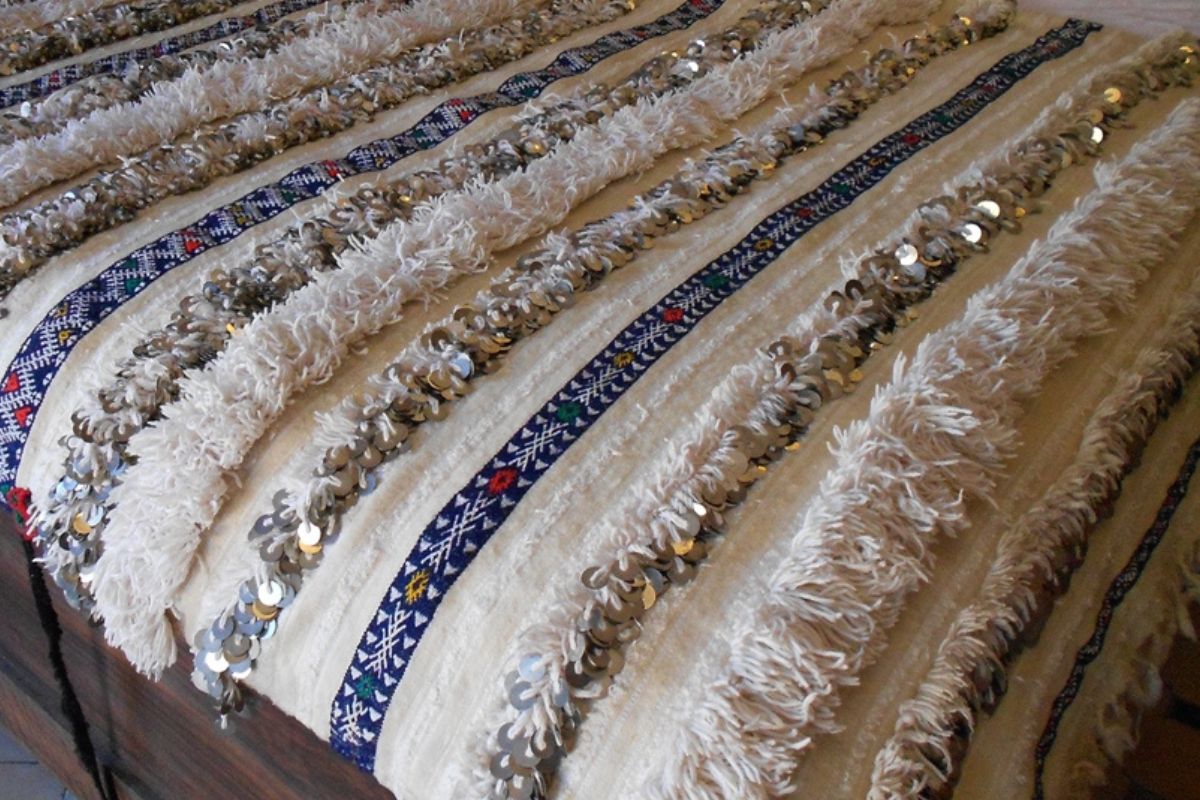
    The handira is the textile most often sold as a "Moroccan wedding blanket." It is usually a flatwoven wool piece, often white or cream, frequently decorated with sequins.

    This is a clear case where sources disagree about what the object is.

    • Seller and blog pages mostly describe the handira as a blanket, and market it as a throw, bedspread or wall hanging. Many say the bride wore it on her way to her husband's home and later used it on the bed, and that the sequins were meant to ward off the evil eye. The pages we reviewed give no source for those statements.
    • The Met's catalog entry titles its example a "cape" and classifies it as outerwear. In other words, the museum records it first as something worn, not as bedding.

    These positions are not necessarily in conflict. A textile can be worn at a wedding and used as a cover afterward, and objects often change roles over a lifetime. But the museum classification is a useful corrective to the idea that a handira is simply a decorative blanket.

    The protective meaning of the sequins is widely repeated, and we could not find it stated in a museum or scholarly source we could read in full, so we report it as a claim, not a fact. The people best placed to say what a handira meant are the women who wove and wore them, and their families. Our guide to the women who weave Moroccan rugs looks at that knowledge and who holds it today.

    Rugs as bedding: the everyday life of a pile rug

    The dowry story gets attention, but it describes a moment in a rug's life. Most of a rug's life was spent being used.

    Several dealer and travel-guide pages we reviewed describe the thick pile rugs of the Atlas Mountains as bedding: bed coverings, sleeping mats, blankets and mattresses. They typically contrast these heavy-pile mountain pieces with lighter flatweaves from drier, warmer areas. These are commercial sources, and we could not locate a museum object record that describes a specific Middle Atlas pile rug as bedding. The claim is plausible and consistent across the pages we read, but we have not been able to document it independently.

    The physical logic is easy to follow. A long, loose wool pile traps air and holds warmth, which suits a cold mountain winter. If you have seen a Beni Ourain rug up close, the depth of the pile makes as much sense as a mattress or a winter cover as it does as a floor rug.

    If a rug did spend years as bedding, that would explain some features that puzzle buyers today:

    • Irregular shapes and sizes. A rug made for a household was woven to the family's loom and wool supply, not to a standard room dimension.
    • Soft, loose pile. A rug meant to be slept on did not need to resist shoes and furniture.
    • Wear that looks uneven. A rug used as bedding, folded, and later put on a floor can show a mix of wear patterns. That history can be real, but it is not evidence of age on its own.

    How a rug's width and length are set by the loom, rather than by a buyer's room, is covered in our article on how Moroccan rugs are made.

    Household objects beyond the floor

    The bedding role is the best known, but dealer and guide pages also describe Moroccan rugs and flatweaves as seating, floor insulation, tent furnishings and saddle covers. Most of the sources we found for these uses are commercial, so we pass them on as reported uses, not verified ones.

    What the documented sources do support is the broader point: these were household objects made by women for their own families and communities, and marriage was one of the occasions tied to weaving. Becker's study of textiles as a women's art linked to identity, and the Taznakht center manager's description of rugs as a medium for emotion, both point the same way. A rug on a gallery floor in New York or London may well have begun life as something with a job to do at home.

    What this means for a rug you own or are buying

    This is the part most pages about the Moroccan rug dowry tradition leave out.

    "Dowry rug" and "wedding rug" are now common sales labels, and they are nearly impossible to check. Here is how the most common claims hold up against the sources above.

    Claim you may hear Who supports it How much weight to give it
    Rugs were part of brides' dowries in some places Africanews report on Taznakht, 2025 Documented for a named place; do not generalize to all of Morocco
    Weaving was a women's art tied to identity and marriage Becker, University of Texas Press, 2006 Supported for the Ait Khabbash; do not generalize
    Handiras were worn as wedding capes Met collection record Supported by a museum classification
    Handira sequins ward off the evil eye Sellers and blogs Unsourced in what we could read; treat as a claim
    Thick pile rugs were used as bedding Dealers and guides Plausible and consistent, not museum-documented by us
    Rugs with many triangles or diamonds were dowry rugs Sellers No source we found; a motif cannot prove a rug's purpose

    A few practical points follow from this:

    1. Motifs do not prove a dowry origin. Symbol meanings in Amazigh weaving are contested, and none of the sources above ties any motif to dowry rugs. A seller who says a rug "must be a dowry rug" because of its triangles is offering an interpretation, not a fact.
    2. Ask how the seller knows. A dowry or wedding history should come from somewhere specific: the weaver, her family, or a cooperative that records who made each piece. If the answer is "tradition," the story is general, not about your rug.
    3. Wear is not provenance. Signs of use as bedding do not date a rug or confirm its history, and new rugs can be artificially aged to look used.

    We cannot authenticate an individual rug, confirm that it was a dowry piece, or give it a value. For that, a qualified appraiser with textile expertise, a museum textile department that offers identification, or a cooperative that documents its weavers by name will serve you far better than any website, including this one.

    Why the use history matters

    It is easy to write about these rugs as mysterious objects from a timeless past. They are not. They come from named regions and named communities, and from women whose skill was, and still is, part of how households and marriages are built. Many are still woven today, often through cooperatives like those in Taznakht.

    Seeing a rug as bedding, a wedding garment, or part of what a bride brought into her new home does not make it less beautiful on a modern floor. It makes it more specific. It also makes it easier to spot when a sales story has been added to a rug that never had one.

    FAQ

    Were Moroccan rugs really part of a bride's dowry?

    In some places, yes. Africanews reported in July 2025 that in Taznakht, rugs were typically part of a bride's dowry and were exchanged to announce marriages. Practices varied across Morocco, so this should not be read as a nationwide rule.

    Is a handira a blanket or a cape?

    Both descriptions appear. Sellers usually call it a wedding blanket. The Metropolitan Museum of Art catalogs its early 20th-century example as a "Tamizart (handira) Cape" and classifies it as outerwear. A handira may have been worn at a wedding and used as a cover afterward.

    Can a rug's pattern show that it was a dowry rug?

    No. We found no named scholarly or museum source that links a specific motif, such as triangles or diamonds, to dowry rugs. Motif meanings are contested and vary by region. Only documentation from the weaver, her family or a cooperative can support a dowry history.

    Were Moroccan rugs originally made for floors?

    Many were made for use at home, and dealer and guide pages widely describe the thick pile rugs of the Atlas Mountains as bedding, sleeping mats and covers. We could not confirm this from a museum object record, so treat it as a well-reported use rather than a documented one.

  • Amazigh Tattoo Symbols and Rugs: A Shared Visual Language

    Amazigh Tattoo Symbols and Rugs: A Shared Visual Language

    Amazigh tattoo symbols and rugs share much of the same vocabulary: chevrons, dots, crosses, lozenges and zigzag lines appear on women's faces and hands in older photographs and on woven wool. Museums and scholars agree the overlap is real. They do not agree on what the shapes mean. Some read them as protection, some as markers of identity or life stage, and one influential author reads many as fertility symbols. No single meaning is fixed, and a motif on your rug cannot tell you who wove it or what she intended.

    If you have seen marks on the face of an older Amazigh woman and then recognized the same shapes in a rug, you are noticing something documented. This guide sets out what the evidence supports, where it runs out, and how to talk about these motifs with the respect they are owed.

    What the sources say about Amazigh tattoo symbols and rugs

    The clearest recent statement comes from the Mucem in Marseille. Its exhibition Amazighes: Cycles, Ornaments, Patterns, which ran from April 30 to November 2, 2025, was curated by the anthropologist Salima Naji and Alexis Sornin, director of the Yves Saint Laurent Marrakech and Pierre Bergé Berber Arts museums. The exhibition page, read for this guide on 2026-09-23, puts the core point plainly: "From tattooed bodies to jewellery, domestic objects, veils or tent stretchers, house walls or doors, the same motifs, forms and symbols can be found everywhere."

    That sentence is worth reading slowly. It does not say tattoos were copied onto rugs, or rugs onto skin. It says a shared repertoire of forms runs across many media at once, of which tattooing and weaving are two. The same page describes a "grammar of forms" that dresses a weaving in Tunisia or Morocco or a pottery vessel in Niger or Libya.

    So the honest short answer is this: the resemblance between Amazigh tattoos and rug motifs is recognized by museum curators, and it belongs to a wider visual language. It is not evidence of a secret code that maps one tattoo to one rug pattern.

    Where the shared motifs appear, beyond skin and wool

    Tattooing was not the only way these shapes were put on the body. The Encyclopédie berbère, the scholarly reference work founded by the archaeologists Gabriel and Henriette Camps, carries an entry by J. Herber on ḥarqūs, the temporary body decoration (volume 22, 2000; online edition 2012, read on 2026-09-23). Herber describes ḥarqūs as very close to tattooing, reproducing both its technique and its motifs, and differing mainly in that it lasts only a few days.

    Two details from that entry matter for rug owners:

    • The motifs cross media. Herber writes that ḥarqūs designs reproduce the designs of tattoos and of Berber pottery, and the illustrated forms include chevrons, crossed lines and stars.
    • The motifs had uses beyond decoration. The entry records ḥarqūs being applied to newborns in the period after birth and notes its protective character, while not spelling out a precise meaning for each shape.

    Notice what Herber does not say. The entry concerns body decoration and pottery; weaving is barely mentioned. Linking these same motifs to rugs rests on sources like the Mucem exhibition, which place textiles in the shared repertoire, rather than on this particular entry.

    What the motifs were for, according to people who studied them

    Here the sources start to diverge, and it helps to keep each voice separate.

    The Mucem curators (2025) describe the signs as "not just decorative," playing "a triple role: aesthetic, of course, but also therapeutic and apotropaic, and as a social and gender marker." Apotropaic means intended to turn away harm. On this reading a single motif can do several jobs at once: it can be beautiful, protective, and a statement about who the wearer or maker is.

    Cynthia Becker, an art historian, spent years with Ait Khabbash women in southeastern Morocco for her book Amazigh Arts in Morocco: Women Shaping Berber Identity (University of Texas Press, 2006). Its opening chapter concerns textiles, and the publisher's description presents the women's clothing, tattoos and jewelry as public statements of identity, with the control of these visual symbols giving women prestige. Becker's lens is identity and social meaning within one named community, not a universal dictionary of shapes.

    Bruno Barbatti, in Berber Carpets of Morocco: The Symbols, Origin and Meaning (English edition, 2008), takes a different route. He reads core forms such as the lozenge, the chevron and the X-shape largely as female and fertility symbols, and compares them with prehistoric art to argue for very old roots. His book is widely consulted for its large catalogue of motifs.

    Where the sources disagree

    Put those three side by side and the disagreement is not small.

    Question Mucem curators (2025) Becker (2006) Barbatti (2008)
    What is the main frame? Several roles at once: aesthetic, protective, social Identity, made and displayed by women Fertility and sexual symbolism
    Where does evidence come from? Museum collections across North Africa and the Sahara Long fieldwork with one community Motif comparison, including prehistoric art
    Is meaning fixed? Presented as layered Tied to a specific community and history Treated as largely recoverable

    The sharpest point of tension is method. Barbatti builds meaning partly by comparing Moroccan motifs with prehistoric imagery, while Becker's approach starts from what women in a specific community do with these symbols and what they say about them. The practical difference for a reader is that his comparisons with prehistoric imagery are not the same kind of evidence as what weavers themselves report. His readings are not worthless; they are one interpretation, and they should be labeled as his.

    For a reader, the practical consequence is simple. When a website tells you a diamond "means fertility" or a cross "means protection," ask whose reading that is. Often it is Barbatti's, or a seller repeating it without credit. It may be a reasonable reading. It is not a settled fact.

    Why the same shapes might travel between skin and wool

    One question the symbol lists rarely ask: why do tattoos and rugs look so alike in the first place?

    Shared meaning is one answer, and the museum sources support it. Technique may be another, and this is a consideration rather than a documented finding. Tattoos applied by pricking the skin tend toward dots, short lines and angles. Weaving on an upright loom builds a design row by row on a grid of warp and weft, which also favors straight lines, stepped diagonals, lozenges and chevrons over curves. Our guide to the Moroccan vertical loom explains how the grid shapes what a weaver can easily make.

    When two crafts both push toward geometry, some resemblance would be expected even before meaning enters the picture. That does not cancel the shared vocabulary the Mucem describes. It is a reason to be cautious about treating every visual match as proof of a shared message.

    A living history of people, not a pattern library

    Amazigh facial and hand tattoos were worn by real women, in named places, within their own families and communities. They were not made for outsiders to decode, and they are not a design trend waiting to be borrowed.

    The practice has also changed a great deal. Becker's publisher notes that French colonial rule, the later Arab-dominated national government and the more recent transnational Amazigh movement have all pushed Ait Khabbash women to adapt their arts. Yet the Mucem exhibition also included contemporary tattoos and writing that resonate with older practices. This is a living tradition with a history, not something frozen or vanished.

    That matters when you write or talk about a rug. The women who weave these rugs are, in many cases, from the same communities as the women who wore the tattoos. Our profile of the women behind Moroccan rugs covers who they are and how the work is organized today. Describing their motifs as "mystical" or "primitive," or treating a grandmother's face as a source of décor, flattens real people into an aesthetic.

    A note on words: this guide uses Amazigh alongside Berber. As our explainer on what a Berber rug is sets out, "Berber" is an outsider's term that some communities reject.

    How to read the motifs on your own rug

    You cannot authenticate or date a rug from its motifs, and neither can we. What you can do is read it carefully and ask better questions.

    1. Name what you see, not what it "means." "A column of lozenges with a dot at the center" is accurate. "A fertility symbol" is an interpretation borrowed from someone.
    2. Look for the source behind any meaning you are told. A museum page, an ethnography or a named scholar can be checked. A seller's symbol chart usually cannot.
    3. Expect variation. The same shape can be named and read differently from one community or generation to the next. Some styles, such as Azilal rugs, are known for freely improvised compositions, where a motif may be the weaver's own choice.
    4. Do not infer origin from a single motif. Shared shapes occur across regions and media, which is exactly what makes them poor evidence for where a rug was made.
    5. Ask the maker when you can. If you buy from a cooperative or a weaver directly, her explanation outranks any chart, including this one.

    For questions about a specific rug's origin, age or value, a museum textile department, an independent appraiser who works with North African weaving, or the cooperative that sold it are better placed to help than any website, this one included.

    Frequently asked questions

    Do Amazigh rug symbols come from tattoos?

    No source we found says rugs copied tattoos, or the reverse. The Mucem's 2025 exhibition describes the same motifs appearing on tattooed bodies, jewelry, domestic objects, textiles and buildings. Treat them as a shared visual language across many crafts rather than a line of descent from skin to wool.

    What do Amazigh tattoo symbols mean?

    It depends on who you ask. The Mucem curators describe aesthetic, protective and social roles. Cynthia Becker (2006) frames tattoos and textiles as statements of identity. Bruno Barbatti (2008) reads many shapes as fertility symbols. Meanings also varied between communities and changed over time.

    Is it respectful to buy a rug with tattoo-like motifs?

    Buying a rug made by an Amazigh weaver is not disrespectful in itself. What matters is how you describe it and whom you buy from. Avoid inventing or repeating unsourced meanings, and where possible buy from cooperatives or weavers who are paid fairly for their work.

    Can a motif tell me which tribe or region made my rug?

    Not on its own. The same shapes appear across regions and across media, from pottery to jewelry. Construction, materials, color and documented provenance are more useful, and even then an expert with the rug in hand is the right person to ask.

  • Berber Evil Eye Rug: What the Protective Motifs Mean

    Berber Evil Eye Rug: What the Protective Motifs Mean

    A Berber evil eye rug is an Amazigh (Berber) rug whose motifs, usually diamonds, lozenges, or diamonds with a dot or cross at the center, are read as protection against the evil eye, the belief that an envious glance can cause harm. Museums do record eye motifs used protectively in Amazigh art. But no single meaning is fixed: scholars disagree, motif names shift between places and generations, and only the weaver can say what a particular rug was meant to do.

    That last point matters more than any symbol chart. The rest of this guide sets out what the evidence actually supports, where the sources part ways, and how to read a seller's story about a rug in front of you.

    What "evil eye" means in an Amazigh rug

    The evil eye is a widespread belief across North Africa, the Middle East and the Mediterranean: that admiration or envy, even unintended, can bring misfortune to a person, a child, a home or a possession. In Morocco it sits alongside other ideas about blessing and harm, including baraka, a word usually translated as divine blessing.

    In Amazigh visual culture, protection from the evil eye is not a separate category of rug. There is no traditional "evil eye rug" style the way there is a Beni Ourain rug or an Azilal rug. The phrase is a modern search term, and it describes a function people attribute to certain motifs, not a type of weaving. A rug from almost any region can carry motifs that someone, somewhere, reads as protective.

    It also helps to separate two things that often get blended online. The blue-and-white glass eye bead sold as a charm is associated with Turkey and the eastern Mediterranean. Mass-market rugs printed with a literal blue eye borrow that image. Amazigh weaving, as museums describe it, works in abstract geometry instead, so an Amazigh "eye" is almost always a shape, not a picture of an eye.

    What museums actually document

    The clearest institutional statement comes from Harvard's Peabody Museum of Archaeology and Ethnology. Its online exhibition Imazighen: Amazigh Aesthetics and Symbology, curated by Susan G. Miller and Lisa Bernasek and read for this guide on 2026-09-23, says that symbols such as the "eye" and the "hand of Fatima" are used to ward off the misfortune associated with the evil eye. The same gallery is careful about scope: it says the names and interpretations of these motifs may differ from place to place and have changed over time, while often relating to a belief in the protective power of the sign.

    The gallery backs this with specific objects rather than a general claim. It describes a man's wool and goat hair cape (akhnif) from the Siroua Mountains of Morocco with eye motifs meant to protect the wearer from invisible dangers, and a Kabyle ceramic vessel from Algeria on which the lozenge shape is described as representing an eye.

    Notice what that evidence does and does not establish. It shows that eye motifs and lozenges were used protectively on some Amazigh objects, including a woven garment. It does not show that every diamond on every Moroccan rug is an eye, or that every weaver intended protection.

    The symbols most often linked to protection

    Below are the motifs that rug sellers and some scholars most often connect with the evil eye. Each comes with who says so, because the attribution is the useful part.

    The diamond or lozenge

    This is the motif people usually mean when they search for a Berber evil eye rug. Nested diamonds, or a diamond with a dot or cross in the middle, are widely sold as an "eye." The Peabody gallery supports an eye reading for the lozenge on at least one documented object. The diamond is also the single most common shape in Amazigh weaving, which is exactly why a fixed reading is risky: it appears in lattices, borders and fillers where no one has recorded an intended meaning.

    The zigzag, sickle and scissors

    Cynthia Becker, an art historian who carried out more than two years of fieldwork among the Ait Khabbash of southeastern Morocco, notes in Amazigh Arts in Morocco: Women Shaping Berber Identity (University of Texas Press, 2006; publisher page read on 2026-09-23) that authors refer to the zigzag as a sickle, scissors or saw, pointed objects said to pop or burst the evil eye. Her wording is worth reading closely. She reports how writers on Amazigh art have named the motif; she does not present it as the one meaning weavers share.

    The triangle and the hand

    Becker also records that scholars interpret the triangle as a stylized, protective hand motif. The hand, known as the khamsa or hand of Fatima, is the protective symbol the Peabody gallery names alongside the eye. On a rug it rarely looks like a hand; it tends to survive as a triangle, a comb-like shape or a five-part cluster, which again leaves room for competing readings.

    Where the sources disagree

    This is where most online symbol guides stop being useful, because they present one reading as settled. The scholarly picture is not settled.

    Protection. The Peabody gallery documents eye and hand motifs used against the evil eye in Amazigh art, with named objects. This is the reading most sellers use.

    Fertility and the feminine. Bruno Barbatti, a Swiss historian and collector, argues in Berber Carpets of Morocco: The Symbols, Origin and Meaning that the core geometric forms, including the lozenge, the chevron and the X shape, are fertility symbols with very ancient roots. His book is widely quoted by rug sellers. It has also drawn criticism from readers for leaning on prehistoric comparisons more than on what weavers themselves say. Becker's fieldwork notes that fertility associations run through Amazigh women's arts, but she does not reduce motifs to a single code.

    Names that change. Becker's most important point for a buyer may be this one: the names given to motifs change from generation to generation, depending on the historical and political circumstances of the time. She records that the Ait Khabbash call the triangle or diamond motif on woven textiles tahanut, meaning "room." So the same diamond a seller calls an "eye" may be named for something quite different by the women who weave it in one community.

    Both, or neither. None of these readings rules out the others. A diamond could carry a protective meaning in one household, a fertility meaning in another, and simply be the shape a weaver learned from her mother in a third. The honest summary is that protection is a documented use of some Amazigh motifs, not a documented meaning of every one.

    Why a single "meaning chart" can mislead you

    Amazigh rugs were, for most of their history, woven by women for household use, as covered in our guide to the women who weave Moroccan rugs. Designs were learned, adapted and passed on inside families and communities, and much of that knowledge was never written down by the weavers themselves. The written record is largely made by outsiders: travelers, colonial-era ethnographers, collectors, and later scholars and dealers.

    That produces three problems for anyone reading a symbol chart:

    1. Translation drift. A motif name recorded in one valley gets repeated as a universal meaning.
    2. Commercial pressure. A rug described as a protective charm is an easier story to sell than a rug described as "a diamond, meaning unrecorded."
    3. The loom itself. Many shapes follow from how weaving works. Diagonals on a vertical loom naturally build stepped diamonds and zigzags, so the frequency of a shape is partly technical, not symbolic.

    None of this makes the protective tradition false. It means a respectful reading treats weavers as the authority on their own work, rather than treating their rugs as puzzles for outsiders to decode.

    How to read a seller's evil eye claim

    If you are looking at a rug described as protective, these questions will tell you more than the motif will.

    • Who said it means protection? A claim that traces to the weaver, a named cooperative or a museum is different from an unsourced listing.
    • Is a weaver or community named? A specific, checkable origin is more meaningful than "ancient tribal symbol."
    • Does the description allow for doubt? Careful sellers say a motif "is often read as" protection. Absolute claims ("this symbol means…") are a warning sign about the quality of the rest of the listing.
    • Is the rug itself described accurately? The symbol story should never substitute for basic facts about fiber, construction and age. Our overview of what a Berber rug actually is covers those basics.

    What this guide cannot tell you

    This guide cannot authenticate an individual rug, date it, attribute it to a specific tribe or community, or say what its maker intended. Nobody can do that from a photograph and a symbol chart. The people best placed to help are the weaver or women's cooperative that made the rug, if they can be identified; a museum textile or ethnography department; or an independent textile specialist who examines the rug in person. For a formal valuation, look for an appraiser with specific experience in North African weaving.

    Frequently asked questions

    Is a Berber evil eye rug supposed to protect the house?

    Some Amazigh motifs have been used for protection. Harvard's Peabody Museum documents eye and hand motifs used against the evil eye, including on a woven cape from the Siroua Mountains. Whether a particular rug was meant to protect a home depends on its maker, and that is rarely recorded.

    What does the diamond mean on a Moroccan rug?

    There is no single answer. It is read as an eye (protection), as a fertility or feminine symbol (Bruno Barbatti), and among the Ait Khabbash as tahanut, "room" (Cynthia Becker). Meanings vary by community and have changed over time.

    Is it respectful to buy a rug for its protective symbols?

    Appreciating the tradition is fine. The respectful approach is to treat the symbolism as the weavers' own knowledge, avoid claiming a certainty they did not state, and favor sellers who name the makers and pay them fairly.

    Is the blue eye design on rugs a Berber tradition?

    The blue-and-white eye bead is associated with Turkey and the eastern Mediterranean. Amazigh weaving, as museums describe it, expresses the eye through abstract geometry such as the lozenge, not a literal painted eye.

    Can you tell if a rug's symbols were meant as protection?

    Not from the pattern alone. Ask for the source of the claim, a named weaver or cooperative, and any documentation. Without that, the protective reading is an interpretation, not a fact about the rug.

  • Berber Rug Zigzag Meaning: What Sources Actually Say

    Berber Rug Zigzag Meaning: What Sources Actually Say

    There is no single, documented berber rug zigzag meaning. Rug sellers most often say the zigzag stands for water, a river, or a snake. The scholarly record points somewhere else: anthropologist Cynthia Becker, in her 2006 book on Amazigh women's art, reports that writers on the subject have called the zigzag a sickle, scissors or saw, sharp objects thought to burst the evil eye. She also found that weavers themselves give the same motif different names. So a zigzag may carry a meaning for the woman who wove it, but no source lets a buyer read that meaning from the rug.

    This guide sorts the common readings by who actually makes each claim, and where those sources disagree.

    Why the Zigzag Question Has No One Answer

    Two words first. "Berber" is the familiar market term, but it comes from an outside label, and many people prefer Amazigh (plural Imazighen). Our explainer on what a Berber rug is and where the word comes from covers that history. This article uses both, because readers search with one and the weavers' communities often use the other.

    The deeper problem is how the meanings were passed on. Amazigh weaving has been taught mostly by women, to women, inside households and villages, rather than written down in a pattern book. Becker's fieldwork makes the consequence plain. Writing about how motifs are named, she notes that "the names given to the motifs change from generation to generation," depending on the historical and political circumstances of the time. A symbol dictionary that assigns one fixed meaning to one shape is flattening a living, spoken, regional practice into something tidier than it ever was.

    That does not mean the zigzag is meaningless. It means any meaning you read online needs a source attached, and most of them do not have one.

    The Readings You Will See, and Who Actually Makes Them

    Here is the short version, before the detail. Each reading is paired with the kind of source behind it.

    Reading of the zigzag or chevron Who says it Type of source How much weight it can bear
    Water, river, rain Many rug retailers and decor blogs Commercial Low. Widely repeated, no named study behind it in our research
    Snake, often as a male sign Some retailers; snake and male symbols appear in Barbatti's 2008 book index Commercial, plus one independent author Low to moderate. We could not confirm Barbatti's exact text on zigzags
    Sickle, scissors or saw that bursts the evil eye Becker (2006), summarizing earlier writers Academic book, University of Texas Press Moderate. Named, dated, but reported as other authors' interpretation
    Female or fertility sign (especially the chevron) Dealers citing Barbatti (2008); Becker's work on fertility symbolism Independent book, secondhand summary; academic article Moderate for the general theme, low for any single rug
    A shared protective vocabulary across media Mucem exhibition (2025) and Peabody Museum exhibition text Museum Strong for the general principle, silent on the zigzag specifically
    Different names from weaver to weaver Becker (2006) Academic fieldwork Strong, and it undercuts every fixed reading above

    The pattern in that table is the whole story. The most confident claims come from the weakest sources, and the strongest sources are the most cautious.

    Water and Snakes: The Seller Reading

    Search for the berber rug zigzag meaning and page one is almost entirely rug shops. The dominant answer is water: a river, a stream, rain, or life-giving water in a dry landscape. A second answer, often on the same page, is the snake, sometimes described as a male symbol, sometimes as a healer or a protector.

    Both readings are plausible, and both may well match what some weavers in some places have said. The problem is attribution. In our research on 2026-09-23, none of the retailer pages we checked named a fieldwork study, an ethnographer, a museum record or a weaver they had spoken to for the water reading. Several repeat nearly the same wording, which suggests they are copying each other rather than drawing on separate evidence.

    One retailer-run magazine, Layers of Morocco, says it outright: the interpretations are tendencies that emerge from comparing objects, not explicit statements made by weavers. That is an honest admission, and it applies to the water reading more than most.

    Treat "zigzag means water" as a popular modern interpretation. It is not wrong to enjoy it. It is wrong to present it as documented fact.

    Sickle, Scissors, Saw: The Protective Reading in the Scholarship

    The most useful academic source we found is Cynthia Becker's Amazigh Arts in Morocco: Women Shaping Berber Identity, published by University of Texas Press in 2006 and consulted on 2026-09-23. Becker spent more than two years of fieldwork among the Ait Khabbash, an Amazigh group around the Tafilalet oasis in southeastern Morocco.

    In discussing protective motifs, she reports that authors refer to the zigzag pattern as the sickle, scissors, or saw, pointed objects that can "pop and burst the evil eye." In the same passage she notes that the diamond and triangle are commonly interpreted as a mirror or an eye, and that overlapping triangles are often called spiders or chameleons.

    Two details matter here. First, Becker is reporting what other writers have proposed, with citations to earlier scholarship, rather than declaring a single meaning herself. Second, her own fieldwork found that names were not stable. In a 2006 article in the journal African Arts, "Amazigh Textiles and Dress in Morocco: Metaphors of Motherhood," she describes the triangle as the building block of most textile motifs, including the zigzag and the diamond, and reports that motif names differed from region to region and even from weaver to weaver in the same region.

    So the scholarly reading is protective, not aquatic. It is also explicitly hedged by the scholar who records it.

    Chevrons and the Fertility Reading

    The chevron, a V shape or a stacked run of them, is often treated as a separate symbol from the zigzag, though on a rug the two blur together. A zigzag is essentially a chain of chevrons turned on their side.

    Bruno Barbatti's Berber Carpets of Morocco: The Symbols, Origin and Meaning (ACR Édition, 2008, 344 pages) is the book most often cited by dealers on this point. Its published index lists terms including zigzag, chevrons, snake, male symbols, female symbols and sexual symbolism, which tells you his framework reads motifs through prehistoric fertility imagery. Dealers who cite him summarize that framework as treating the chevron and the lozenge as female signs and straight, sharp forms as male.

    We have not read Barbatti's full text, so we cannot confirm exactly how he treats the zigzag. What we can say is that his approach, tracing carpet motifs back to prehistoric sexual symbolism, is one scholar's thesis, not a consensus. Becker's work also stresses fertility and motherhood as themes in Amazigh women's art, but she grounds them in songs, dress and ritual she recorded, not in a fixed motif-to-meaning code.

    Where the Sources Disagree

    Put side by side, the sources pull in three directions:

    • Water or snake (retailers): the zigzag depicts something in nature.
    • Sickle, scissors or saw (earlier writers, as reported by Becker in 2006): the zigzag is a sharp, protective form aimed at the evil eye.
    • Female or male sign (Barbatti, 2008, as summarized by dealers): the zigzag and chevron belong to a fertility and gender symbolism with deep prehistoric roots.

    Museums sidestep the specific question. The Mucem in Marseille, in its 2025 exhibition Amazighes: Cycles, ornaments, patterns (curated by Salima Naji and Alexis Sornin, page consulted 2026-09-23), states that "the same motifs, forms and symbols can be found everywhere," serving aesthetic purposes alongside therapeutic and apotropaic, meaning protective, roles. Harvard's Peabody Museum, in its exhibition text for Imazighen: Amazigh Aesthetics and Symbology, similarly says motif names and interpretations differ from place to place and have changed over time, and are often linked to belief in the protective power of the sign.

    Neither museum text we saw assigns a meaning to the zigzag. That silence is informative. Institutions with collections and curators to answer to are careful about exactly the claim that rug listings make with confidence.

    Plain Lines and Bands

    Horizontal bands and plain lines are common, especially in flatweaves and in the borders and dividing stripes of pile rugs. We did not find a named scholarly or museum source giving plain lines a fixed symbolic meaning. Retail pages sometimes call them paths, rivers or the journey of life. Treat those readings the same way as the water reading.

    Lines also have a practical side. On a vertical loom, weavers work row by row, and bands of color are one of the most natural ways to divide a field or use up a batch of dyed wool. Our guide to the Moroccan vertical loom and what it decides explains how the loom shapes what a weaver can easily make. Structure and meaning are not opposites, but a line can exist for structural reasons whether or not it carries a story.

    How a Zigzag Is Built

    Becker's point that the triangle is the building block of most motifs has a practical side. In knotted pile, a diagonal is built as a small staircase: each row shifts the colored knots one or more places to the side. Reverse the direction and you have a chevron. Repeat it across the width and you have a zigzag. That is part of why zigzags and diamonds are everywhere in Amazigh weaving: they grow naturally from the grid of knots and wefts. If you want to see that process from fleece to finished piece, how Moroccan rugs are made walks through it.

    None of this rules out meaning. It is simply a reminder that a motif being easy to weave and a motif carrying significance can both be true at once.

    What This Means When You Are Looking at a Listing

    This site cannot authenticate an individual rug, date it, or tell you what its maker intended. Nobody can do the last of those from a photograph. What you can do is question the story.

    • Ask where the meaning comes from. "Zigzags mean water" with no source is a sales line. A seller who can tell you the region, the cooperative or the weaver, and what that weaver said, is offering something different.
    • Watch for tribe-specific claims. A listing that says "in this tribe the zigzag always means X" is claiming more certainty than the scholarship supports, given that Becker found names varying from weaver to weaver.
    • Do not pay for symbolism. Meaning cannot be checked after a rug leaves the loom. Weave quality, wool, dyes and condition can be.
    • Credit the weaver, not "tradition." The person who chose to put a zigzag in the rug was a specific woman with her own habits and reasons. Our piece on who weaves Moroccan rugs covers what is actually documented about them.

    For an opinion on a particular piece, a textile curator at a museum with a North African collection, or an independent appraiser who specializes in North African textiles, is the right person to ask.

    FAQ

    What does a zigzag mean on a Berber rug?
    There is no single documented meaning. Retailers usually say water or a snake. Scholar Cynthia Becker (2006) reports that earlier writers read the zigzag as a sickle, scissors or saw that protects against the evil eye, and she found that weavers name motifs differently from one another.

    Is the zigzag on a Moroccan rug a snake?
    Some sellers say so, often calling it a male symbol, and snake and male symbols appear in the index of Bruno Barbatti's 2008 book on Berber carpet symbols. We found no museum or fieldwork source confirming that a rug zigzag means a snake as a general rule.

    What is the difference between a zigzag and a chevron?
    A chevron is a single V shape; a zigzag is a continuous run of them. Dealers citing Barbatti describe the chevron as a female sign, while Becker's research treats both as built from the triangle, the basic unit of most Amazigh textile motifs.

    Do museums explain Berber rug symbols?
    The Mucem (2025) and Harvard's Peabody Museum describe a shared Amazigh vocabulary of protective motifs across pottery, jewelry, textiles and tattoos, and both say meanings vary by place. Neither exhibition text we read assigns a fixed meaning to the zigzag.

    Can a seller tell me what the zigzags on my rug mean?
    Only if they know who wove it and what she said about it. Otherwise any meaning is a general interpretation, not a fact about your rug, and it should not affect what you pay.

  • Moroccan Style Rug Made in Turkey, India or China?

    Moroccan Style Rug Made in Turkey, India or China?

    No, a "Moroccan style" rug is usually not Moroccan. The phrase describes a look, and rugs sold that way are commonly machine-made in Turkey, or woven or tufted in India or China. In the US you do not have to guess: under Federal Trade Commission rules, rugs are covered textile products, an imported rug must be labeled with the country where it was made, and catalog and mail-order advertising must say whether a product is imported or made in the USA. The country is on the label. The style name is not a country.

    This guide explains what "style" is doing in a listing, why Turkey, India and China come up, what US labeling rules require, and how to find the real country of origin before you buy.

    What "Moroccan style" means, and does not

    "Moroccan style" is a design description. It tells you the rug resembles a Moroccan type, most often the cream-and-black diamond grid associated with Beni Ourain, or the bright abstract motifs associated with Azilal. It makes no claim about who made the rug, where, or how.

    That is not dishonest in itself. A machine-made rug in a Beni Ourain design, clearly labeled with its country of origin and sold at a price that reflects what it is, is a legitimate product that many people are happy to own. The problem starts when a listing lets "Moroccan" do the work of a country and "style" slip out of view, or when the price assumes a hand-knotted Moroccan rug and the product is something else.

    Why Turkey, India and China come up

    These three countries appear because they make a very large share of the world's rugs, in every construction and at every price.

    Turkey and machine-made rugs. Daily Sabah reported on 23 October 2019, quoting Ahmet Kaplan, chairman of the Southeastern Anatolia Carpet Exporters' Association, that Turkey accounts for more than 67% of the world's machine-made carpet production, and that more than 60% of those are produced in the southern province of Gaziantep. The same report put China first in carpet exports overall, at $2.9 billion, with Turkey second. Those are 2019 figures from an industry association and will have moved since, but the shape is clear: a machine-made rug in a Moroccan design is very often Turkish.

    Turkey also has its own hand-weaving tradition, which is a separate thing entirely. Moroccan, Persian and Turkish rugs compared covers the handmade traditions side by side.

    India and hand-knotted or hand-tufted copies. Exporters in India's carpet belt, around Bhadohi, openly list hand-knotted and hand-tufted rugs in "Beni Ourain" and "Moroccan" designs, as the results for this topic showed on 11 September 2026. Some of these are well made by hand. They are handmade rugs in a Moroccan design, made in India, and an honest listing says so.

    China. China makes rugs across the range, from machine-made to hand-tufted. A listing that describes "Moroccan patterning" in the title and gives China as the country in the specifications is common in mass retail.

    None of this is an accusation against any country's makers. It is a description of where the world's rugs come from. The only thing that matters to a buyer is whether the listing tells the truth about which one they are getting.

    What US rules require, in plain terms

    This section describes US federal rules as published and read on 11 September 2026. It is general information, not legal advice. Rules outside the US differ, so check your own country's consumer and customs authority.

    Rugs are covered textile products. The FTC's business guide, Threading Your Way Through the Labeling Requirements Under the Textile and Wool Acts, lists "floor coverings: rugs, carpets and mats" as products covered by the Textile Act. The same guide notes that rugs are excluded from the separate Wool Act rules because they are covered by the Textile Act instead.

    Imported rugs must name the country. The regulation at 16 CFR 303.33 states that "each imported textile fiber product shall be labeled with the name of the country where such imported product was processed or manufactured." For floor coverings, the FTC guide says the required information must appear on a conspicuous and readily accessible label on the inside or outside of the product.

    Mail-order advertising must say where it is from. Under 16 CFR 303.34, when a textile product is advertised in a mail order catalog or mail order promotional material, the description must contain "a clear and conspicuous statement that the product was either made in U.S.A., imported, or both." The FTC's guide applies the same origin disclosure to internet sales.

    Customs marking applies at the border. Separately, 19 CFR 134.11 requires that every article of foreign origin imported into the United States be marked "in such manner as to indicate to an ultimate purchaser in the United States the English name of the country of origin," unless an exception applies.

    Put together: a rug sold in the US should carry its country of origin on a label, and an online listing should at least say it is imported. Neither requires the listing to put the country in the title, which is why the title is the last place to look.

    How to find the real country before you buy

    1. Skip the title and read the specifications. The country of origin is usually in a specifications or details section, often lower on the page than the photographs.
    2. Look for "imported." If a listing says only "imported," ask which country. A seller of a genuine Moroccan rug has every reason to name Morocco.
    3. Ask for a photograph of the label. The country of origin label is attached to the rug itself. A seller who cannot photograph it is telling you something.
    4. Ask for a photograph of the back. Country answers where. Construction answers how. Handmade vs machine-made: read the back shows what hand-knotted, hand-tufted and machine-made backs look like.
    5. Keep the listing. Screenshot the description and specifications before you pay. If the rug arrives labeled differently from how it was described, that record matters.

    If the label on the rug names a different country from the one the listing implied, that is a misdescription, and buying a Moroccan rug online covers what to establish about returns and recourse before you pay.

    What a "Made in Morocco" label does not settle

    A correct label settles one question and leaves others open.

    "Made in Morocco" tells you the country. It does not tell you the rug was hand-knotted, which region it came from, how old it is, or whether the style name is accurate. Machine-made and tufted rugs are sold in Morocco too, and a Moroccan origin does not make a rug handmade. Is my Moroccan rug authentic covers the four questions that are worth separating: country, construction, age and style.

    If you are bringing a rug home from Morocco yourself, the marking and duty questions work differently, and customs and duty on a rug imported from Morocco covers that route.

    FAQ

    Is a "Moroccan style" rug made in Morocco?
    Usually not. "Moroccan style" describes a design. Many rugs sold that way are machine-made in Turkey or made in India or China. The country of origin is on the label and in the listing's specifications, not in the style name.

    Where are most machine-made Moroccan style rugs made?
    Often in Turkey. Daily Sabah reported in 2019, quoting a Turkish carpet exporters' association, that Turkey produced more than 67% of the world's machine-made carpets, mostly in Gaziantep. China and India also produce rugs in Moroccan designs.

    Does a rug sold in the US have to show its country of origin?
    Yes. FTC rules at 16 CFR 303.33 require imported textile products, which include rugs, to be labeled with the country where they were processed or manufactured. Mail-order advertising must state whether a product is imported or made in the USA.

    Is a Moroccan style rug from India or Turkey a fake?
    Not if it is described honestly. A rug in a Moroccan design, labeled with its real country and priced for what it is, is a legitimate product. It becomes a problem when the listing implies Moroccan origin or hand-knotting that the rug does not have.