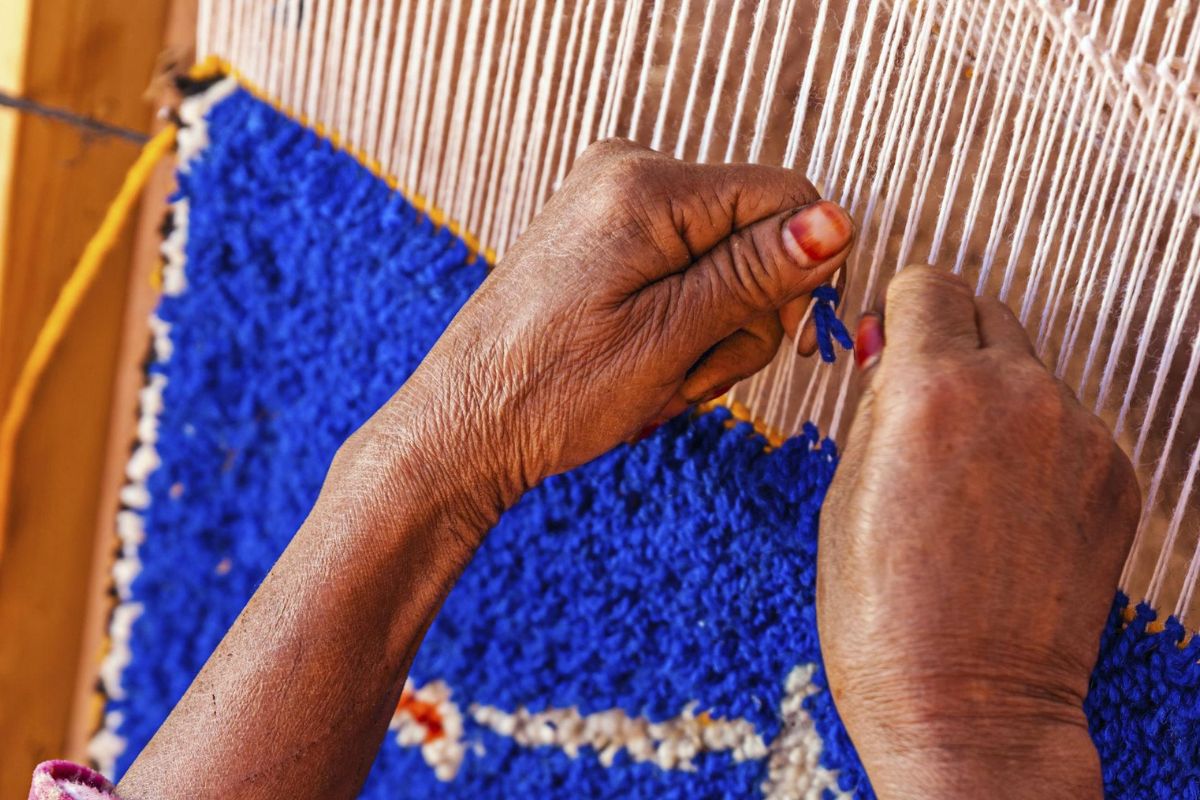
A pile knot is tied by hand, one at a time, around the vertical warp threads on the loom. In the symmetrical knot, the one most often described for Moroccan pile rugs, a short length of yarn is passed between two adjacent warp threads, brought back under one of them, wrapped around both to form a collar, and pulled through so both ends come up together on the surface. That pair of ends is the pile. A row of these is tied, then one or more plain weft threads are passed through and the whole row is beaten down hard with a comb. Repeat, upward, until the rug is finished.
This page publishes no knot counts, no weaving durations and no wool weights. The reasons are set out at the end.
The two standard knots, and the vocabulary that goes with them
The structural convention is not controversial and is the same in every reference account of knotted pile:
| Symmetrical knot | Asymmetrical knot | |
|---|---|---|
| Also called | Turkish knot, Ghiordes knot | Persian knot, Senneh knot |
| Warps used | Wrapped around two adjacent warps | Wrapped around one warp, passed behind the next |
| Ends emerge | Both together, between the two warps | Divided, one on each side |
| Associated with | Anatolia, the Caucasus, western Iran, and generally described for Moroccan pile | Much of Iran, and finer curvilinear design work |
There is also a family of single-warp knots, tied around one warp thread only, documented in early Spanish and Coptic Egyptian pile weaving. That category matters here only because it is the shape of the claim some sources make about Morocco, which is the next section.
Note what none of these terms is: a quality grade. A knot type is a structure, not a ranking, and it does not tell you where a rug was made either, since the same knot is used across enormous distances.
Is there a distinct "Berber knot"? The sources disagree
You will meet the phrase constantly, and it is not used consistently.
One group of sources treats "Berber knot" as simply the local name for the symmetrical Turkish or Ghiordes knot, and describes Moroccan pile rugs, including the Middle Atlas styles, as symmetrically knotted. Another group describes the Berber knot as something structurally different, a looping knot that produces a high, lofty pile. The International Folk Art Market's profile of the Moroccan women's cooperative Atelier Talasin, published 11 April 2024, refers to "the Berber knot" as the group's traditional technique without defining its structure.
What this guide could not find is a museum or academic source, readable in English today, that settles the question with a structural analysis of Moroccan pile rugs. Nearly every page asserting a definition is a rug seller's. So the honest position is: the symmetrical knot is what most accounts describe for Moroccan pile, the phrase "Berber knot" is used both as a synonym for it and as a claim about something different, and a seller using the phrase may mean either. It is worth asking which they mean, because the answer tells you how much they know.
The weft is doing more work than you think
Knots alone do not hold a rug together. Between each row of knots, one or more plain weft threads are passed straight through the warp, and the beating drives everything down into a compact structure. Warp and weft form the foundation; the knots ride on it.
That is why the weave, rather than the knot, is what governs how a rug behaves. How many weft passes are used, how firmly each row is beaten, how even the warp tension was: those set the density, the stiffness and the way the rug lies. It is also why the back of a rug is the informative side. The knot structure, the weft rows and the regularity of the whole thing are visible there in a way they are not from the pile side, which is the basis of the checks in handmade versus machine-made.
Flatweave is a different technique, not a lesser one
A flatweave has no knots at all. The pattern is made entirely by the weft threads passing through the warp, packed down so the warp is hidden, so the surface is flat and the design frequently reads on both faces. This is the technique behind Moroccan kilim and hanbel weaving, and it demands a different kind of skill rather than less of it: with no pile to hide behind, tension errors and pattern mistakes show.
Some traditions run both techniques in one piece, alternating flatwoven bands with knotted sections and sometimes adding fringing or sequins within the same object. Treating pile as the real thing and flatweave as a simpler substitute is a habit of the retail market, not of the craft. The practical differences between the two, in a room rather than on a loom, are covered in flatweave versus pile.
Pattern without a pattern
One more technical point that changes how you read a rug: in these traditions the design is generally not drawn out first. There is no cartoon pinned beside the loom of the kind used in workshop production of fine curvilinear carpets. The pattern is held in memory and worked out as the rug rises, which is why motifs shift scale partway up a field, why a border can change its mind, and why two rugs from one weaver are related rather than identical.
That is a structural fact about the method, and it is worth separating from the much larger body of claims about what the resulting motifs mean. Symbolic readings of Moroccan rug patterns are asserted with great confidence online, mostly by people selling rugs, and the academic literature on the subject is contested rather than settled. This page describes how a rug is built, not what it says.
Why there are no numbers on this page
The map row for this article carries an explicit instruction against fabricated figures, and the reason is visible in the market.
Knot counts per square inch are quoted for Moroccan styles as if they were specifications. They are not: knot density measures how fine a pattern a weave can resolve, which barely applies to open geometric designs, and it does not measure quality or durability. What knots per square inch does and does not tell you sets out the whole argument, and the specific pair of figures that circulates for Beni Ourain and Beni Mrirt traces those numbers back and finds nothing cited behind them.
Weaving durations are in the same position. Reported figures from Taznakht differ between two named news agencies less than a year apart, so a single "a Moroccan rug takes X weeks" claim is a choice between sources rather than a fact. This guide also encountered pages supporting technical claims about Moroccan knotting with academic-looking author-and-year citations that could not be matched to any traceable publication. Where the wool itself is the question rather than the knot, the Beni Ourain guide covers the style whose reputation rests on fiber rather than fineness.
FAQ
What is the Berber knot?
The phrase is used two ways. Most accounts treat it as the local name for the symmetrical Turkish or Ghiordes knot, tied around two warp threads. Others describe it as a distinct looping knot producing a high pile. This guide found no museum or academic source that settles it, so it reports the disagreement.
What knot do Moroccan rugs use?
The symmetrical knot is what most descriptions give for Moroccan pile weaving. The asymmetrical Persian knot is associated with finer curvilinear traditions elsewhere. Knot type is a structure, not a quality grade or a proof of origin.
How is a rug knot actually tied?
Yarn is passed between two adjacent warp threads, taken back under one, wrapped around both, and pulled through so both ends emerge on the surface as pile. Rows of knots are separated by plain weft passes and beaten down with a comb.
Do Moroccan flatweaves use knots?
No. A flatweave is built from weft passing through warp, with no pile knots at all. It is a different technique, not an easier one, and some traditions combine flatweave and knotted sections in a single piece.
Does a knot count tell me how good a Moroccan rug is?
No. Knot density describes how fine a pattern the weave can carry, which is largely beside the point on open geometric designs, and it says nothing about wool quality or durability. This guide publishes no knot-count figures for Moroccan styles.
Leave a Reply