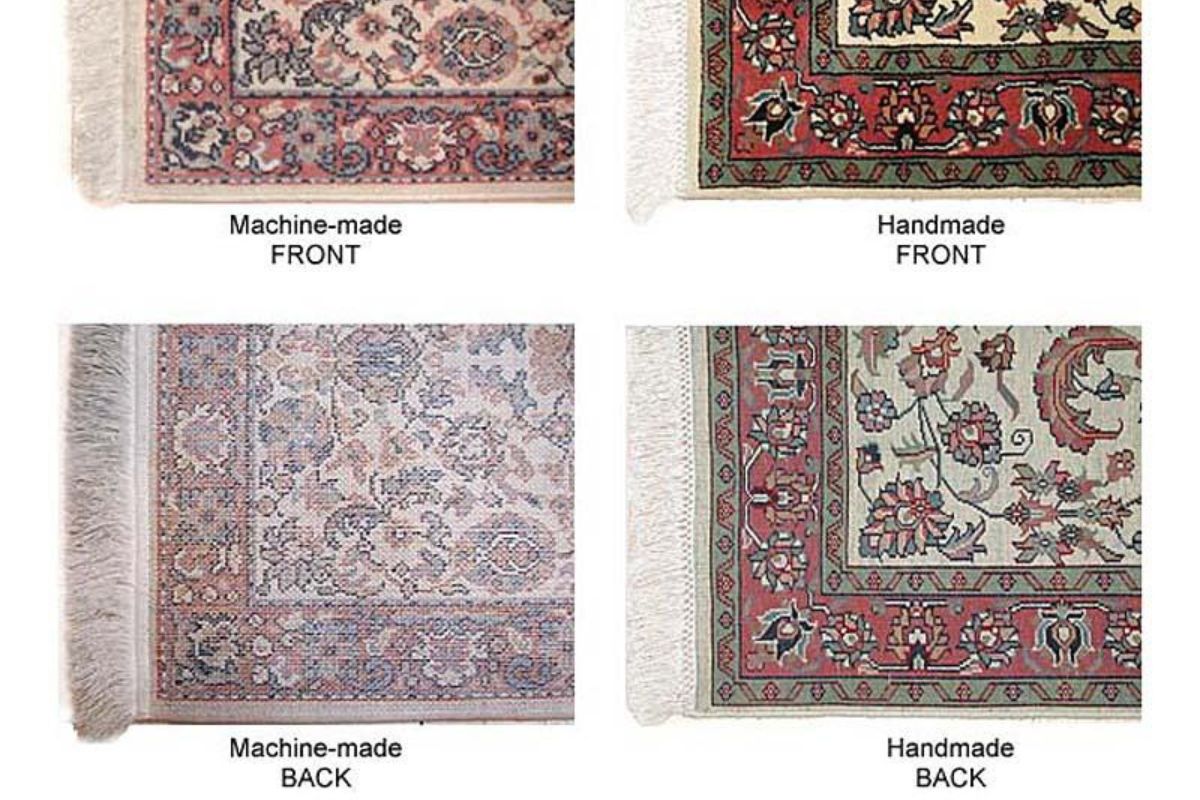
Turn the rug over and you are looking for one thing: whether you can see the structure. A hand-knotted rug shows its pattern on the back in individual tied knots with small irregularities in the rows. A machine-made rug shows a flat, uniform, printed-looking back, usually with a serged edge and a fringe stitched on as a separate flap. A hand-tufted rug shows neither, because a glued canvas backing covers the underside completely. Three categories, not two, and the third is the one most buyers have never heard of.
Why this is the one check worth learning
Almost every question about a Moroccan rug ends in somebody's word against nobody's evidence. Age, tribe, region, wool grade: all of them depend on a seller's claim or on an inference from appearance.
Construction is different. It is a physical fact about the object, it is visible, and it does not require trusting the person selling it. That makes it the highest-value check a buyer can learn, and it takes about ten seconds once you know what you are looking at.
It is also the check with the clearest financial consequence. The gap between a hand-knotted rug and a hand-tufted one is substantial, both in what it cost to make and in how long it will last, and the two are routinely sold in the same shops to the same buyers.
Hand-knotted: the structure is the rug
In a hand-knotted rug, the pile is tied onto the warp threads knot by knot. There is no adhesive anywhere. The knots are the thing holding the rug together, which is why the back of a hand-knotted rug is a legible object rather than a covering.
What you should see: the design repeated on the back, slightly softer and less crisp than on the front, made up of individual points of color. Look closely and each of those points is a knot. Look along a row and you will see it wander a little, because the rows were tied by a person over weeks or months and no person is a machine.
That irregularity is the signal. Not damage, not sloppiness, just the evidence of hand work. In Moroccan pile rugs the knotting is often relatively open and the pile relatively high, which can make the back look sparse compared with a fine Persian weave. That is normal for the category and not a defect. What KPSI does and does not tell you explains why density means something different here.
Hand-tufted: the category most buyers do not know exists
A hand-tufted rug is made by punching yarn through a fabric backing with a tufting gun. It is hand work, genuinely, and it is skilled. But the loops are not knotted to anything. They are held in place by a layer of latex adhesive spread across the back, and then a second canvas or scrim backing is glued over that to hide it.
So when you turn a hand-tufted rug over, you do not see the design at all. You see plain cloth. That is the tell, and it is unmistakable once you know to look for it.
Two consequences worth knowing. First, the adhesive has a working life, and when it degrades the rug sheds and the backing can separate, which is not something a hand-knotted rug does. Second, that adhesive is why some new rugs smell strongly of rubber or glue. If a rug you were told was hand-knotted arrives smelling of chemicals, the smell itself is telling you something about the construction, which why a new rug smells of chemicals goes into.
Machine-made: uniformity is the tell
A power loom produces a back that looks manufactured, because it is. The pattern is there, but it is perfectly regular. The rows do not wander. The color changes are exact. There is often a visible grid or a stiff, tight weave structure, and the edges are usually serged, meaning wrapped in yarn by a machine rather than finished by hand.
The other reliable sign is the underside feel: machine-made backs are frequently stiffer and flatter, sometimes with a light backing applied for stability.
None of this makes a machine-made rug a bad object. It is a legitimate product with an honest use, and if a consistent size, a lower price, or a rug you are not afraid of matters more to you than hand work, it is a sensible purchase. The problem is only when it is sold as something else. This site covers hand-knotted and handwoven traditions, so a machine-made "Moroccan-style" rug is a design reference rather than a piece from those traditions.
The fringe test, and where it fails
The most repeated advice on this topic is to check the fringe: on a hand-knotted rug the fringe is the warp threads of the foundation, emerging from the body of the rug, while on a machine-made rug it is sewn on afterward.
That is broadly true and it is a useful first look. Tug gently at a few strands. Fringe that is part of the structure resists as part of the whole rug. Fringe stitched onto a flap of backing moves as a separate piece, and you can often see the seam where it is attached.
But it fails in three ways. Fringes get worn and replaced, so a genuine old rug can end up with a sewn-on replacement fringe. Some hand-knotted rugs are finished with the warps turned under rather than left as fringe. And many Moroccan flatweaves finish differently again, with braided or knotted ends that are part of the weaving but do not look like classic Persian fringe. Flatweave or pile: which Moroccan style suits your room covers those construction differences.
So use the fringe as a hint and the back as the answer.
What this check settles, and what it does not
It settles construction. That is a real thing to have settled, and it is the fact most directly tied to what the rug cost to make and how long it will last.
It does not tell you where the rug was made, how old it is, whether the wool is good, whether the dyes are natural, or whether the piece was chemically treated to look aged. A rug can be unambiguously hand-knotted and still be six months old and sold as vintage. Those questions are covered in is my Moroccan rug authentic and in the wider guide to buying a Moroccan rug.
One practical note for buying online: ask for a photograph of the back. A seller with a hand-knotted rug has no reason to refuse, and a listing with twelve styled photographs and none of the underside is worth a question.
FAQ
What is the difference between hand-knotted and hand-tufted?
Hand-knotted pile is tied onto the foundation knot by knot and needs no adhesive. Hand-tufted pile is punched through a backing and held in place with latex glue, then covered with a second backing. The back tells you which: knots and pattern for one, plain glued cloth for the other.
Is a hand-tufted rug a fake?
No. It is a genuine handmade product, just a different and less durable one than hand-knotted, with a different cost of production. The problem is when it is described or priced as hand-knotted.
Why does the back of my Moroccan rug look sparse compared to a Persian rug?
Moroccan pile rugs are often more openly knotted with a higher pile, and their designs are geometric rather than finely curvilinear. Lower knot density is normal for the category rather than a sign of poor quality.
Can I check the fringe instead of the back?
Use it as a first hint. Fringes get replaced, some hand-knotted rugs have no fringe at all, and Moroccan flatweaves finish their ends differently. The back is the reliable answer.
Does this check tell me if my rug is old?
No. Construction and age are separate questions, and nothing about the back reveals when the rug was made.
Leave a Reply