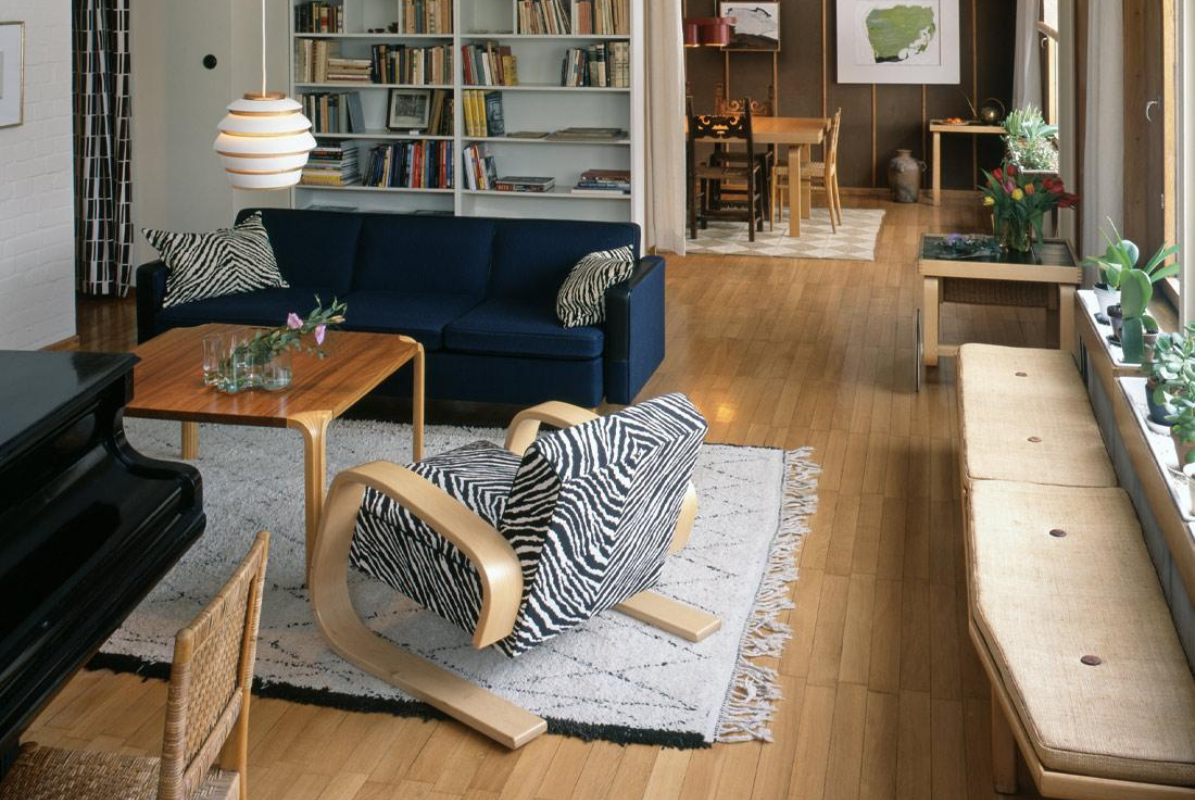
The short answer. The Beni Ourain modernism design history starts earlier and is messier than most retellings admit. Amazigh (Berber) rugs from Morocco entered Western modernist interiors in the 1920s and 1930s, first through Paris architects such as Le Corbusier and then, far better documented, through design shops in Zurich and Helsinki that sold them beside modern furniture. Most of the famous designer anecdotes are repeated by rug dealers without sources. The strongest record comes from peer-reviewed research on the 1930s, and it names several Amazigh groups, not only the Beni Ourain.
This article sorts the story by evidence: what is documented, what is plausible but thinly sourced, and what we could not trace at all.
Why the Beni Ourain modernism design history is hard to pin down
Search for this topic and almost every page-one result is a rug seller. That matters, because a dealer has a reason to want the rug on your screen to sit in the same sentence as Le Corbusier. The same list of names travels from page to page: Le Corbusier, Alvar Aalto, Frank Lloyd Wright, Charles and Ray Eames, Marcel Breuer, Arne Jacobsen. The sources behind the list rarely travel with it.
There is a second problem, and it is about the label. "Beni Ourain" today names a style: thick, undyed cream wool with dark lines, often in lozenges. Our guide to the Beni Ourain rug covers that style in detail. But in the modernist story, "Beni Ourain" is often used loosely for any pale, shaggy Moroccan pile rug, and sometimes for any Moroccan rug at all. When a page says a designer "used Beni Ourain rugs," it is worth asking whether the source said that, or said "Berber rugs" and the Beni Ourain part was added later.
We cannot settle every case. What we can do is show you which claims have a trail.
The designer stories, sorted by evidence
This table reflects what we could trace on 2026-09-23. "Documented" means a museum, house museum or peer-reviewed source says it. "Thin" means we found it only on dealer pages or in magazine copy without a named source.
| Claim | What we found | Evidence level |
|---|---|---|
| Le Corbusier used Moroccan (Berber) rugs at Maison La Roche, Paris | Stated by the Iconic Houses network | Documented for "Berber rugs"; the specific type is disputed |
| Moroccan carpets were sold beside modern furniture in 1930s Zurich and Helsinki | Peer-reviewed research in the Journal of Design History | Documented |
| Aalto interiors, including Villa Mairea, used pale Moroccan pile rugs | Dealer pages reproduce period photos credited to Aalto archives; the peer-reviewed article covers Artek broadly | Plausible, photo-based, type attribution from dealers |
| A 1938 photo of Fallingwater shows a Beni Ourain rug | Repeated in Dwell, excerpted from a gestalten book, without an archive reference | Thin; we could not trace the photo |
| Charles and Ray Eames owned a Beni Ourain | A dealer photo caption of their home describes "a Moroccan carpet" | Thin; the type is not stated |
| Breuer and Jacobsen "used" Beni Ourain rugs | Dealer lists | Thin, except Breuer's link to Wohnbedarf (below) |
Notice that the most confident claims online are often the weakest. The Fallingwater photo is quoted widely, yet we found no page that says which archive holds it.
Paris in the 1920s: Le Corbusier and the Berber rug
The earliest well-attested chapter is Maison La Roche in Paris, designed by Le Corbusier and Pierre Jeanneret between 1923 and 1925 and now run by the Fondation Le Corbusier as a house museum. The Iconic Houses network lists "Berber rugs" among its freestanding furnishings, beside Thonet chairs and Maple armchairs.
That is solid for "Berber rugs." It is not solid for "Beni Ourain." Dwell, excerpting a design book, says Le Corbusier used Beni Ourain carpets there. Maroc Tribal, a vintage rug dealer, describes the rugs at the house as "deep and boldly-colored," which does not sound like a cream Beni Ourain at all. Two popular sources, two different pictures, neither citing an inventory. We present the disagreement rather than choose between them.
Le Corbusier's relationship with textiles was also more conflicted than the "he loved Berber rugs" line suggests. The Journal of Design History article discussed below notes that he treated textiles as a form of concealment he criticized in principle, while still allowing himself to use them.
Zurich and Helsinki in the 1930s: the best-documented chapter
The richest evidence comes from Daniele Burlando's open-access article, "'Moroccan' Artek: Colonized Textiles within 1930s Modernist Interiors" in the Journal of Design History (Oxford Academic, read 2026-09-23). Its key points, as the article presents them:
- Wohnbedarf, Zurich. The shop was founded in 1931 by art historian Sigfried Giedion, architect Werner Moser and businessman Rudolf Graber. Marcel Breuer, who designed the shop, had traveled to North Africa several times. In August 1935 Wohnbedarf hosted a "North African Folk Art Exhibition."
- Artek, Helsinki. In 1936 Artek staged two displays with a substantial presence of Amazigh carpets: a model apartment on Minervankatu, where the rugs sat in living rooms and bedrooms with Aalto furniture, and a "Moroccan" carpet display in its shop.
- The names used. The groups and places named in the research include Marmoucha, Beni M'Guild and Beni M'Tir, and villages such as Bhalil and Guigou. Press of the time described both "black-and-white undyed wool compositions" and rugs in shades of red.
That last point is the one most retellings skip. The documented 1930s rugs were a range of Moroccan styles, not a single cream-and-black type. If you know the Marmoucha rug, often described as a quieter relative of the Beni Ourain, you can see how easily one popular label could later absorb its neighbors.
The colonial layer most retellings leave out
The rugs did not simply "travel" to Europe. They moved under the French protectorate of Morocco, and the same research describes that setting directly.
The protectorate's Service des Arts Indigènes set out to document and regulate Moroccan crafts. Prosper Ricard, who became its director in 1920, compiled the Corpus des Tapis Marocains (1923 to 1934), a catalog of carpet patterns. According to the Burlando article, designs in that system were "corrected and cleansed" for quality control and export. In other words, colonial officials were already shaping what counted as an authentic Moroccan rug before modernist shops put those rugs in their showrooms.
European press of the 1930s, the article reports, described the carpets as products of "surviving ancestral traditions of secluded populations, unspoiled by modernity." That phrasing still echoes in seller copy today. The article's argument is that this framing helped turn Amazigh household textiles into modern commodities, while the women who wove them stayed anonymous in the colonial record.
We think a reader deserves that context. It does not make owning a rug wrong. It does explain why the "timeless tribal rug meets modern master" story is so appealing, and why it leaves the makers out. Our piece on the women who weave Moroccan rugs picks up that thread in the present day.
Why the rugs looked "modern" to modernists
There is a real design reason the pairing worked, and it is not only marketing. Modernist interiors favored plain surfaces, exposed structure and little applied ornament. A pale, undyed wool rug with a few dark lines added warmth, texture and sound softening without competing with the architecture. Abstract geometry read as contemporary to people who were deliberately rejecting figurative decoration.
Die Neue Sammlung, the design museum in Munich, built an entire exhibition around that affinity. Moroccan Carpets and Modern Art at Die Neue Sammlung (museum exhibition page, read 2026-09-23) ran from September 14, 2013 to January 5, 2014 at the Pinakothek der Moderne. It drew on the collection of Munich architect Jürgen Adam and stated that Moroccan carpets "fascinated artists such as Wassily Kandinsky and Le Corbusier" in the early twentieth century. The accompanying book, Moroccan Carpets and Modern Art by Jürgen Adam (Arnoldsche), is the closest thing we found to a scholarly survey of the visual argument.
Keep one caution in mind. Saying a rug "looks modern" describes a European viewer, not the weaver. These rugs were made as bedding, floor covering and household goods for cold mountain winters, for use, not as anticipations of abstract art. Our explainer on what the word "Berber rug" means covers why the vocabulary itself carries an outsider's view, and why this site uses Amazigh alongside Berber.
From modernist interiors to the recent revival
After the interwar period the trail thins again. The mid-century names on dealer lists (Eames, Jacobsen, Wright) are where sourcing is weakest, and we have not found primary records that confirm the rug types involved.
The modern revival is easier to see, though harder to date precisely. Dealer pages describe a renewed wave of interest in Moroccan rugs over roughly the last two decades, tied to the wider return of mid-century modern furniture. The 2013 Munich exhibition is one fixed point in that revival. Much of the rest is commercial, and some dealers themselves warn that rugs sold under the "Beni Ourain" name are now also machine-made or woven outside Morocco. The modernist story, in other words, has become part of how the label is sold.
What this history can and cannot tell you about a rug you own
This history explains why a cream Moroccan rug looks right in a Bauhaus-style room. It cannot tell you anything about a specific rug in your house or in a listing.
- It cannot authenticate a rug. A seller's claim that a piece is "the kind Aalto used" is a sales line, not provenance.
- It cannot date a rug. Age is judged from the object itself: wool, dyes, wear, construction. That takes hands-on examination.
- It cannot value a rug. A modernist association adds story, not documented worth.
For an individual piece, the people who can help are textile specialists at museums with North African collections, and independent appraisers who do not sell the rug they are assessing. We are a reading guide, not an authenticator, and we say so plainly.
FAQ
Did Le Corbusier really use Beni Ourain rugs?
He used Berber rugs at Maison La Roche in Paris, according to the Iconic Houses network. Whether they were Beni Ourain specifically is disputed: some design writing says yes, while a dealer describes them as boldly colored. We found no inventory that settles it.
Which modernist designers are best documented with Moroccan rugs?
The strongest record is for the 1930s shops Wohnbedarf in Zurich and Artek in Helsinki, covered in peer-reviewed research in the Journal of Design History. Aalto interiors appear in period photos. Claims about Eames, Wright and Jacobsen rest mostly on dealer pages.
Why do Beni Ourain rugs suit modernist interiors?
Undyed wool, sparse geometric lines and deep pile add warmth and texture to plain modernist rooms without adding figurative ornament. That affinity was the subject of the 2013 to 2014 Munich exhibition Moroccan Carpets and Modern Art.
Does a modernist connection make my rug more valuable?
Not on its own. A general design history says nothing about a particular rug's age, origin or worth. For that you need a hands-on assessment by an independent appraiser or a museum textile specialist.
Leave a Reply