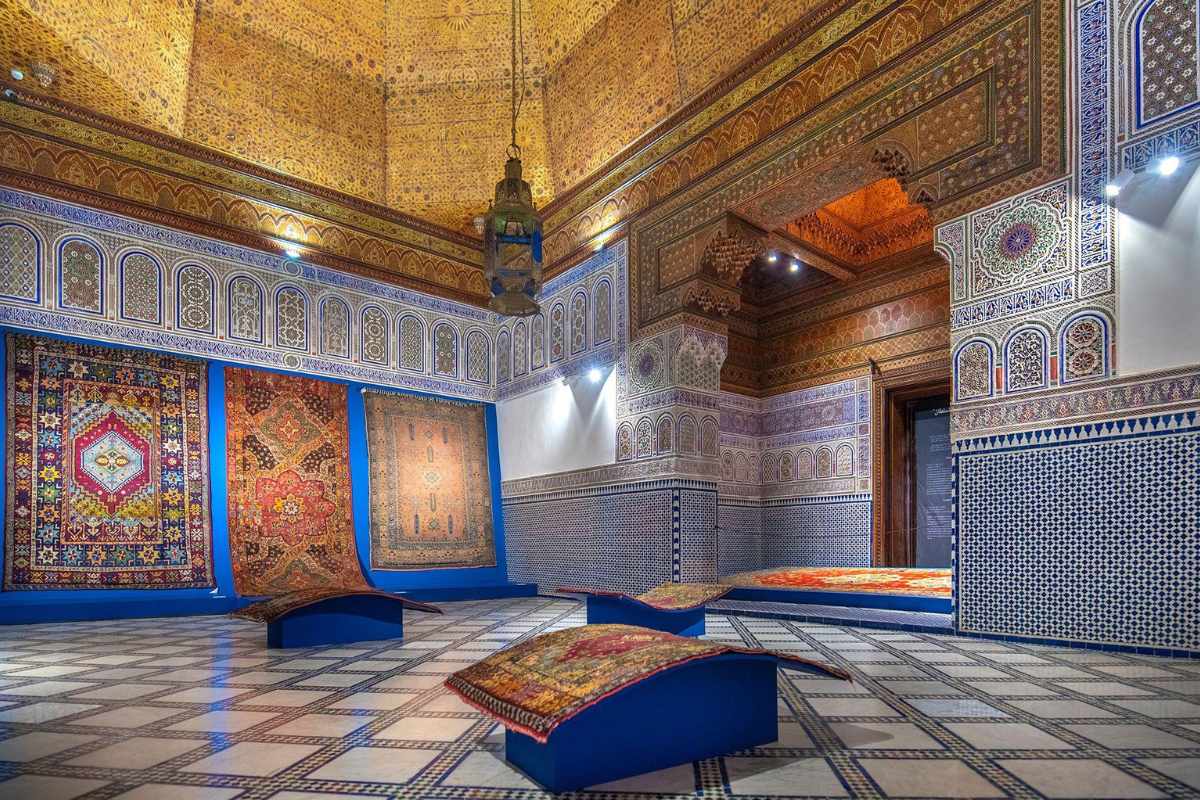
Short answer: The largest public Moroccan rugs museum collection is in Morocco itself, at Dar Si Saïd in Marrakech, the National Museum of Weaving and Carpets, which has been closed for restoration since the 2023 earthquake. Outside Morocco, you can look up documented pieces online. The Victoria and Albert Museum in London holds Moroccan carpets you can see by appointment, and The Metropolitan Museum of Art in New York catalogs a 19th-century carpet attributed to Rabat. Each record tells you what the museum knows about a rug, which is often less than a dealer's description claims.
This guide covers where those collections are, what their records actually say, and what a museum can and cannot tell you about a rug you own.
Where Moroccan rugs sit in public collections
Most people meet Moroccan rugs in shops and interiors, not museums. The museum side is smaller and more careful. The table below lists only holdings we confirmed on each institution's own website on September 23, 2026.
| Institution | What its own records show | How to see it | Status to check |
|---|---|---|---|
| Dar Si Saïd, Marrakech (Fondation Nationale des Musées) | Carpets and weavings from across Morocco, including the Tensift, Sous, High Atlas, Anti Atlas, Bani and Tafilalet | Visit in person once it reopens | Closed for restoration after the September 2023 earthquake, per news reports |
| Victoria and Albert Museum, London | Moroccan carpets including T.18-1914 (dated 1860 to 1900) and T.139-1993 (High Atlas, probably 1950s) | View by appointment at V&A East Storehouse | Check each record for the ordering option |
| The Metropolitan Museum of Art, New York | A 19th-century knotted carpet attributed to Rabat, accession 45.114.16 | Online record in the Department of Islamic Art | Check the record for gallery status |
That is not a complete list. Other museums hold Moroccan textiles, and temporary exhibitions come and go. It is a list of places where we could read the record ourselves, which is the standard this guide keeps to.
Dar Si Saïd: Morocco's national museum of weaving and carpets
Dar Si Saïd is a 19th-century palace in the Riad Zitoun Jdid area of the Marrakech medina. The Fondation Nationale des Musées (FNM), which runs Morocco's national museums, restored it and reopened it on June 28, 2018 under a new name: the Musée National du Tissage et du Tapis, or National Museum of Weaving and Carpets.
The FNM's page for the museum describes a rich and varied collection of Moroccan carpets and weavings from every region, covering both urban and rural carpets, along with woven textiles and traditional garments. It names pieces from the Tensift, the Sous, the High Atlas, the Anti Atlas, the Bani and the Tafilalet. That regional spread matters. It is one of the few places where you can compare rugs from very different parts of the country in one building, which is the best way to see why a single label like "Berber rug" covers so much. If the regions are unfamiliar, our map of Moroccan rug regions and the styles tied to each is a useful companion before a visit.
Check before you travel. The September 2023 Al Haouz earthquake damaged the building, and Moroccan news outlets have reported it closed for restoration since then, with a restoration contract awarded in 2025. The FNM page still lists opening hours, so the page and the building may not match. Confirm the current status with the FNM directly before planning a trip around it.
The Victoria and Albert Museum: two records worth reading
The V&A in London is a good example of a museum whose online records reward slow reading. Two Moroccan carpets stand out.
Carpet, 1860 to 1900, Morocco (T.18-1914). The record describes hand-knotted wool pile on a wool warp and weft, with a symmetrical knot and a stated density of 32 knots per square inch. It measures roughly 4.4 meters long. The catalog note points out that each element of the design is simple and only eight colors were used, yet so many patterns are combined that the effect is complex. The photograph shows almost half of this very long carpet. Notice what the record does not do: it names no region more precise than Morocco and no maker.
Carpet, High Atlas, probably 1950s (T.139-1993). The V&A's collection record for carpet T.139-1993, which we read on September 23, 2026, describes knotted wool pile, two panels separated by a band with three crosses, diamonds in solid colors and with blossom motifs, and a weaving error in the lower panel. It also notes synthetic dyes, several yarn types and a trader's label from Marrakesh. The date is hedged with "probably," and the maker is listed as unknown.
Both carpets are listed as viewable by appointment at V&A East Storehouse. The V&A's Order an Object service, which we checked on September 23, 2026, lets members of the public book a free appointment to see stored objects. Not every item marked "view by appointment" can be ordered that way, so check each record for the ordering option, and bear in mind that large carpets may be handled differently from small objects.
The Metropolitan Museum of Art: an urban carpet attributed to Rabat
The Met's collection data lists a carpet, accession number 45.114.16, in its Department of Islamic Art. It is dated to the 19th century, described as wool with symmetrically knotted pile, and measures 363.2 by 178.4 centimeters. Its place is given as Rabat, Morocco, with the attribution type "attributed to."
This one is worth knowing because it is not the kind of rug most shoppers picture. Rabat is one of Morocco's urban carpet traditions. Urban carpets and rural Amazigh rugs developed along different lines, and a collection that includes both corrects the common idea that every Moroccan rug is a shaggy cream rug from the Middle Atlas. For the rural style that idea usually comes from, see our guide to the Beni Ourain rug and how to buy one.
Why museum rugs don't look like shop rugs
If you arrive at a Moroccan rugs museum collection expecting the pieces you see in design magazines, the difference can be a surprise. A few reasons explain it.
- Collecting history. Many museum pieces were acquired generations ago. The V&A's T.18-1914 carries its acquisition year, 1914, in its accession number. A collection reflects what curators chose to buy at the time, which was not always the rural pile rugs now popular in interiors.
- Urban and rural traditions sit side by side. Dar Si Saïd deliberately shows both. Shops mostly sell rural styles.
- Materials change over time. The V&A's High Atlas carpet uses synthetic dyes, which its record states plainly. Museum records are one of the few places you will see dye and yarn noted as a matter of routine.
- Broad labels give way to specifics. Museums usually prefer a place and a date range over a sweeping label like "Berber," and they say how confident they are in each.
How to read a Moroccan rugs museum collection record
This is the part most rug articles skip, and it is the most useful skill a buyer or owner can pick up from museums. A good catalog record is careful about what it knows. Learning its language helps you read dealer descriptions with the same care.
Dates are ranges or hedges. "1860 to 1900," "19th century" and "probably 1950s" are all normal. A museum with the object in hand, and staff to study it, still gives a range. A dealer who dates a similar rug to a single year should be able to explain how.
"Attributed to" is a real qualifier. The Met's carpet is attributed to Rabat. That means the place is the museum's best judgment, not a documented fact. Compare that with the confident tribe names in many sales listings.
The maker is usually unknown. Both V&A carpets list an unknown maker. Moroccan rugs have largely been woven by women whose names were rarely recorded by the people who bought and exported their work. Our piece on the women who weave Moroccan rugs looks at that history.
Technique fields are the most reliable. Knot type, pile, warp and weft materials, and knot density are observed facts rather than judgments. If you want to understand what those words describe, our guide to how Moroccan rugs are made, from fleece to finished rug walks through each stage.
Description is not interpretation. The V&A's High Atlas record describes crosses, diamonds and blossom motifs. It does not tell you what they mean. That restraint is deliberate. Writers on Moroccan rug symbolism disagree, and the meaning of a motif can differ between weavers, families and regions, or be purely decorative. A record that names shapes without decoding them is being honest about the evidence.
Object history tells you how it arrived. "Purchased," a donor's name, or a trader's label are clues to where a rug passed through, not where it was woven. The Marrakesh trader's label on T.139-1993 is an example: it records a sale, not an origin.
What a museum can and cannot do for your rug
Seeing documented pieces is the best training for your eye. It is not a way to authenticate your own rug, and we cannot do that from a description or photo either.
What museums are good for:
- Seeing real construction up close: knot density, edge finishes, how panels and borders are built.
- Learning how careful professionals phrase dates, places and attributions.
- Comparing regional styles side by side, especially at Dar Si Saïd once it reopens.
What museums generally will not do:
- Give a valuation. Curators generally do not appraise privately owned objects. For value, you need a qualified independent appraiser who specializes in rugs and textiles.
- Confirm that your rug "matches" a museum piece. A similar look does not mean a similar date or origin, because many styles have been woven for generations and reproduced widely.
- Assign a meaning to your rug's symbols.
If you are buying, treat a museum comparison as a starting question for the seller, not as proof. Ask what evidence supports their stated date, region and materials, and see whether their answer is as careful as a catalog record.
How to search museum collections yourself
You do not need to travel to use these collections. A simple routine:
- Search the museum's own collection site, not a general search engine. Try "Morocco carpet," "Morocco rug" and "High Atlas," since museums catalog under different words.
- Filter by place and object type where the site allows it. Some records sit under Islamic art departments, others under textiles.
- Read the full record, not just the image. Date, place, attribution, technique, dimensions and object history are where the knowledge is.
- Note the accession number. It is the permanent way to refer to that object, and it often shows the year of acquisition.
- Check the display status. Many textiles are kept in storage because light damages them. Look for appointment or study-room options before you visit.
FAQ
Where is the largest Moroccan rugs museum collection?
Dar Si Saïd in Marrakech, the National Museum of Weaving and Carpets run by the Fondation Nationale des Musées, is dedicated to Moroccan carpets and weavings from every region. It was damaged in the 2023 earthquake and has been reported closed for restoration, so confirm with the FNM before visiting.
Can I see Moroccan rugs at the V&A in London?
The V&A holds Moroccan carpets, including T.18-1914 and T.139-1993, which its records list as viewable by appointment at V&A East Storehouse. Check each record for an ordering option, because not every appointment item can be booked through Order an Object.
Do museums explain what Moroccan rug symbols mean?
Usually not. Catalog records tend to describe motifs such as diamonds and crosses without assigning meanings, because interpretations vary between writers and communities. Be cautious of any single fixed meaning presented as fact.
Can a museum tell me what my Moroccan rug is worth?
Generally, no. Curators rarely value privately owned pieces. For value, consult an independent appraiser who specializes in rugs, and for background, compare your rug's construction with published museum records.
Why do museum Moroccan rugs look different from ones in stores?
Museum collections reflect what was acquired decades ago and include urban carpets, such as the one the Met attributes to Rabat, alongside rural rugs. Stores mostly sell recent rural styles made for today's interiors.
Leave a Reply