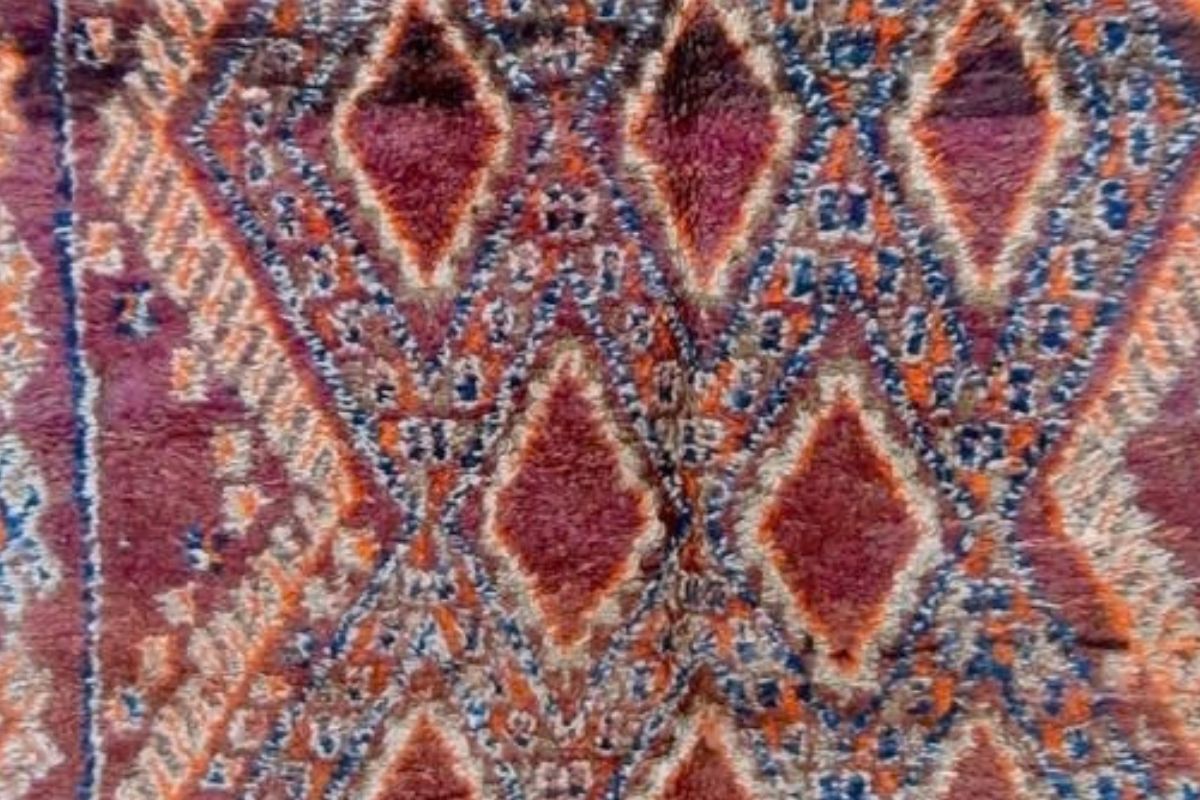
Some of the best-known Moroccan rug names refer to real Amazigh groups, and some do not. Beni Ourain, Beni Mguild and Zemmour are names of peoples or confederations. Azilal is a province, Boujad and Taznakht are towns, and Boucherouite is a rag-weaving technique. So the Berber tribes Morocco rugs are named after are real communities, but on a sales listing the name describes a style. It does not prove who wove the rug or where.
This guide sorts the names by kind, shows which scholarly and museum sources actually attach them to groups, and marks where those sources disagree. We cannot authenticate an individual rug or place it with a particular community. Near the end, we point to who can.
Is "Beni Ourain" a people or a product line?
Both, and that is the source of most confusion. The name began as the name of a people. In the trade, it now also works as a style label, used for almost any rug with an undyed cream ground and dark lines. Our Beni Ourain guide covers how loosely the label is now applied.
The same double life applies to most named styles. It helps to sort them into three groups before asking what any one name proves.
| Name on the listing | What kind of name it is | Where this guide's attribution comes from |
|---|---|---|
| Beni Mguild | A group of people, Middle Atlas | Named in Prosper Ricard's Middle Atlas volume of the Corpus des tapis marocains (1926) |
| Zaïane, Aït Ighezrane | Groups of people, Middle Atlas | Named in the same Ricard volume, though rarely seen on listings today |
| Ait Khabbash | A group of people, Tafilalet, southeastern Morocco | Cynthia Becker's fieldwork, University of Texas Press (2006) |
| Beni Ourain (Beni Ouarain) | A group of people, northeastern Middle Atlas | Mainly dealer and trade sources; see the disagreement section below |
| Zemmour | A group of people, historically placed between Rabat and Meknès | Trade and specialist sources; we found no museum record confirming it |
| Azilal | A province in the High Atlas | An administrative name, not a group |
| Boujad, Taznakht | Towns | Place and market names, not groups |
| Boucherouite | A technique (rag rugs) | Not a group at all |
Read the right-hand column as carefully as the middle one. The sourcing behind these names is uneven, and a confident list on a shop page often has less behind it than it appears.
Which Berber tribes Morocco rugs are named after, and who says so
Three kinds of source are worth more than a seller's list: an early systematic catalog, academic fieldwork with a named community, and a museum. Each one tells you something different.
The earliest systematic catalog: Ricard's Corpus (1923 to 1934)
The most-cited early attempt to sort Moroccan carpets by group is the Corpus des tapis marocains, prepared by Prosper Ricard as head of the Service des arts indigènes, the arts office of the French protectorate administration. Bookseller and library listings date the original volumes between 1923 and 1934. Volume 1 covers Rabat (1923). Volume 2 covers the Middle Atlas (1926). Volume 3 covers the High Atlas and the Haouz of Marrakech (1927). Volume 4 gathers miscellaneous carpets, including more from the Middle Atlas and eastern Morocco (1934).
The Google Books record for the Middle Atlas volume, Corpus des tapis marocains: Tapis du Moyen Atlas, read on 23 September 2026, lists a 1975 Geuthner reprint. Its index terms include the Beni Mguild, the Zaïane and the Aït Ighezrane, alongside places such as Midelt, Boulmane and the Moulouya valley, and technical terms for knotting and weaving.
Two things follow. First, at least one trade name, Beni Mguild, appears in this early catalog. Second, the catalog also names groups, such as the Zaïane and Aït Ighezrane, that the modern trade rarely uses as labels. The trade's list of "tribal" styles is a selection, not a complete map of who wove.
Keep the catalog's origin in mind as well. It was compiled by an office of the colonial administration. That makes it a primary document of how the protectorate classified Moroccan weaving. It is not necessarily a record of how weaving communities described themselves.
Fieldwork with a named community: Becker and the Ait Khabbash
The strongest academic source we found on Amazigh women's arts is Cynthia Becker's Amazigh Arts in Morocco: Women Shaping Berber Identity, listed on Project MUSE and read on 23 September 2026. The book was published by the University of Texas Press, first in 2006, and Project MUSE lists a 2009 edition. It is based on Becker's fieldwork with the Ait Khabbash, an Amazigh community near the Tafilalet oasis in southeastern Morocco.
The book's description says the women it studies create "brightly colored carpets" among other arts, and it argues that "the arts are expressions of ethnic identity," with women as "guardians of Amazigh identity."
This is a different kind of evidence from Ricard's catalog. It ties weaving to one named community through direct fieldwork, rather than assigning carpet types to groups for an administrative catalog. It also shows how much the trade's style list leaves out. The Ait Khabbash are not one of the famous named styles, yet they are among the best-documented weaving communities in the academic record. Our guide to the women who weave Moroccan rugs covers this research in more depth.
Collectors and museums: Barbatti and the Musée Pierre Bergé
Bruno Barbatti's Berber Carpets of Morocco: The Symbols, Origin and Meaning (ACR Édition, Paris, 2008, translated from the German by Alan J. Bridgeman) is the book dealers cite most. Bookseller biographies say Barbatti, who taught history in Zurich, collected carpets during long stays in Marrakech, and that part of the collection was shown at the Museum Bellerive in Zurich in 1996. His book is a collector-scholar's work, valuable for its range of examples. Its central argument, that carpet motifs descend from prehistoric fertility symbols, is his thesis and not a settled consensus.
In Marrakech, the Musée Pierre Bergé des Arts Berbères at the Jardin Majorelle opened in 2011. On its own website, read on 23 September 2026, the museum says it holds "more than 600 objects, collected from the Rif Mountains to the Sahara," and describes "a map showing the location of the major Berber tribes throughout the country." That approach, grouping objects by region and placing peoples on a map, is closer to how Morocco's museums work than the seller's habit of one tribe per style. Our Moroccan rug regions map sets out how two Marrakech museums group weaving by region.
Where the sources disagree
These are the disagreements a reader will actually run into, and how we handle each one.
How many groups make up the Beni Ourain. Dealer pages commonly describe the Beni Ouarain as a confederation of about seventeen tribes in the northeastern Middle Atlas. We did not find a museum or scholarly record that confirms that figure, so we report it as the trade's description, not as a checked fact. We also found a seller page that placed Beni Ourain weavers in the High Atlas. Most sources, including our own style guides, place them in the Middle Atlas.
Whether "Beni Ourain" means all Berber rugs. At least one large dealer page uses the name as if it covered Amazigh weaving in general, while describing it elsewhere on the same page as one confederation. The second use is the accurate one.
Whether a style is a tribe at all. Some seller lists present Boucherouite as a tribe. It is a rag-rug technique used in several regions. Azilal is sometimes written as if it were a single people, when it is a province covering many communities.
Grouping by tribe or by region. Seller pages sort rugs by tribe name. Ricard's volumes are organized by region, with groups named inside each one. The museums we checked lead with region. None of these approaches is wrong. They answer different questions, and a region grouping makes fewer claims about any one rug.
What the motifs mean. Barbatti reads motifs as prehistoric fertility symbols. Becker's fieldwork looks at what the women she worked with said about their own work, and ties meaning to identity and community. These approaches can reach different answers about the same motif. We attribute any reading to the person who made it and do not state a single meaning as fact.
What "Beni," "Ait" and "tribe" tell you
Two prefixes appear across these names. Beni is the Arabic word for "sons of" or "children of." Ait plays the same role in Tamazight, the Amazigh language. Either prefix tells you the name started as the name of a people, which is a useful first check when you meet an unfamiliar label.
The word "tribe" needs more care. Ricard's catalog, one of the main early sources for these group names, was produced by a colonial administration, and its categories reflect that administration's way of sorting people and objects. Communities may describe themselves by village, lineage, valley or region as readily as by a tribal name. "Berber" also comes from an outside name that many communities reject. That is why this guide uses Amazigh (plural Imazighen) for people and keeps "Berber" where it is the trade term a reader is searching for. Our explainer on what a Berber rug is covers the history of the word.
None of this makes the names meaningless. They point to real people in real places, most of the weavers are women, and the craft has named cooperatives and a working rug economy today. The names are a starting point for knowing who made a rug. They are not a guarantee.
What a tribe name on a label can and cannot prove
A tribe name on a listing tells you which look the seller is describing. It does not tell you that a member of that group wove the rug. Popular styles are woven outside their home areas, commissioned wherever there is weaving capacity, and sometimes produced outside Morocco.
Here is what is worth asking a seller when a listing names a group:
- Do you mean the style or the origin? A good seller will say plainly which one they mean.
- Where was this rug woven, and how do you know? A named town, cooperative or source is a claim you can weigh. "Authentic tribal" on its own is not.
- Is the attribution based on anything written down? A purchase record, a cooperative's documentation, or a comparison with a published reference such as Ricard's volumes is stronger than a story.
What we cannot do is tell you which community wove a specific rug, or how old it is. For that, the people to ask are a museum textile department, a textile conservator, or an independent appraiser with documented experience in North African weaving. None of them has a stake in the sale, and a second opinion from someone with nothing to sell is worth more than any label.
FAQ
Is Beni Ourain a tribe or a style?
Both. Beni Ourain (also written Beni Ouarain) began as the name of an Amazigh group in the northeastern Middle Atlas. In the rug trade it is also a style label for undyed cream rugs with dark lines, applied to rugs woven well beyond that group.
Which Moroccan rug names are real tribal names?
Beni Ourain, Beni Mguild and Zemmour are names of peoples. Beni Mguild is named in Prosper Ricard's 1926 Middle Atlas catalog. Azilal is a province, Boujad and Taznakht are towns, and Boucherouite is a rag-weaving technique.
How many Berber tribes make Moroccan rugs?
We found no reliable count. Seller pages give numbers, but we found no scholarly or museum source that fixes one. The Moroccan museums we checked group weaving by region rather than listing every group.
Can a tribe name prove where my rug was made?
No. A tribe name describes a style. Only a documented source, such as a named cooperative or a seller's written record, supports an origin claim. For an opinion on a specific rug, ask a museum textile department, a conservator or an independent appraiser.
Why do some people say Amazigh instead of Berber?
"Berber" comes from an outside name that many communities reject. Amazigh, plural Imazighen, is the name many use for themselves. The rug trade still mostly uses "Berber."
Leave a Reply