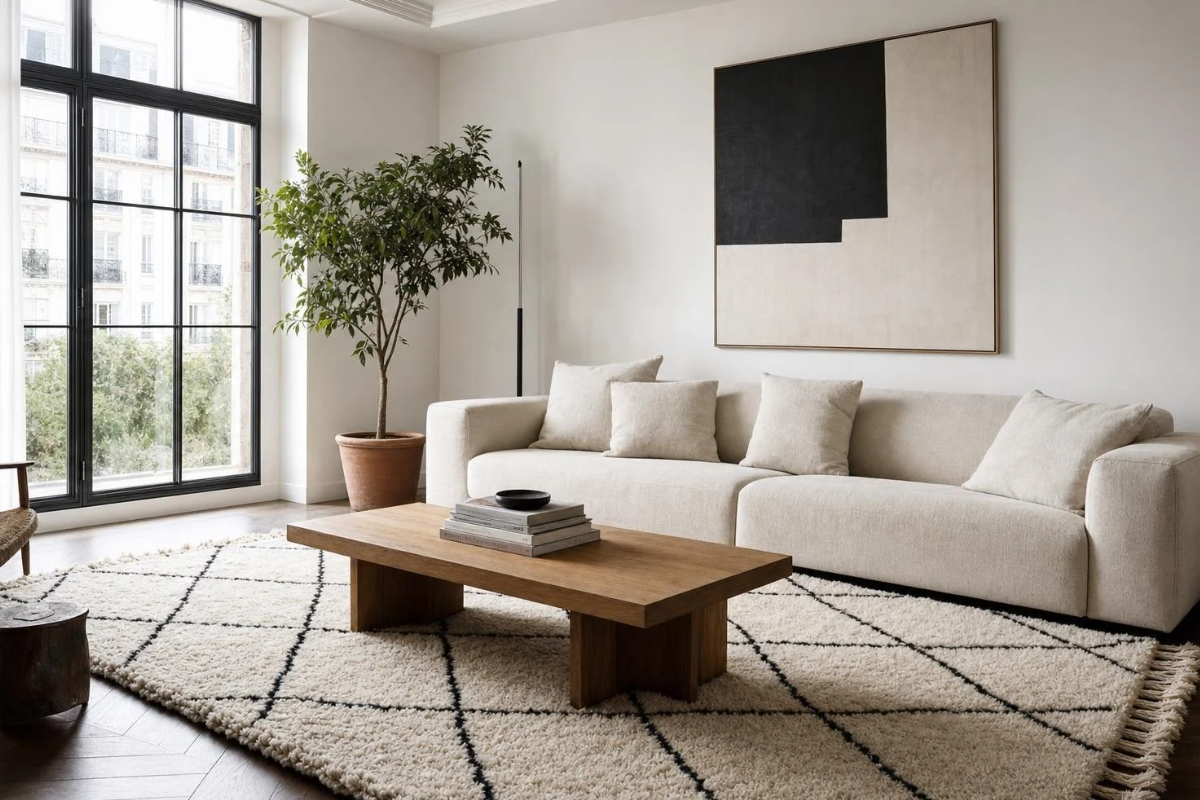
Short answer: When you are working out what size rug for a living room suits a Moroccan piece, size it to your seating group, not to a retail chart. Measure the actual rug on all four edges and both diagonals, plan around the smallest numbers, and check that at least the front legs of your sofa and chairs can rest on it. An odd dimension like 6'3 x 9'7 works in many rooms. What decides it is your furniture layout and the rug's real measurements, not whether the size has a standard name.
Most sizing advice assumes you are choosing from a menu of standard sizes. A hand-woven Moroccan rug does not come off a menu. It comes as one object, with one set of measurements, and often from a seller who cannot swap it for the next size up. This guide is for that situation.
Why a Moroccan rug is rarely a standard size
A retail rug is cut or woven to a size chart. A hand-knotted Moroccan rug is not. Its width is bounded by the loom it was woven on, and its length is set by where the weaver chose to finish. If you want to understand why the loom matters so much, our piece on the Moroccan vertical loom and what it decides explains it in detail.
Two further things make the listed size less reliable than it looks:
- Hand-woven edges are not perfectly straight. Tension changes across a long weave, so one side can come out slightly longer or narrower than the other.
- Sellers measure differently. Some include the fringe, some do not. Some round to the nearest inch or centimeter, some to the nearest few.
This is not a defect or a sign of a fake. It is what hand weaving produces. Even an organization that commissions rugs to order treats accuracy as something that varies by maker. The Anou Cooperative's made-to-order page, which we read on September 23, 2026, says finished commissions are measured at its office in Fes, and that "a group known for landing the measurement is held to exactly that; a looser group is held to their average plus a 10% margin." That is a weaver-owned organization saying plainly that precision differs between groups. A listing from a reseller is unlikely to be more exact.
Measure the rug you actually have (or ask the seller to)
Before any room planning, get six numbers. If the rug is already with you, take them yourself. If it is still a listing, ask the seller for them in writing.
- Length along the left edge, from where the knotting starts to where it ends.
- Length along the right edge, the same way.
- Width at one end.
- Width at the other end.
- Both diagonals, corner to corner.
If the two diagonals match, the rug is close to square. If they differ, the rug is slightly wedge-shaped or skewed, and the difference tells you how much.
Then ask one extra question: does the stated size include the fringe? Anou's commission page describes a buyer who had the selvedge and fringe counted into the measurement so the finished piece matched the space she had. Many resale listings do not say either way. The fringe can add noticeably to the overall length, so it matters.
When you plan, use the smallest length and the smallest width you measured, without fringe. If the plan works at the smallest numbers, it will work with the real rug. For more on what to put in writing before you pay, our list of twelve questions worth asking any rug seller covers sizing alongside condition and origin.
What size rug for a living room works with a Moroccan piece: start from the seating
The standard advice for living rooms is built around furniture legs, and that part transfers well to an odd-sized rug. The furniture retailer Room & Board's guide to choosing a rug size, which we read on September 23, 2026, recommends a rug somewhat longer than the sofa, with at least 8 to 12 inches on either side, and suggests having at least the front legs of the sofa and chairs on the rug. For large rugs, it recommends leaving about 18 inches of floor exposed around the edge as a natural border.
Those numbers are one retailer's guidance, not a law, and other design sources give different ranges. But they give you a working test. Here is how the three common layouts translate to a rug you cannot resize:
| Layout | What the rug must do | What it asks of an odd size |
|---|---|---|
| All legs on | Every sofa and chair leg sits on the rug | The rug must be larger than the whole seating group. Rarely possible with a mid-size vintage piece. |
| Front legs on | Front legs of sofa and chairs rest on the rug, back legs on the floor | The most forgiving layout. The rug needs to be longer than the sofa and deep enough to reach from the sofa's front legs to the chairs opposite. |
| Floating | No furniture on the rug; it sits under or around the coffee table | Works with smaller rugs but tends to look like the rug is too small unless the room is small too. |
For most people with a single Moroccan rug that is not huge, front legs on is where the odd size fits best, because it lets the rug set the size of the seating group rather than the other way round.
A worked example: does 6'3 x 9'7 work?
Take a rug listed at 6'3 x 9'7. This is an example, not a typical size; your rug's numbers will be different. Assume your own measuring confirmed the smallest length and width match the listing.
- Length against the sofa. 9'7 is 115 inches. Using Room & Board's 8 to 12 inches of rug on each side of the sofa, subtract 16 to 24 inches. That leaves a sofa of roughly 91 to 99 inches wide at most, if the sofa runs along the long side.
- Depth for front legs on. 6'3 is 75 inches. With the sofa's front legs on one long edge, you have 75 inches of rug to reach across to the chairs or the opposite sofa. Measure your coffee table and the walking space you want around it, then check whether the chairs' front legs still land on the rug.
- Room clearance. If you wanted the full 18-inch border on every side, you would need a clear floor area of at least 111 inches by 151 inches (about 9'3 by 12'7) just for the rug and its border. In a larger room this does not matter, because a living room rug usually sits under the seating group, not centered in the room.
If your sofa is wider than that range, the rug may still look fine turned the other way, or with the sofa off the rug entirely and only the chairs touching it. Mark the rug's outline on the floor with painter's tape, using your smallest measurements, and leave it there for a day before you commit.
An out-of-square rug next to straight lines
A rug that is slightly wedge-shaped rarely looks wrong on its own. It looks wrong next to something perfectly straight: a wall, a sofa back, a line of floorboards, a fireplace hearth.
A few practical ways to handle it:
- Give it a wider border. The closer the rug sits to a wall, the easier it is to compare the two edges. More floor between them makes a small skew much harder to see.
- Align the rug to the sofa, not the wall. People read the rug against the furniture on it. If the sofa sits square on the rug, the room tends to read as square.
- Put the longer edge where the eye lands first. If one side of the rug measured longer, place it toward the entry or the main view, so the shorter edge sits under the sofa and out of sight.
Thick pile changes the plan
Many Moroccan rugs, especially Middle Atlas pile styles, have a deep, soft pile. That affects sizing decisions in ways a flat retail rug does not.
With a front-legs-on layout, the front legs of the sofa sit on the pile and the back legs sit on the bare floor. On a deep pile, that can make the sofa tilt slightly backward or rock. Some people never notice it; some find it irritating. Test it with the actual rug before settling the layout. If it bothers you, the all-legs-off or all-legs-on layouts avoid the problem.
A deep pile also makes the rug's edge a trip point where it meets bare floor, and a rug that moves when you step on it is a fall risk. A rug pad solves both the movement and much of the edge lift. Our guide to choosing a rug pad for a wool rug explains what to look for; size the pad slightly smaller than your smallest rug measurement so it does not show at the edges.
What we cannot tell you, and who can
We have not seen your room or your rug, so we cannot say whether a specific piece will work. Nobody can from a listing alone. Here is where the honest limits sit:
- The seller's measurements may be approximate. We cannot verify them. Only your own tape measure, or photos of a tape measure laid along each edge, can.
- Design rules are opinions with numbers attached. The 18-inch border and the 8 to 12 inches beside the sofa come from one retailer's guidance. They are useful starting points, not standards.
- A wrong size may not be returnable. Many one-of-a-kind rugs are sold without the option to swap for another size, because there is no other size. Before you buy, read our guide to rug returns and recourse when it arrives wrong, and get the seller's return terms in writing.
- An interior designer can help with the room. If the layout is complicated, such as an open-plan space with two seating groups, a designer who can visit is better placed than any general guide, including this one.
FAQ
What size rug for a living room works if my Moroccan rug is an odd size?
Size to the seating group, not the room. If at least the front legs of your sofa and chairs can rest on the rug, and the rug is longer than the sofa, an odd size usually works. Plan using the smallest length and width you measure, without fringe.
Does the size on a Moroccan rug listing include the fringe?
It depends on the seller, and many listings do not say. Ask directly, in writing. Anou's commission page describes a buyer who had the fringe and selvedge counted into the measurement, which shows it is a real choice, not a detail everyone handles the same way.
How do I know if a hand-woven rug is out of square?
Measure both diagonals from corner to corner. If they match, the rug is close to square. If they differ, the rug is slightly skewed, and a wider border of bare floor around it will make that much harder to see.
Is a Moroccan rug too small if the furniture is not on it?
Not necessarily. A floating rug under a coffee table can work in a small room. In a larger room, a rug with no furniture on it often looks undersized. Getting at least the front legs of the seating onto the rug is the usual fix.
Can I trim a Moroccan rug to fit my living room?
Cutting a hand-knotted rug means the cut edge has to be professionally secured, or the knots can unravel. It is a repair job, not a home project, and it changes the rug permanently. Try a different layout or orientation first.
Leave a Reply