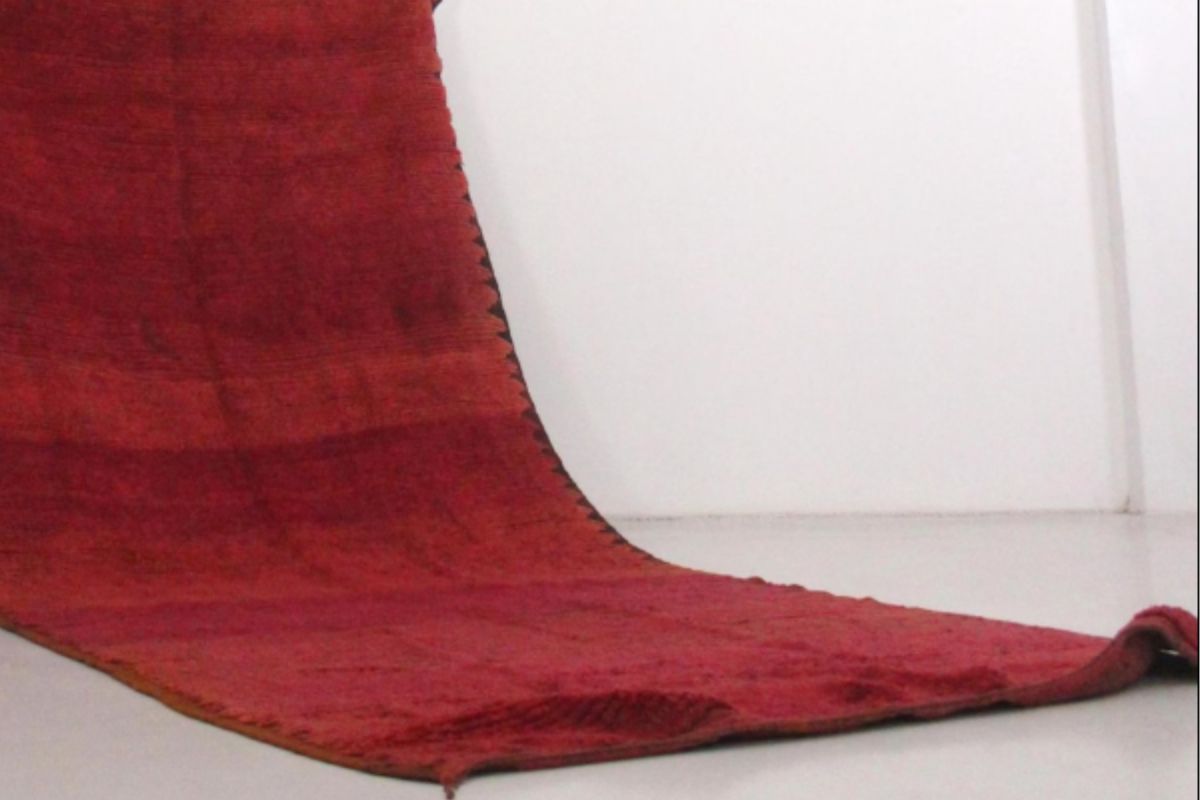
A Rehamna rug comes from the Haouz plains north of Marrakech, and it looks different from anything else covered so far in this guide: a dominant red or orange ground, often with natural color variation across the field, framed by a distinctive sawtooth-edge border, rather than the neutral cream or saturated pastel palettes of the Atlas Mountain styles.
Where the name and region sit
Rehamna refers to a region on the Haouz plains, extending north of Marrakech and bordered by the Oum Er-Rbia river. Rug specialists commonly attribute the tradition to the Rehamna, described as an Arab Maqil tribal group alongside Arabised Berber communities in the area, a reminder, consistent with what our Boujad guide already notes, that Moroccan weaving is not a single uniform Amazigh tradition but includes Arab and Arabised Berber groups as well. This guide treats that specific tribal attribution as reported by rug specialists rather than as independently confirmed, in keeping with how it treats every tribal-name claim across this site.
Two recognized looks
Rug dealers and specialists generally describe Rehamna production as falling into two recognizable types:
- Monochromatic red or orange ground. A dominant single-color field, often showing abrash, natural variation in tone caused by dye lots or hand-spinning, sometimes with a few sparsely scattered motifs rather than a dense pattern.
- A more abstract, scattered-motif style. Directional lines and chess-board-style elements arranged across the field, said by some specialists to draw influence from the urban carpet tradition of Rabat, further north.
Both types typically share a red or orange ground framed by a sawtooth-edge border. Which type a specific rug falls into is mostly a matter of what a weaver chose for a given piece rather than a strict rule tied to age or sub-region, so treat the two descriptions as a useful way to recognize what you're looking at, not as two separate named styles you need to choose between. On the monochromatic type especially, the abrash is often the main source of visual texture, since the pattern itself is otherwise minimal.
Construction details
A few construction features show up consistently across multiple independent rug-dealer descriptions, which gives them more weight than a single seller's claim:
- Goat-hair warp, sometimes blended with wool, rather than the all-wool construction of the Atlas Mountain styles
- Sawtooth-edge framing around the field, a distinctive zigzag border rather than a plain edge
- Striped kilim bands woven at both ends of the rug, a flatwoven finish bracketing the main knotted or patterned field
These are useful, checkable identification points: if you're looking at a rug with a warm monochrome or sparsely scattered field, a zigzag border, and flatwoven striped bands at each end, Rehamna is a reasonable style to consider before assuming it's simply "a red Moroccan rug."
How this differs from the Atlas Mountain styles
Everything else covered in this cluster so far, Beni Ourain, Beni Mrirt, Beni Mguild, Azilal, Boujad, Zanafi, comes from the Middle or High Atlas mountain regions. Rehamna sits on the plains, closer to Marrakech itself, which shows up directly in the look: a plains rug tends toward a bolder, more saturated single-color field rather than the mountain styles' either neutral-and-restrained (Beni Ourain) or scattered-and-painterly (Azilal) approach to color. If you're trying to place a red or orange rug geographically, Rehamna and its plains neighbors are a more likely starting point than the Atlas styles covered in our complete guide to Moroccan rug styles.
Where a Rehamna suits a room
Because the field runs bold and warm rather than neutral, a Rehamna tends to work as a statement piece rather than a background rug, closer in role to Boujad than to the quieter Beni Ourain or Beni Mrirt. A monochromatic red-ground piece with abrash reads as a single strong block of color, useful for anchoring a room that otherwise stays neutral. The more abstract, scattered-motif type carries more visual activity and suits a space that can take a busier floor without feeling crowded. Either type tends to compete with, rather than sit quietly beside, other strongly patterned or brightly colored elements in a room.
What to look for
- Check the warp material. A goat-hair or goat-hair-blend warp, visible at the fringe or edges, is a specific, checkable detail distinguishing this style's construction from the all-wool Atlas styles.
- Look at the border, not just the field. The sawtooth edge is one of the more distinctive and consistent identification markers across sources for this style.
- Don't assume every red Moroccan rug is Rehamna. Boujad also runs warm and red-toned, but on a fully dyed wool ground without the sawtooth border or goat-hair warp. Compare construction, not just color.
- Ask about the region directly, since the tribal attribution here, as with most named styles on this site, is reported by specialists rather than something this guide can independently verify from a listing.
- Check the end-bands specifically. The striped kilim bands at each end are a flatwoven finish distinct from the main field's construction; their presence and condition are a useful, checkable quality signal separate from the field itself.
One honest limit worth repeating here as on every style page: this guide can describe the tradition and its typical markers, but it cannot authenticate a specific rug from a photo, and no checklist substitutes for a seller who can answer direct questions about where a specific piece came from.
FAQ
What is a Rehamna rug?
A rug from the Rehamna region on the Haouz plains north of Marrakech, typically featuring a red or orange ground, a sawtooth-edge border, a goat-hair or goat-hair-blend warp, and striped kilim bands at both ends.
Where do Rehamna rugs come from?
The Haouz plains, extending north of Marrakech and bordered by the Oum Er-Rbia river, distinct from the Middle and High Atlas mountain regions that produce styles like Beni Ourain and Azilal.
What's the difference between a Rehamna rug and a Boujad rug?
Both run warm and red-toned, but Boujad is a fully dyed wool ground without a sawtooth border, while Rehamna typically shows a goat-hair warp and a distinctive zigzag sawtooth edge, sometimes with abrash color variation in a largely monochromatic field.
Are Rehamna rugs made by a specific tribe?
Rug specialists commonly attribute the tradition to the Rehamna, described as an Arab Maqil tribal group alongside Arabised Berber communities in the area. This guide treats that as a reported attribution rather than an independently verified fact.
What does "abrash" mean on a Rehamna rug?
Natural variation in color tone across a single-color field, typically caused by different dye lots or hand-spun wool. It's a normal feature of handmade rugs, not a flaw.
Leave a Reply