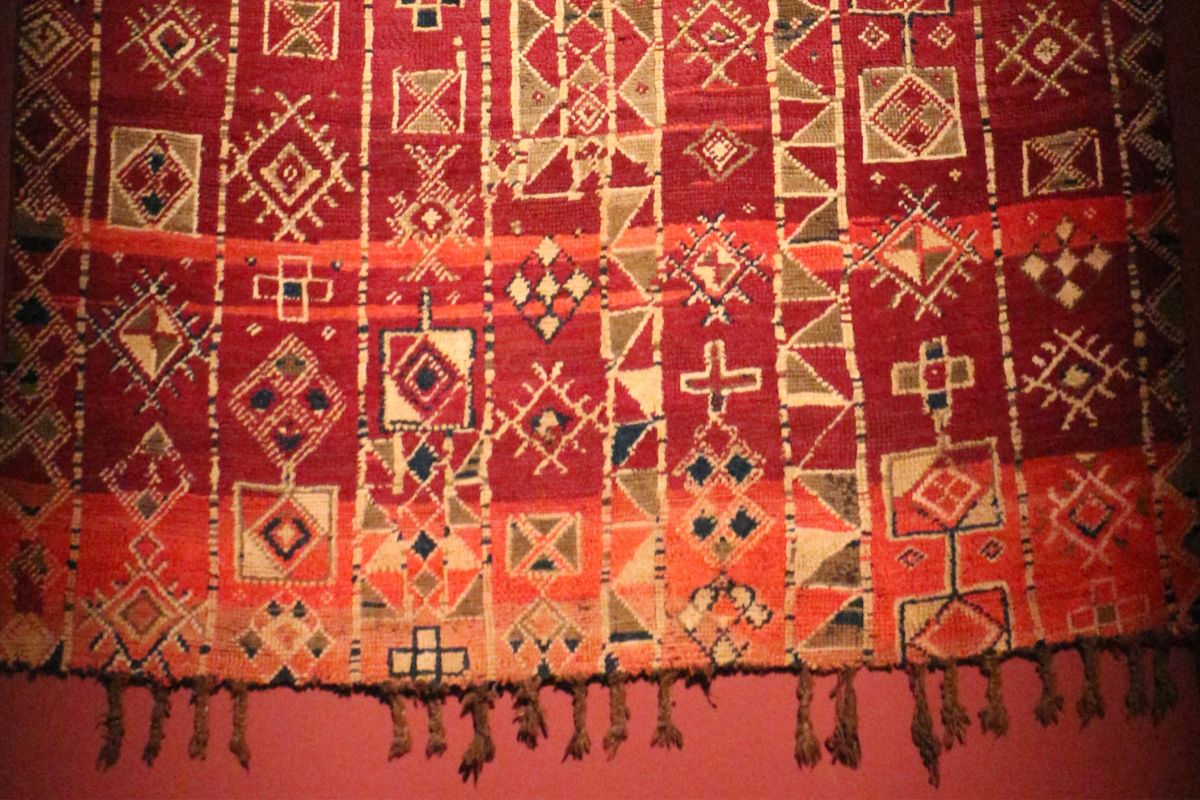
A Zemmour rug (also spelled Azmour or Azemmour) is known in the rug trade primarily as a dense, red-dominant flatweave, patterned with geometric bands, chessboard arrangements, and diamond or triangular motifs worked in vertical and horizontal rows. The name is associated with a Berber tribal confederation whose historical territory rug specialists place between Rabat and Meknès, further north than most of the Middle Atlas styles covered elsewhere on this site.
Where the name and territory sit
The Zemmour are described by rug and textile specialists as a confederation of tribes whose territory historically sat between Rabat and Meknès, a more northerly stretch of the Middle Atlas region than Beni Ourain, Beni Mrirt, or Beni Mguild territory. This guide presents that geography as reported by specialists rather than as independently verified from a primary historical source, consistent with how every regional and tribal attribution is handled on this site.
The look: red grounds and geometric bands
The defining visual feature is color: a dominant, dense red ground, worked with geometric motifs arranged in vertical and horizontal bands rather than scattered loosely across the field. Chessboard-style arrangements are common, along with diamond and triangular shapes, often set off with white or lighter-toned line work that stands out sharply against the red. The overall effect reads as more structured and banded than the sparse, asymmetric lines of Beni Ourain or the scattered motifs of Azilal.
A note on construction: flatweave, mostly
Most retail descriptions of Zemmour rugs treat them as a flatweave, kilim-style tradition, without a knotted pile, and that is the more commonly stated construction across the sources this guide checked. A smaller number of sources also describe piled rugs attributed to the same tribal name. This guide did not find a way to resolve that inconsistency cleanly, so it is stated here as an open point rather than settled either way: if you are shopping for a specific construction, ask the seller directly whether the individual piece in front of you is flatwoven or knotted, rather than assuming from the name alone.
If you want the general mechanics of how a flatweave is built and why it behaves differently from a pile rug, see our guide to Moroccan kilim and hanbel rugs.
How it compares to Rehamna
Zemmour is not the only red-dominant Moroccan style; Rehamna rugs also run warm and red-toned. The distinguishing features are geography and construction detail: Rehamna comes from the Haouz plains north of Marrakech and is typically described with a goat-hair warp and a sawtooth-edge border, while Zemmour is placed further north, between Rabat and Meknès, and is more consistently described as a banded, geometric flatweave without the sawtooth border. If you're trying to tell the two apart in a listing, check for the sawtooth edge and goat-hair warp first; their absence points toward Zemmour rather than Rehamna.
Where a Zemmour suits a room
A dense red ground with organized geometric banding reads as a strong, graphic statement rather than a quiet neutral base, closer in role to Boujad or Rehamna than to Beni Ourain. Because the pattern runs in structured bands rather than scattered motifs, a Zemmour tends to look more formal and considered on the floor than the looser, more improvised styles in this cluster, which can make it a good fit for a room that wants boldness without visual chaos. Its smaller reported sizing, where accurate, also makes it a reasonable candidate for an accent placement, a hallway, or layering over a larger neutral rug, rather than as a single large-room anchor.
What to look for
- Confirm construction directly. Given the flatweave/piled ambiguity in available sources, ask the seller plainly whether the specific rug is a flatweave or a knotted pile rather than assuming from the style name.
- Look for banded, not scattered, patterning. Zemmour's geometric motifs typically run in organized vertical and horizontal rows, which is a more structured look than Azilal's freehand scattering or Boucherouite's improvisation.
- Check the red for depth and variation. A genuine hand-dyed red ground often shows some natural variation in tone rather than a single flat, uniform shade.
- Ask about size expectations. Some sources describe Zemmour pieces as running smaller than typical Middle Atlas rugs; treat this as a general tendency to ask about, not a fixed rule, since no dimension figures are verified here.
- Ask what materials were used. Specialists describe Zemmour weaving as combining wool with cotton in some pieces; confirm the specific material mix for the rug you're considering rather than assuming an all-wool construction.
One honest limit that applies here as on every page in this guide: description and reported tendencies are not the same as authentication. This guide can tell you what a Zemmour rug is generally reported to look like and how it is generally constructed; it cannot confirm the origin of a specific piece from a photograph.
For how Zemmour fits alongside the rest of the region's named traditions, see the complete guide to Moroccan rug styles.
FAQ
What is a Zemmour rug?
A red-dominant geometric rug, most commonly described as a flatweave, associated with a Berber tribal confederation whose historical territory specialists place between Rabat and Meknès in Morocco.
Is a Zemmour rug flatwoven or knotted?
Most retail sources describe it as a flatweave (kilim-style), but a smaller number of sources also mention piled production under the same name. This guide could not resolve that inconsistency, so ask the seller directly which construction a specific piece uses.
How is a Zemmour rug different from a Rehamna rug?
Both run warm and red-toned, but Rehamna comes from the Haouz plains near Marrakech and typically has a goat-hair warp and sawtooth-edge border, while Zemmour is placed further north, between Rabat and Meknès, and is described more as a banded geometric flatweave without that sawtooth border.
What patterns appear on Zemmour rugs?
Geometric motifs arranged in organized vertical and horizontal bands, including chessboard arrangements, diamonds, and triangles, often in white or light line work against a dense red ground.
Are Zemmour rugs small?
Some sources describe them as tending to run smaller than typical Middle Atlas rugs, though this guide has no verified dimension data and treats it as a general tendency rather than a fixed rule.
What materials are used in a Zemmour rug?
Specialists describe the tradition as using both wool and cotton, alongside notably skilled use of red dye. Confirm the specific material mix directly with a seller for any individual piece rather than assuming a single standard construction.
Leave a Reply