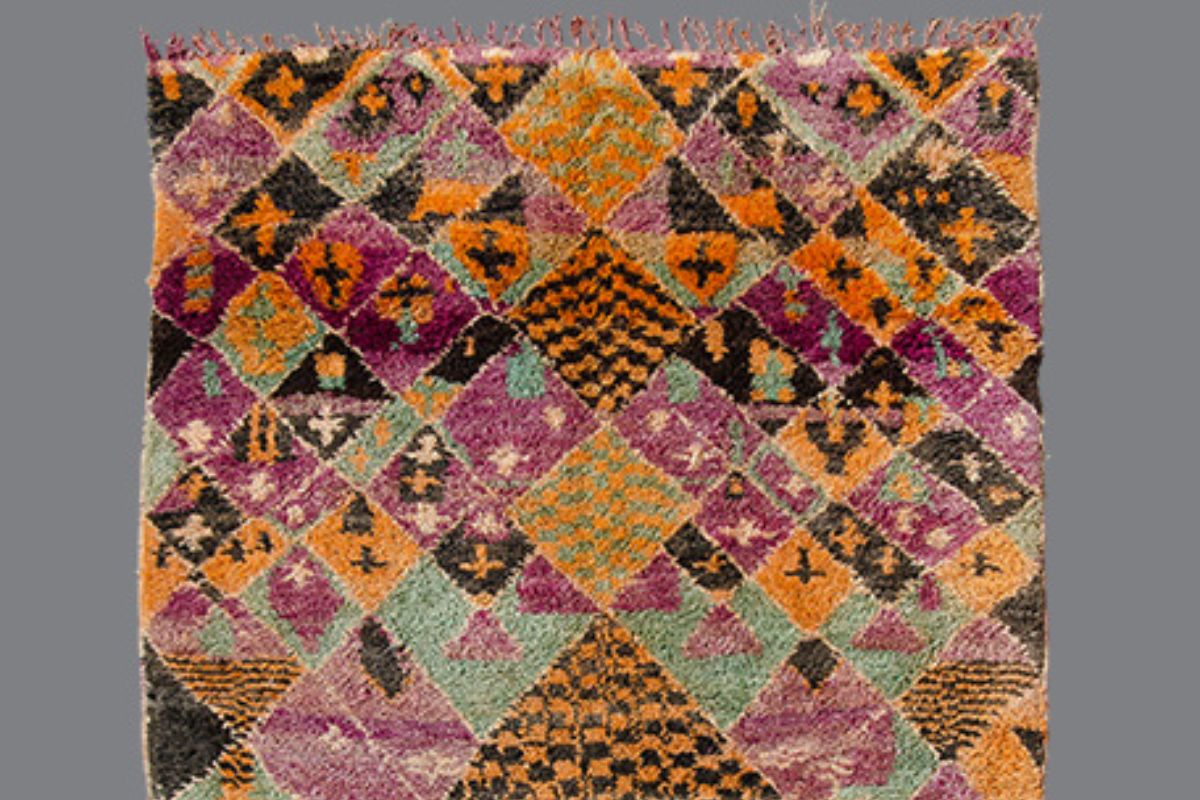
An Aït Bou Ichaouen rug, sometimes labeled a Talsint rug after the nearby town, comes from the far eastern edge of Morocco's High Atlas, near the Algerian border. It looks different from almost everything else covered on this site: instead of the undyed ivory of a Beni Ourain or the sketchy brightness of an Azilal, expect a dense, saturated palette of aubergine, mauve, tangerine, sage, and ochre worked into bold, tightly packed geometric motifs. If a rug you're looking at doesn't fit the Middle Atlas or High Atlas families already covered here, this is one of the styles worth checking against.
Where the name and territory sit
Rug dealers place the Aït Bou Ichaouen in the far eastern High Atlas, in the Figuig province, close to the Algerian frontier. Several vintage-rug dealers and collectors describe this area as geographically isolated enough that it remained largely outside the international rug trade until sometime in the 1990s, when a wider audience of collectors began acknowledging pieces from the region. That specific timeline is a dealer claim, repeated across several rug-trade sites, not something this guide found in independent journalism or academic sourcing. Treat it as the trade's own account of how these rugs entered the market, not a verified historical date.
The nearby town of Talsint gives the weaving its alternate market name, and you will see "Ait Bou Ichaouen" and "Talsint" used more or less interchangeably in listings for the same tradition.
This is one of the least-documented styles in this site's own Cluster 1 map, and that is worth saying up front rather than glossing over. Compare it with Taznakht, where independent journalism names an actual women's cooperative and a manager by name, or with Beni Ourain, a style so commercially dominant that dozens of sellers describe it in overlapping detail. Aït Bou Ichaouen sits at the opposite end: a real weaving tradition that entered the international collector market comparatively recently and late, according to the dealers who sell it, and about which comparatively little independent material exists in English.
What the rugs look like
Where this differs from most of what this site has already covered is the color. Rug dealers consistently describe an aubergine-and-mauve base, often combined with tangerine, sage green, and ochre, arranged into dense, geometric, knotted-pile patterns. That knotted-pile construction is itself notable: it is described in dealer sourcing as an unusual survival of an older North African weaving approach in a region where other eastern traditions lean more toward flatweave. The motifs tend to be packed closer together than the open, sparse fields common on some High Atlas styles, giving the rugs a busier, more saturated look overall.
If you're trying to place a rug from a photo, the combination of aubergine/mauve tones with tangerine and ochre accents, in a dense pattern, is the strongest visual signal for this style specifically, a very different read from the cream-ground minimalism of a Beni Ourain.
Quick comparison
| Aït Bou Ichaouen / Talsint | Beni Ourain | Taznakht | |
|---|---|---|---|
| Region | Far eastern High Atlas, near Algeria | Middle Atlas | Southeastern Morocco, Anti-Atlas edge |
| Ground color | Aubergine, mauve base | Undyed ivory/cream | Colorful, plant-dyed |
| Pattern density | Dense, tightly packed | Sparse, minimal | Dense, geometric |
| Independent sourcing found | Dealer accounts only | Extensive dealer coverage | Named journalism (Africanews) |
This table reflects what dealer sources describe and what this guide could verify independently, not a scientific classification, and not a claim that every individual rug sold under these names will match the pattern exactly. Hand-woven work varies piece to piece even within one named tradition.
What this guide could and could not source
This is worth stating plainly, because it's a real difference from some of the other style pages on this site. For a row like Taznakht, independent journalism, Africanews and reporting picked up by The Arab Weekly, named actual cooperatives, a specific manager, and reported weaver counts. For Aït Bou Ichaouen, every source found in this guide's research is a rug dealer, auction house, or collector site: 1stDibs listings, an auction description from a private collector, and vintage-rug retailers. No museum record, academic paper, or independent news report turned up in this guide's research to corroborate the tribal name, the isolation date, or the specific palette description beyond what dealers themselves state.
That doesn't mean the dealer account is wrong. It means this guide cannot independently verify it the way it can for better-documented traditions, and says so rather than presenting dealer marketing copy with the same confidence as sourced journalism. No age, knot count, or production date should be taken as settled fact from a dealer listing alone, and this guide will not manufacture one.
This gap also matters for a practical reason. A style with thin independent documentation is easier for a seller to describe however suits a sale, since there is less published material a buyer can check a claim against. That is not a reason to avoid a genuinely interesting, underserved tradition; it is a reason to ask more questions of the specific seller, not fewer, before treating any dealer's account of origin, age, or rarity as settled.
Why this style shows up in decor searches at all
Aït Bou Ichaouen and Talsint rugs turn up in general "eclectic," "boho," or "colorful vintage rug" decor searches more often than in dedicated Morocco-style searches, largely because their saturated, jewel-toned palette photographs well against neutral modern interiors, a different appeal than the muted, minimalist look that made Beni Ourain a design-world staple. If you found one this way rather than by searching for the tradition by name, that is consistent with how dealers say these pieces circulate: as standout color pieces first, named tradition second.
What to look for
- The palette first. Aubergine, mauve, tangerine, sage, and ochre together, in a dense pattern, is the strongest identifying signal dealers describe for this style.
- Ask where the sourcing comes from. If a seller states a specific age, weaving date, or tribal attribution with certainty, ask what that's based on. Given how thin the independent sourcing is for this style, a confident-sounding claim deserves a follow-up question, not automatic trust.
- Compare construction, not just color. The knotted-pile structure described for this tradition is a different construction than a flatweave like a Moroccan kilim or hanbel, even where colors might look superficially similar in a photo.
- Don't expect this guide, or any photo-based guide, to authenticate a specific piece. As with every style on this site, an actual purchase decision on an individual rug should involve direct questions to the seller, not a checklist alone.
FAQ
What is an Aït Bou Ichaouen rug?
A knotted-pile rug tradition attributed to the Aït Bou Ichaouen people of Morocco's far eastern High Atlas, near the Algerian border, known in the rug trade for a distinctive aubergine, mauve, tangerine, sage, and ochre palette in dense geometric patterns.
Is Talsint the same thing as Aït Bou Ichaouen?
In the rug trade, yes, "Talsint" is used as an alternate market name, referring to a nearby town, for rugs attributed to the same tradition.
How old are Aït Bou Ichaouen rugs typically?
This guide could not find an independently sourced age figure for this tradition and will not state one. Dealer listings sometimes describe specific pieces as vintage or antique, but those are claims about the individual item for sale, not a verified fact about the tradition as a whole.
How is this different from a Beni Ourain rug?
Visually, almost entirely opposite: a Beni Ourain is built around undyed ivory wool with sparse dark motifs, while an Aït Bou Ichaouen rug is densely patterned in saturated purple, orange, and green tones. See the Beni Ourain guide for the contrast in detail.
Why is there less written about this style than about Taznakht or Beni Ourain?
Based on this guide's own research, the sourcing available is thinner. Taznakht has independent journalism naming cooperatives and weaver numbers; for Aït Bou Ichaouen, only dealer and collector sources were found. That gap is stated here rather than papered over.
Leave a Reply