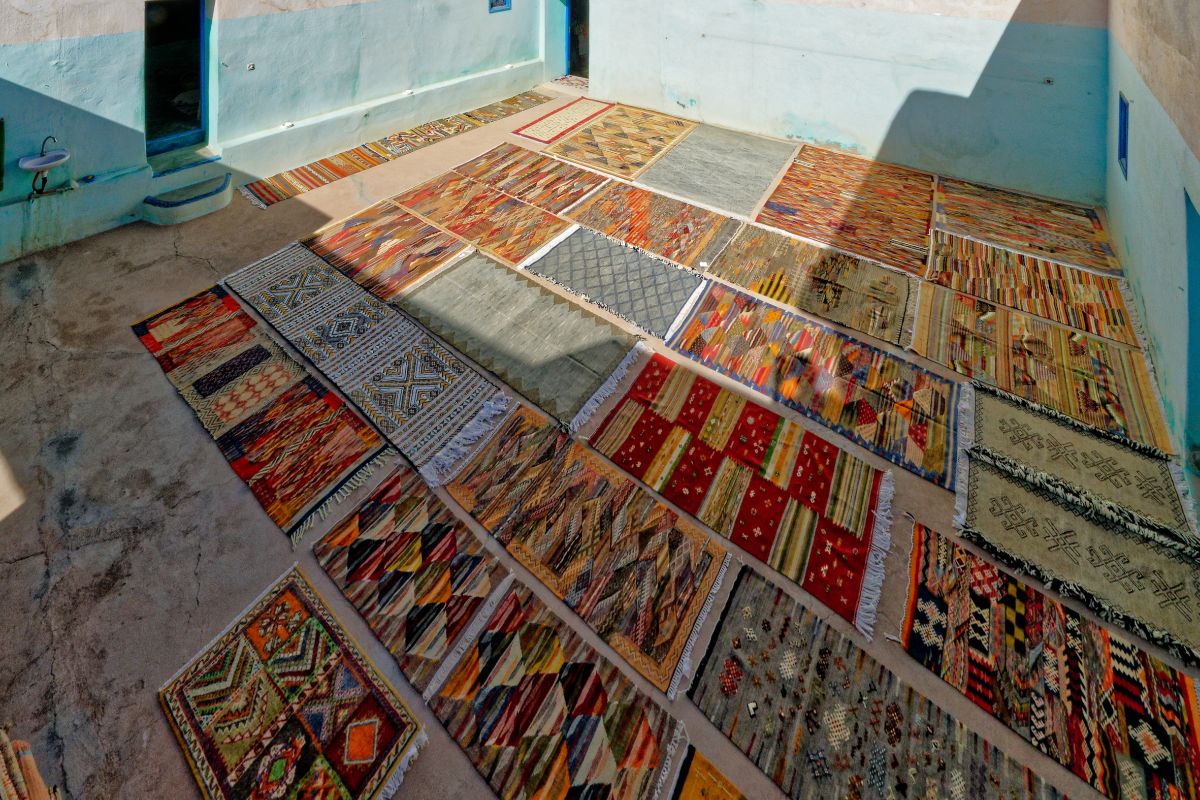
Taznakht is a town in southeastern Morocco, and rugs sold under its name, sometimes also labeled "Ouaouzguit," come from one of the best-documented weaving traditions in the country. Unlike most of the styles on this site, where the only accounts available are seller marketing copy, Taznakht's cooperatives have been reported on directly by international journalists, which means this page can name real organizations, a real number of weavers, and a real person, rather than repeating unsourced tribal lore.
Who actually makes these rugs
According to Africanews (July 2025), the town of Taznakht is home to a genuine, organized weaving economy built around women's cooperatives. The most prominent is the Women's Centre for the Promotion of the Taznakht Carpet, established in 2016, which brings together 35 cooperatives and roughly 3,500 women weavers. The centre is reported to produce up to 300 carpets a month. Abderrahmane Janah, who manages the centre, is quoted describing the rugs as a way weavers "expressed their creativity" and "used it as a medium to convey their emotions."
This is a genuinely different kind of evidence than most Moroccan-rug content online, which tends to describe an unnamed, anonymous "tribal craft." Taznakht's weavers are not anonymous: they work through named, dated, sourced organizations, at a documented scale.
The same reporting notes that a new exhibition space in Taznakht now lets some weavers sell their work directly to buyers, alongside training in digital marketing, both aimed at cutting out the middlemen who have traditionally set prices at the region's markets. That detail matters for anyone buying a Taznakht rug who wants their money to reach the person who made it, not just the person selling it.
Materials and process
Africanews's reporting describes the process in specific, checkable terms: wool is sourced from sheep in the region, including animals from the nearby Sirwa mountains. Weavers wash the wool, spin it, and dye it using colors drawn from plant materials: henna, pomegranate peel, saffron, and indigo leaves. The rugs are woven on a traditional wooden loom, and a single piece is reported to take several weeks to several months to complete, depending on its size and the complexity of the design.
That plant-based dye list is worth noting on its own: it means at least some Taznakht production carries the same natural-dye character found in other named Moroccan traditions, rather than relying purely on modern synthetic dyes.
The tribal-name question
You will see "Taznakht rugs" also referred to as "Ouaouzguit" rugs, and several rug-trade sources attribute this second name to the Ait Ouaouzguite, described as an Amazigh (Berber) tribal grouping associated with the mountain villages around Taznakht. This guide could not confirm that specific tribal attribution against the journalism sources used above, which discuss the cooperatives and the town but do not name this tribal grouping directly. Treat the "Ait Ouaouzguite" name as a claim made by rug specialists and sellers, useful context, but not independently verified here the way the cooperative numbers above are.
You may also see these rugs described in listings as traditionally part of a bride's dowry, exchanged as a way of marking a marriage. That is a claim reported by rug-trade sources rather than the journalism used elsewhere on this page, so it is noted here as an attributed detail rather than a confirmed fact about the tradition as a whole.
How this differs from the Middle Atlas styles
Everything covered so far in this Cluster (Beni Ourain, Beni Mrirt, Beni Mguild) comes from the Middle Atlas, in the country's north-central mountains. Taznakht sits much further south, near the edge of the Anti-Atlas and Sirwa ranges, and its rugs are generally more colorful and pattern-dense than the restrained, largely undyed Middle Atlas wool styles. If you are trying to place a rug geographically from a listing, "Taznakht" or "Ouaouzguit" on the label should point you south, not to the Beni Ourain / Beni Mrirt / Beni Mguild family covered in our complete guide to Moroccan rug styles.
What to look for
- Ask who made it, specifically. Given how well-documented Taznakht's cooperative network is, a seller who cannot say which cooperative a rug came from, or whether it passed through the Women's Centre network, is giving you less information than is actually available for this style.
- Look for the plant-dye palette. Henna, pomegranate, saffron, and indigo produce a warmer, earthier range than purely synthetic dyes. A flat, uniform, highly saturated color across the whole piece is worth a second look.
- Don't assume every "Ouaouzguit" claim is verified. The cooperative facts above are journalism-sourced; the specific tribal name and the dowry tradition are not, and this guide treats them accordingly.
One honest limit: this page describes a documented weaving economy, not a specific rug you may be looking at. It cannot authenticate an individual piece or confirm which cooperative made it from a photo alone; that requires asking the seller directly.
FAQ
What is a Taznakht rug?
A rug produced in or attributed to Taznakht, a town in southeastern Morocco, home to a documented network of women's weaving cooperatives, including the Women's Centre for the Promotion of the Taznakht Carpet, established in 2016.
What does "Ouaouzguit" mean?
It is an alternate name used for Taznakht-area rugs. Rug-trade sources attribute it to the Ait Ouaouzguite, described as an Amazigh tribal grouping in the region, though this guide could not independently confirm that attribution against available journalism.
How many weavers are involved in Taznakht rug production?
Africanews reported in 2025 that the Women's Centre for the Promotion of the Taznakht Carpet alone includes 35 cooperatives and roughly 3,500 women weavers, producing up to 300 carpets a month.
What materials go into a Taznakht rug?
Wool from sheep in the region, including the nearby Sirwa mountains, washed, spun, and dyed with plant materials such as henna, pomegranate peel, saffron, and indigo leaves, then woven on a traditional wooden loom.
Is it true Taznakht rugs were traditionally part of a bride's dowry?
That claim appears in rug-trade sources but was not confirmed in the journalism used for this guide. Treat it as an attributed detail from sellers and regional specialists rather than an independently verified fact.
Leave a Reply