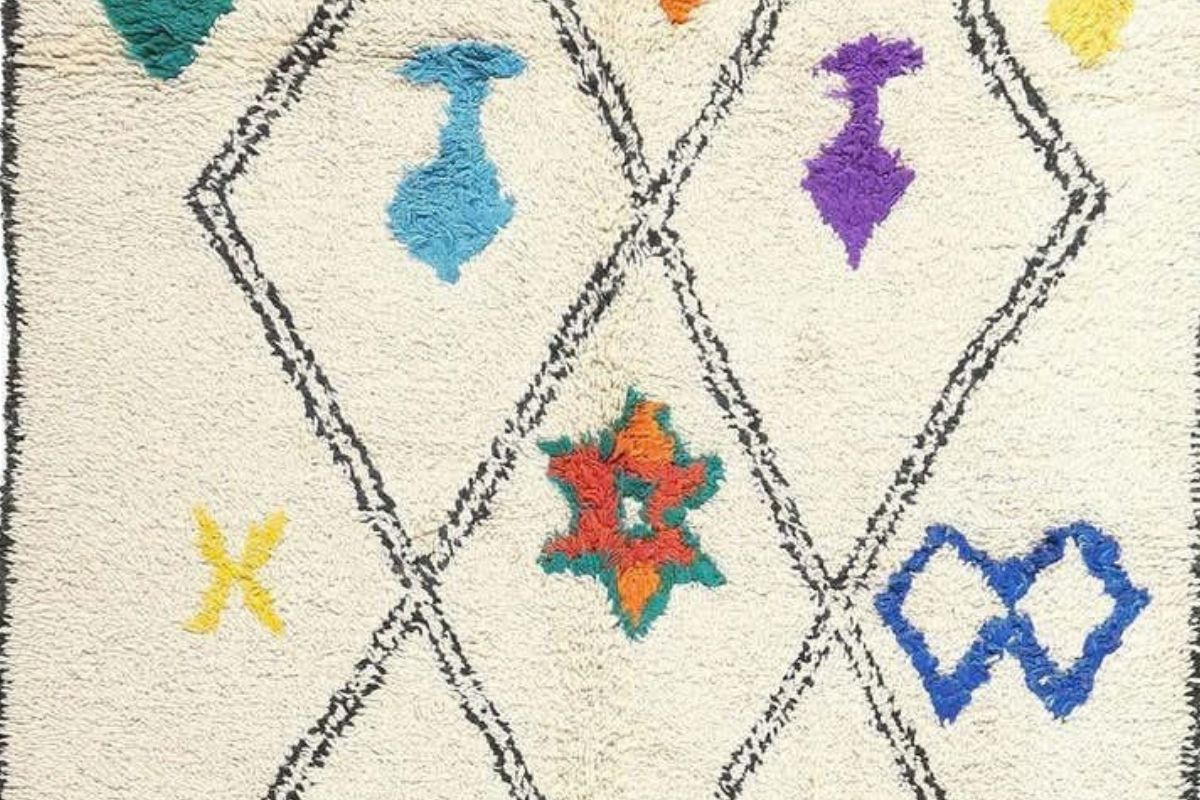
A Berber evil eye rug is an Amazigh (Berber) rug whose motifs, usually diamonds, lozenges, or diamonds with a dot or cross at the center, are read as protection against the evil eye, the belief that an envious glance can cause harm. Museums do record eye motifs used protectively in Amazigh art. But no single meaning is fixed: scholars disagree, motif names shift between places and generations, and only the weaver can say what a particular rug was meant to do.
That last point matters more than any symbol chart. The rest of this guide sets out what the evidence actually supports, where the sources part ways, and how to read a seller's story about a rug in front of you.
What "evil eye" means in an Amazigh rug
The evil eye is a widespread belief across North Africa, the Middle East and the Mediterranean: that admiration or envy, even unintended, can bring misfortune to a person, a child, a home or a possession. In Morocco it sits alongside other ideas about blessing and harm, including baraka, a word usually translated as divine blessing.
In Amazigh visual culture, protection from the evil eye is not a separate category of rug. There is no traditional "evil eye rug" style the way there is a Beni Ourain rug or an Azilal rug. The phrase is a modern search term, and it describes a function people attribute to certain motifs, not a type of weaving. A rug from almost any region can carry motifs that someone, somewhere, reads as protective.
It also helps to separate two things that often get blended online. The blue-and-white glass eye bead sold as a charm is associated with Turkey and the eastern Mediterranean. Mass-market rugs printed with a literal blue eye borrow that image. Amazigh weaving, as museums describe it, works in abstract geometry instead, so an Amazigh "eye" is almost always a shape, not a picture of an eye.
What museums actually document
The clearest institutional statement comes from Harvard's Peabody Museum of Archaeology and Ethnology. Its online exhibition Imazighen: Amazigh Aesthetics and Symbology, curated by Susan G. Miller and Lisa Bernasek and read for this guide on 2026-09-23, says that symbols such as the "eye" and the "hand of Fatima" are used to ward off the misfortune associated with the evil eye. The same gallery is careful about scope: it says the names and interpretations of these motifs may differ from place to place and have changed over time, while often relating to a belief in the protective power of the sign.
The gallery backs this with specific objects rather than a general claim. It describes a man's wool and goat hair cape (akhnif) from the Siroua Mountains of Morocco with eye motifs meant to protect the wearer from invisible dangers, and a Kabyle ceramic vessel from Algeria on which the lozenge shape is described as representing an eye.
Notice what that evidence does and does not establish. It shows that eye motifs and lozenges were used protectively on some Amazigh objects, including a woven garment. It does not show that every diamond on every Moroccan rug is an eye, or that every weaver intended protection.
The symbols most often linked to protection
Below are the motifs that rug sellers and some scholars most often connect with the evil eye. Each comes with who says so, because the attribution is the useful part.
The diamond or lozenge
This is the motif people usually mean when they search for a Berber evil eye rug. Nested diamonds, or a diamond with a dot or cross in the middle, are widely sold as an "eye." The Peabody gallery supports an eye reading for the lozenge on at least one documented object. The diamond is also the single most common shape in Amazigh weaving, which is exactly why a fixed reading is risky: it appears in lattices, borders and fillers where no one has recorded an intended meaning.
The zigzag, sickle and scissors
Cynthia Becker, an art historian who carried out more than two years of fieldwork among the Ait Khabbash of southeastern Morocco, notes in Amazigh Arts in Morocco: Women Shaping Berber Identity (University of Texas Press, 2006; publisher page read on 2026-09-23) that authors refer to the zigzag as a sickle, scissors or saw, pointed objects said to pop or burst the evil eye. Her wording is worth reading closely. She reports how writers on Amazigh art have named the motif; she does not present it as the one meaning weavers share.
The triangle and the hand
Becker also records that scholars interpret the triangle as a stylized, protective hand motif. The hand, known as the khamsa or hand of Fatima, is the protective symbol the Peabody gallery names alongside the eye. On a rug it rarely looks like a hand; it tends to survive as a triangle, a comb-like shape or a five-part cluster, which again leaves room for competing readings.
Where the sources disagree
This is where most online symbol guides stop being useful, because they present one reading as settled. The scholarly picture is not settled.
Protection. The Peabody gallery documents eye and hand motifs used against the evil eye in Amazigh art, with named objects. This is the reading most sellers use.
Fertility and the feminine. Bruno Barbatti, a Swiss historian and collector, argues in Berber Carpets of Morocco: The Symbols, Origin and Meaning that the core geometric forms, including the lozenge, the chevron and the X shape, are fertility symbols with very ancient roots. His book is widely quoted by rug sellers. It has also drawn criticism from readers for leaning on prehistoric comparisons more than on what weavers themselves say. Becker's fieldwork notes that fertility associations run through Amazigh women's arts, but she does not reduce motifs to a single code.
Names that change. Becker's most important point for a buyer may be this one: the names given to motifs change from generation to generation, depending on the historical and political circumstances of the time. She records that the Ait Khabbash call the triangle or diamond motif on woven textiles tahanut, meaning "room." So the same diamond a seller calls an "eye" may be named for something quite different by the women who weave it in one community.
Both, or neither. None of these readings rules out the others. A diamond could carry a protective meaning in one household, a fertility meaning in another, and simply be the shape a weaver learned from her mother in a third. The honest summary is that protection is a documented use of some Amazigh motifs, not a documented meaning of every one.
Why a single "meaning chart" can mislead you
Amazigh rugs were, for most of their history, woven by women for household use, as covered in our guide to the women who weave Moroccan rugs. Designs were learned, adapted and passed on inside families and communities, and much of that knowledge was never written down by the weavers themselves. The written record is largely made by outsiders: travelers, colonial-era ethnographers, collectors, and later scholars and dealers.
That produces three problems for anyone reading a symbol chart:
- Translation drift. A motif name recorded in one valley gets repeated as a universal meaning.
- Commercial pressure. A rug described as a protective charm is an easier story to sell than a rug described as "a diamond, meaning unrecorded."
- The loom itself. Many shapes follow from how weaving works. Diagonals on a vertical loom naturally build stepped diamonds and zigzags, so the frequency of a shape is partly technical, not symbolic.
None of this makes the protective tradition false. It means a respectful reading treats weavers as the authority on their own work, rather than treating their rugs as puzzles for outsiders to decode.
How to read a seller's evil eye claim
If you are looking at a rug described as protective, these questions will tell you more than the motif will.
- Who said it means protection? A claim that traces to the weaver, a named cooperative or a museum is different from an unsourced listing.
- Is a weaver or community named? A specific, checkable origin is more meaningful than "ancient tribal symbol."
- Does the description allow for doubt? Careful sellers say a motif "is often read as" protection. Absolute claims ("this symbol means…") are a warning sign about the quality of the rest of the listing.
- Is the rug itself described accurately? The symbol story should never substitute for basic facts about fiber, construction and age. Our overview of what a Berber rug actually is covers those basics.
What this guide cannot tell you
This guide cannot authenticate an individual rug, date it, attribute it to a specific tribe or community, or say what its maker intended. Nobody can do that from a photograph and a symbol chart. The people best placed to help are the weaver or women's cooperative that made the rug, if they can be identified; a museum textile or ethnography department; or an independent textile specialist who examines the rug in person. For a formal valuation, look for an appraiser with specific experience in North African weaving.
Frequently asked questions
Is a Berber evil eye rug supposed to protect the house?
Some Amazigh motifs have been used for protection. Harvard's Peabody Museum documents eye and hand motifs used against the evil eye, including on a woven cape from the Siroua Mountains. Whether a particular rug was meant to protect a home depends on its maker, and that is rarely recorded.
What does the diamond mean on a Moroccan rug?
There is no single answer. It is read as an eye (protection), as a fertility or feminine symbol (Bruno Barbatti), and among the Ait Khabbash as tahanut, "room" (Cynthia Becker). Meanings vary by community and have changed over time.
Is it respectful to buy a rug for its protective symbols?
Appreciating the tradition is fine. The respectful approach is to treat the symbolism as the weavers' own knowledge, avoid claiming a certainty they did not state, and favor sellers who name the makers and pay them fairly.
Is the blue eye design on rugs a Berber tradition?
The blue-and-white eye bead is associated with Turkey and the eastern Mediterranean. Amazigh weaving, as museums describe it, expresses the eye through abstract geometry such as the lozenge, not a literal painted eye.
Can you tell if a rug's symbols were meant as protection?
Not from the pattern alone. Ask for the source of the claim, a named weaver or cooperative, and any documentation. Without that, the protective reading is an interpretation, not a fact about the rug.
Leave a Reply