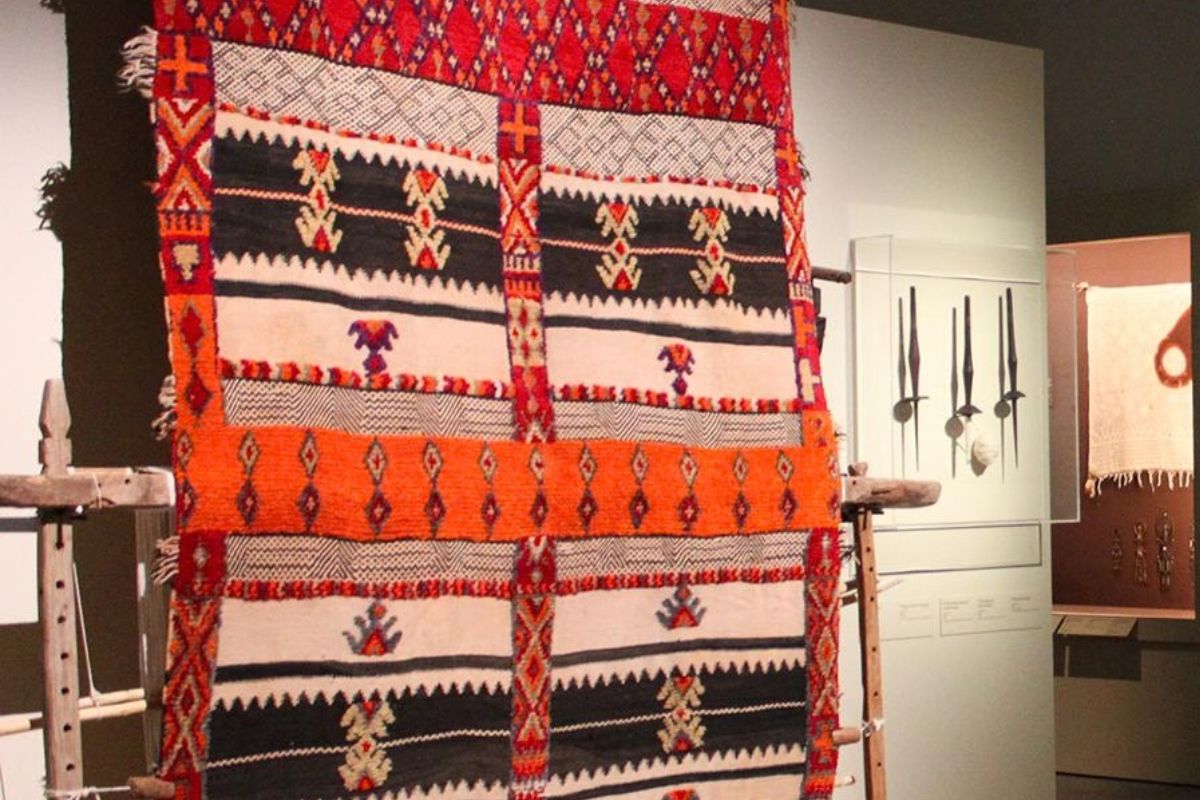
Amazigh tattoo symbols and rugs share much of the same vocabulary: chevrons, dots, crosses, lozenges and zigzag lines appear on women's faces and hands in older photographs and on woven wool. Museums and scholars agree the overlap is real. They do not agree on what the shapes mean. Some read them as protection, some as markers of identity or life stage, and one influential author reads many as fertility symbols. No single meaning is fixed, and a motif on your rug cannot tell you who wove it or what she intended.
If you have seen marks on the face of an older Amazigh woman and then recognized the same shapes in a rug, you are noticing something documented. This guide sets out what the evidence supports, where it runs out, and how to talk about these motifs with the respect they are owed.
What the sources say about Amazigh tattoo symbols and rugs
The clearest recent statement comes from the Mucem in Marseille. Its exhibition Amazighes: Cycles, Ornaments, Patterns, which ran from April 30 to November 2, 2025, was curated by the anthropologist Salima Naji and Alexis Sornin, director of the Yves Saint Laurent Marrakech and Pierre Bergé Berber Arts museums. The exhibition page, read for this guide on 2026-09-23, puts the core point plainly: "From tattooed bodies to jewellery, domestic objects, veils or tent stretchers, house walls or doors, the same motifs, forms and symbols can be found everywhere."
That sentence is worth reading slowly. It does not say tattoos were copied onto rugs, or rugs onto skin. It says a shared repertoire of forms runs across many media at once, of which tattooing and weaving are two. The same page describes a "grammar of forms" that dresses a weaving in Tunisia or Morocco or a pottery vessel in Niger or Libya.
So the honest short answer is this: the resemblance between Amazigh tattoos and rug motifs is recognized by museum curators, and it belongs to a wider visual language. It is not evidence of a secret code that maps one tattoo to one rug pattern.
Where the shared motifs appear, beyond skin and wool
Tattooing was not the only way these shapes were put on the body. The Encyclopédie berbère, the scholarly reference work founded by the archaeologists Gabriel and Henriette Camps, carries an entry by J. Herber on ḥarqūs, the temporary body decoration (volume 22, 2000; online edition 2012, read on 2026-09-23). Herber describes ḥarqūs as very close to tattooing, reproducing both its technique and its motifs, and differing mainly in that it lasts only a few days.
Two details from that entry matter for rug owners:
- The motifs cross media. Herber writes that ḥarqūs designs reproduce the designs of tattoos and of Berber pottery, and the illustrated forms include chevrons, crossed lines and stars.
- The motifs had uses beyond decoration. The entry records ḥarqūs being applied to newborns in the period after birth and notes its protective character, while not spelling out a precise meaning for each shape.
Notice what Herber does not say. The entry concerns body decoration and pottery; weaving is barely mentioned. Linking these same motifs to rugs rests on sources like the Mucem exhibition, which place textiles in the shared repertoire, rather than on this particular entry.
What the motifs were for, according to people who studied them
Here the sources start to diverge, and it helps to keep each voice separate.
The Mucem curators (2025) describe the signs as "not just decorative," playing "a triple role: aesthetic, of course, but also therapeutic and apotropaic, and as a social and gender marker." Apotropaic means intended to turn away harm. On this reading a single motif can do several jobs at once: it can be beautiful, protective, and a statement about who the wearer or maker is.
Cynthia Becker, an art historian, spent years with Ait Khabbash women in southeastern Morocco for her book Amazigh Arts in Morocco: Women Shaping Berber Identity (University of Texas Press, 2006). Its opening chapter concerns textiles, and the publisher's description presents the women's clothing, tattoos and jewelry as public statements of identity, with the control of these visual symbols giving women prestige. Becker's lens is identity and social meaning within one named community, not a universal dictionary of shapes.
Bruno Barbatti, in Berber Carpets of Morocco: The Symbols, Origin and Meaning (English edition, 2008), takes a different route. He reads core forms such as the lozenge, the chevron and the X-shape largely as female and fertility symbols, and compares them with prehistoric art to argue for very old roots. His book is widely consulted for its large catalogue of motifs.
Where the sources disagree
Put those three side by side and the disagreement is not small.
| Question | Mucem curators (2025) | Becker (2006) | Barbatti (2008) |
|---|---|---|---|
| What is the main frame? | Several roles at once: aesthetic, protective, social | Identity, made and displayed by women | Fertility and sexual symbolism |
| Where does evidence come from? | Museum collections across North Africa and the Sahara | Long fieldwork with one community | Motif comparison, including prehistoric art |
| Is meaning fixed? | Presented as layered | Tied to a specific community and history | Treated as largely recoverable |
The sharpest point of tension is method. Barbatti builds meaning partly by comparing Moroccan motifs with prehistoric imagery, while Becker's approach starts from what women in a specific community do with these symbols and what they say about them. The practical difference for a reader is that his comparisons with prehistoric imagery are not the same kind of evidence as what weavers themselves report. His readings are not worthless; they are one interpretation, and they should be labeled as his.
For a reader, the practical consequence is simple. When a website tells you a diamond "means fertility" or a cross "means protection," ask whose reading that is. Often it is Barbatti's, or a seller repeating it without credit. It may be a reasonable reading. It is not a settled fact.
Why the same shapes might travel between skin and wool
One question the symbol lists rarely ask: why do tattoos and rugs look so alike in the first place?
Shared meaning is one answer, and the museum sources support it. Technique may be another, and this is a consideration rather than a documented finding. Tattoos applied by pricking the skin tend toward dots, short lines and angles. Weaving on an upright loom builds a design row by row on a grid of warp and weft, which also favors straight lines, stepped diagonals, lozenges and chevrons over curves. Our guide to the Moroccan vertical loom explains how the grid shapes what a weaver can easily make.
When two crafts both push toward geometry, some resemblance would be expected even before meaning enters the picture. That does not cancel the shared vocabulary the Mucem describes. It is a reason to be cautious about treating every visual match as proof of a shared message.
A living history of people, not a pattern library
Amazigh facial and hand tattoos were worn by real women, in named places, within their own families and communities. They were not made for outsiders to decode, and they are not a design trend waiting to be borrowed.
The practice has also changed a great deal. Becker's publisher notes that French colonial rule, the later Arab-dominated national government and the more recent transnational Amazigh movement have all pushed Ait Khabbash women to adapt their arts. Yet the Mucem exhibition also included contemporary tattoos and writing that resonate with older practices. This is a living tradition with a history, not something frozen or vanished.
That matters when you write or talk about a rug. The women who weave these rugs are, in many cases, from the same communities as the women who wore the tattoos. Our profile of the women behind Moroccan rugs covers who they are and how the work is organized today. Describing their motifs as "mystical" or "primitive," or treating a grandmother's face as a source of décor, flattens real people into an aesthetic.
A note on words: this guide uses Amazigh alongside Berber. As our explainer on what a Berber rug is sets out, "Berber" is an outsider's term that some communities reject.
How to read the motifs on your own rug
You cannot authenticate or date a rug from its motifs, and neither can we. What you can do is read it carefully and ask better questions.
- Name what you see, not what it "means." "A column of lozenges with a dot at the center" is accurate. "A fertility symbol" is an interpretation borrowed from someone.
- Look for the source behind any meaning you are told. A museum page, an ethnography or a named scholar can be checked. A seller's symbol chart usually cannot.
- Expect variation. The same shape can be named and read differently from one community or generation to the next. Some styles, such as Azilal rugs, are known for freely improvised compositions, where a motif may be the weaver's own choice.
- Do not infer origin from a single motif. Shared shapes occur across regions and media, which is exactly what makes them poor evidence for where a rug was made.
- Ask the maker when you can. If you buy from a cooperative or a weaver directly, her explanation outranks any chart, including this one.
For questions about a specific rug's origin, age or value, a museum textile department, an independent appraiser who works with North African weaving, or the cooperative that sold it are better placed to help than any website, this one included.
Frequently asked questions
Do Amazigh rug symbols come from tattoos?
No source we found says rugs copied tattoos, or the reverse. The Mucem's 2025 exhibition describes the same motifs appearing on tattooed bodies, jewelry, domestic objects, textiles and buildings. Treat them as a shared visual language across many crafts rather than a line of descent from skin to wool.
What do Amazigh tattoo symbols mean?
It depends on who you ask. The Mucem curators describe aesthetic, protective and social roles. Cynthia Becker (2006) frames tattoos and textiles as statements of identity. Bruno Barbatti (2008) reads many shapes as fertility symbols. Meanings also varied between communities and changed over time.
Is it respectful to buy a rug with tattoo-like motifs?
Buying a rug made by an Amazigh weaver is not disrespectful in itself. What matters is how you describe it and whom you buy from. Avoid inventing or repeating unsourced meanings, and where possible buy from cooperatives or weavers who are paid fairly for their work.
Can a motif tell me which tribe or region made my rug?
Not on its own. The same shapes appear across regions and across media, from pottery to jewelry. Construction, materials, color and documented provenance are more useful, and even then an expert with the rug in hand is the right person to ask.
Leave a Reply