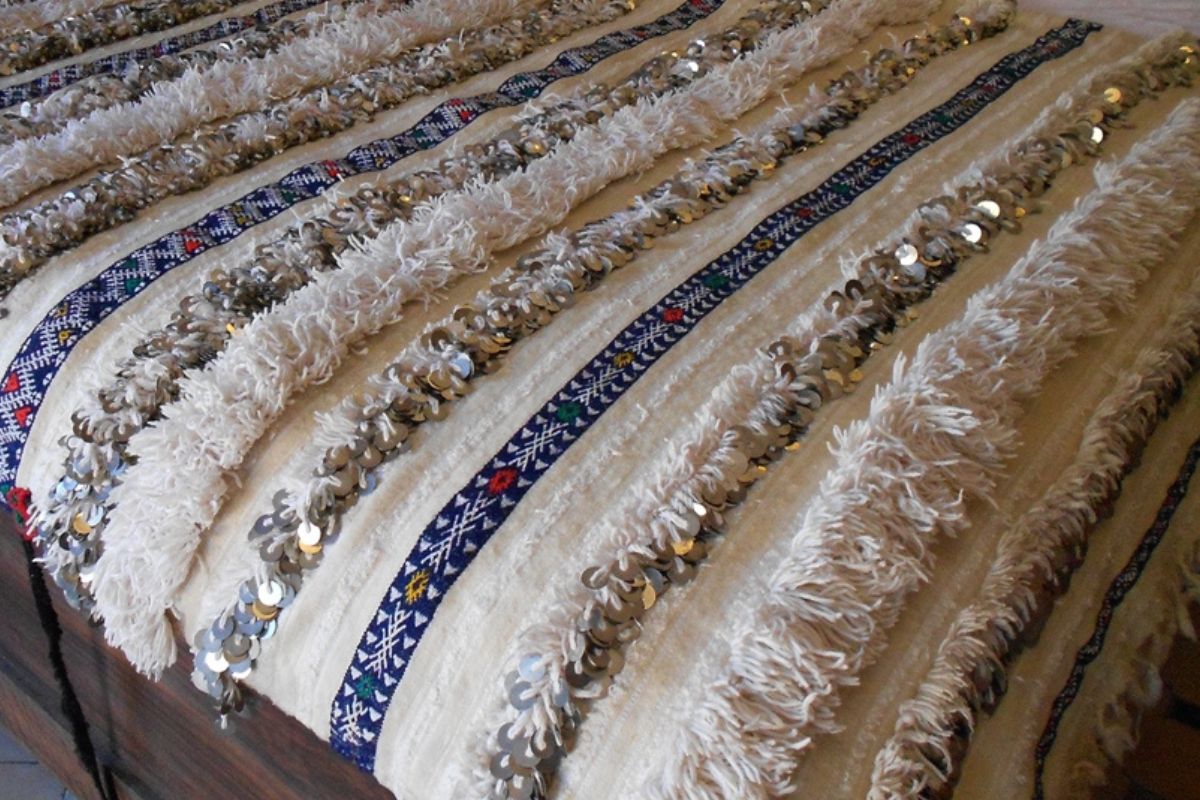
The Moroccan rug dowry tradition is real but narrower than most shop pages suggest. Reporting from Taznakht in southern Morocco records that rugs were typically part of a bride's dowry and were exchanged to announce marriages. Beyond marriage, many Amazigh (Berber) rugs and textiles were made to be used at home: slept on, slept under, worn and carried. What the documented record does not support is the idea that any given rug's pattern proves it was a dowry piece.
That gap between what is documented and what is sold is the subject of this guide. Below, each claim is tied to the source that makes it, with a note where sources disagree or where we could not verify something ourselves.
What "dowry" means in a Moroccan context
The English word "dowry" does a lot of loose work in the rug trade, and it helps to pin it down first.
In Moroccan law, the marriage payment runs the other way from the common English picture. Article 26 of Morocco's Family Code (the Moudawana, reformed in 2004) defines the sadaq as property the husband gives to the wife, and it becomes hers. That is a legal payment, not a rug.
When rug sellers and journalists write about "dowry rugs," they usually mean something different: textiles woven by a bride or the women of her family that went with her into married life. In English that is closer to a trousseau than a dowry. We use "dowry" in this article because it is the word the sources and readers use, but the distinction matters. A "dowry rug" in a shop listing is describing a household textile tied to a marriage, not a formal marriage payment.
It also matters that Morocco is not one weaving culture. Practices around marriage, weaving and household goods differ between regions, between Amazigh groups, and between rural and urban families. Our map of Moroccan rug regions shows how many distinct traditions sit under the single label "Moroccan rug." A custom documented in one valley should not be read as a rule for the whole country.
What the sources actually say about the Moroccan rug dowry tradition
Here is what we could confirm from named, checkable sources, each read for this article on 2026-09-23.
Taznakht, southern Morocco. A report by Africanews, published July 2, 2025, states that "typically, the rugs were part of a bride's dowry and were exchanged as a way of announcing marriages." The same report quotes Abderrahmane Janah, manager of the women's carpet center in Taznakht, saying women "expressed their creativity in making the rug and used it as a medium to convey their emotions." It describes the Women's Centre for the Promotion of the Taznakht Carpet, established in 2016, as grouping 35 cooperatives and 3,500 women weavers. This is journalism about one named place, and it is the clearest dated statement of the dowry custom we found.
The Ait Khabbash of southeastern Morocco. Art historian Cynthia J. Becker's book Amazigh Arts in Morocco: Women Shaping Berber Identity (University of Texas Press, 2006) is based on fieldwork among the Ait Khabbash near the Tafilalet oasis. The publisher's description says the Ait Khabbash weave brightly colored carpets and that these arts are primarily made by women. The book's first chapter covers Ait Khabbash textiles, and two later chapters cover the adornment of the bride and groom and wedding ceremonies. One honest limit: we confirmed the book's scope and chapter structure, not a specific passage on dowry textiles, so we do not attribute any dowry claim to Becker here.
A wedding textile in a museum record. The Metropolitan Museum of Art holds an early 20th-century Moroccan woven wool piece titled Tamizart (handira) Cape, classified in its collection as outerwear. We return to why that classification matters in the next section.
What these sources share is a picture of weaving as women's work tied to family and marriage. What none of them says is that a particular motif marks a rug as a dowry piece, or that every rug from a region was woven for a wedding.
The handira: wedding blanket, cape, or both?
The handira is the textile most often sold as a "Moroccan wedding blanket." It is usually a flatwoven wool piece, often white or cream, frequently decorated with sequins.
This is a clear case where sources disagree about what the object is.
- Seller and blog pages mostly describe the handira as a blanket, and market it as a throw, bedspread or wall hanging. Many say the bride wore it on her way to her husband's home and later used it on the bed, and that the sequins were meant to ward off the evil eye. The pages we reviewed give no source for those statements.
- The Met's catalog entry titles its example a "cape" and classifies it as outerwear. In other words, the museum records it first as something worn, not as bedding.
These positions are not necessarily in conflict. A textile can be worn at a wedding and used as a cover afterward, and objects often change roles over a lifetime. But the museum classification is a useful corrective to the idea that a handira is simply a decorative blanket.
The protective meaning of the sequins is widely repeated, and we could not find it stated in a museum or scholarly source we could read in full, so we report it as a claim, not a fact. The people best placed to say what a handira meant are the women who wove and wore them, and their families. Our guide to the women who weave Moroccan rugs looks at that knowledge and who holds it today.
Rugs as bedding: the everyday life of a pile rug
The dowry story gets attention, but it describes a moment in a rug's life. Most of a rug's life was spent being used.
Several dealer and travel-guide pages we reviewed describe the thick pile rugs of the Atlas Mountains as bedding: bed coverings, sleeping mats, blankets and mattresses. They typically contrast these heavy-pile mountain pieces with lighter flatweaves from drier, warmer areas. These are commercial sources, and we could not locate a museum object record that describes a specific Middle Atlas pile rug as bedding. The claim is plausible and consistent across the pages we read, but we have not been able to document it independently.
The physical logic is easy to follow. A long, loose wool pile traps air and holds warmth, which suits a cold mountain winter. If you have seen a Beni Ourain rug up close, the depth of the pile makes as much sense as a mattress or a winter cover as it does as a floor rug.
If a rug did spend years as bedding, that would explain some features that puzzle buyers today:
- Irregular shapes and sizes. A rug made for a household was woven to the family's loom and wool supply, not to a standard room dimension.
- Soft, loose pile. A rug meant to be slept on did not need to resist shoes and furniture.
- Wear that looks uneven. A rug used as bedding, folded, and later put on a floor can show a mix of wear patterns. That history can be real, but it is not evidence of age on its own.
How a rug's width and length are set by the loom, rather than by a buyer's room, is covered in our article on how Moroccan rugs are made.
Household objects beyond the floor
The bedding role is the best known, but dealer and guide pages also describe Moroccan rugs and flatweaves as seating, floor insulation, tent furnishings and saddle covers. Most of the sources we found for these uses are commercial, so we pass them on as reported uses, not verified ones.
What the documented sources do support is the broader point: these were household objects made by women for their own families and communities, and marriage was one of the occasions tied to weaving. Becker's study of textiles as a women's art linked to identity, and the Taznakht center manager's description of rugs as a medium for emotion, both point the same way. A rug on a gallery floor in New York or London may well have begun life as something with a job to do at home.
What this means for a rug you own or are buying
This is the part most pages about the Moroccan rug dowry tradition leave out.
"Dowry rug" and "wedding rug" are now common sales labels, and they are nearly impossible to check. Here is how the most common claims hold up against the sources above.
| Claim you may hear | Who supports it | How much weight to give it |
|---|---|---|
| Rugs were part of brides' dowries in some places | Africanews report on Taznakht, 2025 | Documented for a named place; do not generalize to all of Morocco |
| Weaving was a women's art tied to identity and marriage | Becker, University of Texas Press, 2006 | Supported for the Ait Khabbash; do not generalize |
| Handiras were worn as wedding capes | Met collection record | Supported by a museum classification |
| Handira sequins ward off the evil eye | Sellers and blogs | Unsourced in what we could read; treat as a claim |
| Thick pile rugs were used as bedding | Dealers and guides | Plausible and consistent, not museum-documented by us |
| Rugs with many triangles or diamonds were dowry rugs | Sellers | No source we found; a motif cannot prove a rug's purpose |
A few practical points follow from this:
- Motifs do not prove a dowry origin. Symbol meanings in Amazigh weaving are contested, and none of the sources above ties any motif to dowry rugs. A seller who says a rug "must be a dowry rug" because of its triangles is offering an interpretation, not a fact.
- Ask how the seller knows. A dowry or wedding history should come from somewhere specific: the weaver, her family, or a cooperative that records who made each piece. If the answer is "tradition," the story is general, not about your rug.
- Wear is not provenance. Signs of use as bedding do not date a rug or confirm its history, and new rugs can be artificially aged to look used.
We cannot authenticate an individual rug, confirm that it was a dowry piece, or give it a value. For that, a qualified appraiser with textile expertise, a museum textile department that offers identification, or a cooperative that documents its weavers by name will serve you far better than any website, including this one.
Why the use history matters
It is easy to write about these rugs as mysterious objects from a timeless past. They are not. They come from named regions and named communities, and from women whose skill was, and still is, part of how households and marriages are built. Many are still woven today, often through cooperatives like those in Taznakht.
Seeing a rug as bedding, a wedding garment, or part of what a bride brought into her new home does not make it less beautiful on a modern floor. It makes it more specific. It also makes it easier to spot when a sales story has been added to a rug that never had one.
FAQ
Were Moroccan rugs really part of a bride's dowry?
In some places, yes. Africanews reported in July 2025 that in Taznakht, rugs were typically part of a bride's dowry and were exchanged to announce marriages. Practices varied across Morocco, so this should not be read as a nationwide rule.
Is a handira a blanket or a cape?
Both descriptions appear. Sellers usually call it a wedding blanket. The Metropolitan Museum of Art catalogs its early 20th-century example as a "Tamizart (handira) Cape" and classifies it as outerwear. A handira may have been worn at a wedding and used as a cover afterward.
Can a rug's pattern show that it was a dowry rug?
No. We found no named scholarly or museum source that links a specific motif, such as triangles or diamonds, to dowry rugs. Motif meanings are contested and vary by region. Only documentation from the weaver, her family or a cooperative can support a dowry history.
Were Moroccan rugs originally made for floors?
Many were made for use at home, and dealer and guide pages widely describe the thick pile rugs of the Atlas Mountains as bedding, sleeping mats and covers. We could not confirm this from a museum object record, so treat it as a well-reported use rather than a documented one.
Leave a Reply