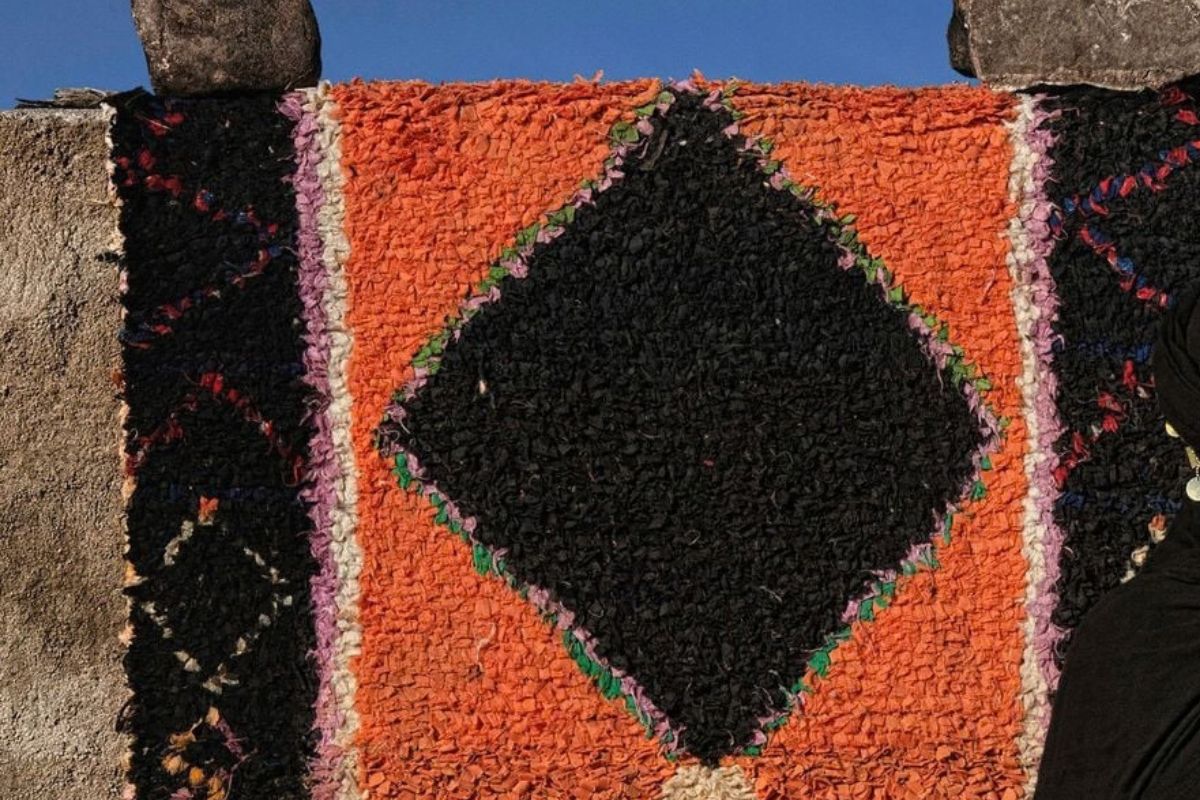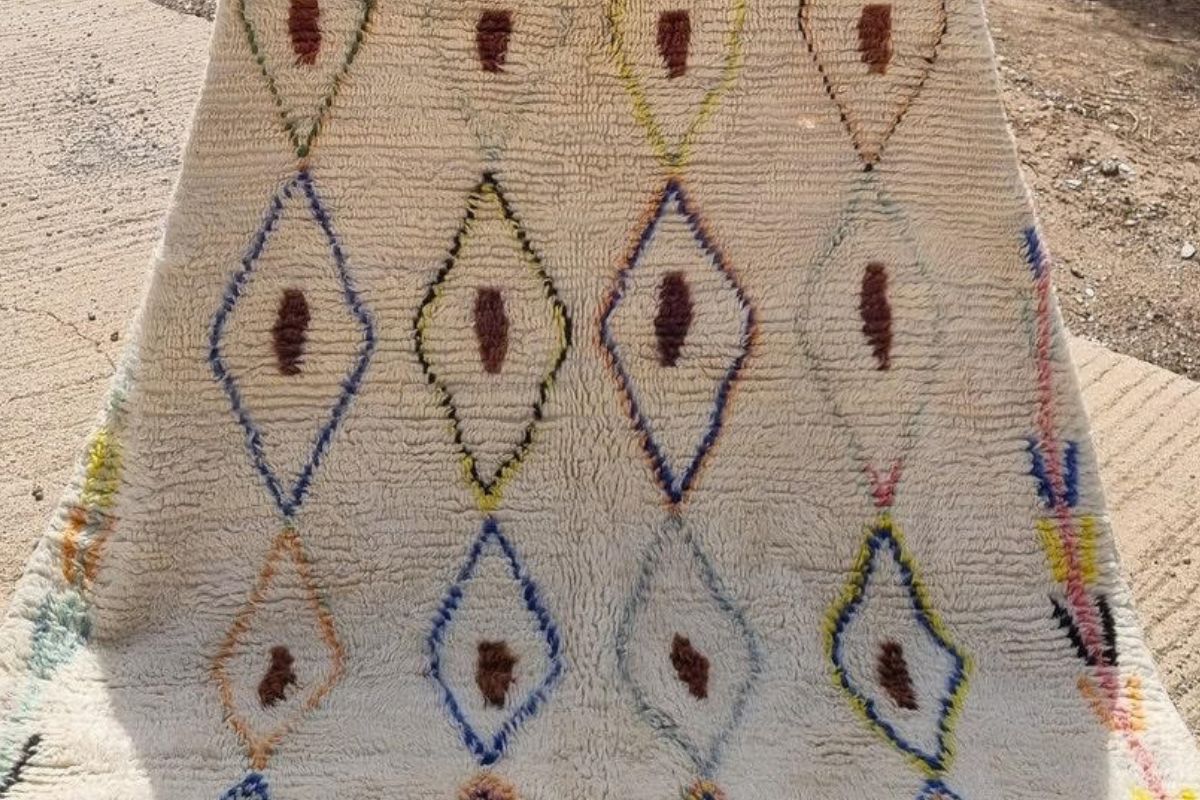
The berber rug diamond symbol is the most common single motif in Amazigh weaving, and museum sources document the diamond shape, in other Amazigh media, as a protective eye against misfortune. The reading you will see far more often online, that a diamond represents womanhood, the womb, or fertility, is a widely repeated folk and marketing interpretation. It shows up consistently across tribal traditions and rug-seller sites, but no academic or museum source in our research names it as documented scholarship specifically for the rug diamond. Both readings coexist because Amazigh symbolism is genuinely layered and regionally inconsistent, not because one has been proven and the other hasn't.
The Berber Rug Diamond Symbol: What the Shape Actually Looks Like
On a Moroccan rug, the diamond, also called a lozenge, is a four-sided shape set on its point rather than its base. It appears alone as a single accent, stacked in vertical columns, linked edge to edge in a chain, or nested inside progressively larger diamonds like a target. Sometimes a small dot or cross sits at the center. Sometimes zigzag lines or triangular "teeth" run along the outer edge. These variations matter to how a piece gets read, because sellers and weavers alike describe the plain single diamond, the linked chain, and the nested version as carrying different weight, even where the underlying claim about meaning is the same.
The shape is not exclusive to rugs. It turns up on Amazigh pottery, jewelry, tattoos historically applied to women's faces and hands, and woven capes, which is part of why researchers treat it as a shared visual vocabulary rather than a rug-specific code.
What a Museum Source Actually Documents
The strongest source we found is the Peabody Museum of Archaeology and Ethnology at Harvard University, in its exhibition materials for Imazighen: Amazigh Aesthetics and Symbology (read 2026-09-18). Describing a ceramic vessel from Kabylia, Algeria, in its own collection, the Peabody Museum states that the lozenge shape on the pottery represents an eye, one of several protective design elements used to ward off the evil eye. The same exhibition text notes that geometric motifs across Amazigh pottery, textiles and leatherwork draw on a shared symbolic vocabulary, with some elements traced to the ancient tifinagh alphabet and others drawn from daily life, and that the exact name and reading of a given motif can vary from one place to the next.
That is a genuinely sourced claim: a named institution, describing a specific object in its own holdings, stating that a lozenge functions as a protective eye motif. It is documented for a piece of pottery, not for a woven rug, and the exhibition itself flags that meanings shift by region. Extending that reading to a rug's diamond is a reasonable inference given the shared vocabulary the museum describes, but it is an inference, and this article treats it as one rather than as a museum statement about rugs specifically.
A related, independently documented example comes from a different Amazigh garment. Smarthistory, an academic art history publisher, describes an akhnif, a hooded wool cape from the Sirwa region of central Morocco, in an essay read 2026-09-18. The cape carries a red woven eye-shaped motif the essay names irghis n-ukhnif, and describes it as serving two functions at once: the garment's visual focal point, and a protective sign positioned over the wearer's back, tied to the same evil-eye belief the Peabody exhibition describes. The akhnif motif is an eye shape rather than a diamond, and a cape rather than a rug, so it does not settle the rug-diamond question directly. What it does confirm, from a second independent academic source, is that the protective-eye reading of Amazigh geometric motifs is a real, documented thread in the scholarship, not something a rug seller invented from nothing.
The Fertility and Womanhood Reading, and Why It Stays Folklore Here
Search "berber rug diamond meaning" and the dominant answer across rug retailers, craft blogs and decor sites is that the diamond represents womanhood, the womb, and fertility, sometimes specifically tied to the Beni Ourain weaving tradition. This reading is consistent and widespread enough that it is clearly a real oral and craft tradition among some weavers and communities, not something a single seller made up in isolation.
It is also, as far as our research could establish, undocumented in the kind of named academic or museum source this article requires before stating a meaning as fact. The sources repeating it are almost entirely commercial: rug shops, decor blogs and craft retailers, several of them citing each other rather than fieldwork or a named ethnographer. That does not make the fertility reading false. Amazigh weaving traditions are largely oral, passed within families and workshops rather than written down, so an undocumented meaning is not automatically a fabricated one. It does mean this site cannot present it as settled the way the Peabody Museum's statement about the eye motif is settled. Treat "the diamond represents womanhood and fertility" as a widely held folk and tribal interpretation, not as an academically verified fact.
Nested Diamonds and Lineage Claims: A Step Further Into Folklore
Some rug sellers go further, describing a chain of nested diamonds as recording a family's generations, one diamond per daughter or per generation of women in a weaving family. It is a compelling story, and it may reflect something real inside specific families or workshops. But it is even less documented than the general womanhood reading, appearing mainly as individual anecdotes on retail blogs rather than in any source with a name, an institution, or a citation attached. Read it as a marketing narrative or, at best, an unverified single account, not as a tradition established across Amazigh weaving generally.
Why the Same Shape Gets Different Answers
Amazigh weaving spans dozens of tribal and regional traditions across the Atlas and Anti-Atlas mountains, each with its own dialect, dye habits and symbolic vocabulary, and the craft was carried mostly by oral transmission rather than a written canon. A weaver in one valley can attach a different name and story to the same shape than a weaver two valleys over, and both are legitimate inside their own tradition. Cooperative-based weaving regions make this visible in practice. Taznakht Cooperatives, where roughly 3,500 weavers sell into one weekly market, is a place where you can see the diamond motif repeated across many individual weavers' work, with the kind of small variation in proportion and combination that reflects personal and family habit rather than a single fixed rulebook.
How the Diamond Gets Into the Rug
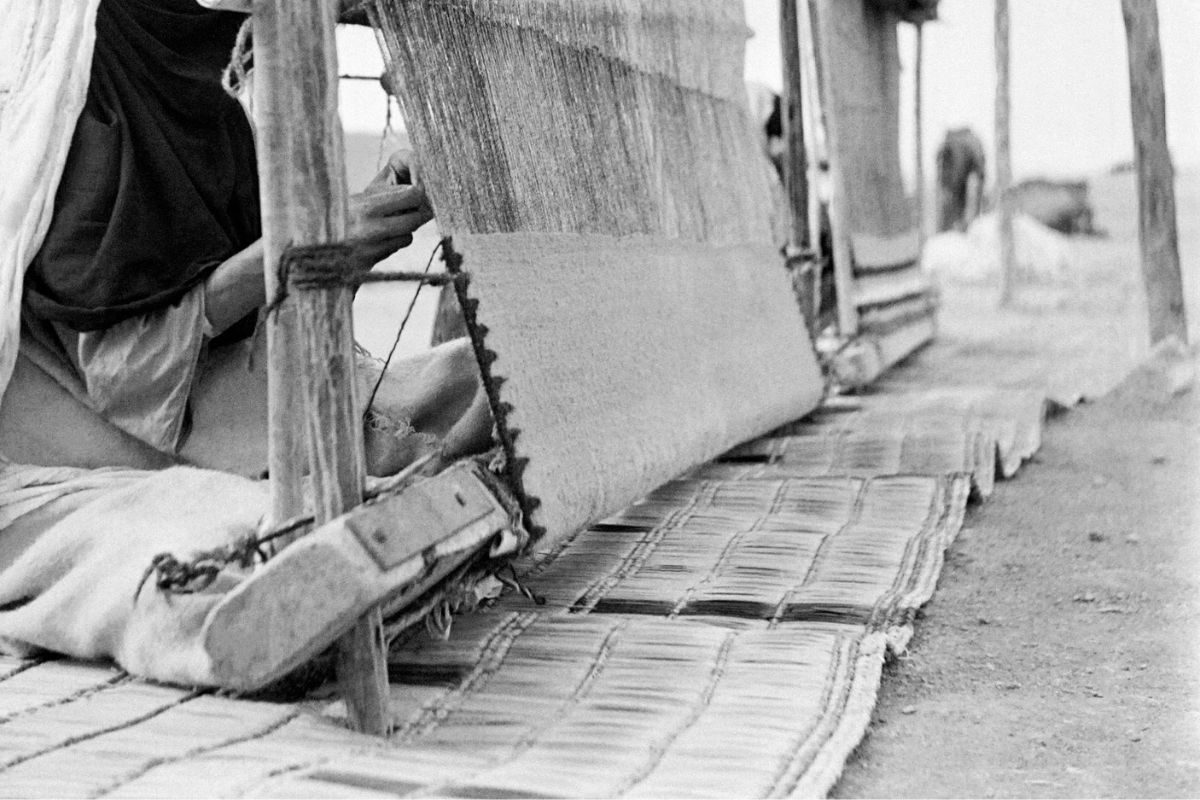
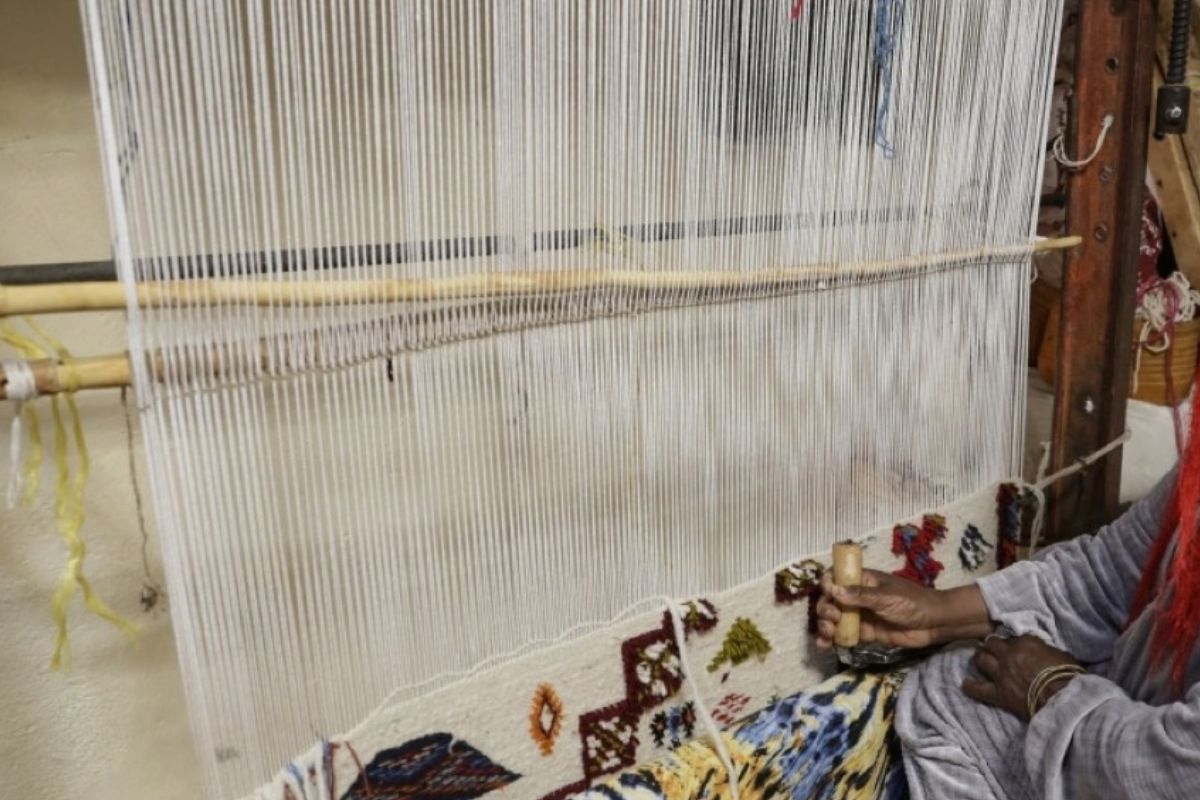
Whatever meaning a weaver attaches to it, the diamond motif is built the same way any other geometric pattern in a Moroccan pile rug is built: knot by knot, on a vertical loom, following a mental or verbally transmitted pattern rather than a printed chart. The Berber Knot explains the specific tying method that lets weavers place a single colored knot precisely enough to form a clean diamond outline, and How Moroccan Rugs Are Made walks through the full process from raw fleece to a finished piece, including where in that process a motif like the diamond actually gets decided and placed.
It is also worth being direct about who is doing this work. Amazigh rug weaving, historically and today, is overwhelmingly done by women, and Who Weaves Moroccan Rugs covers what is actually documented about them, as opposed to the anonymous "tribal artisan" framing that shows up in a lot of retail copy. If a diamond motif carries a personal or family meaning, that meaning sits with the individual weaver who chose it, not with an abstract "Berber tradition" a listing invokes to justify a price.
What This Means When You're Looking at a Rug
If a listing tells you the diamonds on a specific rug mean fertility, protection, or three generations of women in one family, treat that as a story the seller is telling, not as a documented fact about that piece. It may be true. There is usually no way to verify it after the rug has left the workshop, and no seller claim about symbolic meaning is independently checkable the way a knot count or a wool type is. The honest position is the one this article has taken throughout: the protective-eye reading has a real academic and museum source behind it, applied to Amazigh material culture broadly; the womanhood and lineage readings are real traditions in some communities, but undocumented at the level this site can confirm. Enjoy the pattern and the story if it appeals to you. Do not pay a premium for an unverifiable meaning.
FAQ
What does the diamond symbol mean on a Berber rug?
The most commonly repeated meaning online is womanhood and fertility, but that reading is folk and retail tradition rather than documented academic scholarship. A museum source, the Peabody Museum, documents a related but distinct claim: that the lozenge shape functions as a protective eye against misfortune in other Amazigh media, including pottery.
Is the diamond really the "evil eye" symbol?
There is genuine academic and museum support for a protective-eye reading of Amazigh geometric motifs generally, including a lozenge on Kabylia pottery and a separate woven eye motif on the Amazigh akhnif cape. Whether a specific rug's diamond was intended that way by the weaver who made it is not something a buyer can verify after the fact.
Do all Berber tribes use the diamond the same way?
No. Amazigh weaving spans many regional and tribal traditions with their own oral symbolic vocabularies, so the same shape can carry a different name or story depending on where and by whom it was woven.
Does a nested or chained diamond pattern mean something different from a single diamond?
Sellers often describe chains or nested diamonds as representing lineage or protection specifically, distinct from a single diamond. This is a popular narrative with limited independent documentation, so treat it as a possible tradition rather than an established rule.
Should I pay more for a rug because of its symbolism?
Symbolism is not something you can verify after a rug leaves the workshop, so it should not be the basis for a price premium. Buy for the weaving quality, materials and craftsmanship you can actually check, and treat any meaning attached to the pattern as a bonus story.