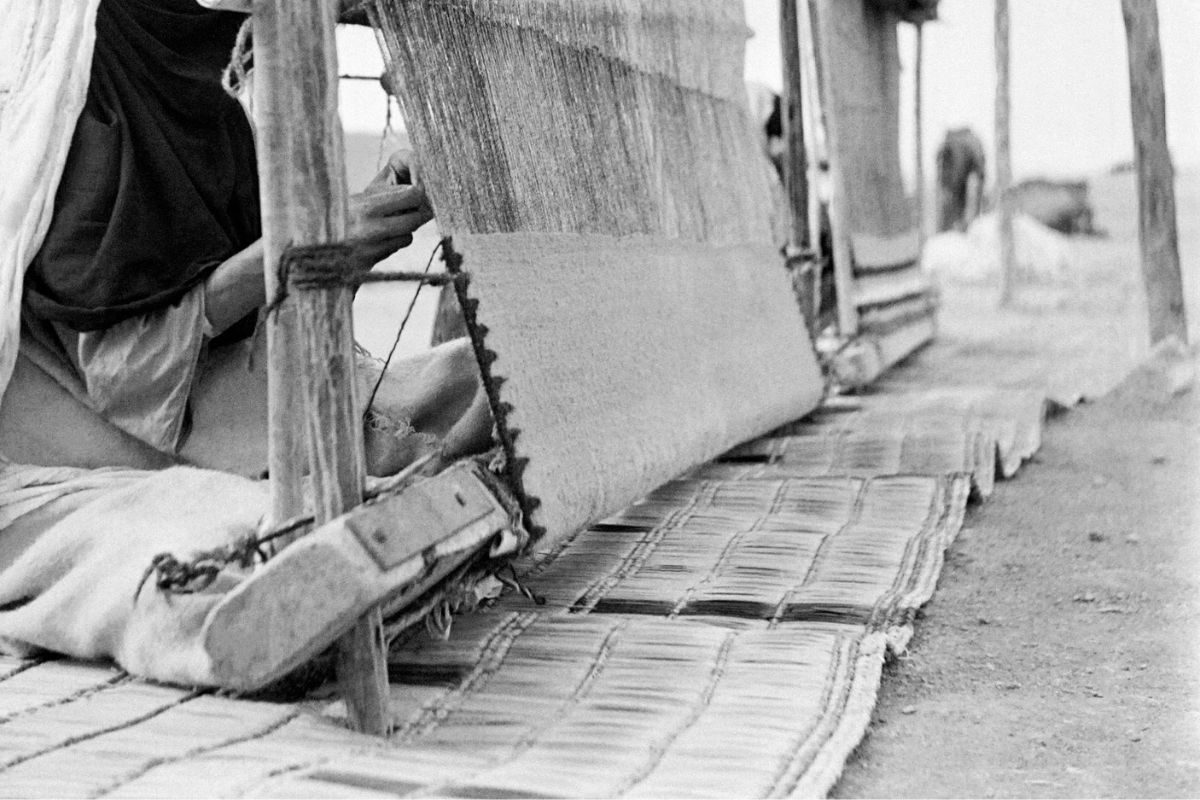
The history of Moroccan rugs begins with the Amazigh (Berber) people of the Atlas Mountains, who wove wool floor coverings for warmth and shelter long before anyone outside North Africa took notice. Weaving was passed from mother to daughter on the same loom for generations. Exactly how many centuries the craft goes back is genuinely unclear, most of what is repeated online as ancient fact is oral tradition and marketing shorthand, not a documented timeline. What is documented is a mid-20th-century turning point: modernist designers in Europe discovered these rugs, and that discovery reshaped how the world sees them today.
Amazigh, Not Just "Berber"
The people who wove these rugs call themselves Amazigh, meaning roughly "free people." "Berber" is the name outsiders gave them, tracing back to the Greek and Roman word for people who did not speak Greek or Latin. Both terms circulate in the rug trade, but Amazigh is the name the weavers use for themselves, and it is worth using in a piece about their history rather than only the imported label.
The Amazigh are Indigenous to North Africa and have lived across present-day Morocco, Algeria, and neighboring regions for a very long time. Rug weaving developed within specific tribal groups, primarily in the Middle and High Atlas Mountains, the Anti-Atlas, and parts of the pre-Saharan south. Each tribal group settled into its own palette, motif vocabulary, and knotting habits, which is why a Beni Ourain rug and a Boujaad rug look like they come from different countries even though both are Moroccan and Amazigh.
The Documented History of Moroccan Rugs vs. the Marketing Version
This is the part where a source-honest answer has to disappoint the reader a little. Many rug sellers state that Amazigh weaving goes back to the Paleolithic era or "over 4,000 years." Those figures are not backed by dated archaeological finds of actual rugs, wool textiles decompose, and very little survives from deep antiquity in this climate. What can be said honestly: weaving with local wool is a long-standing pastoral practice tied to sheep and goat herding in the region, and the craft was clearly well established by the time outside collectors began documenting it in writing.
The Peabody Museum of Archaeology and Ethnology at Harvard, in its published collection notes on Berber art (read 2026-09-18), records that most of its North African textile holdings, more than 450 pieces from Morocco and Algeria, were acquired by travelers and Harvard-trained anthropologists in the late 19th and early 20th century, and that these were everyday objects already in domestic use before they were collected. That tells us the tradition was mature and established by roughly 1900. It does not, on its own, prove a specific age of thousands of years, and a careful writer should not borrow that certainty from a museum record that does not make the claim.
Wool, the Vertical Loom, and a Craft Taught by Hand
Wool carries real weight in Amazigh culture beyond its warmth. It comes from sheep and goats raised by the same families who weave, and preparing it, washing, carding, spinning, sometimes dyeing with plants like madder root, saffron, or indigo, was traditionally a woman's task from start to finish. The weaving itself happens on a fixed vertical loom set up in the home, a piece of equipment that shapes what size and shape of rug a weaver can even attempt. The mechanics of that loom, and why it limits traditional rug width, are covered in more detail in the Moroccan vertical loom, and what it decides.
The knot itself, the actual hand movement repeated tens of thousands of times per rug, is a specific technique passed down without written instructions. For readers who want the mechanical detail rather than the folklore, the Berber knot and how a Moroccan rug is tied walks through it step by step. Historically this knowledge moved from an older weaver to a younger one at the same loom, which is also why the women behind Moroccan rug weaving is really a history of who held and passed on this knowledge, not a footnote to it.
Regional Styles: A Map Drawn in Wool
Morocco does not have one rug tradition, it has dozens, one per tribal region, and the differences are historical as much as aesthetic.
- Beni Ourain rugs come from the Middle Atlas and Rif border area and are known for their undyed cream wool and sparse black geometric lines. The oversized, room-filling Beni Ourain seen in Western interiors today is a modern format; the original rugs were narrower and served as bedding and tent flooring.
- Azilal rugs come from the Azilal province in the High Atlas and lean into bold color and abstract, almost freehand shapes, a looser style than Beni Ourain's restraint.
- Boujaad rugs come from the plains between the Atlas Mountains and the coast and are recognizable for their deep reds and pinks and dense, dreamlike motifs.
- Boucherouite rugs are the newest tradition by a wide margin. They emerged in the second half of the 20th century, when wool became expensive or scarce for some families and weavers began knotting rugs from recycled fabric, cotton, synthetic scraps, old clothing. The name comes from an Arabic word close to "torn" or "used." Boucherouite is a genuine break from the older wool tradition, not a continuation of it, and treating it as equally ancient misstates the history.
What the Symbols Are Said to Mean, and What Is Actually Documented
This is the section where a lot of rug marketing overreaches, and it is worth saying so plainly. It is common to read that a diamond shape "means" fertility, that a triangle "means" a woman, or that a zigzag "means" a river or a mountain range. Some of these readings come from writers who have spent years studying specific tribal collections and interviewing weavers directly, and some readings genuinely vary by tribe, by weaver, and by generation, which is itself a sign that they were never a fixed, universal alphabet.
No academic or museum source consulted for this article documents a single, agreed meaning for these motifs across all Amazigh weaving groups. The Cleveland Museum of Art's Arts of the Maghreb gallery notes (read 2026-09-18), developed with input from textile specialist Cynthia Becker of Boston University, situates Amazigh motifs and jewelry within regional identity and craft practice rather than assigning them a fixed symbolic dictionary. The honest position: some motifs likely carried meaning to the specific women who wove them and their communities, but a general claim like "this shape always means marriage" should be read as folk interpretation passed through the rug trade, not as settled ethnographic fact. If a specific meaning matters to you, ask the seller where that reading comes from, and treat "our weaver told us" differently from "this is documented by researchers."
How Modernist Designers Found Moroccan Rugs
The part of this history that is comparatively well documented is the mid-20th-century Western discovery. Berber knotted-pile rugs began drawing attention from European collectors and designers in the 1920s and 1930s, and design historians consistently point to figures like Le Corbusier as early owners and admirers of Beni Ourain rugs, drawn to their minimal geometry and lack of figurative imagery, qualities that lined up with modernist design thinking of the period. That endorsement mattered commercially: it moved Moroccan rugs from a regional craft object into an item Western designers specified deliberately, a status the Beni Ourain in particular still holds in contemporary interior design.
It is worth stating clearly, because sources on this vary in how they frame it: the weaving tradition itself did not begin with that discovery. It was centuries of established Amazigh practice before any European designer ever saw one of these rugs. The 1920s and 1930s mark when the West noticed, not when the craft started.
From Village Looms to Cooperatives
The most recent chapter of this history is organizational rather than artistic. As demand from outside Morocco grew, individual weavers in many regions began working through cooperatives that pool production, set fairer pricing, and connect weavers directly to buyers instead of relying only on middlemen. Taznakht's weaving cooperatives, where thousands of weavers bring finished rugs to a weekly regional market, are one well-documented example of how this shift plays out on the ground. This does not replace the older, home-based tradition, most weaving still happens on a home loom exactly as it always did, but it changes who benefits financially from the rug once it leaves the village, and it is now one of the more visible ways this centuries-old craft meets a global market.
FAQ
Are Moroccan rugs really thousands of years old?
The weaving practice is genuinely old and tied to long-standing pastoral herding traditions in the Atlas Mountains, but specific figures like "4,000 years" or "Paleolithic" are not backed by dated evidence of actual surviving rugs. Treat those numbers as unverified tradition rather than documented fact.
What is the difference between "Berber" and "Amazigh"?
Amazigh is the name the weavers use for themselves. "Berber" is an older, externally applied term with roots in a Greek and Roman word for outsiders. Both appear in the rug trade, but Amazigh is the more accurate and respectful term.
Do the symbols on Moroccan rugs have fixed meanings?
Not in any single, agreed way that applies to all tribes. Meanings are often specific to a weaver, family, or region, and general claims that a shape "always means" one thing should be treated as folklore unless a specific academic or museum source documents it for that particular group.
Why did Moroccan rugs become popular in Western design?
European designers and collectors began noticing Beni Ourain and other Berber rugs in the 1920s and 1930s, drawn to their minimal geometry. That attention helped move the rugs into mainstream Western interior design, a popularity that has continued to grow.
What is a Boucherouite rug, and how is it different from a Beni Ourain?
Boucherouite rugs are woven from recycled fabric scraps rather than wool, and the style only emerged in the second half of the 20th century, making it far newer than the wool-based Beni Ourain tradition it is sometimes displayed alongside.
Leave a Reply