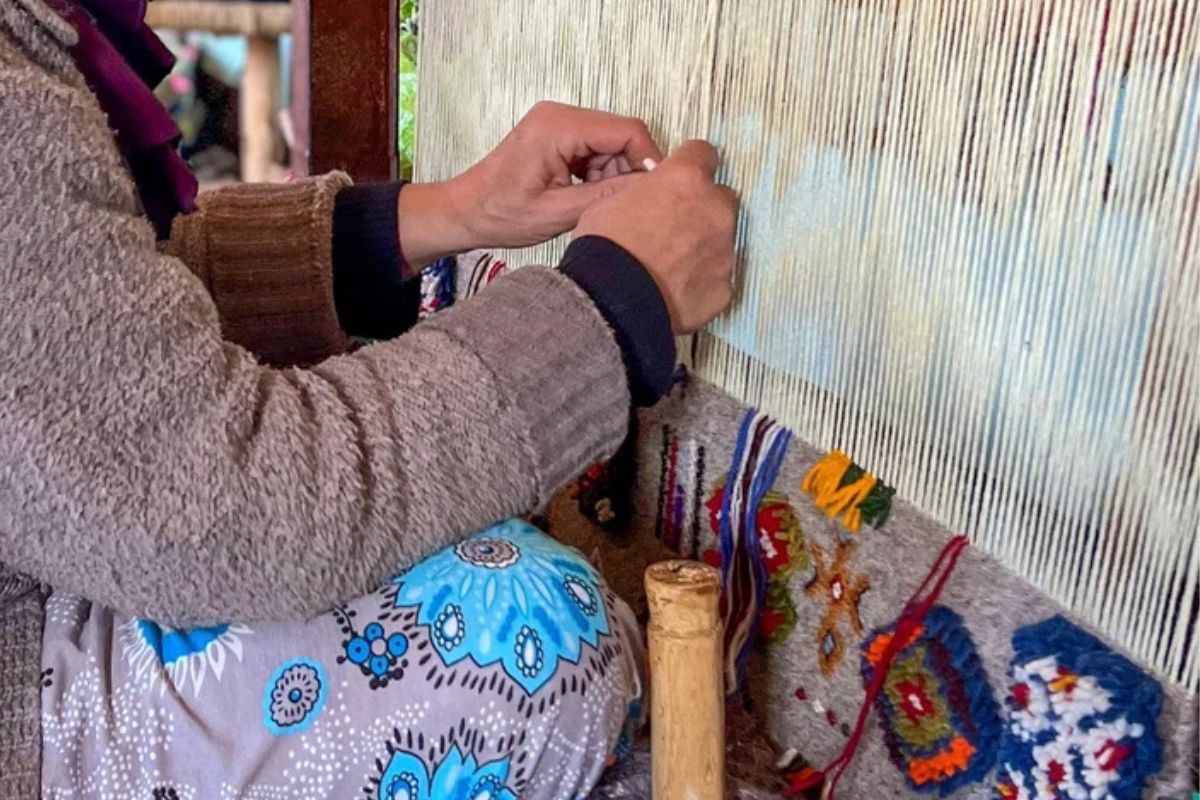
A Moroccan rug is made by hand, in a sequence: fleece is shorn from a sheep, washed, carded and spun into yarn, dyed, then wound onto a vertical wooden loom as the warp. The rug is built up row by row, either by tying pile knots or by passing weft, usually by a woman working from memory rather than from a drawn pattern. It is then cut from the loom, its ends are secured, and it is washed again. AFP, reporting from the town of Taznakht in December 2024, described a single carpet as two to four weeks of work.
The chain, in order
| Stage | What happens | Who does it |
|---|---|---|
| Shearing | Fleece comes off the sheep, usually in spring | Herders, often the weaver's own household |
| Sorting and washing | Grease, vegetable matter and soiled wool removed | Weaver, household, or a cooperative |
| Carding and spinning | Fibers aligned, then drawn into yarn, often on a hand spindle | Weaver |
| Dyeing | Plant or synthetic dye, applied to the spun yarn | Weaver, cooperative, or a dye workshop in Fes or Marrakech |
| Warping | Vertical threads tensioned between two beams | Weaver, usually with help |
| Weaving | Knots tied or weft passed, then beaten down | Weaver, sometimes several at one loom |
| Finishing | Cut from the loom, ends secured, pile trimmed, washed | Weaver, then often the trade |
Every stage on that list is done by hand in the traditions this site covers. What varies, and what a listing rarely tells you, is which stages the weaver did herself and which were bought in.
Where the wool comes from
Moroccan rug wool is a regional product before it is a craft material. The FAO's reference volume on small ruminants in the Near East, which compiles breed surveys for North Africa, records a set of distinct Moroccan sheep populations with measurably different fleeces: the Sardi of the western plateaus, the Beni Guil of the eastern plateaus, the D'man of the southern oases, and mountain types including the Marmoucha of the Taza district.
One entry in that survey is unusually specific for this subject. The FAO describes the Siroua sheep, found southwest of Ouarzazate, as producing fine wool used for the "carpet of Tazenakht." That is an agricultural reference work, written for livestock specialists, independently naming the wool source that AFP later named from the weaving side, describing high-quality sheep wool from Jbel Sirwa. Two unrelated sources landing on the same mountain is the kind of corroboration this subject rarely gets.
Washing, carding and spinning
Raw fleece cannot go on a loom. It carries lanolin, dust and vegetable matter, so it is washed, then carded to align the fibers, then spun into yarn. In the cooperatives that supply the trade directly, this is skilled paid work in its own right. The Anou Cooperative, a weaver-owned Moroccan organization, described in a post of 15 May 2017 how it employs artisans to identify shepherds, shear wool directly, and then scour and spin it through cooperatives in the Middle and High Atlas before the yarn is dyed.
Hand spinning gives yarn that varies slightly in thickness along its length, which is why hand-spun wool takes dye unevenly and produces the soft banding across a field that the trade calls abrash. That texture is a by-product of the method, not a decorative choice, and it is one of the more reliable things your hand can read on a finished rug. Judging wool quality without a lab sets out what the fiber tells you and where that test stops working.
Dyeing, and the honest state of it
Africanews, reporting from Taznakht on 2 July 2025, described weavers dyeing wool with colors drawn from henna, pomegranate peel, saffron and indigo leaves. AFP's December 2024 report from the same town named henna, pomegranate peel and indigo as the traditional pigments and then added the part sellers tend to leave out: industrial dyes now commonly replace the natural ones.
Both things are true at once, and a buyer should hold them together. Plant dyeing is a live practice with named plants behind it in specific places, and most Moroccan rugs on the market today are not dyed that way. The Anou Cooperative's 2017 account goes further, describing artisans suffering allergic reactions to wool that dye workshops in Marrakech and Fes had treated with formaldehyde to bond cheap dye in twenty minutes rather than through a slower process. If you want the difference set out properly, natural dye versus synthetic dye is the page for it.
The loom, and what happens on it
The loom is vertical: two horizontal beams held in a wooden frame, with the warp threads tensioned between them. It is simple enough to be built, dismantled and moved, and Africanews describes the Taznakht weavers working on traditional wooden looms of this kind. Africanews and AFP both photograph women weaving at home or in a cooperative workshop rather than in a factory.
From there the rug is built upward. A pile rug is made by tying rows of knots onto pairs of warp threads and beating each row down with a heavy comb, with plain weft passes locking the rows in place. A flatweave has no knots at all: the pattern is made entirely by the weft passing through the warp. Both are genuine Moroccan traditions, not a quality ladder, which is the argument set out in flatweave versus pile.
Off the loom, and the wash nobody advertises
When the weaving reaches the top beam the rug is cut free, the ends are secured, and the pile is trimmed level. Then it is washed, and this is where the process stops being only craft.
A finishing wash is normal. What is not always disclosed is the strength of it, or its purpose. The Anou Cooperative described in a post of 14 December 2020 the treatments used to make new rugs look old, including a roughly one-to-one water and bleach solution applied repeatedly, and sulfur-heavy chemicals to accelerate fading. A wash at that strength changes the wool itself, which means the rug you handle may not feel the way the fleece would predict. How new rugs are made to look old covers the practice in detail.
How long it takes, and why the sources disagree
This is worth stating plainly rather than resolving. AFP reported in December 2024 that creating a single carpet takes two to four weeks depending on size. Africanews reported in July 2025 that it takes several weeks or even months, depending on size and the complexity of the design. Both were reporting from the same town, less than a year apart.
They are not necessarily contradicting each other, since size and pattern density change the answer enormously and a plain flatweave is not a densely knotted pile rug. But they are also not the same claim, and anyone quoting a single figure for "how long a Moroccan rug takes" is choosing one and dropping the other. This guide publishes no single number for it.
What the making does not decide
The last thing worth knowing about how a Moroccan rug is made is that the making is not what sets its price. AFP reported that weavers around Taznakht travel to a weekly market on Thursdays to sell to middlemen who set the prices, with a large rug going for an average of about 250 Moroccan dirhams, roughly 24 dollars at the time, and the same piece reselling in Marrakech at up to ten times that, or up to 6,000 dollars online. The Anou Cooperative has put the middlemen's share of the final selling price at an average of 96 percent, which is that organization's own figure from its 2017 post and reflects the position of a body set up to bypass them.
One further note on status. Moroccan rug weaving is often described online as UNESCO-recognized. It is not. Checked against UNESCO's own list of Morocco's inscribed elements, the country has sixteen entries, from Jemaa el-Fna and Gnawa to couscous, henna and, in 2025, the Moroccan caftan. No carpet, rug or general weaving element appears among them.
FAQ
Are Moroccan rugs made by hand?
In the named traditions this site covers, yes. Spinning, dyeing, warping and weaving are hand processes, done on a wooden vertical loom. Machine-made imitations of the same designs exist and are a separate product.
Who makes Moroccan rugs?
Overwhelmingly women in Amazigh communities, working at home or through cooperatives. AFP and Africanews both reported from women's weaving cooperatives in Taznakht, naming individual weavers and the organizations they work through.
How long does it take to make a Moroccan rug?
Reported figures differ. AFP said two to four weeks in December 2024; Africanews said several weeks to months in July 2025. Size and pattern density change the answer, so this guide does not publish a single figure.
What wool is used in Moroccan rugs?
Sheep wool, sourced regionally. The FAO's North African breed survey records the Siroua sheep southwest of Ouarzazate as producing the fine wool used for the Taznakht carpet, and AFP named Jbel Sirwa as the wool source for the same town.
Are Moroccan rugs dyed with plants?
Some are. Henna, pomegranate peel, saffron and indigo are named in reporting from Taznakht. AFP also reported that industrial dyes now commonly replace natural ones, so plant dyeing cannot be assumed from a style name alone.
Leave a Reply