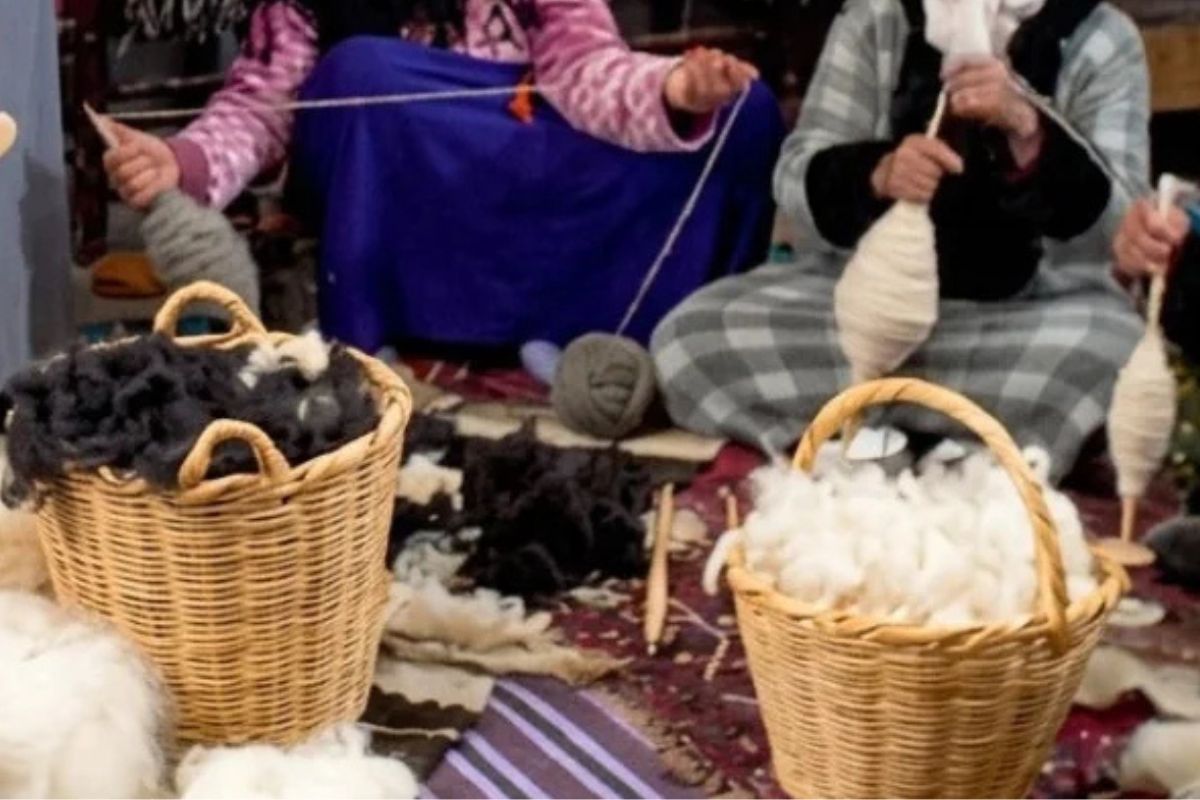
Yes, there is an organized industry behind the rugs sold under the Taznakht name, and it is documented. Africanews reported on 2 July 2025 that the Women's Centre for the Promotion of the Taznakht Carpet, established in 2016, brings together 35 cooperatives and 3,500 women weavers, and can produce up to 300 carpets a month. AFP, reporting from the same town in December 2024, described weavers travelling to a weekly market to sell to middlemen who set the prices. Both facts belong in the same picture: a real institutional structure, and a market that still largely determines what a weaver is paid.
Every figure on this page is attributed to a named source with a date. Where this guide could not source something, it says so instead of estimating.
What the numbers are, and where each one comes from
| Figure | Source | Date |
|---|---|---|
| 35 cooperatives in the centre | Africanews | 2 July 2025 |
| 3,500 women weavers | Africanews | 2 July 2025 |
| Up to 300 carpets a month | Africanews | 2 July 2025 |
| Centre established 2016 | Africanews | 2 July 2025 |
| Weekly market on Thursdays | AFP | 18 December 2024 |
| About 250 dirhams, roughly 24 dollars, for a large rug | AFP | 18 December 2024 |
| Carpets nearly 22 percent of Morocco's artisan exports in 2022 | AFP | 18 December 2024 |
| 8,027 women's cooperatives nationally, 73,700+ members, end of 2025 | Morocco World News | 1 May 2026 |
The two rug figures worth being careful with are the last two. The 22 percent export share is a national figure for all traditional carpets, not for Taznakht. The 8,027 women's cooperatives are across every sector of the Moroccan economy, from argan to agriculture, and are not a count of weaving cooperatives.
What a Moroccan cooperative actually is
A cooperative in Morocco is a registered legal entity, not a loose group of women who weave together. The governing statute is Law 112-12, published in the Bulletin Officiel on 18 December 2014 and running to 108 articles, which replaced the framework in force since 1983. It defines the permitted categories of cooperative activity, sets out governance obligations including general assemblies and accounts, and creates a public register of cooperatives.
That is why cooperative membership is a slightly better signal than most things a seller can tell you. A cooperative is registered, named, and in principle traceable, which a middleman at a market is not. It is not, however, a guarantee about pay, and this guide has not read any Taznakht cooperative's accounts. Sources describing the internal role of Morocco's Office de Développement de la Coopération after the 2014 law differ, so this page states the law and stops there.
The weekly market, and what it does to prices
This is the part of the Taznakht story that seller pages do not carry. AFP reported that weavers travel every Thursday to a weekly market to sell their rugs, often to middlemen who set the prices, with a large rug going for an average of about 250 Moroccan dirhams, around 24 dollars at the time. The same report described those rugs going on to resell in Marrakech at up to ten times that, and appearing in online listings at up to 6,000 dollars.
One caution on the day itself. AFP names a Thursday market; travel and tour operator sources describe Taznakht's main souk on a Saturday. This guide could not resolve that from a source it would rely on, and a reader planning a trip around a market day should confirm locally rather than trust either. What is not in dispute is the structure: a periodic rural market, buyers who set the price, and a very large gap between that price and the retail one. How a rug's price changes between the loom and the showroom covers that gap in full.
What the centre is trying to change
Both reports describe the same intervention rather than only the problem. Africanews and AFP each note a new exhibition space in Taznakht that lets some weavers sell directly to buyers, bypassing middlemen, and training in digital marketing intended to open independent sales channels. Africanews also describes the wider shift from home weaving into cooperative workshops as an attempt to give the work a steadier income and keep younger women in the profession.
Whether that succeeds is not something this guide can assess from outside, and no page should tell you it has. What can be said is that the mechanism is real and named, and that buying through a channel where the seller is the cooperative rather than an intermediary is the version of this purchase where the most money reaches the loom. The practical form of that decision is covered in buying a Moroccan rug online, including what a cooperative-direct listing looks like and what it does not prove.
The wool behind the name
The materials side has independent corroboration, which is rare here. AFP described the Taznakht weavers using high-quality sheep wool from Jbel Sirwa, the volcanic massif southwest of Ouarzazate. The FAO's reference survey of North African sheep breeds, compiled for livestock specialists rather than for the rug trade, records the Siroua sheep of that same area as producing fine wool used for the "carpet of Tazenakht."
An agricultural reference work and a news agency arriving independently at the same mountain is stronger evidence than a hundred seller pages repeating each other. On dyes, Africanews lists henna, pomegranate peel, saffron and indigo leaves in use at the centre, while AFP notes that industrial dyes now commonly replace natural ones. Both are current, and neither makes a plant-dye claim safe to assume from the town name alone, which is why natural dye versus synthetic dye matters more than a regional label.
What a "Taznakht cooperative" label does not settle
A cooperative name on a listing is a lead, not proof. It does not tell you which of the 35 cooperatives wove the piece, whether the seller bought it from the weaver or from a middleman at a market, when it was made, or whether it was washed or otherwise treated afterwards. None of that is visible in a photograph.
The useful move is to ask, because on this style the information genuinely exists and a seller who has it will produce it. The questions worth asking a rug seller sets them out in order, and the Taznakht and Ouaouzguit style guide covers what the rugs themselves look like and where the tribal naming is and is not confirmed.
FAQ
How many weavers are in the Taznakht cooperatives?
Africanews reported on 2 July 2025 that the Women's Centre for the Promotion of the Taznakht Carpet brings together 35 cooperatives and 3,500 women weavers. That is the figure this guide uses, attributed to that report, and it describes one organization rather than every weaver in the region.
How much does a Taznakht weaver get for a rug?
AFP reported in December 2024 that a large rug sold at the weekly market for an average of about 250 Moroccan dirhams, roughly 24 dollars, usually to middlemen who set the price. That is one figure from one market at one date, not a wage.
What day is the Taznakht carpet market?
AFP names a Thursday weekly market. Travel sources describe a Saturday souk in the town. This guide could not settle which applies now, so confirm locally rather than planning around either.
Is a cooperative rug guaranteed to be fairly paid?
No. A Moroccan cooperative is a registered legal entity under Law 112-12, which makes it traceable in a way a market middleman is not, but registration is not an audit of what members are paid, and this guide has read no cooperative's accounts.
Can I buy directly from a Taznakht cooperative?
Reporting from 2024 and 2025 describes a new exhibition space in the town for direct sales and digital marketing training aimed at independent selling. Whether a particular online listing is genuinely cooperative-direct is a question to put to the seller.
Leave a Reply