Amazigh vs Berber is a question of who is doing the naming. Amazigh (plural Imazighen) is the name North Africa's indigenous peoples use for themselves. Berber is the outside name: most linguists trace it to the Greek word for "foreigner" that also produced "barbarian," carried into North Africa through Arabic and later French colonial administration. Amazigh is now the preferred term in scholarship and Moroccan law; Berber persists mainly in trade language. This guide sets out where each word comes from and why the difference still matters to anyone reading about Moroccan weaving.
| Berber | Amazigh | |
|---|---|---|
| Type of name | Exonym (outside name) | Endonym (self-name) |
| Traced root | Greek bárbaros / Latin barbarus | Disputed; commonly glossed "free people," also argued to mean "tent dweller" |
| Carried by | Arabic usage, then French colonial administration | The people themselves, and since 2011 the Moroccan state |
| Where it still shows up | Rug and carpet trade terms, older scholarship, search habits | Scholarship, Moroccan law, cultural institutions, this site's primary usage |
Where "Berber" Came From
The word Berber did not start in North Africa. Most linguists trace it to the ancient Greek bárbaros, a word Greeks used for anyone whose speech sounded like meaningless "bar-bar" babble to them, not originally a statement about savagery so much as a statement that the person was not Greek-speaking. Latin picked up the same root as barbarus, and Rome extended it to peoples living beyond direct imperial control, including groups in what are now Algeria, Morocco, and Libya. The word later passed into Arabic as a term for North Africa's indigenous non-Arab population, and centuries after that, French colonial administrators formalized "Berber" as an official ethnic and administrative category, used in practice to classify Amazigh communities separately from Arab ones. The Society for Linguistic Anthropology's explainer on the two terms traces this chain from the Greek and Latin root through to modern usage and argues the word still carries the sense of "otherness" it started with (read 2026-09-18).
What "Amazigh" Means, and Why the Meaning Is Debated
Imazighen (singular Amazigh) is what the people historically labeled "Berber" call themselves, and it is the term this site treats as primary. The commonly repeated gloss is "free people" or "free man," a translation credited to the sixteenth-century writer Leo Africanus and supported by related words such as the Tuareg amajegh, meaning "noble." It is a flattering derivation, and it is also disputed among linguists. The linguist Salem Chaker has argued the root may instead relate to pitching a tent, meaning Amazigh could originally have described a way of life, "the one who lives in a tent," rather than a claim of nobility. Neither reading is settled fact, and this guide has no basis for presenting one as certain. What is not contested is the family of forms now in everyday and official use: Imazighen for the people, Tamazight for the language and its feminine singular form, and Amazigh as the adjective.
Not Everyone Called Themselves Amazigh Either
Even "Amazigh" as a shared umbrella term is a relatively recent unifying label. Historically, most of the groups now grouped under it used their own separate names first. The Kabyle people of Algeria traditionally called themselves Leqbayel, and the Chaoui people of Algeria's Aurès mountains used Ishawiyen; dozens of other regional and tribal names existed the same way across Morocco, Algeria, Libya, and Tunisia. "Amazigh" as a common, pan-regional identity term grew largely out of the twentieth-century Berber Culture Movement, which built a shared political and cultural identity across language communities that had rarely organized under one name before. That history matters for a rug reader too: a piece described today as "Amazigh weaving" may come from a specific tribal or regional tradition that had, and often still uses, its own older name long before "Amazigh" became the common umbrella term for all of them.
From Exonym to Official Language: Morocco's 2011 Recognition
The shift from Berber to Amazigh in public life is not only a vocabulary preference; it tracks a real political change. Decades of Amazigh cultural activism, including a set of demands issued in 2000 that came to be known as the Berber Manifesto, pushed for recognition of Tamazight and of Amazigh identity in Moroccan public life. Morocco's 2011 constitution answered part of that demand directly: Article 5 made Tamazight an official language of the state alongside Arabic, describing it as "the common heritage of all Moroccans without exception." Implementation has been gradual since then. Tamazight is now taught in some public schools and has been used experimentally in a handful of courtrooms, but the constitutional line itself marked the first time an Amazigh language held that formal status anywhere in North Africa.
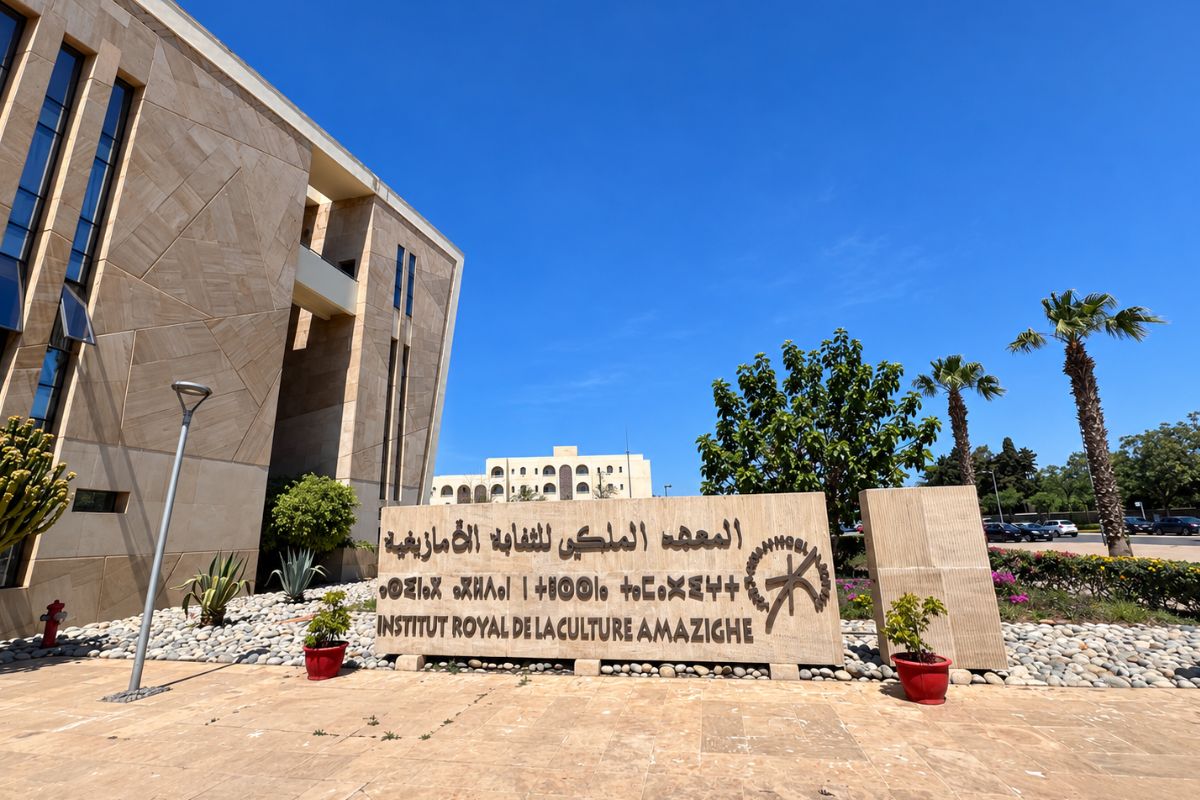
That constitutional moment had institutional groundwork already in place. In October 2001, a full decade earlier, King Mohammed VI created the Royal Institute of Amazigh Culture (IRCAM) by royal decree, an academic institute based in Rabat and charged with standardizing written Amazigh and developing its place in public schools. Mohamed Chafik, an activist and scholar whose earlier writing had argued for exactly that kind of recognition, became the institute's first rector. IRCAM operating for ten years before the 2011 constitutional change is one more sign that "Amazigh" had already displaced "Berber" inside Moroccan institutions well before it reached the country's founding law, and by extension into the vocabulary museums and researchers increasingly reach for first.
How the Two Words Sit Side by Side in the Rug World Today
None of this erased "Berber" from everyday use, and a rug reader will keep meeting it. The rug trade still calls the double-loop pile stitch used across the Middle Atlas the Berber knot, a piece of vocabulary that predates the current preference for Amazigh and is unlikely to disappear from listings soon. Cooperatives themselves are often the clearest place to watch the shift happen in real time: a group like the one behind Taznakht's weekly rug market may describe its own output as Amazigh weaving in its own materials, while a retailer three steps down the supply chain still lists the same rug as a "Berber rug" because that is the phrase shoppers actually search. The craft itself, the fleece-to-finished-rug process and the women who do most of the weaving, has not changed with the vocabulary around it. What has changed is who gets named as its source: increasingly, that is Amazigh weavers and Amazigh cooperatives, named as such, rather than an anonymous "Berber" craft with no people attached to it. The Smithsonian's National Museum of African Art, which hosted a 2008 exhibition of Amazigh jewelry and craft from Algeria, Morocco, Egypt, and Tunisia titled Desert Jewels, is one example of an American museum making that same distinction in its own labeling (read 2026-09-18).
Amazigh vs Berber: Which Word Should You Use?
For most everyday purposes, Amazigh is the more accurate and more respectful term for the people, their language, and their cultural heritage, and it is the term this site reaches for first when writing about the weavers behind a rug. Berber has not become forbidden. It remains the term most search engines, retailers, and even some older scholarship still use, and a guide that refused to use the word at all would be harder for an actual reader to find or follow. The distinction worth holding onto is between the people and the trade term: call the weavers Amazigh, and understand that "Berber rug," "Berber carpet," and "the Berber knot" are trade phrases with their own separate history, not descriptions of an ethnic group. The same shift shows up in how the subject is studied: the Society for Linguistic Anthropology's explainer notes that scholars increasingly favor calling the field "Amazigh studies" rather than the older "Berber studies," for the same reason the people themselves are increasingly named Amazigh rather than Berber. Where a symbol, motif, or meaning gets attributed to "Berber tradition" without naming a source, treat that claim as folklore rather than documented fact until it can be traced to an actual academic or museum record.
FAQ
Is "Berber" an offensive word?
Many Amazigh people and scholars consider it a loaded exonym because of its root connection to "barbarian" and its use as a French colonial administrative category. Others use it without that weight, mainly because it is the more widely recognized term. This guide treats Amazigh as the respectful default and explains "Berber" where it remains the common trade or search term.
What is the difference between Amazigh and Imazighen?
Amazigh is the singular form and also functions as the adjective ("Amazigh weaving," "Amazigh identity"). Imazighen is the plural, used for the people as a group. Tamazight refers to the language, and to a feminine singular form of the same word.
When did Morocco officially recognize Tamazight?
Morocco's 2011 constitution made Tamazight an official language of the state under Article 5, alongside Arabic. It was the first time an Amazigh language held that constitutional status in North Africa, though full implementation in schools and courts has taken years and is still ongoing.
Does "Berber carpet" mean the same thing as an Amazigh rug?
No. "Berber carpet" in the US flooring trade usually refers to a machine-made, loop-pile broadloom product sold by the roll, unrelated to hand-knotted or handwoven Amazigh rugs from Morocco. The name is a marketing borrowing, not a description of the same craft.
Why do some rug sellers still say "Berber" instead of "Amazigh"?
Mostly because that is the term buyers already search for. Vocabulary in scholarship and cultural organizations has shifted toward Amazigh faster than it has shifted in retail listings, so both words continue to appear side by side in the same market.
Leave a Reply