Category: Rug Styles

  • Beni Ourain Rug: What It Is and How to Buy One

    Beni Ourain Rug: What It Is and How to Buy One

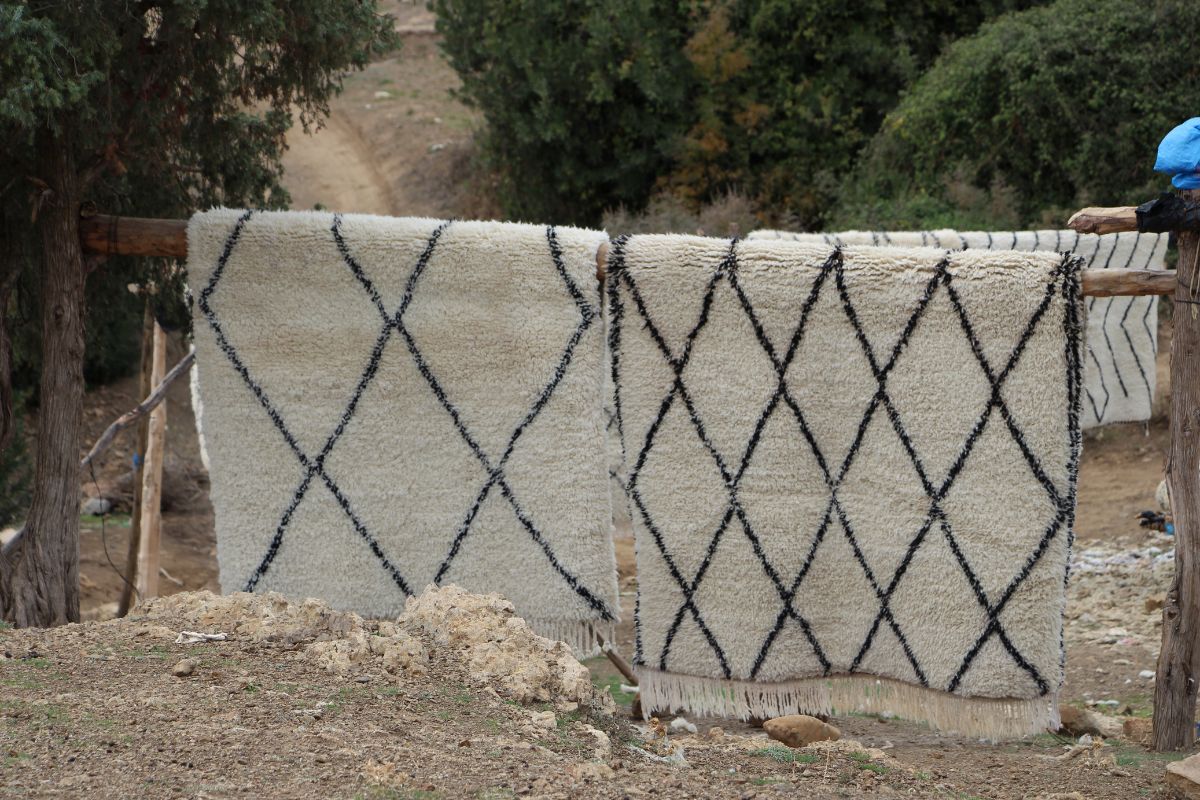
    A Beni Ourain rug is a handwoven wool rug made by the Beni Ouarain, a confederation of Berber tribes in the Middle Atlas Mountains of Morocco. The classic version has a thick, plush pile of undyed cream or ivory sheep wool, marked with a sparse pattern of dark brown or black geometric lines and diamonds. Because it is knotted by hand, no two are exactly alike, and small irregularities are normal rather than flaws. Today the name is also used loosely for machine-made lookalikes, so knowing what a genuine one actually is matters before you spend real money.

    This guide covers where the style comes from, what a genuine piece feels like, how it differs from the rug it gets confused with most, and the claims floating around the internet that deserve a second look. Atlas Rug Guide does not sell rugs and earns no commission on any purchase, so nothing here is written to steer you toward one seller over another.

    What makes a rug a Beni Ourain

    The name points to people, not just a pattern. The Beni Ouarain (also spelled Beni Ourain) are often described as a confederation of around 17 Berber tribes living in the high country of the northeastern Middle Atlas. Families there wove thick wool rugs for a practical reason first: warmth. At altitudes above 2,000 meters, a heavy wool pile worked as a sleeping mat and a blanket against mountain cold, which is why traditional pieces were often woven large enough for a whole family.

    Three things define the classic look:

    • Undyed wool. The cream, ivory, or soft off-white ground is the natural color of the sheep's wool, not a bleached or dyed finish. Slight variation in tone across the rug is expected because the wool is hand-spun.
    • Sparse geometric marks. Thin dark-brown or black lines form diamonds, lozenges, and irregular grids. The pattern is minimal and asymmetric, not a dense repeating motif.
    • A high, soft pile. Wool from high-altitude sheep tends to be rich in lanolin, which gives the pile its plush, slightly springy feel.

    The exact age of the tradition is not well documented, and you will see confident but conflicting origin dates repeated across seller blogs. Where the history is genuinely uncertain, this guide leaves it uncertain rather than picking a number to sound authoritative.

    What to expect: pile, weight, and feel

    A genuine Beni Ourain is heavy. The dense wool pile gives it real weight for its size, and the surface feels shaggy and open rather than tight and flat. Run your hand across it and you may notice the wool feels slightly oily or waxy; that is natural lanolin, and it is one reason the wool resists dirt and wear.

    Traditional sizing runs long and narrow because the rugs followed the shape of a sleeping space, though pieces made for the export market come in a wide range of dimensions today. Color stays in the neutral family: cream grounds with brown or black line work, sometimes with faint gray. Bright, saturated color is not part of the traditional Beni Ourain vocabulary; a rug loaded with vivid dyes is a different style, or a modern reinterpretation, rather than a classic Beni Ourain.

    Why the look suits modern interiors

    The Beni Ourain became a design icon in the mid-20th century, when modernist architects and designers paired its plain wool ground and graphic lines with clean, minimal rooms. That pairing still works. A neutral high-pile rug adds warmth and texture without competing with the rest of a space, which is why it reads equally at home under mid-century furniture, in a Scandinavian-minimal room, or in a warm neutral "quiet luxury" scheme.

    If you like the palette but want a bit more color or a looser, more painterly pattern, two related Middle Atlas styles are worth comparing before you commit: Azilal rugs, which keep a wool ground but add sparse color and freer motifs, and Boujad rugs, which lean into warm pinks and reds. Our complete guide to Moroccan rug styles lays out how all of these relate.

    Beni Ourain vs Beni Mrirt: the real differences

    The style Beni Ourain gets confused with most is Beni Mrirt, another Middle Atlas wool rug. Several seller pages exist specifically to move shoppers from one to the other, so it helps to see the actual differences plainly:

    Feature Beni Ourain Beni Mrirt
    Pile Higher, shaggier, more open Lower, denser, more velvet-like
    Feel Fluffy, loose, cloud-like Compact, smooth, plush
    Knot density Lower (looser weave) Higher (tighter weave)
    Pattern Minimal lines and diamonds Often bolder, more detailed
    Palette Undyed cream with dark marks Similar neutrals, sometimes richer

    Neither is "better" in the abstract. A denser weave takes more time and wool, which generally tracks with a higher price, but the open, shaggy Beni Ourain pile is exactly what many people want. The right choice depends on the texture and look you are after, not on which one a seller has framed as the upgrade.

    Claims worth being skeptical of

    This is where independent guidance matters most, because a few claims get repeated across the web as settled fact when they are not.

    The burn test does not prove a rug is a genuine Beni Ourain

    Nearly every buying guide online repeats the same "burn test": snip a fiber, hold a flame to it, and judge by how it burns and smells. Real wool chars slowly and smells like burnt hair; synthetic fiber melts, beads up, and smells like plastic. That much is true, and the test can tell you whether a fiber is wool or synthetic.

    Here is what those guides leave out: the burn test only checks fiber content. It cannot tell you where a rug was made, whether it was hand-knotted, or how old it is. A rug can be 100% wool and still be a machine-made copy woven far from the Middle Atlas. Passing a burn test means "this is wool," not "this is a genuine Beni Ourain." Treat it as one small data point, not proof of origin.

    Knot-density numbers are inconsistent, so treat them as a concept, not a spec

    You will also see specific knot-per-square-inch figures quoted for Beni Ourain and Beni Mrirt rugs. The problem is that the exact numbers vary from site to site and are rarely sourced, so it is not sound to treat any single figure as a fixed standard. The underlying idea holds up: a denser, tighter weave takes more labor and more wool, which generally correlates with more value. Use density as a relative sense of quality you can feel with your hand, not as a number to verify a rug against.

    "Beni Ourain" vs "Beni Ourain style": the gap sellers skip

    The single most useful thing to understand before buying is that the market is full of "Beni Ourain style" rugs, and "style" is doing a lot of quiet work in that phrase. A genuine Beni Ourain is handwoven by weavers in the Middle Atlas from local wool. A "Beni Ourain style" or "Beni Ourain inspired" rug is anything that copies the cream-and-diamond look, including machine-made rugs produced in bulk from synthetic or blended fiber anywhere in the world.

    Both can be attractive. But they are not the same object, and they should not carry the same expectations for durability, feel, or value. The look-alike is a product; the genuine article is a handmade textile with real variation baked in.

    Genuine Beni Ourain "Beni Ourain style" lookalike
    Made Hand-knotted by Middle Atlas weavers Often machine-made, mass-produced
    Material Undyed natural sheep wool Frequently synthetic or wool blend
    Variation Slight irregularities throughout Perfectly uniform, repeating
    Back of rug Visible hand-tied knots, uneven Machine-neat, often a printed or glued backing

    A quick note on limits: Atlas Rug Guide is a reference, not an appraisal service, and no article can authenticate a specific rug from a photo or description. The points below help you ask better questions, not replace an expert's hands-on judgment when a purchase is significant.

    What actually helps you judge one in front of you

    • Turn it over. On a hand-knotted rug the back shows the pattern in individual, slightly uneven knots. A print or machine copy often looks suspiciously perfect, or has a separate backing material.
    • Look for honest irregularity. In a genuine piece, lines wobble slightly, diamonds are not identical, and tone shifts a little across the field. Flawless symmetry is a red flag, not a selling point.
    • Feel the wool. Natural wool feels dense and often slightly oily from lanolin, and it has an earthy, not chemical, smell. A strong synthetic odor is a warning sign.
    • Ask direct provenance questions. Where was it woven and by whom? Is the wool natural and undyed? Is it hand-knotted? A confident, specific seller answer is worth more than any single physical test.

    For how a Beni Ourain sits against the other named Moroccan traditions, and where each one is woven, see the wider family of Moroccan rug styles.

    Caring for a Beni Ourain rug

    Wool is forgiving, which is part of the appeal. A few basics keep a genuine piece looking right:

    • Vacuum gently and avoid a hard beater bar on a high pile, which can pull fibers.
    • Blot spills quickly rather than rubbing them in; wool's lanolin helps resist staining if you act fast.
    • Rotate the rug periodically so light and foot traffic wear it evenly.
    • For deep cleaning, use a professional experienced with handmade wool rugs rather than a general carpet-cleaning machine.

    Natural shedding is normal early on and settles over time. It is a property of a real wool pile, not a defect.

    FAQ

    What is a Beni Ourain rug?
    It is a handwoven wool rug from the Beni Ouarain Berber tribes of the Middle Atlas Mountains in Morocco, known for a thick undyed cream or ivory pile marked with sparse dark-brown or black geometric lines and diamonds.

    Are Beni Ourain rugs always cream colored?
    The traditional palette is undyed cream or ivory wool with dark line work, sometimes with faint gray. Brightly colored versions are either a different Moroccan style or a modern reinterpretation, not the classic Beni Ourain look.

    Does the burn test prove a Beni Ourain is authentic?
    No. A burn test can suggest whether a fiber is wool or synthetic, but it cannot confirm where a rug was made, whether it was hand-knotted, or how old it is. A wool rug can still be a machine-made copy.

    What is the difference between Beni Ourain and Beni Mrirt?
    Beni Ourain has a higher, shaggier, more open pile, while Beni Mrirt is denser and more velvet-like from a tighter weave. Both are Middle Atlas wool rugs with similar neutral palettes.

    Why do genuine Beni Ourain rugs look slightly imperfect?
    Because they are made by hand. Small irregularities in the lines, diamonds, and wool tone are expected and are one of the clearest signs a rug was woven by a person rather than a machine.
  • Moroccan Rug Styles: The Complete Guide to Every Type

    Moroccan Rug Styles: The Complete Guide to Every Type

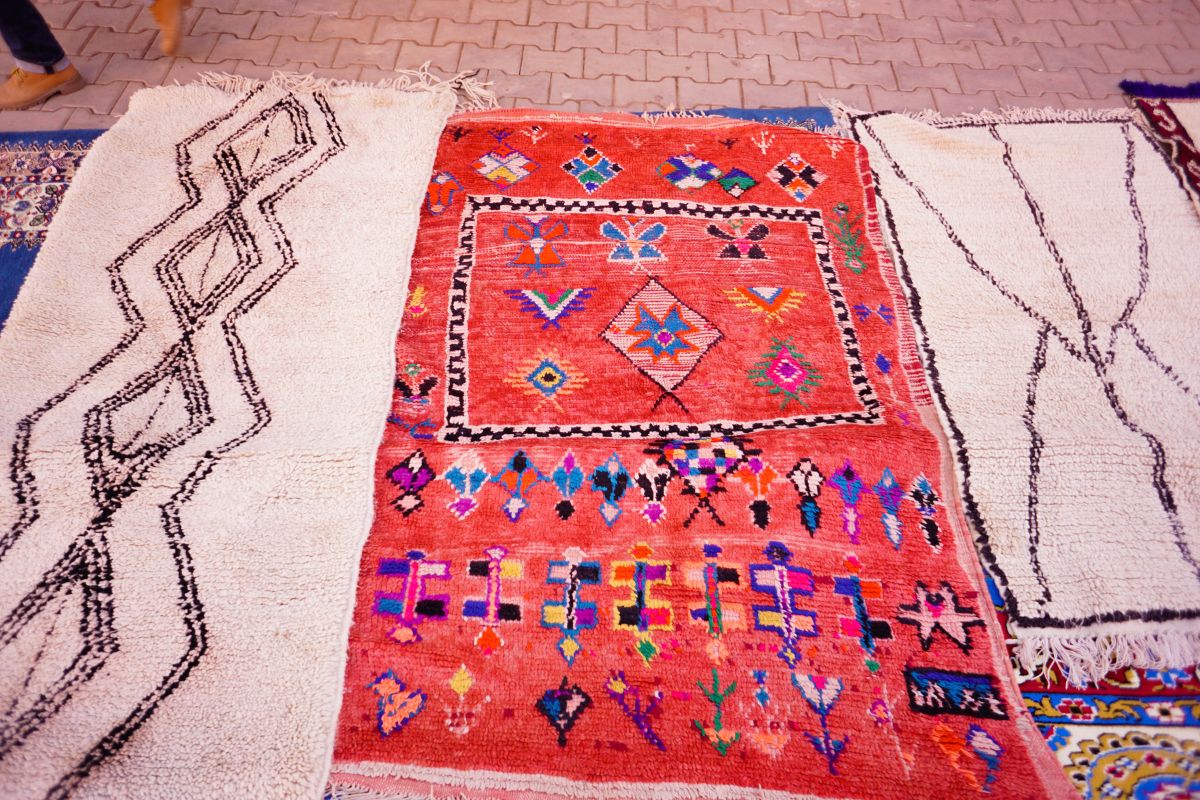
    The four Moroccan rug styles you will run into most often are Beni Ourain, Boucherouite, Azilal, and Boujad, and each one comes from a different part of Morocco with its own look. Beni Ourain rugs are thick cream wool with simple black geometric lines. Boucherouite rugs are bright and busy, woven from recycled fabric scraps rather than pure wool. Azilal rugs have a natural wool background scattered with colorful, freehand motifs. Boujad rugs run warm, in pinks, reds, oranges, and purples. Sort them by material, pile height, and color palette, and the whole category stops feeling like one blurry "Moroccan rug" and starts making sense.

    Here is the fast version before we go deeper.

    Style Region reported Base material Palette Feel underfoot Best for
    Beni Ourain Middle Atlas Natural undyed wool Cream with black or brown lines Thick, plush, high pile Living rooms, bedrooms, cold floors
    Boucherouite Made across Morocco Recycled cloth, cotton, sometimes synthetic scraps Bold, mixed, no fixed palette Thin to medium, uneven Color accents, playrooms, low-traffic spots
    Azilal High Atlas Natural wool ground with dyed wool or cotton motifs Ivory base, bright abstract accents Medium pile Rooms that want art on the floor
    Boujad Central plains near Boujaad Sheep wool Pink, red, orange, purple Low to medium pile Warm, bohemian, layered interiors

    A note on how this guide is written: Atlas Rug Guide does not sell rugs. Almost every other page you will find on this topic is a rug seller's blog, which is fine, but it means the "best" style is usually the one that seller happens to stock. Here, no style is being sold to you. Where a fact is genuinely contested or thinly sourced, this guide says so instead of pretending it is settled.

    What "Moroccan rug" actually means

    "Moroccan rug" is not a single product or a certified category. It is a shorthand for a wide family of hand-weaving traditions practiced by the Indigenous Amazigh (Berber) peoples of Morocco, most of them in and around the Atlas Mountains, where each tribal area developed its own visual language over generations. Amazigh weaving is also found in Algeria and Tunisia, but the largest and most varied production comes from the Moroccan Atlas, as reported by Berber-rug specialists.

    That matters for one practical reason: the style names are descriptive, not regulated. "Beni Ourain," "Azilal," and "Boujad" point to a region or a group of tribes and the general weaving tradition there, not to a stamped, guaranteed grade. Two rugs sold under the same name can look quite different, and origin dates you see repeated online (everything from "a few centuries" to "thousands of years") are rarely sourced and rarely agree. Treat the names as a helpful map, not a certificate.

    Beni Ourain: the cream wool classic

    Beni Ourain is the style most people picture first: a thick, ivory or cream wool pile marked with thin black or dark brown geometric lines, often diamonds or loose lattice patterns. The rugs are made from natural, undyed sheep wool, which is where the soft off-white ground comes from.

    The name refers to the Beni Ourain (also written Beni Ouarain), described by rug specialists as a confederation of Amazigh tribes in the lower Middle Atlas Mountains, in the area between Fez and Taza. The plush, warm pile has a functional origin: these were floor and sleeping coverings made to insulate against hard mountain winters, not decorative objects first. Because the palette is so restrained, Beni Ourain reads as calm and modern, which is why it shows up constantly in minimalist interiors.

    Best use: high-traffic living rooms and bedrooms where you want warmth and a neutral base. For the full breakdown of knots, wool grades, and how vintage pieces differ from new production, see our deep-dive Beni Ourain rug guide.

    Boucherouite: color from recycled cloth

    Boucherouite is the outlier of the group, and the most misunderstood. Instead of wool pile, these rugs are woven from whatever fabric was on hand: strips of old clothing, cotton, fabric scraps, and sometimes nylon or plastic. The name itself comes from a Moroccan Arabic term for a scrap or torn piece of used cloth, which tells you exactly what they are made from.

    That origin is the opposite of luxury. Boucherouite rugs grew out of thrift, made in households where wool was scarce or too valuable to use on the floor, so weavers improvised with textile leftovers. The result is unpredictable: saturated, clashing color, loose or improvised patterns, and a texture that changes across the rug. No two are alike, and there is no "correct" Boucherouite palette.

    Best use: a jolt of color in an otherwise quiet room, kids' spaces, or as a layered accent. Keep them out of the highest-traffic paths, since mixed materials wear less evenly than dense wool. Our Boucherouite rug guide covers materials, washing cautions, and why condition varies so much piece to piece.

    Azilal: the painterly one

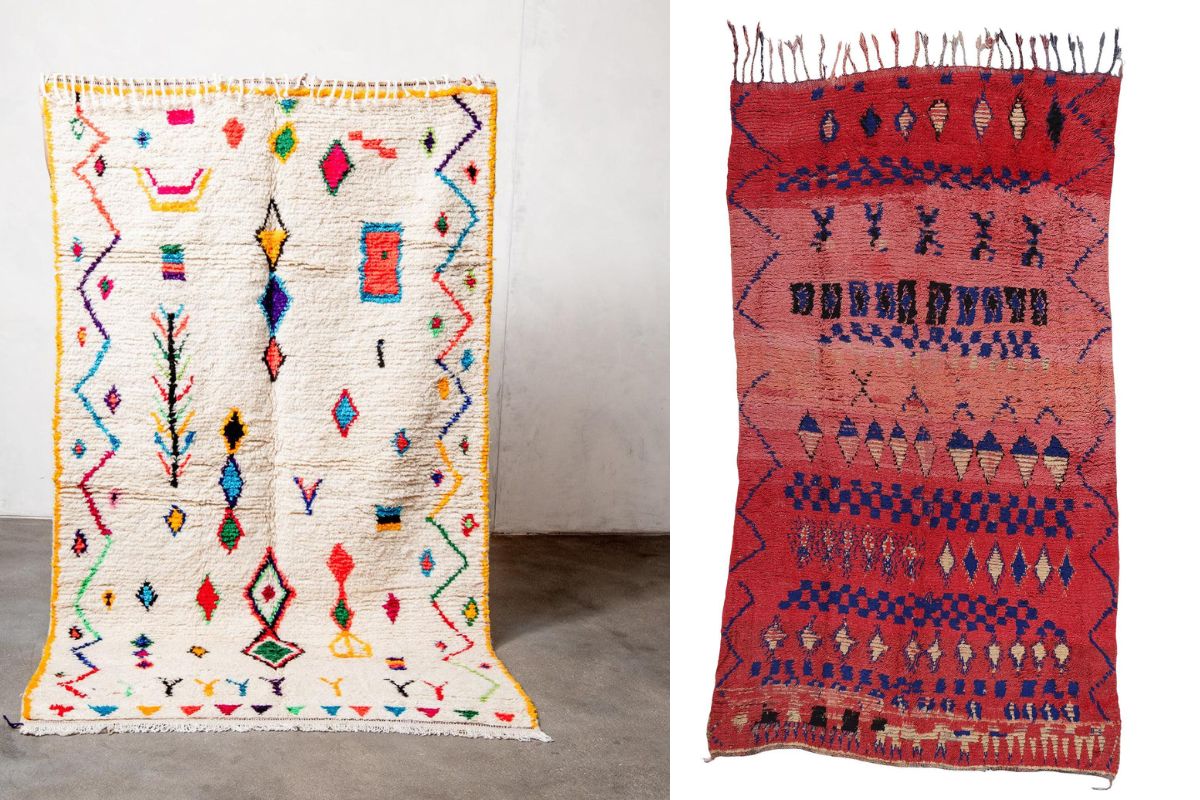
    Azilal rugs sit between Beni Ourain's restraint and Boucherouite's chaos. They usually start from a natural, undyed ivory wool ground, then add sparse, freehand motifs in dyed wool or cotton: diamonds, lines, hooks, and abstract shapes that look almost drawn on. The effect is closer to a canvas than a carpet.

    The name comes from the Azilal region, which specialists place in the High Atlas, northeast of Marrakech, on the seam between the High and Middle Atlas. One reported detail worth knowing: Azilal rugs stayed largely off the international market until the late 20th century, which is part of why they feel fresher and less formula-driven than the more commercialized styles. Weavers there are described as using a single knotted line worked between woven rows, a technique passed down among women in the region.

    Best use: a room that wants one expressive, art-like piece without going full rainbow. See the Azilal rug guide for how to read the motifs and tell older pieces from newer, brighter production.

    Boujad: warm tones from the central plains

    Boujad (also spelled Boujaad) rugs are the warm-blooded ones, built on pinks, magentas, reds, oranges, and purples, often layered over each other so the color feels sun-faded and lived-in. They are woven in sheep wool at a low to medium pile.

    The name comes from the town of Boujaad, and here is a genuinely contested point this guide will not paper over: many sources place Boujad production in the central plains at the foothills of the Middle Atlas, while some sellers loosely file these rugs under the Haouz region near Marrakech. The town of Boujaad sits in Morocco's central plains, not in Marrakech, so the "central plains" description is the more precise one. Rug specialists also note these rugs are made by Arab and Arabised Berber tribes, a reminder that Moroccan weaving traditions are not all strictly Amazigh.

    Best use: bohemian and maximalist rooms, or as a warm layer over a neutral floor. The Boujad rug guide goes deeper on the dye story and why mid-century pieces are collected.

    The part sellers skip: handmade versus machine-made imitation

    Here is the section most "types of Moroccan rugs" articles leave out, because most of them are trying to sell you a rug. A large share of "Moroccan rugs" sold online, especially the cheapest ones, are machine-made imitations produced in factories, often outside Morocco, from synthetic fibers designed to mimic the look. They can copy the pattern. They do not copy the construction.

    You do not need a "burn test" or any of the unsourced tricks that circulate online to see the difference. A few honest signals do most of the work:

    • The back. A handmade rug shows individual knots and slightly irregular rows on the reverse. A machine-made one looks mechanically uniform, sometimes with a grid backing or glued layer.
    • Regularity. Handwoven pieces have small imperfections: a line that wobbles, a motif that is not perfectly symmetrical. Flawless, ruler-straight repetition is a machine tell.
    • Edges and fringe. Authentic rugs have hand-finished edges and fringe that is part of the weave, not a separately sewn-on strip.
    • Material and weight. Real wool (or genuine recycled cloth, for Boucherouite) feels denser and warmer than thin synthetic pile.

    One honest limit: photos and words can only take you so far. Atlas Rug Guide is a reference, not an appraisal or authentication service, and no online guide can certify a specific rug you are looking at. For a high-stakes purchase, a hands-on inspection by a specialist beats any checklist, including this one. What this guide can do is stop you from mistaking a mass-produced copy for the tradition it is imitating.

    How to choose a Moroccan rug style for your room

    Skip the "which is best" question, because it depends entirely on your space. Choose by use instead:

    • Want warmth and a calm, neutral base? Beni Ourain. Thick wool, quiet palette, forgiving in busy rooms.
    • Want the floor to be the color? Azilal for an art-like, controlled pop, or Boucherouite if you want maximum, unpredictable energy.
    • Want warm, cozy, lived-in tones? Boujad, especially layered over a plain floor or a larger neutral rug.
    • High-traffic hallway or entry? Favor dense wool pile (Beni Ourain, some Boujad) over thinner recycled-cloth Boucherouite, which wears less evenly.

    Match the pile height to the room too. Thick pile feels great in a bedroom and reads busy in a small office; a lower pile is easier under doors and dining chairs.

    FAQ

    What are the main types of Moroccan rugs?
    The most common named styles are Beni Ourain (thick cream wool with black geometric lines), Boucherouite (bright rugs made from recycled cloth), Azilal (ivory wool grounds with colorful freehand motifs), and Boujad (warm pink, red, and purple tones). Other styles exist, but these four cover most of what people mean by "Moroccan rug."

    What is the difference between Beni Ourain and Azilal rugs?
    Beni Ourain rugs are minimalist: undyed cream wool with a few dark geometric lines. Azilal rugs keep a similar natural wool base but add bright, abstract colored motifs, so they read as more artistic and less neutral. Beni Ourain comes from the Middle Atlas; Azilal comes from the High Atlas region.

    Are Moroccan rugs always handmade?
    Traditionally yes, they are handwoven by Amazigh (Berber) weavers. But many rugs sold as "Moroccan" online are machine-made imitations in synthetic fibers. Check the back for irregular hand knots, look for small imperfections in the pattern, and feel the material to tell a genuine handmade rug from a factory copy.

    What is a Boucherouite rug made of?
    Recycled textiles: strips of old clothing, cotton, fabric scraps, and sometimes synthetic material. The style grew out of thrift, when wool was scarce or too valuable, so weavers used whatever cloth they had. The name itself comes from a Moroccan Arabic word for scrap or torn cloth.

    Why do Boujad rugs vary so much in color?
    Boujad rugs are built on warm dyed wool, and many are vintage pieces where the color has softened over decades, so pinks, reds, and purples layer and fade differently in each rug. Because they are one-of-a-kind handmade pieces, no two share the exact same palette.

  • Azilal vs Boujad Rug: How to Tell Them Apart

    Azilal vs Boujad Rug: How to Tell Them Apart

    Azilal and Boujad are the two Moroccan rug styles most likely to get swapped in a listing, because both break from the neutral cream-and-line look of Beni Ourain and lean into color. The fast test: look at the ground wool and the weight. Azilal starts from a natural, undyed ivory wool base with sparser, more graphic color added on top, and feels lighter. Boujad is fully dyed wool throughout, denser, and heavier in the hand, built on warm pinks, reds, and purples rather than Azilal's more varied palette.

    This guide is a comparison only, sitting alongside the complete guide to Moroccan rug styles. For the full profile of either style on its own, see our dedicated guides to Azilal rugs and Boujad rugs.

    Where each comes from, briefly

    Azilal rugs are associated with the Azilal region in the High Atlas, northeast of Marrakech. Boujad rugs take their name from the town of Boujaad, generally placed in Morocco's central plains at the foothills of the Middle Atlas, though some sellers loosely file them under the Haouz region near Marrakech instead; our Boujad guide covers that discrepancy in more depth. Both are made by Amazigh (Berber) weavers, though Boujad rugs are also attributed by rug specialists to Arab and Arabised Berber tribes in the region, a reminder that Moroccan weaving is not a single uniform tradition.

    Material and construction

    This is the most reliable, checkable difference between the two styles.

    • Azilal starts from a natural, undyed ivory or cream wool ground, with motifs added in dyed wool or cotton worked sparsely across that base. Some sellers describe certain Azilal production as including a synthetic fiber blended in to help stabilize the added color; this guide could not independently confirm how common that is, so treat it as a claim you may see on some listings, not a defining feature of the style as a whole.
    • Boujad is fully wool, dyed throughout rather than left in a natural ground, and is described consistently as denser and heavier than Azilal.

    Feel is the fastest real-world test: an Azilal rug feels lighter and airier, closer to a canvas with color drawn on top of a pale field, while a Boujad rug feels weightier and more saturated all the way through.

    Color and pattern

    Azilal's color sits on top of a mostly ivory field: diamonds, lines, hooks, and abstract shapes worked sparsely, so a lot of the natural undyed wool is still visible between the motifs. The overall effect reads closer to a sketch or a painting than a fully patterned textile.

    Boujad is built from warm, dyed wool throughout, in pinks, magentas, reds, oranges, and purples, often layered so the color reads as sun-faded and lived-in rather than flat. Geometric shapes, including diamonds and triangles, appear, but the ground itself carries color everywhere rather than staying mostly natural.

    Quick-look comparison

    Feature Azilal Boujad
    Region High Atlas Central plains, Middle Atlas foothills
    Ground Natural, undyed ivory wool Fully dyed wool
    Weight/feel Lighter, airier Heavier, denser
    Color placement Sparse motifs on a pale field Color throughout the ground
    Typical palette Ivory base with varied bright accents Pink, magenta, red, orange, purple

    How to tell them apart in a listing photo

    • Check how much natural, undyed wool is visible. If a lot of the pale ground shows through between motifs, that points to Azilal. If the whole surface is saturated with warm color, that points to Boujad.
    • Look at the palette family. Boujad stays specifically in pinks, reds, magentas, and purples. Azilal's color choices are more varied and less tied to one warm family.
    • Ask about weight if you can't feel it. A seller can tell you whether a piece feels light or substantial; Boujad tends to run heavier for a similar size.
    • Don't rely on the listing title alone. Because the styles are visually close and commercially confused, a mislabeled listing is not rare. Use the ground-and-weight test above rather than trusting the name a seller has attached.

    One honest limit: photos flatten texture and weight, the two most reliable signals here, so a photo-only judgment will always be softer than handling the actual rug. For a significant purchase, ask direct questions about the wool base and construction rather than relying on the style name in the title.

    Choosing between them for a room

    Since both styles bring color rather than neutrality, the choice usually comes down to how much of the floor you want that color to cover and how heavy you want the rug to feel. Azilal's lighter weight and pale visible ground make it a reasonable choice if you want a colorful accent that still reads as airy, more like a piece of graphic art on the floor than a dense block of color. Boujad's fuller, heavier saturation suits a room that wants genuine warmth and boldness, functioning closer to a design anchor than an accent. Neither is the more "authentic" choice; they simply solve different visual problems, and a room can reasonably use either depending on what else is already in it.

    FAQ

    What is the easiest way to tell an Azilal rug from a Boujad rug?
    Check the ground. Azilal keeps a lot of natural, undyed ivory wool visible with sparse color added on top. Boujad is fully dyed wool throughout, in warm pinks, reds, and purples, and feels noticeably heavier.

    Are Azilal and Boujad rugs from the same region?
    No. Azilal is associated with the High Atlas, northeast of Marrakech. Boujad is generally placed in the central plains at the foothills of the Middle Atlas, though some sellers describe it differently.

    Which is heavier, Azilal or Boujad?
    Boujad. It is fully wool and dyed throughout, and is consistently described as denser and heavier than Azilal, which keeps a lighter, more open feel from its undyed wool ground.

    Do Azilal rugs contain synthetic fiber?
    Some sellers describe certain Azilal pieces as including a small amount of synthetic fiber to help stabilize added color. This guide could not confirm how widespread that is, so it should be treated as a claim seen on some listings rather than a defining feature of the style.

    Can a listing be mislabeled between the two styles?
    Yes. Because both are colorful, non-neutral Moroccan styles and the names are used loosely in the market, mislabeling happens. Checking the ground wool and weight yourself is more reliable than trusting the title alone.