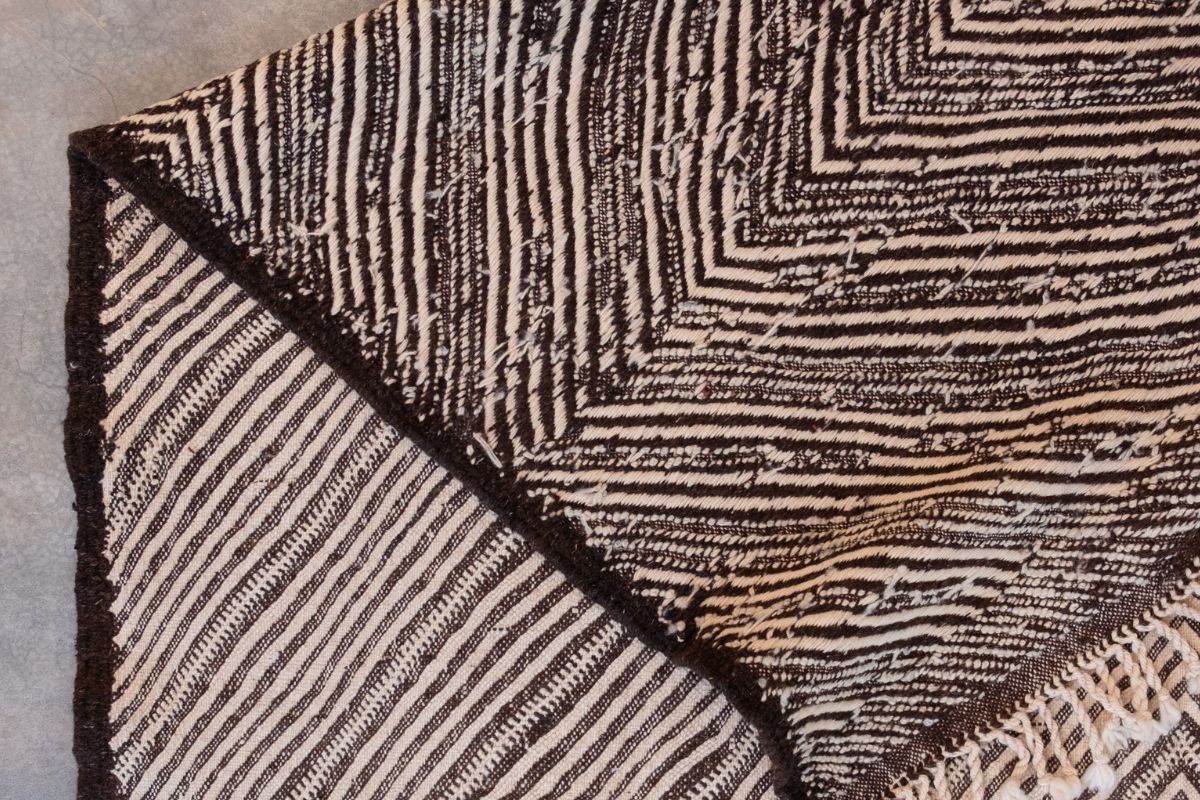
A Zanafi rug is a Moroccan flatweave, woven in the kilim style rather than knotted with a pile, and it is genuinely reversible: both faces are finished and usable, not just one side dressed up to look that way. Bold, symmetrical geometric patterns in contrasting two-tone colors, often black and white or cream and deep brown, are the style's signature look, along with fringe finished along the vertical sides. It is one of several named traditions within the wider family of Moroccan rug styles.
Where the name is associated
Rug specialists commonly associate the Zanafi name with weaving communities in the High Atlas, around the Ouarzazat area. This guide did not find an independent, non-commercial source confirming that specific attribution, so it is presented here as what rug-trade sources report, not as a confirmed regional or tribal fact. What can be said plainly is the construction and look, which is consistent and checkable across the pieces sold under this name.
Why a flatweave can genuinely be reversible
This is the part worth understanding before anything else, because "reversible" sounds like a marketing word and here it is actually a structural fact. A knotted, pile rug (like Beni Ourain or Beni Mrirt) is built by tying individual knots into a foundation, which means one face carries the pile and the back shows the knot structure. There is a clear right side and wrong side, and only one of them is meant to be walked on.
A flatweave, by contrast, is woven by interlacing weft threads directly through the warp, the same basic technique as a kilim, with no knots and no pile standing up from a base. Because the pattern is created by the weave itself rather than by tufts sitting on top of a foundation, the design typically shows through to both faces, sometimes as a mirror image, sometimes nearly identical. That is the real, physical reason a genuine flatweave like a Zanafi can be flipped and used on either side, and it is worth knowing because it means the "reversible" claim is a consequence of construction, not a special extra technique unique to this one style name.
The look: pattern, palette, and fringe
Zanafi designs lean toward bold, symmetrical geometry: diamonds, chevrons, and tribal-style motifs worked in strong, contrasting two-tone combinations, most often black against white or cream against a deep brown. The effect reads graphic and confident rather than busy, closer in spirit to the restrained lines of Beni Ourain than to the color-saturated Boujad or Azilal styles. Fringe is typically finished along the vertical sides of the piece, a detail worth checking on a genuine hand-woven example versus a machine-made copy, where fringe is often a separately sewn-on strip rather than part of the weave itself.
Practical fit: where a flatweave earns its keep
Because there is no pile standing up from the foundation, a flatweave like a Zanafi is lighter and flatter than a knotted rug of the same size, which has real practical consequences:
- Easier under doors. A low-profile flatweave clears door swings and furniture that a thick pile rug can catch on.
- Simpler to clean and move. Without a deep pile trapping dust and debris, a flatweave is generally easier to shake out, vacuum, or reposition.
- Doubled wear life, in principle. Because both faces are finished, a worn or faded piece can in theory be flipped to present the less-worn side, extending how long it stays presentable, though heavy fading or a stain that has soaked through will still show on both sides.
- A good fit for high-traffic, low-fuss spots. Hallways, kitchens, and entryways suit a flatweave's lighter, flatter profile better than a thick, shaggy pile that can bunch or trip underfoot in a narrow space.
Checking whether a "reversible" claim is genuine
Because "reversible" is a real selling point, it is also a claim worth verifying rather than taking on faith from a listing photo of one side only. On a genuine flatweave, both faces should show the interlaced weave structure directly, with the pattern visible (even if slightly softer or mirrored) on the back. A rug that shows a clean woven pattern on the front but a fuzzy, felted, or backed reverse is not a true reversible flatweave, whatever the listing calls it; that kind of construction, a pile or tufted rug with a separate backing material glued or stitched on, cannot be flipped and used on the other side no matter how the fringe or edges are finished. If a seller advertises reversibility, ask to see or describe both faces specifically before assuming the claim holds.
How this compares to other Moroccan flatweaves
Zanafi is not the only Moroccan flatweave on the market; kilims and hanbels made across other regions share the same basic no-pile construction with different regional patterns and palettes. See our guide to Moroccan kilim and hanbel rugs for how the wider flatweave family relates. For a contrast with the thick, high-pile end of the spectrum, our Beni Ourain guide covers the opposite construction entirely.
FAQ
What is a Zanafi rug?
A Moroccan flatweave rug, woven kilim-style without a knotted pile, known for bold two-tone geometric patterns and genuine reversibility, meaning both faces are finished and usable.
Why is a Zanafi rug reversible?
Because it is a flatweave. The pattern is created by interlacing threads directly, without knots or a raised pile, so the design typically shows through to both sides of the fabric. That is a structural consequence of the weave, not a special added feature.
Is a Zanafi rug the same as a kilim?
It shares the same basic flatweave construction as a kilim. "Zanafi" refers to a specific regional style and pattern tradition within that broader flatweave family rather than a separate construction technique.
Where are Zanafi rugs from?
Rug-trade sources commonly associate the name with weaving communities in the High Atlas, around the Ouarzazat area. This guide could not independently confirm that specific attribution, so it is presented as reported by rug specialists rather than as a settled fact.
Are flatweave rugs like Zanafi durable?
Yes, generally. They are lightweight and hold up well in high-traffic areas because there is no pile to crush or wear unevenly, though the trade-off is less cushioning underfoot than a thick knotted pile rug.
Leave a Reply