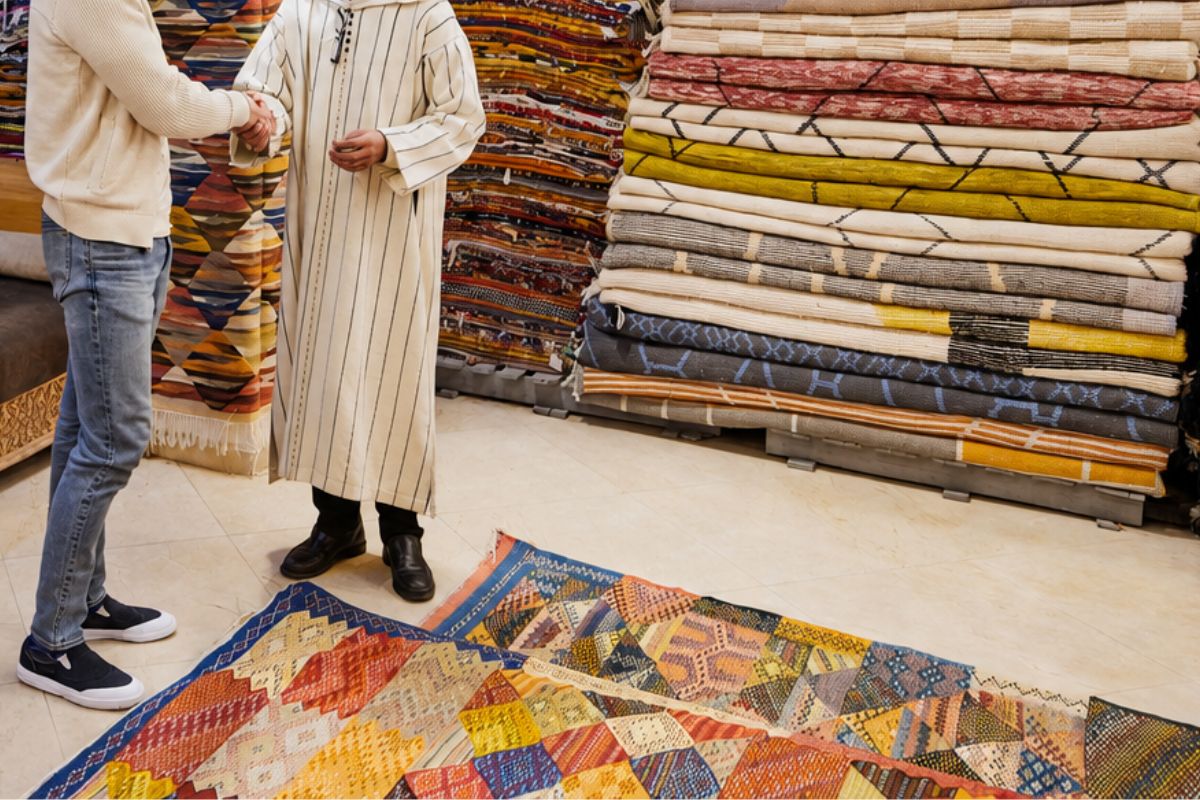
Yes, you are expected to negotiate. Prices in a rug shop are not fixed and the first figure is an opening position, not an insult and not a final answer. No, there is no correct percentage to open at. The widely repeated advice to start at two thirds off is a heuristic somebody invented, it is not sourced to anything, and on a hand-knotted rug that took weeks to weave it can land as genuinely rude. The way to be both effective and courteous is to be specific, unhurried and honest about your limit.
Why the "cultural dance" framing is the wrong one
Most travel writing on this describes bargaining as a charming ritual, a dance, a piece of local colour laid on for visitors to enjoy. That framing is common and it is worth pushing back on for two reasons.
The first is respect. The person across the counter is running a business with rent, stock, staff and a family, in an economy where the outcome of this sale matters more to them than it does to you. Treating their livelihood as an entertainment you have travelled to sample is the actual discourtesy, not offering a low number.
The second is that it makes you worse at it. Someone who thinks they are performing a ritual plays theatrically, over-dramatises, and walks away pleased at a "win" they cannot assess. Someone who understands it as an ordinary commercial negotiation in a market where posted prices do not exist asks better questions and gets better outcomes.
Bargaining in this context is a pricing mechanism, not folklore. Take it seriously and you will be treated seriously.
What is actually being negotiated
Here is the thing almost no guide tells you, and it changes the ethics of the whole exchange.
You are not negotiating with the weaver, and you are almost never negotiating down her share. The documented chain runs weaver, weekly market, middleman, processing and washing, export, import, retail. AFP reporting from December 2024, carried by outlets including Business Recorder, described weavers in southern Morocco selling large rugs for around 250 dirhams to middlemen who set the prices, with a single carpet taking two to four weeks to make. The Anou Cooperative reported in December 2020 that some artisans earn as little as 5 dirham a day.
By the time a rug reaches a city showroom, the maker's payment is long since fixed and spent. The margin you are arguing over belongs to intermediaries and to the retailer, and the retailer's part of it is covering real costs. Why the same rug costs four times more in a showroom walks the chain properly.
So the guilt some buyers feel about negotiating hard, on the grounds that they are squeezing an artisan, is generally misplaced. And the satisfaction some buyers take in a very low price, on the grounds that they beat the system, is equally misplaced: the weaver's share did not change either way.
The advice in circulation, and which of it holds up
Sorting the common tips by whether anything supports them.
"Open at two thirds off and meet in the middle." Unsourced. It appears across travel guides as a rule and originates nowhere in particular. On low-value souvenirs it is harmless. On a rug it can be far enough below any plausible figure that the conversation ends, and the seller is entitled to read it as not serious.
"Do not show which rug you want." Sound, and for a plain reason: obvious enthusiasm tells the seller your ceiling is high. This is ordinary negotiation, not a trick.
"Take your time, exchange pleasantries." Sound and consistently reported. The transaction is designed to be slow, and rushing signals either disinterest or that you will pay to leave.
"Morning is cheaper because the vendor wants the first sale." Folklore. Repeated widely, sourced nowhere. It may be true and this guide has no way to know.
"Walking away gets you a better price." Partly true and often over-taught. It works when your number is genuine. Performing a walk-away you do not mean, twice, mostly wastes an afternoon.
"Negotiate shipping as part of the deal." Sound and practical. Shipping is a real cost with real margin in it and it is legitimately part of the total. See buying a rug in the Marrakech souk for the substitution risk that goes with it.
How to be firm without being rude
- Decide your number before you walk in, in your own currency, and treat it as real. Everything else is easier once this exists.
- Open low but not absurd. If you have no idea what the range is, say so and ask what the price covers rather than firing a number.
- Negotiate on specifics, not on principle. "It has a rewoven section here" and "the wool feels dry at the base" are arguments. "That is too much" is not.
- Be pleasant and slow. Both sides expect this to take time, and hurry costs you money.
- Say a real no. "That is more than I am going to spend" is respectful, final, and ends the exchange cleanly.
- Do not use the story as leverage you do not believe. If the age claim is unverifiable, that is a reason to value the rug as an object, not a debating point to extract a discount with.
- Buy the rug, not the win. A rug you like at a fair price is a better outcome than a rug you do not at a price you enjoyed getting.
Walking away, deposits, and payment
Walking away is normal and nobody will be offended by it. A long presentation does not create an obligation, and the tea is hospitality that the seller has factored in.
Be careful with deposits. Know what a deposit commits you to and whether it is refundable before you hand one over, especially if the rug is going to be shipped or held. Get it in writing.
On payment, prefer a method that leaves a trail and may carry protections your bank defines, and agree the currency and any card surcharge before you settle on a figure, so the number you agreed is the number that leaves your account. Ask for a receipt describing that specific rug, with measured dimensions and any claim the seller made about it.
For what drives the number in the first place, see what actually drives a Moroccan rug's price. For the whole set of failure modes, how to buy a Moroccan rug without getting taken. And for why the word "Berber" on the tag is doing more work than it should, what "Berber rug" actually means.
FAQ
How much should I offer for a rug in Morocco?
There is no correct percentage, and this guide does not publish a target price. Decide a real limit in your own currency beforehand and negotiate on specifics about the rug rather than on a formula.
Is haggling rude in Morocco?
No. Prices are not fixed and negotiation is expected. What can be rude is treating the exchange as entertainment, or opening so far below any plausible figure that the seller reads you as not serious.
Am I taking money from the weaver when I negotiate?
Generally not. The weaver is paid at the start of the chain and that price is long settled by the time a rug reaches a showroom. The margin under discussion belongs to intermediaries and the retailer.
Does walking away actually work?
When your number is genuine, yes, because it is real information. Performing a walk-away you do not mean mostly costs you time.
Should I negotiate shipping too?
Yes, it is a legitimate part of the total and is normally treated that way. Settle who ships, how it is tracked and who bears the risk in transit, not just the price.
Leave a Reply