Tag: rug authenticity

  • Moroccan Style Rug Made in Turkey, India or China?

    Moroccan Style Rug Made in Turkey, India or China?

    No, a "Moroccan style" rug is usually not Moroccan. The phrase describes a look, and rugs sold that way are commonly machine-made in Turkey, or woven or tufted in India or China. In the US you do not have to guess: under Federal Trade Commission rules, rugs are covered textile products, an imported rug must be labeled with the country where it was made, and catalog and mail-order advertising must say whether a product is imported or made in the USA. The country is on the label. The style name is not a country.

    This guide explains what "style" is doing in a listing, why Turkey, India and China come up, what US labeling rules require, and how to find the real country of origin before you buy.

    What "Moroccan style" means, and does not

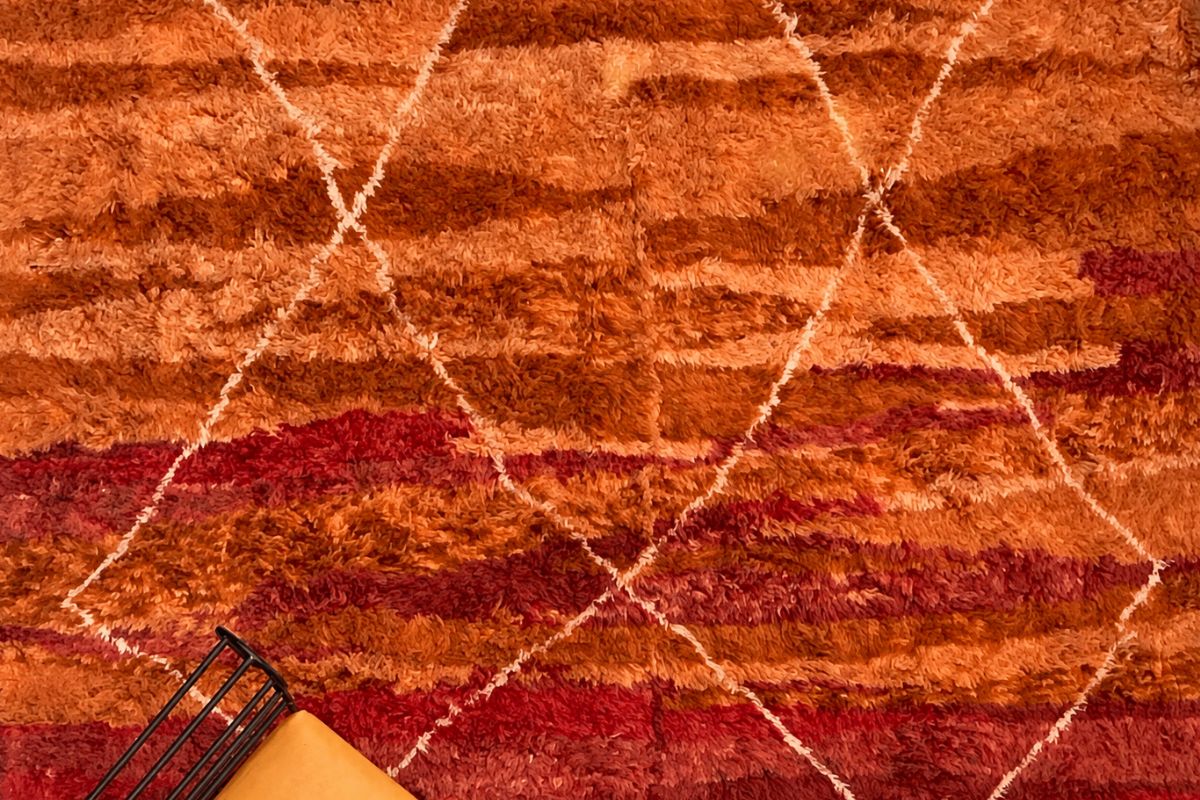
    "Moroccan style" is a design description. It tells you the rug resembles a Moroccan type, most often the cream-and-black diamond grid associated with Beni Ourain, or the bright abstract motifs associated with Azilal. It makes no claim about who made the rug, where, or how.

    That is not dishonest in itself. A machine-made rug in a Beni Ourain design, clearly labeled with its country of origin and sold at a price that reflects what it is, is a legitimate product that many people are happy to own. The problem starts when a listing lets "Moroccan" do the work of a country and "style" slip out of view, or when the price assumes a hand-knotted Moroccan rug and the product is something else.

    Why Turkey, India and China come up

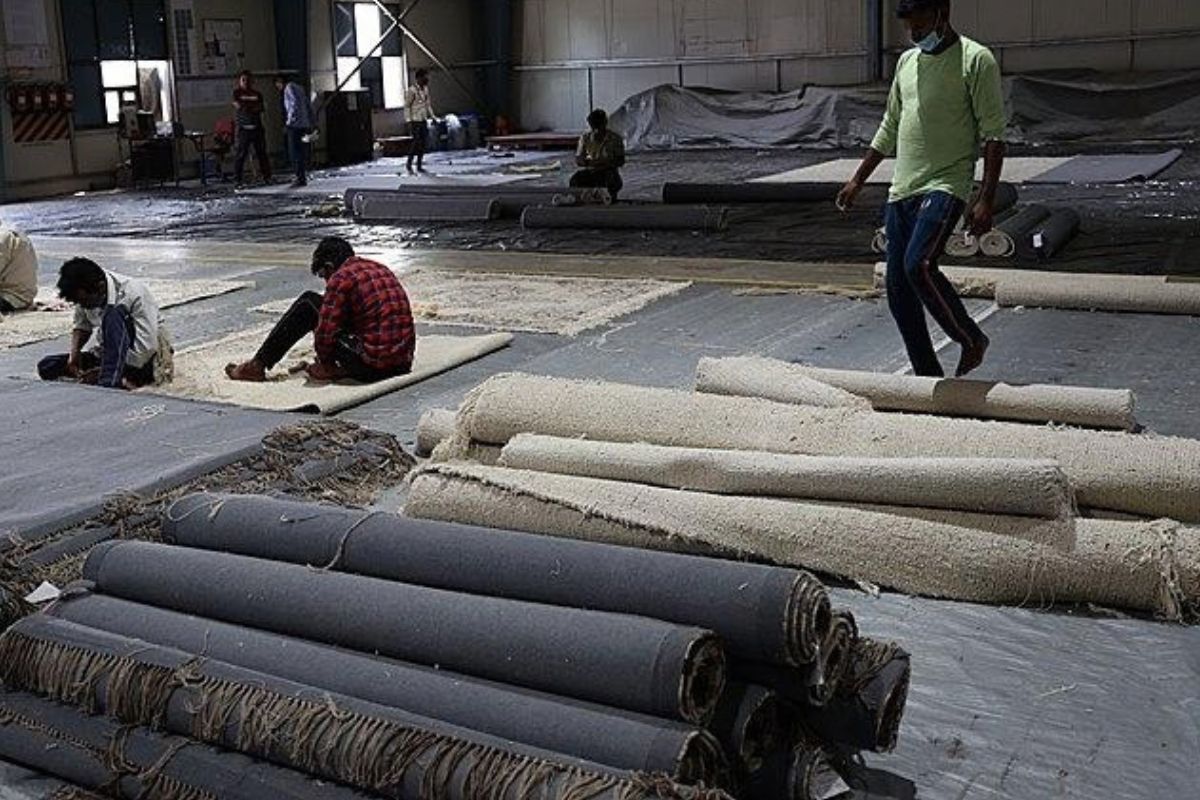
    These three countries appear because they make a very large share of the world's rugs, in every construction and at every price.

    Turkey and machine-made rugs. Daily Sabah reported on 23 October 2019, quoting Ahmet Kaplan, chairman of the Southeastern Anatolia Carpet Exporters' Association, that Turkey accounts for more than 67% of the world's machine-made carpet production, and that more than 60% of those are produced in the southern province of Gaziantep. The same report put China first in carpet exports overall, at $2.9 billion, with Turkey second. Those are 2019 figures from an industry association and will have moved since, but the shape is clear: a machine-made rug in a Moroccan design is very often Turkish.

    Turkey also has its own hand-weaving tradition, which is a separate thing entirely. Moroccan, Persian and Turkish rugs compared covers the handmade traditions side by side.

    India and hand-knotted or hand-tufted copies. Exporters in India's carpet belt, around Bhadohi, openly list hand-knotted and hand-tufted rugs in "Beni Ourain" and "Moroccan" designs, as the results for this topic showed on 11 September 2026. Some of these are well made by hand. They are handmade rugs in a Moroccan design, made in India, and an honest listing says so.

    China. China makes rugs across the range, from machine-made to hand-tufted. A listing that describes "Moroccan patterning" in the title and gives China as the country in the specifications is common in mass retail.

    None of this is an accusation against any country's makers. It is a description of where the world's rugs come from. The only thing that matters to a buyer is whether the listing tells the truth about which one they are getting.

    What US rules require, in plain terms

    This section describes US federal rules as published and read on 11 September 2026. It is general information, not legal advice. Rules outside the US differ, so check your own country's consumer and customs authority.

    Rugs are covered textile products. The FTC's business guide, Threading Your Way Through the Labeling Requirements Under the Textile and Wool Acts, lists "floor coverings: rugs, carpets and mats" as products covered by the Textile Act. The same guide notes that rugs are excluded from the separate Wool Act rules because they are covered by the Textile Act instead.

    Imported rugs must name the country. The regulation at 16 CFR 303.33 states that "each imported textile fiber product shall be labeled with the name of the country where such imported product was processed or manufactured." For floor coverings, the FTC guide says the required information must appear on a conspicuous and readily accessible label on the inside or outside of the product.

    Mail-order advertising must say where it is from. Under 16 CFR 303.34, when a textile product is advertised in a mail order catalog or mail order promotional material, the description must contain "a clear and conspicuous statement that the product was either made in U.S.A., imported, or both." The FTC's guide applies the same origin disclosure to internet sales.

    Customs marking applies at the border. Separately, 19 CFR 134.11 requires that every article of foreign origin imported into the United States be marked "in such manner as to indicate to an ultimate purchaser in the United States the English name of the country of origin," unless an exception applies.

    Put together: a rug sold in the US should carry its country of origin on a label, and an online listing should at least say it is imported. Neither requires the listing to put the country in the title, which is why the title is the last place to look.

    How to find the real country before you buy

    1. Skip the title and read the specifications. The country of origin is usually in a specifications or details section, often lower on the page than the photographs.
    2. Look for "imported." If a listing says only "imported," ask which country. A seller of a genuine Moroccan rug has every reason to name Morocco.
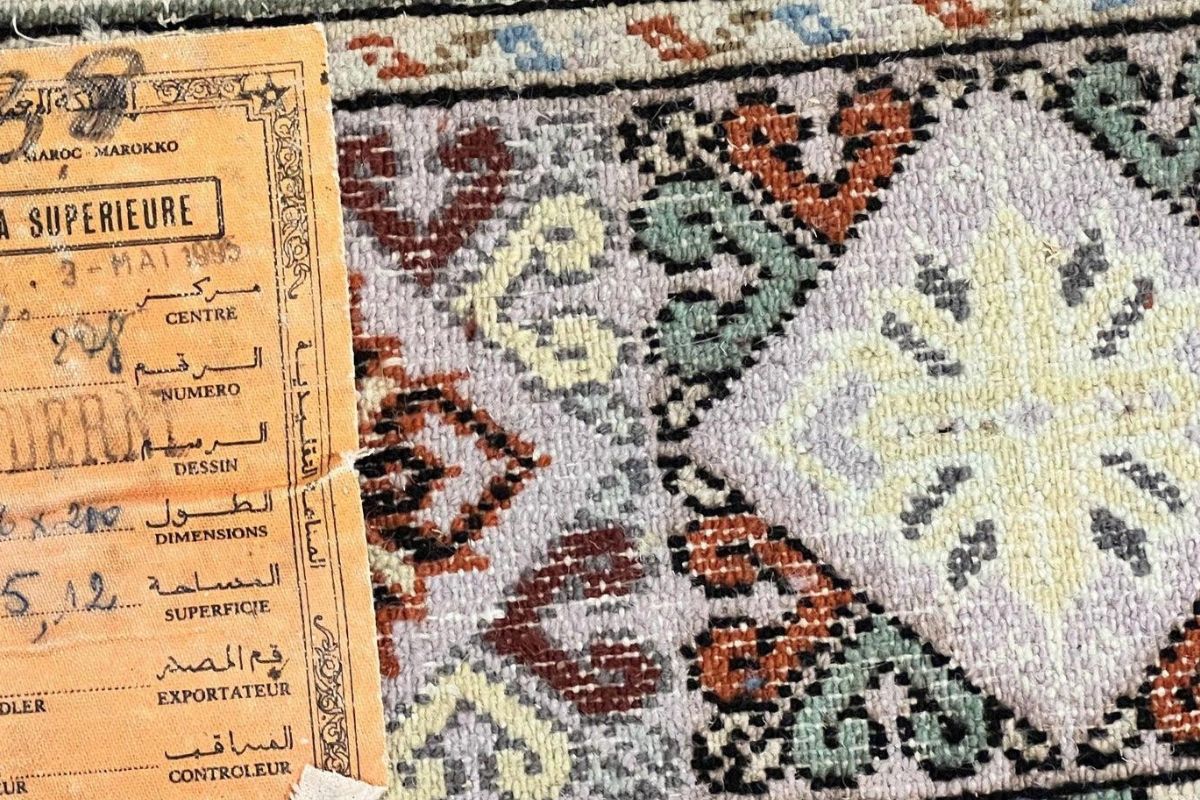
    3. Ask for a photograph of the label. The country of origin label is attached to the rug itself. A seller who cannot photograph it is telling you something.
    4. Ask for a photograph of the back. Country answers where. Construction answers how. Handmade vs machine-made: read the back shows what hand-knotted, hand-tufted and machine-made backs look like.
    5. Keep the listing. Screenshot the description and specifications before you pay. If the rug arrives labeled differently from how it was described, that record matters.

    If the label on the rug names a different country from the one the listing implied, that is a misdescription, and buying a Moroccan rug online covers what to establish about returns and recourse before you pay.

    What a "Made in Morocco" label does not settle

    A correct label settles one question and leaves others open.

    "Made in Morocco" tells you the country. It does not tell you the rug was hand-knotted, which region it came from, how old it is, or whether the style name is accurate. Machine-made and tufted rugs are sold in Morocco too, and a Moroccan origin does not make a rug handmade. Is my Moroccan rug authentic covers the four questions that are worth separating: country, construction, age and style.

    If you are bringing a rug home from Morocco yourself, the marking and duty questions work differently, and customs and duty on a rug imported from Morocco covers that route.

    FAQ

    Is a "Moroccan style" rug made in Morocco?
    Usually not. "Moroccan style" describes a design. Many rugs sold that way are machine-made in Turkey or made in India or China. The country of origin is on the label and in the listing's specifications, not in the style name.

    Where are most machine-made Moroccan style rugs made?
    Often in Turkey. Daily Sabah reported in 2019, quoting a Turkish carpet exporters' association, that Turkey produced more than 67% of the world's machine-made carpets, mostly in Gaziantep. China and India also produce rugs in Moroccan designs.

    Does a rug sold in the US have to show its country of origin?
    Yes. FTC rules at 16 CFR 303.33 require imported textile products, which include rugs, to be labeled with the country where they were processed or manufactured. Mail-order advertising must state whether a product is imported or made in the USA.

    Is a Moroccan style rug from India or Turkey a fake?
    Not if it is described honestly. A rug in a Moroccan design, labeled with its real country and priced for what it is, is a legitimate product. It becomes a problem when the listing implies Moroccan origin or hand-knotting that the rug does not have.
  • Rug Returns and Recourse When It Arrives Wrong

    Rug Returns and Recourse When It Arrives Wrong

    There are five rungs of recourse and you climb them in order: the seller, the platform if there was one, your card issuer or payment provider, the shipper or insurer if the problem is transit damage, and finally your own country's consumer channels. Which rungs are actually open to you was decided before the rug arrived, by what you established in writing and how you paid. A misdescription you can point to on an invoice is a factual dispute. Disappointment without documentation is a matter of taste, and taste loses.

    First: is it wrong, or is it not what you pictured?

    This distinction decides everything that follows, so be honest with yourself about it before you write to anybody.

    Misdescription is factual and provable. The rug was sold as hand-knotted and the back shows a glued canvas backing. The dimensions are materially different from those stated. There is a repair that was not disclosed. It arrived damaged. These are things a third party can assess.

    Disappointment is real and is not a claim. The colour reads differently in your light than on your screen. It is smaller in the room than you imagined. It sheds more than you expected, which why your new wool rug sheds may resolve on its own. The wool feels different from what you hoped.

    Some sellers and platforms accept returns for either. Many accept returns only for the first. Working out which category you are in tells you whether you are asking for a favour or asserting a right.

    Rung one: the seller

    Most problems that get resolved are resolved here, and going in well is worth more than going in hard.

    Write rather than call, so there is a record. State what was described, what arrived, and what you want, in that order. Attach photographs, including the back of the rug and any specific defect. Reference the invoice description if you have one.

    Ask for something specific: a return and refund, a partial refund to reflect the difference, or a replacement. A partial refund is often the outcome both sides prefer, particularly when returning a heavy rug internationally would cost a large fraction of its value.

    Give a reasonable deadline and say what you will do next if it passes. Then actually do it, because the next rungs have time limits.

    Rungs two and three: the platform and the payment provider

    The platform, if you bought through a marketplace, has a dispute process with published rules and its own window. Marketplace protections are generally aimed at items that never arrived or that are materially not as described. They are not an authentication service and they will not adjudicate whether a rug is as old as a seller claimed. Open the case within the platform's stated window rather than negotiating with the seller until it closes. Reading an Etsy or 1stDibs listing properly covers what listing terms commit a seller to.

    Your card issuer or payment provider is the rung most people forget they have. Card networks operate chargeback processes for goods not received or not as described, and the terms, evidence requirements and deadlines are defined in your own cardholder agreement, not by this page or by the seller.

    Two things about this rung. It is why paying by card on a remote purchase matters, and it is why the payment methods listed in rug scams are so costly: they simply do not have this rung. And its windows are counted from the transaction or the expected delivery date, so waiting three months for a seller to reply can close it while you are being patient.

    Rung four: damage in transit

    If the rug arrived damaged, this is a different claim from a misdescription and it goes to the carrier or the insurer rather than to the seller.

    It also has the shortest deadlines of anything here, often measured in days. Note damage on the delivery paperwork before signing if the carrier allows it, photograph the packaging as well as the rug, and open the claim immediately.

    Whether anything is recoverable depends on the declared value and the insurance, which is the practical consequence of the under-declaration question covered in customs, duty and declared value. A rug declared at a fraction of what you paid is a rug you cannot claim properly for.

    Rung five: consumer channels

    Your own country's consumer protection body, and in some places a small claims process, is the last rung. Rules, thresholds and what counts as a remedy vary enormously between countries, and a cross-border purchase from a small seller abroad is the hardest case for any of them.

    This guide will not tell you what rights you have, because they depend entirely on where you are and where the seller is. Check your national consumer body. This is not legal advice.

    The honest cost of returning a rug

    Worth saying plainly, because it changes what outcome to push for.

    A large hand-knotted rug is heavy and awkward, and return shipping from another country can approach a meaningful fraction of what you paid. If the seller does not cover it, a technically returnable purchase can be effectively final. That is a reason to weigh a partial refund seriously rather than holding out for a full return you may not want to fund.

    It is also a reason the returns terms belong in the decision before you buy rather than after, which is why they are one of the twelve questions worth asking any rug seller.

    What to establish next time

    • A written description on the invoice: construction, materials, treatment, repairs, measured dimensions at both ends and both sides, and any age or origin claim.
    • Photographs of the exact rug front and back before it ships.
    • The returns terms in writing, including who pays return shipping and whether large items are excluded.
    • A payment method with a dispute process.
    • The real declared value, so insurance is worth something.

    That list is short, it costs nothing, and it is the difference between a claim and a complaint. Buying a Moroccan rug online covers establishing it remotely, and how to buy a Moroccan rug without getting taken covers the whole picture.

    This site sells nothing, carries no affiliate links and recommends no seller or platform.

    FAQ

    Can I return a Moroccan rug if it is not as described?
    It depends on the seller's own policy and, if you bought through a marketplace, on the platform's process and window. A written description on the invoice is what turns "not as described" into a factual claim rather than an opinion.

    What if the seller stops replying?
    Move up promptly rather than waiting. Platform disputes and card chargebacks have windows counted from the transaction or expected delivery, and patience can close them.

    Who do I claim from if the rug arrived damaged?
    The carrier or the insurer, not the seller, and quickly. Note damage on the delivery paperwork, photograph the packaging and the rug, and check the declared value, which usually caps what is recoverable.

    Is it worth returning a large rug internationally?
    Sometimes not. Return shipping on a heavy rug can be a large fraction of its value, so a partial refund is often the more practical outcome. Confirm who pays return shipping before you buy.

    Does this site give legal advice on consumer rights?
    No. Consumer law varies by country and this guide does not state any jurisdiction's rules as universal. Check your own consumer protection body and your card issuer's published terms.

  • Twelve Questions Worth Asking Any Rug Seller

    Twelve Questions Worth Asking Any Rug Seller

    Here are twelve questions, grouped by whether they can actually be answered. Four are about construction and material and a competent seller will answer them precisely. Three are about treatment and condition and are answerable but rarely volunteered. Three are about provenance and usually cannot be answered honestly at all, which is exactly why they are worth asking: the manner of the answer tells you more than the content. Two are commercial and matter more than any of the romantic ones. Pay attention to how a seller handles the questions they cannot answer.

    How to use this list

    You are not interrogating anybody. Most rug sellers are ordinary businesspeople and most will be glad to talk about their stock in detail.

    The reason to ask in this order is that the answerable questions establish whether the seller knows their material, and the unanswerable ones establish whether they will admit a limit. A seller who is precise about construction and says "honestly, I don't know how old it is" has told you they are reliable. A seller who is vague about construction and certain about the tribe has told you the opposite.

    Take notes, or ask for the important answers in writing on the invoice.

    The four about construction and material

    1. Is this hand-knotted, hand-tufted or machine-made?
    A good answer is immediate and specific, and the seller will happily show you the back to prove it. A weak answer is "handmade," which covers all three and settles nothing. Check it yourself regardless: what the back of the rug shows takes five minutes to learn and is the one thing here you never have to take on trust.

    2. What is the pile, and what is the foundation?
    Wool pile on a cotton or wool foundation is the common answer for Moroccan rugs. A seller who does not know what the warp and weft are made of does not know their stock.

    3. Is the wool hand-spun or machine-spun?
    Answerable, and it should match what your hand tells you. Judging wool quality without a lab covers the feel.

    4. Can you show me the back and a folded corner?
    Not really a question, and the most useful thing on this list. Any hesitation here is information.

    The three about treatment and condition

    5. Has this rug been washed or chemically treated, and how?
    Chemical washing is normal in this trade, so a straight seller will simply say yes and describe it. This matters because it affects how the wool feels, how the colour will age, and whether the rug smells. How new rugs are made to look old covers what the processes involve.

    6. Are there any repairs, reweaves or replaced fringes?
    Answerable by anyone who has handled the rug. Repairs are not disqualifying; undisclosed repairs are a description problem.

    7. Do the dyes run?
    A seller who has washed or tested the rug knows. If they do not know, assume they might, and read natural or synthetic dye, because a colour run is a cleaning constraint rather than proof of anything.

    The three about provenance, which usually cannot be answered

    8. How old is this rug, and how do you know?
    The second half is the whole question. "I bought it from a dealer who said 1970s" is an honest answer and tells you the claim is second-hand. A confident decade with no basis is not better, it is worse.

    9. Where was it made, and can you name the town, region or cooperative?
    Sometimes genuinely answerable, and specificity is the signal. "The Middle Atlas" is plausible. A named town or cooperative is stronger. A general appeal to tribal tradition is not an answer.

    10. Do you know who wove it, or what the seller before you was told?
    Almost never answerable, and asking it politely maps the chain. A seller several steps from the loom will say so if they are straight with you.

    On all three: "I don't know" is a good answer. These claims are usually inferences from appearance rather than documented facts, and a seller willing to say so is more trustworthy than one who is certain. Use Amazigh alongside Berber when you ask, and notice whether the seller distinguishes a style name from a claim about who made the rug. Is my Moroccan rug authentic covers what can actually be established.

    The two commercial ones, which matter most

    11. Will you put the description in writing on the invoice, with measured dimensions?
    Construction, materials, any treatment, any repair, and any age or origin claim, with the rug's actual measurements at both ends and both sides. This single question converts every answer above into something you can act on later, and a refusal tells you how much the seller believes their own description.

    12. What is your returns policy, who pays return shipping, and what happens if it arrives damaged?
    The least romantic question here and statistically the one most likely to matter. On a shipped or online purchase it is the term that decides your outcome. Returns and recourse covers why.

    How to read the answers as a whole

    Look at the pattern rather than any single answer.

    Reassuring: precise on construction, relaxed about admitting what they do not know, willing to put it in writing, clear on returns.

    Worth pausing over: vague on construction but certain about age and tribe. That combination is the classic shape of a seller who is repeating inherited copy rather than describing an object they understand.

    A reason to walk: unwilling to show the back, or unwilling to write the description down. Neither costs an honest seller anything.

    And decide separately what you would pay if the provenance story turned out to be unverifiable, because it usually is. If that number is far below the asking price, the story is what you are buying. How to buy a Moroccan rug without getting taken covers the whole set of risks these twelve questions are designed to surface.

    FAQ

    What is the most important question to ask a rug seller?
    Whether the rug is hand-knotted, hand-tufted or machine-made, and then asking to see the back. It is the answer with the biggest financial consequence and the only one you can verify yourself.

    What if the seller does not know how old the rug is?
    That is a good answer. Age is rarely documented in this market, and a seller who admits the limit is more reliable than one who states a confident decade with nothing behind it.

    Should I ask for things in writing?
    Yes. A description on the invoice covering construction, materials, treatment, repairs, measured dimensions and any age claim is what turns a conversation into something you can act on if the rug is wrong.

    Is it rude to ask this many questions?
    No. Most sellers enjoy talking about their stock, and a serious buyer asking specific questions is treated as a serious buyer.

    What question do buyers most often skip?
    The returns policy, including who pays return shipping. On a shipped or online purchase it is the term most likely to decide the outcome.

  • Moroccan Rug Scams: The Three That Actually Cost You

    Moroccan Rug Scams: The Three That Actually Cost You

    Three different things get called scams and they have very different outcomes. Misrepresentation, where the rug is not as described, is a commercial dispute and is often partly recoverable. Transactional loss, where the rug is substituted or never arrives, is usually unrecoverable once the money is gone. Risk transfer, where a seller offers to under-declare the value to save you customs, costs you nothing on the day and moves the legal exposure onto you. Most sellers do none of these. Knowing the shapes is still worth four minutes.

    A note on proportion

    This page describes patterns, not people. It names no shop, no city and no platform as dishonest, and it should not be read as a claim that buying a rug in Morocco or online is dangerous.

    It is also written without any fraud statistics, because none could be found for this niche that would survive scrutiny. Rather than borrow a number from a general e-commerce study and imply it describes rug buying, this guide says plainly that the scale is not documented and describes the mechanisms instead.

    Substitution: the rug that arrives is not the rug you chose

    The single most common transactional failure, and the least dramatic. You choose a rug, you leave, the rug is packed later, and what arrives is similar but not the same piece. Sometimes it is a deliberate swap. Sometimes it is a shop with forty similar rugs and a busy week.

    Either way you are holding a rug you did not select, and the argument you are now having is about your memory against their records.

    The defence is evidence gathered before you leave. Photograph the exact rug front and back, in close-up, with something for scale. The back of a hand-knotted rug is effectively a fingerprint because the irregularities are unique to that piece, which is why what the back of the rug shows is the most practically useful page on this site. Get measured dimensions on the receipt, taken at both ends and both sides, rather than a rounded description.

    Non-delivery, and why cash makes it final

    The rug is paid for and never ships. Or it ships to an address that does not exist, with tracking that never updates.

    What decides your outcome here is almost entirely how you paid. A card payment or a payment through a platform leaves a counterparty who can be asked to intervene. Cash, a bank transfer to a personal account, or a payment through an app intended for sending money to people you know generally leaves nothing to point at.

    The practical rule: the more remote the seller and the larger the sum, the more it matters that the payment method has a dispute process attached. Ask what it costs to pay by card, and treat that cost as insurance rather than as a fee.

    The "we'll handle customs" offer, which is risk transfer

    This is the one buyers routinely accept as generosity, and it is the reason this article exists.

    A seller offers to declare the rug at a low value, or as a gift, or as a sample, so you avoid duty. It sounds like a favour and it is not, for three reasons.

    The exposure is yours. You are the importer. The declaration is made on your behalf, and if it is false, the consequences fall on you rather than on a shop in another country. Those consequences range from a corrected assessment and a penalty to seizure of the goods.

    It caps your insurance. The declared value is generally the ceiling on any claim if the rug is lost or damaged in transit. A rug declared at a fraction of what you paid is a rug you cannot recover properly.

    It destroys your paperwork. If the rug turns out to be misdescribed, the documentation you would use to prove what you bought and what you paid now says something different. You have undermined your own evidence.

    The seller carries none of these. That asymmetry is what makes it risk transfer rather than a favour. Customs, duty and declared value on an imported rug covers the mechanics.

    Payment channels that leave you with nothing

    A short list, ordered by how often it goes wrong.

    • Cash for a shipped item. Fine for something you carry out of the shop. For anything being sent, you have paid in full for a promise.
    • Bank transfer to a personal account rather than a business account, especially in a different name from the shop.
    • Peer-to-peer payment apps, which are designed for sending money to people you know and generally offer no purchase protection.
    • Moving off a platform mid-transaction. A seller who suggests completing the purchase outside a marketplace is proposing that you give up the marketplace's dispute process. That is the whole effect of it.
    • Paying a "shipping agent" separately, at an address or account unconnected to the shop.

    The online versions of the same three

    The mechanisms are identical, only the surfaces change. Misrepresentation appears as a listing whose photographs and description do not match what arrives. Transactional loss appears as non-delivery or a substituted piece. Risk transfer appears as a request to mark a shipment as a gift.

    Online adds one signal worth knowing: images gathered from different sources, with inconsistent backgrounds, are flagged in marketplace guidance as a sign that the photographs may not show the item actually being sold. Reading an Etsy or 1stDibs listing properly covers listing signals in detail, and buying a Moroccan rug online covers what a remote purchase costs you in checks.

    The routine, and what to do if it has already happened

    Before paying: photograph the exact piece front and back; get measured dimensions and a written description on the receipt; pay by a method with a dispute process; get the carrier name and tracking; declare the real value.

    If it has already gone wrong: act quickly, because every remedy has a window defined by someone else. Contact the seller first and in writing. Then the platform, if there was one. Then your card issuer or payment provider, whose published terms define what is possible. Then the shipper or insurer if the problem is damage or loss in transit. Returns and recourse walks the ladder in order.

    Keep everything: photographs, receipt, messages, tracking. The case is made of documents.

    This guide is not legal advice and no country's consumer rules are universal. Check your own consumer protection body and your own card issuer's terms. For the full set of failure modes, how to buy a Moroccan rug without getting taken, and for the questions that surface most of this before you pay, twelve questions worth asking any rug seller.

    FAQ

    What is the most common rug scam?
    Substitution during shipping is the most common transactional failure: a similar but different rug arrives. Photographing the exact piece front and back before it is rolled is the defence, because the back of a hand-knotted rug is effectively unique.

    Should I let a seller declare my rug as a gift to avoid customs?
    No. You are the importer, so the exposure for a false declaration is yours, the declared value caps any insurance claim, and it undermines the paperwork you would need if the rug is misdescribed.

    How should I pay for a rug abroad?
    Prefer a method with a documented dispute process. Cash for a shipped item, transfers to personal accounts, and peer-to-peer payment apps generally leave no recourse.

    Is it a red flag if a seller wants to complete the sale off-platform?
    It removes the marketplace's dispute process, which is the main protection a platform provides. Treat it as a meaningful loss of protection whatever the stated reason.

    What should I do first if I think I have been scammed?
    Act quickly and in writing, because remedies have windows set by others. Seller first, then the platform, then your card issuer or payment provider, then the shipper or insurer for transit damage.

  • Morocco’s Antique Rug Export Permit Rule, Explained

    Morocco’s Antique Rug Export Permit Rule, Explained

    Two separate laws sit at either end of this journey and they are constantly confused. At the Moroccan end, genuine antiques, described as items over 100 years old, require an export permit from the Ministry of Culture under Morocco's heritage legislation. At the United States end, a bilateral cultural property agreement restricts the import of specific categories of Moroccan archaeological and ethnological material. Reading both carefully, an ordinary Amazigh wool pile rug of the kind this site covers appears to fall outside the US restriction, and outside Morocco's permit rule too unless it is genuinely a century old. Most are not.

    Why this page exists

    Buyers hear "cultural property law" and either panic or ignore it entirely. Sellers rarely raise it at all. The result is a question with real legal exposure attached and almost no accurate information available in the niche.

    This page is not legal advice, gives no opinion on any specific rug, and cannot tell you what applies to your purchase. What it does is name the actual instruments, with dates, so you know what you are dealing with and who to ask.

    Morocco's side: the 100-year permit

    Morocco's framework is Law No. 22-80, on the conservation of historic monuments and sites, inscriptions, works of art and antiquity. Under it, genuine antiques, described in the sources consulted as items over 100 years old, are subject to export licensing and require a permit from the Ministry of Culture.

    For contemporary craft, and that includes essentially all rugs made in recent decades, there is no export restriction. You buy it, you take it, and nothing else applies.

    The obligation falls at the point of export, from Morocco. If you have bought something genuinely a century old, the paperwork is not optional and it is not something to sort out at the airport. The seller should be able to speak to it, and if a seller is claiming that kind of age while shrugging at the paperwork, those two positions do not sit together.

    The United States' side: the cultural property agreement

    The United States and Morocco entered into an agreement under the Convention on Cultural Property Implementation Act, and import restrictions on categories of Moroccan archaeological and ethnological material were imposed in January 2021. They were extended effective 14 January 2026 and now run through 14 January 2031, per US Customs and Border Protection's Federal Register notice.

    Material on the Designated List may not be imported into the United States unless it is accompanied by documentation certifying that it left Morocco legally.

    Why an ordinary Moroccan wool rug appears to sit outside both

    This is the part worth reading closely, because the Designated List is specific and almost nobody in this niche has looked at it.

    The archaeological category covers material dated roughly from one million BC to 1750 AD. It does include textiles, and the textiles it describes are linen, hemp and silk cloth used for burial wrapping, shrouds, garments, banners and sails. A twentieth-century Amazigh wool pile rug is none of those things, in neither material nor use nor date.

    The ethnological category covers architectural elements, manuscripts, and ceremonial and ritual objects of Islamic culture from the Saadian and Alaouite dynasties, roughly 1549 to 1912. Again, a domestic wool floor rug woven for use in a household is not an architectural element, a manuscript, or a ceremonial or ritual object, and the great majority of rugs in the market postdate 1912 in any case.

    So on the face of the list, the US restriction is aimed at a different class of object entirely. This guide reports that as a reading of the published categories, not as a legal opinion, and the list can be amended. If you are importing something you believe is genuinely old or unusual, check the current Designated List and, if there is any doubt, ask a customs broker or a lawyer rather than this page.

    Readers outside the United States: this restriction is US-specific. Your own country will have its own rules on cultural property imports, and they are not the same. Morocco's export rule, on the other hand, applies to everyone leaving Morocco.

    What to do if a seller genuinely claims 100-plus years

    This is where the legal question loops back into the commercial one that runs through the rest of this site.

    If a seller tells you a rug is a century old or more, that claim has consequences. It means an export permit is required, and it means the seller should be able to produce or arrange documentation. Ask for both, in writing, on the invoice.

    What usually happens next is instructive. The age claim softens. As what "vintage" actually means on a Moroccan rug listing sets out, the vocabulary in this trade is loose, unregulated and frequently detached from actual age, and the Anou Cooperative has reported that a great deal of "vintage" Moroccan stock is new and treated to look old, covered in how new rugs are made to look old.

    So the permit question is a useful test of a seller as well as a legal step. A seller who will put a hundred-year claim in writing and handle the permit is telling you something real. A seller who will not do either has answered a different, more important question. Is my Moroccan rug authentic covers what can and cannot be established about age.

    If the rug really is that old, treat the purchase accordingly: proper documentation, a proper declaration, and professional advice. Customs, duty and declared value covers the arrival end, and shipping a rug home from Morocco the journey.

    What this guide is not

    It is not legal advice. It does not interpret the law for your circumstances, it does not tell you whether your rug is covered, and it does not offer any way to reduce or avoid a legal obligation.

    These laws exist to protect cultural property, including the heritage of Amazigh communities whose work this site writes about, and that is a good reason for them rather than an inconvenience. Where a permit is required, the answer is to get one.

    For anything genuinely old, ask the Moroccan Ministry of Culture, your own national customs authority, and a qualified lawyer or customs broker. Sources named on this page were read on 2026-08-04; laws and designated lists change, so check the current versions.

    FAQ

    Do I need a permit to take a Moroccan rug out of Morocco?
    Only if it is a genuine antique. Morocco's heritage law requires an export permit from the Ministry of Culture for items over 100 years old. Contemporary craft, which covers almost all rugs on the market, carries no export restriction.

    Can I bring a Moroccan rug into the United States?
    Ordinary wool rugs are not what the US-Morocco restriction targets. The Designated List covers archaeological material up to 1750 AD, whose textiles are described as linen, hemp and silk burial cloth and similar, and ethnological material such as architectural elements, manuscripts and ceremonial objects from 1549 to 1912. Check the current list if your piece is genuinely old or unusual.

    How long do the US import restrictions last?
    They were imposed in January 2021 and extended effective 14 January 2026, running through 14 January 2031, per CBP's Federal Register notice. They can be extended again.

    My seller says the rug is 100 years old. What should I ask for?
    The age claim in writing on the invoice, and the export permit. If a seller will not provide either, treat the age claim as unsupported rather than treating the paperwork as optional.

    Does this apply if I am not American?
    Morocco's export rule applies to everyone leaving Morocco. The import restriction described here is US-specific, and your own country will have its own cultural property rules, which are not the same.

  • How to Buy a Moroccan Rug Without Getting Taken

    How to Buy a Moroccan Rug Without Getting Taken

    The risks in buying a Moroccan rug are not really about taste. They are about information. Six things go wrong repeatedly: the word "vintage" usually does not mean old, the authenticity tests you have been told to run do not prove what they claim, price is evidence of nothing in either direction, "handmade" covers three different products at three different costs, the knot count on the tag is the wrong metric for this category, and nobody in the transaction tells you what the weaver was paid. This guide covers each one.

    Why this site can say this and a rug shop cannot

    Atlas Rug Guide sells no rugs. That is the only reason this page exists, because almost every other page answering this question belongs to someone with inventory. On the searches run for this guide in August 2026, page one for buying advice was made up of rug sellers and travel-affiliate blogs almost end to end.

    A seller can be honest and many are. But there are things a seller structurally cannot tell you, because saying them costs a sale: that the faded look you are paying a premium for was probably manufactured, that the low price you were warned about is what the weaver actually received, or that the test you are performing on their shop floor settles nothing. This guide has nothing to lose by saying all three.

    It also means this site has limits, and they are stated at the bottom of the page rather than buried.

    Failure one: "vintage" is not a statement about age

    In the rug trade generally, "vintage" conventionally describes something roughly thirty to eighty years old, with "antique" starting somewhere around eighty or a hundred. Dealers and rug lexicons broadly agree on that vocabulary, and several of them note it is not perfectly standardized. What none of them mention is that no authority enforces it.

    In the Moroccan market specifically, the word has come loose from age altogether and now mostly describes a look: muted, faded, softened color. The Anou Cooperative, a weaver-owned organization in Morocco, put it flatly in a blog post of 14 December 2020: "Moroccan vintage rugs don't really exist," at least not in the volume and at the prices the online market offers them. Genuinely old pieces are collector items and do not appear by the hundred on Etsy at accessible prices.

    That gap between what the word implies and what it delivers is where a lot of money goes. What "vintage" actually means on a listing works through the vocabulary and what a seller can genuinely prove.

    Failure two: the tests do not prove what they claim

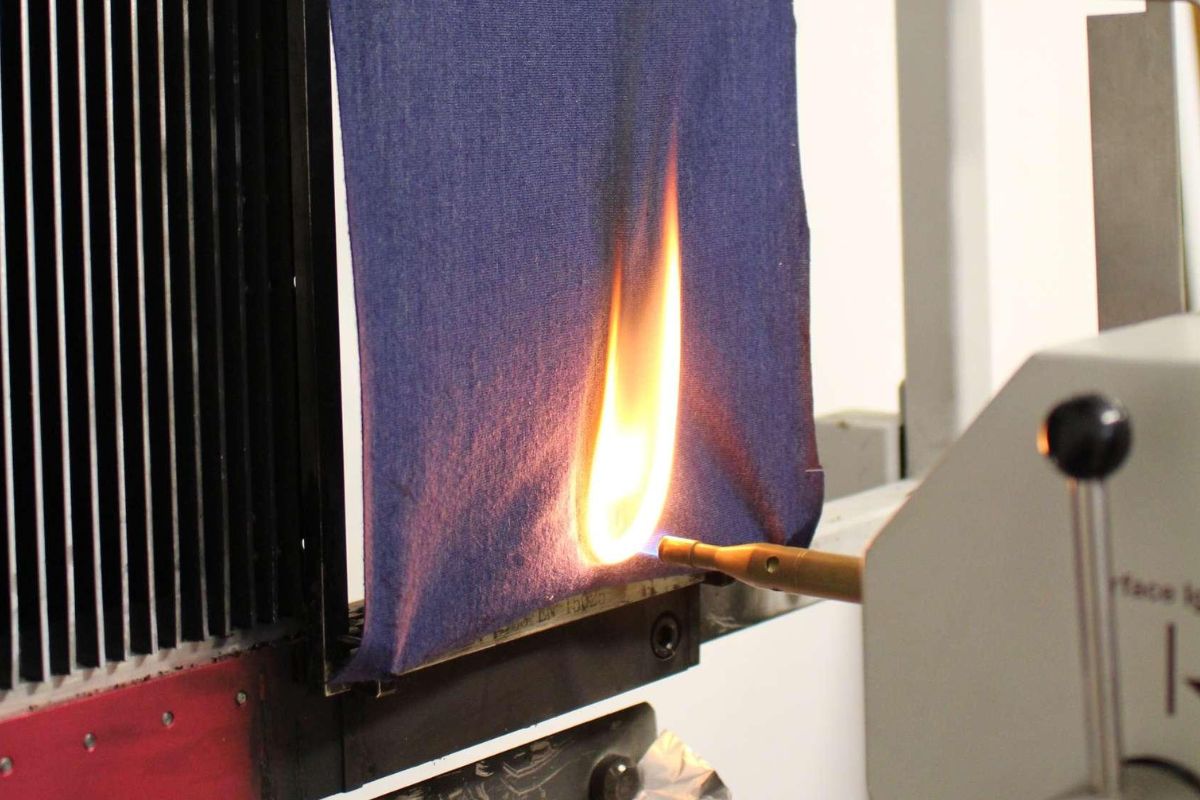
    Two of the buying guides on page one tell readers to hold a lighter to a fiber and report that pure wool "will not light." Wool is harder to ignite than most synthetics, which is a large part of why it is used in carpets. It is not fireproof. A buyer who expects nothing to happen, sees a flame, and concludes "fake" has been misled by the advice, not by the rug.

    The burn test answers one narrow question under controlled conditions, whether a fiber is protein or plastic, and it answers none of the questions a Moroccan rug buyer actually has: age, region, hand-knotted or not, or whether the piece was chemically treated. It is also an open flame applied to a textile that may not be yours yet.

    The same applies to the color rules ("if the red is hot as a tomato it is machine dyed") and to rubbing a damp cloth on the pile. The burn test and other tests that prove less than claimed goes through each one.

    Failure three: price is evidence of nothing

    "If it seems too cheap, it is a fake" is one of the most repeated lines in this niche, and it is worth noticing who benefits from it. It is a claim made almost entirely by people quoting the higher price.

    The documented economics run the other way. AFP reporting from December 2024, carried by outlets including Business Recorder, described weavers in southern Morocco traveling to a weekly market to sell rugs to middlemen who set the prices, with a large rug going for around 250 dirhams, roughly 24 US dollars at the time of that reporting. Ijja Benchri, a sixty-year-old weaver from Taznakht quoted in that reporting, said she had no choice but to accept what intermediaries offered. A single carpet took her two to four weeks.

    So a low price somewhere in the chain is a documented fact about this trade, not proof of a counterfeit. A high price, equally, proves nothing about age or origin. Price tells you about the seller's position in the chain and very little about the object. Taznakht rugs and the cooperatives behind the name covers the organizations set up to change that.

    Failure four: "handmade" is three different products

    This is the one check on this list that you can genuinely settle yourself, in a shop, in about ten seconds, without trusting anybody.

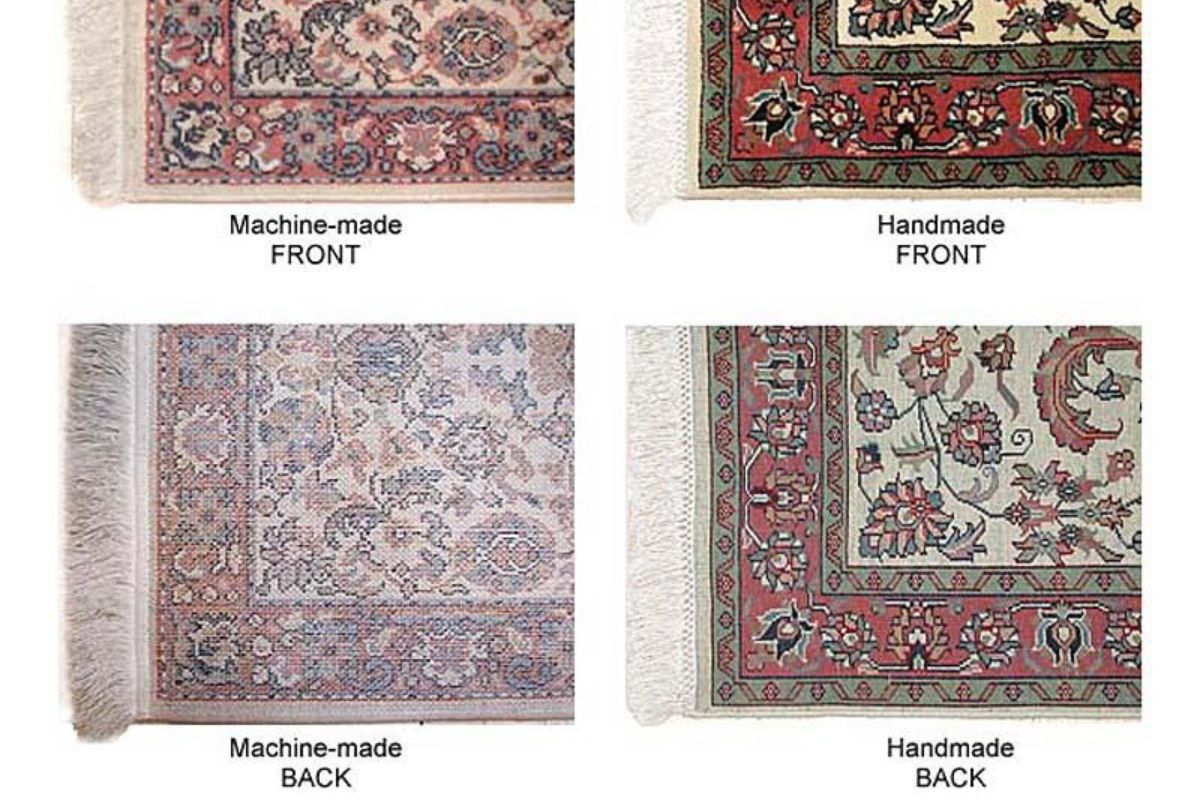
    Hand-knotted rugs are built knot by knot on a loom, and the back shows the pattern in individual tied knots with visible irregularity. Machine-made rugs have a uniform, printed-looking back, usually a serged edge, and a fringe sewn on as a separate flap. Hand-tufted rugs are the category most buyers do not know exists: they are made by hand, sold at hand-made prices, and held together by a glued canvas backing rather than by knots.

    Fold a corner over and look at where the pile meets the foundation. What the back of the rug shows explains what you are looking at in each case, and why the fringe test is less reliable than it is usually presented.

    Failure five: the number on the tag is the wrong number

    Knots per square inch is a real measurement and a legitimate one, in the tradition it comes from. It predicts how fine a pattern a weave can resolve, which is why it matters for detailed curvilinear Persian designs. Even dealer explainers on the subject concede that a higher figure does not mean a better rug.

    Moroccan pile rugs are geometric, sparse, and often deliberately open. The metric that measures pattern fineness has been imported into a category whose designs do not depend on it. When this guide looked for the source of the one Moroccan knot-count figure that circulates widely, the Beni Ourain and Beni Mrirt comparison, it found the same numbers repeated across four competing sellers with no citation behind any of them. What KPSI does and does not tell you sets out the whole case.

    Failure six: nobody mentions the weaver

    The last failure is not a trick played on the buyer. It is an omission, and it is the one that explains most of the others.

    Anou's December 2020 post describes artisans earning as little as five dirham a day for the weaving, and receiving nothing at all for the chemical processing afterward that raises the resale price. The same post describes what that processing involves: dirt and sun, a one-to-one water and bleach solution, sulfur-heavy chemicals to speed things up, and rugs blow torched to force color fading. A follow-up post of 3 September 2021 adds that chemicals of this kind have been banned by US rug-washing facilities since the 1980s after causing lung complications in workers, and that streams in the Khenifra region now run with brine and are no longer potable.

    If you want to know why a "vintage" rug can be both cheap and everywhere, that is the answer. How new rugs are made to look old covers it in full, and why a new rug smells of chemicals covers what you might notice at home.

    The rest of this cluster, in the order you will need it

    The six failures above are the shape of the problem. These pages are the detail, grouped by where you are in the process.

    Working out what you are looking at: is my Moroccan rug authentic, what the back of the rug shows, judging wool quality without a lab, natural or synthetic dye, and why bleeding proves nothing, what KPSI does and does not tell you, and the burn test and other tests that prove less than claimed.

    The age question: what "vintage" actually means on a listing and how new rugs are made to look old.

    What it should cost: what actually drives a Moroccan rug's price and why the same rug costs four times more in a showroom.

    Buying in person: buying a rug in the Marrakech souk and negotiating without insulting anyone.

    Buying remotely: buying a Moroccan rug online and reading an Etsy or 1stDibs listing properly.

    Getting it home: shipping a rug home from Morocco, customs, duty and declared value, and antique rugs and Morocco's export permit rule.

    When it goes wrong: rug scams: substitution, fake shipping and the "avoid customs" offer and returns and recourse.

    Before you talk to anybody: twelve questions worth asking any rug seller.

    And once it is yours: how to care for a Moroccan wool rug, because a rug you chose well and then wash with the wrong product is a rug you have damaged yourself.

    What to do instead

    • Ask what the seller can prove, not what they believe. Age, tribe and region are the claims most confidently asserted and least often documented. A seller who says "I do not know how old this is" is being straight with you.
    • Settle the construction question yourself. It is the one answer you do not need anybody's word for.
    • Treat the look as a look. If you like a faded rug, buy the faded rug. Just do not pay an age premium for it.
    • Ask where it was made and who made it. Named regions and named cooperatives exist. Vagueness is a signal.
    • Get the claims in writing before you pay, especially if you are buying online or abroad.
    • Buy for the room, not for the story. The story is the part most likely to be untrue.

    What this site will not do for you

    This guide cannot authenticate your rug. Nobody can do that from a photograph, a description, or a web page, and this site has handled none of the pieces it writes about. It also will not value your rug or tell you what to pay.

    For a specific object, you need someone with it in their hands and no stake in the sale: an independent appraiser, a textile conservator, or a rug-cleaning professional who does not sell rugs. What this site can do is tell you which questions are answerable, which are not, and who is selling you confidence they do not have.

    Start with the complete guide to Moroccan rug styles if you are still working out what you are looking at, or how to identify a Moroccan rug from a photo if you have a picture and a question.

    FAQ

    What is the single biggest mistake buyers make?
    Paying an age premium for a look that was manufactured. "Vintage" in the Moroccan market usually describes faded color rather than documented age, and the fading is often the result of chemical washing rather than time.

    Is a cheap Moroccan rug automatically fake?
    No. AFP's December 2024 reporting described weavers selling large rugs to middlemen for around 250 dirhams. Low prices exist in this trade as a documented fact about how the chain works, so price alone proves nothing in either direction.

    Can I test a rug myself in a shop?
    You can settle the construction question by looking at the back and the point where the pile meets the foundation. You cannot settle age, region or tribe that way, and no test you can perform in a shop will settle them either.

    Should I buy from a cooperative instead of a dealer?
    Named cooperatives exist and publish what they pay their members, which is more than most of the chain does. This site does not recommend or rank individual sellers, and has no affiliate relationship with any of them.

    Does this site sell rugs or earn commission on them?
    No. It carries no affiliate links and sells nothing, which is the reason it can say the things on this page.

  • Is My Moroccan Rug Authentic? The Four Questions

    Is My Moroccan Rug Authentic? The Four Questions

    "Authentic" is doing the work of four different questions, and they do not have the same answer. Is it wool or synthetic? Is it hand-knotted, hand-tufted or machine-made? Was it made in Morocco? And is it as old, and from the tribe or region, the seller says? The second question you can settle yourself, reliably, by looking at the back. The first you can partly settle. The third is a documentation question. The fourth, the one buyers care about most, generally cannot be answered by eye at all, and this guide will not pretend otherwise.

    Why the word needs splitting up

    Every result on page one for this question in August 2026 was a rug seller, and they mostly answer it as one question with a checklist: irregular weave, knots visible on the back, wool feel, a label saying Morocco. Run that checklist and you get a yes or a no, which feels satisfying and is misleading.

    The trouble is that a rug can pass every item on that list and still not be what the listing says. A hand-knotted wool rug woven in Morocco last year is authentic by all four checks except the one that carried the price, which was the claim that it is a fifty-year-old Beni Ourain. Splitting the word into its four questions is the only way to see which one you are actually asking.

    Question one: is it wool?

    Real wool has a particular feel: warm, slightly uneven, with a springiness that comes back when you press it. Synthetic pile tends to feel more uniform and can have a faint slickness. Wool also holds dirt differently and does not shine under direct light the way many synthetics do.

    None of that is proof. Good synthetics imitate wool well, and blends exist specifically to complicate this. The test most often recommended, holding a flame to a fiber, is less conclusive than its reputation suggests and is covered separately in the burn test and other tests that prove less than claimed.

    If the fiber content genuinely matters to your purchase, the honest answer is that a laboratory fiber test settles it and nothing you do in a shop does. That is a small cost against a four-figure rug, and no seller will object to it if their description is accurate.

    Question two: how was it made? This is the reliable one

    This is the one check on this site that does not depend on trusting anybody, and it is worth learning properly.

    Turn the rug over. A hand-knotted rug shows its pattern on the back in individual knots, with visible small irregularities in the rows, because a person tied every one of them. A machine-made rug shows a flat, uniform, almost printed-looking back, usually with a serged edge and a fringe attached as a separate stitched flap. A hand-tufted rug shows neither: it shows a canvas or scrim backing glued over the whole underside, hiding the structure entirely.

    That third category is the one that catches people. Hand-tufted rugs are genuinely made by hand, sold at prices close to hand-knotted, and are a different product with a different lifespan. What the back of the rug shows walks through each of the three.

    Question three: was it made in Morocco?

    This is mostly a paperwork question, and it is weaker than sellers present it.

    A label saying "Made in Morocco" is a claim printed by whoever printed the label. Several seller pages found in this research treat the label as decisive, and one asserts that rugs certified by the Moroccan government must be handmade, knotted and one hundred percent sheep's wool. That page names no certification scheme, no issuing authority and no document, and this guide could not verify it. Treat it as a seller's claim rather than a fact about Moroccan law.

    What is more useful than a label is specificity. A seller who can name the region, the town or the cooperative, and who answers follow-up questions consistently, is telling you something. A seller whose provenance story is a general appeal to tribal tradition is telling you very little. Named cooperatives with public accounts of their work do exist, and Taznakht rugs and the cooperatives behind the name is an example of what documented provenance actually looks like.

    Question four: is it as old, and as tribal, as the listing says?

    This is where the money is and where the evidence runs out.

    Age cannot be read off a rug by eye. Fading, softness, and wear all look like time, and all of them can be produced deliberately in weeks. The processes are documented by the Anou Cooperative, a weaver-owned organization in Morocco, which described in a post of 14 December 2020 how new rugs are covered in dirt and walked on, laid in the sun, washed in a one-to-one water and bleach solution, and in some cases blow torched to force color fading. Their summary of the market was blunt: "Moroccan vintage rugs don't really exist." How new rugs are made to look old covers that account in detail.

    Tribal attribution has a related problem. Style names in this trade describe recognizable weaving conventions from real places, but a confident claim that one specific rug was woven by one specific group, at one specific time, is normally an inference from the rug's appearance rather than a documented fact about its history. When a seller states it as certainty, that certainty is theirs, not the evidence's.

    So the honest position: a seller can prove very little about age or origin, and the fact that they sound sure is not evidence.

    What a certificate of authenticity is worth

    It is worth exactly the reputation of whoever signed it, and no more. There is no independent registry of Moroccan rugs, no serial numbering, and no third-party body that verifies a shop's claim about a piece it is selling.

    A certificate issued by the seller certifies that the seller says so. That is not worthless, because a written claim is easier to act on than a verbal one if the rug turns out to be misdescribed, but it is not verification. Read it as a warranty rather than as evidence, and check what it actually commits the seller to.

    What this site cannot do, and who can

    Atlas Rug Guide does not authenticate individual rugs. It cannot, and it will not try. This site has handled none of the pieces it writes about, and a photograph cannot carry the information the question needs. Anybody offering to authenticate your rug from an image is selling you confidence rather than a finding.

    For a specific object there are people who can help, and the useful ones have no stake in the sale: an independent appraiser, a textile conservator, a museum textile department for a genuinely old piece, or a rug-cleaning professional who does not deal in rugs. If you are still working out what style you are looking at rather than whether it is genuine, start with how to identify a Moroccan rug from a photo or the complete guide to Moroccan rug styles, and see how to buy a Moroccan rug without getting taken for the wider set of risks.

    FAQ

    Can you tell me if my rug is authentic from a photo?
    No. This site does not authenticate individual rugs and no photograph carries enough information to do it. For a specific piece, use an independent appraiser or a textile conservator who does not sell rugs.

    Does a "Made in Morocco" label prove a rug is authentic?
    It proves a label was printed. It is worth more when the seller can also name a region, town or cooperative and answer follow-up questions consistently.

    What is the most reliable check I can do myself?
    Look at the back. Hand-knotted shows individual knots and small irregularities, machine-made looks uniform with a stitched-on fringe, and hand-tufted has a glued canvas backing covering the structure.

    Is a certificate of authenticity meaningful?
    It is a written claim by the seller, not independent verification. There is no third-party registry for Moroccan rugs. Treat it as a warranty and read what it commits them to.

    Can anyone prove how old a Moroccan rug is?
    Rarely, and not by eye. Fading and wear can be produced deliberately in weeks, and the processes are documented. Age claims in this market should be treated as claims unless there is real provenance behind them.

  • Handmade vs Machine-Made Rug: Read the Back

    Handmade vs Machine-Made Rug: Read the Back

    Turn the rug over and you are looking for one thing: whether you can see the structure. A hand-knotted rug shows its pattern on the back in individual tied knots with small irregularities in the rows. A machine-made rug shows a flat, uniform, printed-looking back, usually with a serged edge and a fringe stitched on as a separate flap. A hand-tufted rug shows neither, because a glued canvas backing covers the underside completely. Three categories, not two, and the third is the one most buyers have never heard of.

    Why this is the one check worth learning

    Almost every question about a Moroccan rug ends in somebody's word against nobody's evidence. Age, tribe, region, wool grade: all of them depend on a seller's claim or on an inference from appearance.

    Construction is different. It is a physical fact about the object, it is visible, and it does not require trusting the person selling it. That makes it the highest-value check a buyer can learn, and it takes about ten seconds once you know what you are looking at.

    It is also the check with the clearest financial consequence. The gap between a hand-knotted rug and a hand-tufted one is substantial, both in what it cost to make and in how long it will last, and the two are routinely sold in the same shops to the same buyers.

    Hand-knotted: the structure is the rug

    In a hand-knotted rug, the pile is tied onto the warp threads knot by knot. There is no adhesive anywhere. The knots are the thing holding the rug together, which is why the back of a hand-knotted rug is a legible object rather than a covering.

    What you should see: the design repeated on the back, slightly softer and less crisp than on the front, made up of individual points of color. Look closely and each of those points is a knot. Look along a row and you will see it wander a little, because the rows were tied by a person over weeks or months and no person is a machine.

    That irregularity is the signal. Not damage, not sloppiness, just the evidence of hand work. In Moroccan pile rugs the knotting is often relatively open and the pile relatively high, which can make the back look sparse compared with a fine Persian weave. That is normal for the category and not a defect. What KPSI does and does not tell you explains why density means something different here.

    Hand-tufted: the category most buyers do not know exists

    A hand-tufted rug is made by punching yarn through a fabric backing with a tufting gun. It is hand work, genuinely, and it is skilled. But the loops are not knotted to anything. They are held in place by a layer of latex adhesive spread across the back, and then a second canvas or scrim backing is glued over that to hide it.

    So when you turn a hand-tufted rug over, you do not see the design at all. You see plain cloth. That is the tell, and it is unmistakable once you know to look for it.

    Two consequences worth knowing. First, the adhesive has a working life, and when it degrades the rug sheds and the backing can separate, which is not something a hand-knotted rug does. Second, that adhesive is why some new rugs smell strongly of rubber or glue. If a rug you were told was hand-knotted arrives smelling of chemicals, the smell itself is telling you something about the construction, which why a new rug smells of chemicals goes into.

    Machine-made: uniformity is the tell

    A power loom produces a back that looks manufactured, because it is. The pattern is there, but it is perfectly regular. The rows do not wander. The color changes are exact. There is often a visible grid or a stiff, tight weave structure, and the edges are usually serged, meaning wrapped in yarn by a machine rather than finished by hand.

    The other reliable sign is the underside feel: machine-made backs are frequently stiffer and flatter, sometimes with a light backing applied for stability.

    None of this makes a machine-made rug a bad object. It is a legitimate product with an honest use, and if a consistent size, a lower price, or a rug you are not afraid of matters more to you than hand work, it is a sensible purchase. The problem is only when it is sold as something else. This site covers hand-knotted and handwoven traditions, so a machine-made "Moroccan-style" rug is a design reference rather than a piece from those traditions.

    The fringe test, and where it fails

    The most repeated advice on this topic is to check the fringe: on a hand-knotted rug the fringe is the warp threads of the foundation, emerging from the body of the rug, while on a machine-made rug it is sewn on afterward.

    That is broadly true and it is a useful first look. Tug gently at a few strands. Fringe that is part of the structure resists as part of the whole rug. Fringe stitched onto a flap of backing moves as a separate piece, and you can often see the seam where it is attached.

    But it fails in three ways. Fringes get worn and replaced, so a genuine old rug can end up with a sewn-on replacement fringe. Some hand-knotted rugs are finished with the warps turned under rather than left as fringe. And many Moroccan flatweaves finish differently again, with braided or knotted ends that are part of the weaving but do not look like classic Persian fringe. Flatweave or pile: which Moroccan style suits your room covers those construction differences.

    So use the fringe as a hint and the back as the answer.

    What this check settles, and what it does not

    It settles construction. That is a real thing to have settled, and it is the fact most directly tied to what the rug cost to make and how long it will last.

    It does not tell you where the rug was made, how old it is, whether the wool is good, whether the dyes are natural, or whether the piece was chemically treated to look aged. A rug can be unambiguously hand-knotted and still be six months old and sold as vintage. Those questions are covered in is my Moroccan rug authentic and in the wider guide to buying a Moroccan rug.

    One practical note for buying online: ask for a photograph of the back. A seller with a hand-knotted rug has no reason to refuse, and a listing with twelve styled photographs and none of the underside is worth a question.

    FAQ

    What is the difference between hand-knotted and hand-tufted?
    Hand-knotted pile is tied onto the foundation knot by knot and needs no adhesive. Hand-tufted pile is punched through a backing and held in place with latex glue, then covered with a second backing. The back tells you which: knots and pattern for one, plain glued cloth for the other.

    Is a hand-tufted rug a fake?
    No. It is a genuine handmade product, just a different and less durable one than hand-knotted, with a different cost of production. The problem is when it is described or priced as hand-knotted.

    Why does the back of my Moroccan rug look sparse compared to a Persian rug?
    Moroccan pile rugs are often more openly knotted with a higher pile, and their designs are geometric rather than finely curvilinear. Lower knot density is normal for the category rather than a sign of poor quality.

    Can I check the fringe instead of the back?
    Use it as a first hint. Fringes get replaced, some hand-knotted rugs have no fringe at all, and Moroccan flatweaves finish their ends differently. The back is the reliable answer.

    Does this check tell me if my rug is old?
    No. Construction and age are separate questions, and nothing about the back reveals when the rug was made.

  • The Rug Burn Test: What It Proves, and Doesn’t

    The Rug Burn Test: What It Proves, and Doesn’t

    The burn test can tell you, imperfectly and under controlled conditions, whether a fiber is protein or plastic. That is the whole of what it does. It cannot tell you how old a rug is, where it was made, who made it, whether it was hand-knotted, or whether it was chemically treated to look aged, which are the questions Moroccan rug buyers actually have. This guide does not recommend running it, and the most repeated version of the advice, that pure wool "will not light," is wrong in a way that costs buyers money.

    Where the claim comes from and why it matters

    Two of the buying guides on page one for Moroccan rug advice in August 2026 tell readers to take a lighter to a fiber and report that the flame will not light pure wool but will melt a synthetic. One of them is a travel-tour operator's blog, one is a well-known Morocco travel site. Neither cites anything.

    Wool is comparatively flame resistant. That is a real property and a large part of why it has been used in carpets for centuries. There is a body of textile literature on the burning behavior of wool carpets, including work indexed under the title "Burning Behavior of Carpets: The Advantages of Wool and Flame-Resistant Wool." Comparatively flame resistant is not the same statement as fireproof.

    The practical consequence is specific and predictable. A buyer holds a flame to a fiber from a genuine wool rug, expecting nothing to happen, sees it catch and burn, and concludes the rug is synthetic. The advice has produced a false negative on a real rug. Someone acting on it walks away from a genuine piece or, worse, uses it to argue the price down on a seller who was telling the truth.

    What the test actually shows, at best

    In a controlled setting, protein fibers and plastics do behave differently. Protein fibers such as wool are harder to ignite, tend to burn slowly and self-extinguish, smell like burning hair, and leave a brittle ash that crushes to powder. Synthetics such as polypropylene and nylon ignite more readily, burn faster, smell acrid or plastic-like, and leave a hard melted bead.

    That is a genuine difference and the reason the test exists at all. Note what it is a test of: fiber chemistry. It is a materials identification, not an authentication.

    Even at that job it has known limits, and even sources that recommend it concede them. Blended fibers have to be separated before testing, because a wool and synthetic blend gives a mixed and unreadable result. And a single strand from one corner tells you about that strand, not about a rug that may use different fibers in pile, warp and weft.

    Why not to do it

    Three reasons, in order of how much they should matter to you.

    It is not your rug. If you are testing in a shop, you are taking a lighter to someone else's property, and taking a strand to test means damaging it first. A seller who agrees is being accommodating, not proving anything.

    It is an open flame on a textile. You may be holding a four-figure wool object in an enclosed retail space with other flammable stock. This site does not publish a protocol for doing this and will not, because there is no version of the instruction that is responsible to give.

    It settles a question you can settle better another way. If fiber content genuinely matters to your decision, a laboratory fiber test gives a definitive answer on the whole rug without burning anything. Against the cost of the rug it is a small expense, and any seller confident in their description will agree to it.

    The other tests sold as proof

    The burn test is not alone. Three more circulate widely and each carries less weight than its reputation.

    The color test. One page-one source advises avoiding "hot" colors, on the theory that a red "hot as a tomato" is machine dyed while a red "as a tulip" is vegetable dyed. Dye chemistry does not divide that neatly, natural dyes produce a wide range of intensities depending on the plant, mordant and process, and a judgment made by eye about a hue is not evidence of anything. Moroccan rug colors: where the palette comes from covers what can honestly be said about the palette.

    The wet cloth rub. Rubbing a damp white cloth on the pile to see whether color transfers is often presented as proof of synthetic dye. It is not. Natural dyes can and do bleed, and a color run is not evidence of a fake. It is covered properly in natural or synthetic dye: how to check, and why bleeding proves nothing.

    The price test. "Too cheap means fake" is the most repeated claim in the niche and the least supported. It is examined in how to buy a Moroccan rug without getting taken, alongside the documented economics that contradict it.

    What these four have in common is that they are quick, they feel like expertise, and they produce a confident answer to a question they do not address.

    What to do instead

    Spend your effort on the checks that actually resolve something.

    • Look at the back. Construction is the one authenticity question you can settle yourself with certainty, and it has direct financial consequences. What the back of the rug shows covers it.
    • Ask what the seller can document, rather than what they assert. Region, town and cooperative are answerable. Tribe and decade usually are not.
    • Treat the aged look as a look. Fading can be manufactured in weeks by processes that are documented, which how new rugs are made to look old sets out.
    • Pay for a fiber test if fiber matters. It is the only version of the burn test question that gives a real answer.
    • Get claims in writing before paying. A written description is something you can act on later. A shop-floor flame is not.

    If you want the full set of questions hiding inside the word, is my Moroccan rug authentic breaks it into the four that have different answers.

    FAQ

    Does pure wool burn?
    Yes. Wool is harder to ignite than most synthetics, tends to burn slowly and self-extinguish, and smells of burnt hair. It is not fireproof, and advice that says a flame "will not light" wool is wrong.

    Should I do a burn test on a rug in a shop?
    No. It damages property that is not yours, it is an open flame on a textile in an enclosed space, and it answers only a fiber question that a laboratory test answers properly.

    What does the burn test actually prove?
    At best, whether a single strand is a protein fiber or a plastic one. It proves nothing about age, origin, tribe, construction or chemical treatment.

    How can I be sure my rug is wool?
    A laboratory fiber test is the definitive answer. Feel and appearance are suggestive but not conclusive, and blends are specifically designed to be hard to judge by hand.

    Does color bleeding mean the dyes are synthetic?
    No. Natural dyes bleed too, so a color run is not evidence of a fake. This is one of the most common false claims in the niche and it has its own page here.

  • What “Vintage” Means on a Moroccan Rug Listing

    What “Vintage” Means on a Moroccan Rug Listing

    In the rug trade generally, "vintage" conventionally describes a piece roughly thirty to eighty years old, with "semi-antique" and "antique" sitting above it. That is a trade convention, not a regulated definition, and no authority enforces it. In the Moroccan market specifically the word has largely detached from age altogether and now describes an appearance: faded, muted, softened color. The Anou Cooperative, a weaver-owned organization in Morocco, stated the position directly in a post of 14 December 2020: "Moroccan vintage rugs don't really exist," at the volume and prices the online market offers.

    Two answers, and page one only gives you the first

    Search this question and you get a tidy vocabulary lesson. Dealer sites and rug lexicons, including Nazmiyal, Jozan's rug lexicon, Matt Camron, Rug & Kilim and others, broadly agree on a set of bands, and several are honest enough to add that the lines are widely used but not perfectly standardized.

    That answer is genuinely useful. If you are talking to a dealer, it tells you what they probably mean.

    What it does not tell you is whether the word on the listing in front of you has any relationship to the age of the object. In this particular category, very often it does not. Both answers are true at once, and you need both.

    What the trade conventionally means

    The bands you will see quoted, and the sources for them are rug dealers and trade lexicons rather than any standards body:

    • Vintage: roughly thirty to eighty years old. The term is a relatively recent addition, covering pieces that are neither new nor antique.
    • Semi-antique: roughly fifty to seventy-five years old, sometimes described as the sweet spot, with some patina but better condition than a true antique.
    • Antique: at least eighty years old by most accounts, with a hundred years often treated as the threshold for a classic antique.

    The bands overlap, different dealers draw them differently, and a piece one seller calls semi-antique another will call vintage. That inconsistency is not fraud. It is the ordinary looseness of trade vocabulary.

    Why none of it is enforceable

    There is no licensing body for rug dealers, no registry of Moroccan rugs, and no independent verification step anywhere in the chain between the loom and the listing. The words are marketing categories that the trade has settled into by habit.

    Customs authorities and auction houses do use age thresholds for their own purposes, and those have real consequences, but they apply to declarations made to those institutions rather than to what a shop writes on a tag.

    The practical upshot: "vintage" on a listing is a claim by the seller, at the same evidential level as "beautiful." If it is carrying a price premium, you are paying for an unverified assertion unless something else backs it up.

    The Moroccan exception: the word came loose from age

    Here is the part the vocabulary guides do not cover, and it is specific to this market.

    The look associated with age in Moroccan rugs, muted color and softened contrast, can be produced deliberately in a matter of weeks. Anou's December 2020 post describes the methods used by the middlemen who supply the online market: rugs covered in dirt and walked on, laid out in the sun for extended periods, washed in a one-to-one water and bleach solution, sometimes treated with sulfur-heavy chemicals to speed the process, and in some cases blow torched to force fading. A follow-up post of 3 September 2021 adds that chemicals of this kind were banned by US rug washing facilities in the 1980s after causing lung complications in workers.

    The market logic follows. Genuinely pre-2000 Moroccan pieces are collector items and are priced accordingly, so a large, cheap, readily available supply of "vintage" rugs on Etsy and Instagram cannot mostly be what the word implies. How new rugs are made to look old covers Anou's account in full.

    Written in 2026, this describes the market as it stands now. It is the kind of thing that changes, and this page should be re-checked rather than assumed permanent.

    What a seller can actually prove about age

    Very little, and it is worth knowing the difference between proof and confidence.

    Things that are not evidence of age: faded color, softness, uneven wear, a worn patch, the presence of natural dyes, a seller's certainty, or a certificate issued by the seller. Every one of those can be produced or asserted.

    Things that count for something: a documented chain of ownership, a photograph of the rug in a dated setting, an auction or estate record, a purchase receipt from decades ago, or provenance from a named collection. These are rare in this market, which is precisely why they matter when they exist.

    What an expert can add: a textile conservator or independent appraiser examining the piece in person can assess construction, dye chemistry and wear in ways that narrow the range. That is a judgment by a qualified person, not a date stamp, and it costs money. It is still worth more than anything you or this site can conclude from an image.

    What to ask before you pay a vintage premium

    • "How old do you believe this is, and how do you know?" The second half is the question. "It came from a dealer in Marrakech who said so" is a real answer, and it tells you the claim is second-hand.
    • "Has this rug been washed or treated?" Chemical washing is standard in the trade and a straight seller will say so.
    • "Will you put the age claim in writing on the invoice?" A seller confident in a claim will. One who will not has told you something useful without saying it.
    • "What is your returns policy if the description is wrong?" More useful than the age claim itself, especially buying online or abroad.
    • Decide whether you actually want age. If you like the faded look, buy the faded rug and pay for the look. The premium is the only part of this that requires the word to be true.

    For the wider set of risks see how to buy a Moroccan rug without getting taken, and for what "authentic" means once age is set aside, is my Moroccan rug authentic. If it is the palette you are drawn to, where the Moroccan rug palette comes from is the honest version of that story, and what "Berber rug" actually means covers another word doing more work than it should.

    FAQ

    How old does a rug have to be to be called vintage?
    By trade convention, roughly thirty to eighty years, with antique starting around eighty to a hundred. The convention comes from dealers and rug lexicons and is not enforced by any authority.

    Are most "vintage" Moroccan rugs actually old?
    Often not. The Anou Cooperative, a weaver-owned organization in Morocco, wrote in December 2020 that Moroccan vintage rugs "don't really exist" at the volume and prices the online market offers, and described the processes used to age new rugs artificially.

    Is a chemically washed rug a bad rug?
    Not necessarily, and washing is standard across much of the trade. The problem is paying an age premium for the result of a process, and the environmental and labor costs documented alongside it.

    What is the difference between vintage and semi-antique?
    Semi-antique is usually given as roughly fifty to seventy-five years and vintage as thirty to eighty, so the bands overlap. Different dealers draw the line differently and neither term is standardized.

    How can I verify a rug's age before buying?
    Ask for documentation rather than an opinion: ownership history, dated photographs, auction or estate records. Failing that, an independent appraiser examining the piece in person can narrow the range. Nothing else in this market verifies age.