Tag: rug pricing

  • How to Buy a Moroccan Rug Without Getting Taken

    How to Buy a Moroccan Rug Without Getting Taken

    The risks in buying a Moroccan rug are not really about taste. They are about information. Six things go wrong repeatedly: the word "vintage" usually does not mean old, the authenticity tests you have been told to run do not prove what they claim, price is evidence of nothing in either direction, "handmade" covers three different products at three different costs, the knot count on the tag is the wrong metric for this category, and nobody in the transaction tells you what the weaver was paid. This guide covers each one.

    Why this site can say this and a rug shop cannot

    Atlas Rug Guide sells no rugs. That is the only reason this page exists, because almost every other page answering this question belongs to someone with inventory. On the searches run for this guide in August 2026, page one for buying advice was made up of rug sellers and travel-affiliate blogs almost end to end.

    A seller can be honest and many are. But there are things a seller structurally cannot tell you, because saying them costs a sale: that the faded look you are paying a premium for was probably manufactured, that the low price you were warned about is what the weaver actually received, or that the test you are performing on their shop floor settles nothing. This guide has nothing to lose by saying all three.

    It also means this site has limits, and they are stated at the bottom of the page rather than buried.

    Failure one: "vintage" is not a statement about age

    In the rug trade generally, "vintage" conventionally describes something roughly thirty to eighty years old, with "antique" starting somewhere around eighty or a hundred. Dealers and rug lexicons broadly agree on that vocabulary, and several of them note it is not perfectly standardized. What none of them mention is that no authority enforces it.

    In the Moroccan market specifically, the word has come loose from age altogether and now mostly describes a look: muted, faded, softened color. The Anou Cooperative, a weaver-owned organization in Morocco, put it flatly in a blog post of 14 December 2020: "Moroccan vintage rugs don't really exist," at least not in the volume and at the prices the online market offers them. Genuinely old pieces are collector items and do not appear by the hundred on Etsy at accessible prices.

    That gap between what the word implies and what it delivers is where a lot of money goes. What "vintage" actually means on a listing works through the vocabulary and what a seller can genuinely prove.

    Failure two: the tests do not prove what they claim

    Two of the buying guides on page one tell readers to hold a lighter to a fiber and report that pure wool "will not light." Wool is harder to ignite than most synthetics, which is a large part of why it is used in carpets. It is not fireproof. A buyer who expects nothing to happen, sees a flame, and concludes "fake" has been misled by the advice, not by the rug.

    The burn test answers one narrow question under controlled conditions, whether a fiber is protein or plastic, and it answers none of the questions a Moroccan rug buyer actually has: age, region, hand-knotted or not, or whether the piece was chemically treated. It is also an open flame applied to a textile that may not be yours yet.

    The same applies to the color rules ("if the red is hot as a tomato it is machine dyed") and to rubbing a damp cloth on the pile. The burn test and other tests that prove less than claimed goes through each one.

    Failure three: price is evidence of nothing

    "If it seems too cheap, it is a fake" is one of the most repeated lines in this niche, and it is worth noticing who benefits from it. It is a claim made almost entirely by people quoting the higher price.

    The documented economics run the other way. AFP reporting from December 2024, carried by outlets including Business Recorder, described weavers in southern Morocco traveling to a weekly market to sell rugs to middlemen who set the prices, with a large rug going for around 250 dirhams, roughly 24 US dollars at the time of that reporting. Ijja Benchri, a sixty-year-old weaver from Taznakht quoted in that reporting, said she had no choice but to accept what intermediaries offered. A single carpet took her two to four weeks.

    So a low price somewhere in the chain is a documented fact about this trade, not proof of a counterfeit. A high price, equally, proves nothing about age or origin. Price tells you about the seller's position in the chain and very little about the object. Taznakht rugs and the cooperatives behind the name covers the organizations set up to change that.

    Failure four: "handmade" is three different products

    This is the one check on this list that you can genuinely settle yourself, in a shop, in about ten seconds, without trusting anybody.

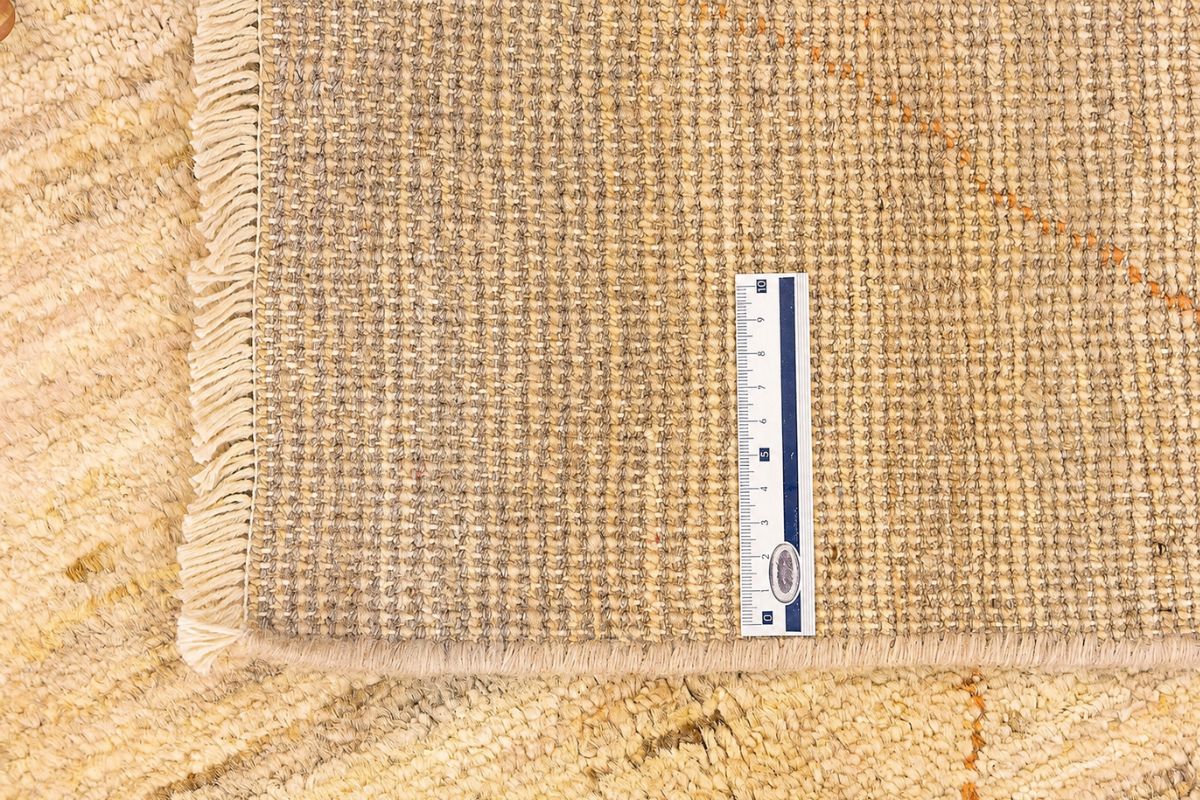
    Hand-knotted rugs are built knot by knot on a loom, and the back shows the pattern in individual tied knots with visible irregularity. Machine-made rugs have a uniform, printed-looking back, usually a serged edge, and a fringe sewn on as a separate flap. Hand-tufted rugs are the category most buyers do not know exists: they are made by hand, sold at hand-made prices, and held together by a glued canvas backing rather than by knots.

    Fold a corner over and look at where the pile meets the foundation. What the back of the rug shows explains what you are looking at in each case, and why the fringe test is less reliable than it is usually presented.

    Failure five: the number on the tag is the wrong number

    Knots per square inch is a real measurement and a legitimate one, in the tradition it comes from. It predicts how fine a pattern a weave can resolve, which is why it matters for detailed curvilinear Persian designs. Even dealer explainers on the subject concede that a higher figure does not mean a better rug.

    Moroccan pile rugs are geometric, sparse, and often deliberately open. The metric that measures pattern fineness has been imported into a category whose designs do not depend on it. When this guide looked for the source of the one Moroccan knot-count figure that circulates widely, the Beni Ourain and Beni Mrirt comparison, it found the same numbers repeated across four competing sellers with no citation behind any of them. What KPSI does and does not tell you sets out the whole case.

    Failure six: nobody mentions the weaver

    The last failure is not a trick played on the buyer. It is an omission, and it is the one that explains most of the others.

    Anou's December 2020 post describes artisans earning as little as five dirham a day for the weaving, and receiving nothing at all for the chemical processing afterward that raises the resale price. The same post describes what that processing involves: dirt and sun, a one-to-one water and bleach solution, sulfur-heavy chemicals to speed things up, and rugs blow torched to force color fading. A follow-up post of 3 September 2021 adds that chemicals of this kind have been banned by US rug-washing facilities since the 1980s after causing lung complications in workers, and that streams in the Khenifra region now run with brine and are no longer potable.

    If you want to know why a "vintage" rug can be both cheap and everywhere, that is the answer. How new rugs are made to look old covers it in full, and why a new rug smells of chemicals covers what you might notice at home.

    The rest of this cluster, in the order you will need it

    The six failures above are the shape of the problem. These pages are the detail, grouped by where you are in the process.

    Working out what you are looking at: is my Moroccan rug authentic, what the back of the rug shows, judging wool quality without a lab, natural or synthetic dye, and why bleeding proves nothing, what KPSI does and does not tell you, and the burn test and other tests that prove less than claimed.

    The age question: what "vintage" actually means on a listing and how new rugs are made to look old.

    What it should cost: what actually drives a Moroccan rug's price and why the same rug costs four times more in a showroom.

    Buying in person: buying a rug in the Marrakech souk and negotiating without insulting anyone.

    Buying remotely: buying a Moroccan rug online and reading an Etsy or 1stDibs listing properly.

    Getting it home: shipping a rug home from Morocco, customs, duty and declared value, and antique rugs and Morocco's export permit rule.

    When it goes wrong: rug scams: substitution, fake shipping and the "avoid customs" offer and returns and recourse.

    Before you talk to anybody: twelve questions worth asking any rug seller.

    And once it is yours: how to care for a Moroccan wool rug, because a rug you chose well and then wash with the wrong product is a rug you have damaged yourself.

    What to do instead

    • Ask what the seller can prove, not what they believe. Age, tribe and region are the claims most confidently asserted and least often documented. A seller who says "I do not know how old this is" is being straight with you.
    • Settle the construction question yourself. It is the one answer you do not need anybody's word for.
    • Treat the look as a look. If you like a faded rug, buy the faded rug. Just do not pay an age premium for it.
    • Ask where it was made and who made it. Named regions and named cooperatives exist. Vagueness is a signal.
    • Get the claims in writing before you pay, especially if you are buying online or abroad.
    • Buy for the room, not for the story. The story is the part most likely to be untrue.

    What this site will not do for you

    This guide cannot authenticate your rug. Nobody can do that from a photograph, a description, or a web page, and this site has handled none of the pieces it writes about. It also will not value your rug or tell you what to pay.

    For a specific object, you need someone with it in their hands and no stake in the sale: an independent appraiser, a textile conservator, or a rug-cleaning professional who does not sell rugs. What this site can do is tell you which questions are answerable, which are not, and who is selling you confidence they do not have.

    Start with the complete guide to Moroccan rug styles if you are still working out what you are looking at, or how to identify a Moroccan rug from a photo if you have a picture and a question.

    FAQ

    What is the single biggest mistake buyers make?
    Paying an age premium for a look that was manufactured. "Vintage" in the Moroccan market usually describes faded color rather than documented age, and the fading is often the result of chemical washing rather than time.

    Is a cheap Moroccan rug automatically fake?
    No. AFP's December 2024 reporting described weavers selling large rugs to middlemen for around 250 dirhams. Low prices exist in this trade as a documented fact about how the chain works, so price alone proves nothing in either direction.

    Can I test a rug myself in a shop?
    You can settle the construction question by looking at the back and the point where the pile meets the foundation. You cannot settle age, region or tribe that way, and no test you can perform in a shop will settle them either.

    Should I buy from a cooperative instead of a dealer?
    Named cooperatives exist and publish what they pay their members, which is more than most of the chain does. This site does not recommend or rank individual sellers, and has no affiliate relationship with any of them.

    Does this site sell rugs or earn commission on them?
    No. It carries no affiliate links and sells nothing, which is the reason it can say the things on this page.
  • What “Vintage” Means on a Moroccan Rug Listing

    What “Vintage” Means on a Moroccan Rug Listing

    In the rug trade generally, "vintage" conventionally describes a piece roughly thirty to eighty years old, with "semi-antique" and "antique" sitting above it. That is a trade convention, not a regulated definition, and no authority enforces it. In the Moroccan market specifically the word has largely detached from age altogether and now describes an appearance: faded, muted, softened color. The Anou Cooperative, a weaver-owned organization in Morocco, stated the position directly in a post of 14 December 2020: "Moroccan vintage rugs don't really exist," at the volume and prices the online market offers.

    Two answers, and page one only gives you the first

    Search this question and you get a tidy vocabulary lesson. Dealer sites and rug lexicons, including Nazmiyal, Jozan's rug lexicon, Matt Camron, Rug & Kilim and others, broadly agree on a set of bands, and several are honest enough to add that the lines are widely used but not perfectly standardized.

    That answer is genuinely useful. If you are talking to a dealer, it tells you what they probably mean.

    What it does not tell you is whether the word on the listing in front of you has any relationship to the age of the object. In this particular category, very often it does not. Both answers are true at once, and you need both.

    What the trade conventionally means

    The bands you will see quoted, and the sources for them are rug dealers and trade lexicons rather than any standards body:

    • Vintage: roughly thirty to eighty years old. The term is a relatively recent addition, covering pieces that are neither new nor antique.
    • Semi-antique: roughly fifty to seventy-five years old, sometimes described as the sweet spot, with some patina but better condition than a true antique.
    • Antique: at least eighty years old by most accounts, with a hundred years often treated as the threshold for a classic antique.

    The bands overlap, different dealers draw them differently, and a piece one seller calls semi-antique another will call vintage. That inconsistency is not fraud. It is the ordinary looseness of trade vocabulary.

    Why none of it is enforceable

    There is no licensing body for rug dealers, no registry of Moroccan rugs, and no independent verification step anywhere in the chain between the loom and the listing. The words are marketing categories that the trade has settled into by habit.

    Customs authorities and auction houses do use age thresholds for their own purposes, and those have real consequences, but they apply to declarations made to those institutions rather than to what a shop writes on a tag.

    The practical upshot: "vintage" on a listing is a claim by the seller, at the same evidential level as "beautiful." If it is carrying a price premium, you are paying for an unverified assertion unless something else backs it up.

    The Moroccan exception: the word came loose from age

    Here is the part the vocabulary guides do not cover, and it is specific to this market.

    The look associated with age in Moroccan rugs, muted color and softened contrast, can be produced deliberately in a matter of weeks. Anou's December 2020 post describes the methods used by the middlemen who supply the online market: rugs covered in dirt and walked on, laid out in the sun for extended periods, washed in a one-to-one water and bleach solution, sometimes treated with sulfur-heavy chemicals to speed the process, and in some cases blow torched to force fading. A follow-up post of 3 September 2021 adds that chemicals of this kind were banned by US rug washing facilities in the 1980s after causing lung complications in workers.

    The market logic follows. Genuinely pre-2000 Moroccan pieces are collector items and are priced accordingly, so a large, cheap, readily available supply of "vintage" rugs on Etsy and Instagram cannot mostly be what the word implies. How new rugs are made to look old covers Anou's account in full.

    Written in 2026, this describes the market as it stands now. It is the kind of thing that changes, and this page should be re-checked rather than assumed permanent.

    What a seller can actually prove about age

    Very little, and it is worth knowing the difference between proof and confidence.

    Things that are not evidence of age: faded color, softness, uneven wear, a worn patch, the presence of natural dyes, a seller's certainty, or a certificate issued by the seller. Every one of those can be produced or asserted.

    Things that count for something: a documented chain of ownership, a photograph of the rug in a dated setting, an auction or estate record, a purchase receipt from decades ago, or provenance from a named collection. These are rare in this market, which is precisely why they matter when they exist.

    What an expert can add: a textile conservator or independent appraiser examining the piece in person can assess construction, dye chemistry and wear in ways that narrow the range. That is a judgment by a qualified person, not a date stamp, and it costs money. It is still worth more than anything you or this site can conclude from an image.

    What to ask before you pay a vintage premium

    • "How old do you believe this is, and how do you know?" The second half is the question. "It came from a dealer in Marrakech who said so" is a real answer, and it tells you the claim is second-hand.
    • "Has this rug been washed or treated?" Chemical washing is standard in the trade and a straight seller will say so.
    • "Will you put the age claim in writing on the invoice?" A seller confident in a claim will. One who will not has told you something useful without saying it.
    • "What is your returns policy if the description is wrong?" More useful than the age claim itself, especially buying online or abroad.
    • Decide whether you actually want age. If you like the faded look, buy the faded rug and pay for the look. The premium is the only part of this that requires the word to be true.

    For the wider set of risks see how to buy a Moroccan rug without getting taken, and for what "authentic" means once age is set aside, is my Moroccan rug authentic. If it is the palette you are drawn to, where the Moroccan rug palette comes from is the honest version of that story, and what "Berber rug" actually means covers another word doing more work than it should.

    FAQ

    How old does a rug have to be to be called vintage?
    By trade convention, roughly thirty to eighty years, with antique starting around eighty to a hundred. The convention comes from dealers and rug lexicons and is not enforced by any authority.

    Are most "vintage" Moroccan rugs actually old?
    Often not. The Anou Cooperative, a weaver-owned organization in Morocco, wrote in December 2020 that Moroccan vintage rugs "don't really exist" at the volume and prices the online market offers, and described the processes used to age new rugs artificially.

    Is a chemically washed rug a bad rug?
    Not necessarily, and washing is standard across much of the trade. The problem is paying an age premium for the result of a process, and the environmental and labor costs documented alongside it.

    What is the difference between vintage and semi-antique?
    Semi-antique is usually given as roughly fifty to seventy-five years and vintage as thirty to eighty, so the bands overlap. Different dealers draw the line differently and neither term is standardized.

    How can I verify a rug's age before buying?
    Ask for documentation rather than an opinion: ownership history, dated photographs, auction or estate records. Failing that, an independent appraiser examining the piece in person can narrow the range. Nothing else in this market verifies age.

  • Knots Per Square Inch: What KPSI Really Tells You

    Knots Per Square Inch: What KPSI Really Tells You

    Knots per square inch measures one thing honestly: how fine a pattern a weave is capable of resolving. It is a real and useful metric in the tradition it comes from, where detailed curvilinear designs need a dense weave to render a curve without it turning into a staircase. It does not measure quality, it does not measure durability, and on Moroccan pile rugs, which are geometric, sparse and often deliberately open, it is close to the wrong question. This guide publishes no KPSI figure of its own for any Moroccan style, for reasons set out below.

    What the metric counts

    KPSI applies only to hand-knotted rugs. You count the knots along one inch horizontally, count the knots along one inch vertically, and multiply. A weave with ten knots across and twelve down is 120 KPSI.

    You count on the back, where the knots are visible, and on a genuine hand-knotted piece the count varies slightly from place to place because a person tied them. That variation is normal. A single measured square inch is a sample, not a specification, and where a rug is quoted at an exact figure, someone has usually rounded a range into a number that sounds like a fact.

    The convention is well documented and not controversial. It appears in the general reference literature on knot density and in the explainers published by rug dealers and manufacturers.

    What it genuinely predicts: design resolution

    Think of it as the weave's resolution. Every knot is one point of color, so the number of knots per inch sets how much detail can exist in that inch.

    This matters enormously for a certain kind of rug. Fine floral and curvilinear Persian and Oriental designs, with tendrils, arabesques and shaded medallions, need a high knot count to render those curves smoothly. At a low density the same design would come out blocky. That is the real reason high-KPSI weaving is prized in those traditions: not because the rug lasts longer, but because it can carry designs a coarser weave cannot.

    It is also a straightforward proxy for labor. More knots per inch means more knots in total, which means more weeks at the loom, which is a legitimate part of what a fine Persian rug costs.

    What it does not predict

    Three things, and the dealer explainers largely agree on this, which is worth noticing.

    Quality. A higher figure does not make a better rug and a lower figure does not make a worse one. Several dealer and manufacturer guides state this outright, including explainers published by Jaipur Rugs, TSAR Carpets and Sharafi & Co. When even the trade says the metric is misunderstood, a seller pushing a number at you is departing from their own trade's guidance.

    Durability. This is the most common misconception. Knot density enables elaborate design rather than adding strength, a point made explicitly in Landry & Arcari's guidance on knots and density. What actually governs how a rug wears is the quality of the wool, the tightness and evenness of the weave overall, the pile height, and how the rug is used and cared for.

    Wool quality or worth. A densely knotted rug in poor, brittle wool is a poor rug. Fiber quality and knot count are independent variables, and the one that matters more day to day is the wool.

    Why it barely applies to Moroccan rugs

    Here is the category error, and it is the reason this page exists.

    Moroccan pile rugs are geometric. Their design vocabulary is diamonds, lozenges, lines, crosses and open fields, and much of the visual character comes from the pile itself: high, loose, shaggy, with the wool doing the work rather than the pattern resolution. Beni Ourain in particular is defined by an open, high pile and sparse line work. Applying a fineness metric to that is like judging a wool blanket by thread count.

    The dealer literature actually concedes the principle. The point that knot density is crucial for detailed curvilinear floral patterns and much less important for geometric tribal designs appears in the trade's own explainers. Moroccan rugs are the textbook case of the second category.

    When this site searched specifically for KPSI figures or benchmark ranges for Moroccan and Beni Ourain rugs in August 2026, page one returned seller collection pages and no figures at all. There is no established Moroccan KPSI benchmark to shop against, which is a useful thing to know before somebody quotes you one.

    The one Moroccan knot-count claim in circulation

    There is an exception, and it is instructive.

    One specific pair of numbers does circulate: a knot count for Beni Ourain and a higher one for Beni Mrirt, used across seller pages to explain why Beni Mrirt costs more. This guide went looking for the source of that figure and found the same numbers repeated across four competing sellers' websites, phrased differently and landing in the same range, with no citation behind any of them. No lab measurement, no named researcher, no cooperative source. Repetition across competitors looks like corroboration and is not.

    The full working is in what the Beni Ourain and Beni Mrirt knot-count claims actually rest on, which also sets out what genuinely does differ between the two, because plenty does. The underlying idea that a denser weave takes more wool and more labor is entirely reasonable. Treating an uncited number as a specification is not.

    How to use the number if a seller quotes one

    • Ask how it was measured, and over what area. A real answer describes counting on the back and a range. An exact figure with no method behind it is marketing.
    • Ask what they think it tells you. If the answer is "it means better quality," they have said something the trade's own explainers contradict.
    • Judge the wool instead. Feel it. Springy, slightly greasy with lanolin, resilient under pressure. That tells you more about how the rug will live than any density figure.
    • Judge the weave for evenness, not fineness. Consistent tension and a rug that lies flat matter more than knots per inch.
    • Do not pay a premium for a number nobody will source. If the density claim is doing the work of justifying the price, ask what else justifies it.

    For the checks that do settle something, see what the back of the rug shows and is my Moroccan rug authentic. For the wider set of buying risks, how to buy a Moroccan rug without getting taken, and for the style itself, the Beni Ourain rug guide.

    FAQ

    What is a good KPSI for a Moroccan rug?
    There is no established benchmark, and this guide publishes no figure. Moroccan pile rugs are geometric and often deliberately openly knotted, so knot density is not the metric that describes them well.

    Does a higher knot count mean a better rug?
    No. Dealer and manufacturer explainers state this themselves. Higher density allows finer pattern detail and reflects more labor, but wool quality, weave evenness and construction matter more for how a rug performs.

    Does KPSI affect how long a rug lasts?
    Not directly. Knot density enables elaborate design rather than adding durability. Wool quality, overall weave tightness, pile height and use are what govern wear.

    How is KPSI measured?
    Count knots across one inch and down one inch on the back of the rug, then multiply. On a hand-knotted piece the count varies from place to place, so a single exact figure is a sample rather than a specification.

    Why do sellers quote knot counts for Beni Ourain and Beni Mrirt rugs?
    Because a specific pair of figures circulates widely across seller sites. This guide looked for the original source of those numbers and could not find one cited anywhere, which is covered in detail on the Beni Ourain versus Beni Mrirt page.

  • What Actually Drives a Moroccan Rug’s Price

    What Actually Drives a Moroccan Rug’s Price

    This guide will not tell you what a Moroccan rug should cost. Not a range, not a per-square-foot figure, not a number to aim for. That is a deliberate refusal rather than a gap: the price of a specific hand-woven object moves independently on construction, size, wool, dye, condition, age, which country you are standing in, and how far along the supply chain you are buying. Any single figure published here would be wrong for most readers and stale within a year. What this page gives instead is the list of drivers and a way to compare without a benchmark.

    Why a number would be worse than useless

    A published price range does one thing reliably: it anchors you. Read "a good Beni Ourain runs between X and Y" and every rug you see afterwards is judged against that, including rugs the figure was never meant to describe.

    The pages that do publish numbers are travel blogs and sellers, and across the searches run for this cluster in August 2026 they disagreed with one another by large multiples. One travel guide claims that up to 67% of travelers pay up to four times local prices, which if true says the spread inside a single market is enormous, and therefore that a single number cannot describe it.

    There is also the freshness problem. Prices in this category move with wool costs, exchange rates, shipping costs, and fashion. A figure written today and read in two years is not a slightly out-of-date fact, it is a wrong one. So this page is dated: written in 2026, and the market description in it should be re-checked rather than assumed permanent.

    Driver one: construction, and it is the biggest

    The single largest determinant is how the rug was made, because it determines how many hours went into it.

    A hand-knotted rug is tied knot by knot over weeks or months. A hand-tufted rug is punched through a backing and glued, which is far faster. A machine-made rug is produced on a power loom in a fraction of the time. These are three different products with three different labour costs, and they are routinely sold in the same shops to buyers who do not know there are three.

    If you check nothing else, check this, because it is the one thing you can verify yourself in seconds. What the back of the rug shows explains what to look for.

    Driver two: size, and why it is not a chart

    More area means more wool and more knots, so size moves price steeply rather than in a straight line. A rug twice the area is generally well more than twice the work.

    The complication specific to hand-woven pieces is that size is not a menu. A genuine hand-knotted rug is whatever the loom and the weaver produced, so you cannot order the next size up and you cannot compare against a standard-size chart the way you can with machine-made stock. Two rugs described as roughly six by nine can differ meaningfully in actual area, and therefore in what they should cost.

    Driver three: wool and dye

    Fiber quality is the driver that most affects how the rug lives with you and the one buyers assess least. Wool with lanolin still in it, hand-spun rather than machine-spun, wears better and holds colour better, and it costs more to produce. Judging wool quality without a lab covers what your hand can and cannot tell you.

    Dye is a smaller but real factor. Natural dyeing is slower and more labour-intensive than industrial dyeing, so it legitimately costs more. What it does not do is guarantee anything about durability, and a colour run does not tell you which kind you have, as natural or synthetic dye sets out.

    Driver four: condition and repair

    Wear moves price both ways and it is not simple. Genuine, even wear on an old piece is often treated as patina and does not depress the price much. Damage does: moth holes, dry rot, rewoven sections, replaced fringes, and repairs done badly enough to show.

    Two things worth knowing. First, a professional repair is expensive, so a damaged rug at a discount is often not the bargain it looks like. Second, and specific to this category, the aged appearance you may be paying for can be manufactured rather than accumulated, which is covered in how new rugs are made to look old. Paying a condition premium for engineered wear is a real risk here.

    Driver five: where in the chain you are standing

    This is the driver no seller lists, and it may be the largest after construction.

    The documented figures at the far end of the chain are low. AFP reporting of December 2024, carried by outlets including Business Recorder, described weavers in southern Morocco selling at a weekly market to middlemen who set the prices, with a large rug going for around 250 dirhams, roughly 24 US dollars at the time. Ijja Benchri, a weaver from Taznakht quoted in that reporting, said a single carpet took two to four weeks. The Anou Cooperative reported in December 2020 that some artisans earn as little as 5 dirham a day.

    Those are not retail prices and this guide is not suggesting you can buy at them. They are the starting point of a chain that adds processing, transport, export, import, storage and retail overhead before the rug reaches you, and each of those steps is a real cost as well as a margin. Why the same rug costs four times more in a showroom walks the chain properly.

    The point for pricing is simply this: the same physical object has several legitimate prices depending on where you meet it, and none of them is the true one.

    How to compare without a benchmark price

    • Compare like for like, and construction first. A hand-knotted rug and a hand-tufted rug are not two prices for one product. Establish which you are looking at before comparing anything.
    • Get at least three quotes in the same market. Three sellers in the same city, on comparable construction and size, tells you the local range far better than any published figure.
    • Normalise for area using the actual measured dimensions of each piece, not the rounded description.
    • Treat an unexplained gap as a question, not a bargain. If one rug is much cheaper, find out what is different. Usually something is.
    • Price the claims separately. Work out what you would pay if the age and provenance story turned out to be unverifiable, because it usually is. If that number is well below the asking price, you are buying a story.
    • Ask what is included. Shipping, insurance, customs handling and returns can move the real cost substantially, especially buying abroad or online.

    For the full set of failure modes see how to buy a Moroccan rug without getting taken, and for the cooperatives that publish what their weavers are paid, Taznakht rugs and the cooperatives behind the name.

    FAQ

    How much does a Moroccan rug cost?
    This guide does not publish a price or a range, because the figure moves independently on construction, size, wool, condition and where in the supply chain you buy, and any number would be stale quickly. Compare three sellers in the same market on comparable construction instead.

    What makes one Moroccan rug so much more expensive than another?
    Construction is usually the largest factor, followed by size, wool quality, condition, and where you are buying. Two rugs that look similar can be hand-knotted and hand-tufted, which is a large real difference in labour.

    Is a more expensive rug a better rug?
    Not reliably. Price reflects the seller's position in the chain and their overheads as much as the object. A high price is not evidence of age, origin or wool quality.

    Why won't this site give me a price range?
    Because a published range anchors every rug you then look at, including ones it was never meant to describe, and because it would be wrong within a year. The method matters more than the number.

    What do weavers actually get paid?
    AFP reported in December 2024 that a large rug sold for around 250 dirhams at a weekly market where middlemen set prices, and the Anou Cooperative reported in December 2020 that some artisans earn as little as 5 dirham a day. Those are the documented figures at the start of the chain.

  • Why the Same Rug Costs More in a Showroom

    Why the Same Rug Costs More in a Showroom

    Between the loom and a showroom floor a Moroccan rug typically passes through five or six sets of hands: the weaver, a middleman at a weekly market, a processing and washing operation, an exporter, an importer, and the retailer. Each takes a margin, and several of them add something real. The weaver's share is documented and it is the smallest. This guide cannot publish a verified multiplier, because none is sourced anywhere, but it can walk the chain and say honestly which steps are costs and which are simply margin.

    Why nobody explains this

    Across every search run for this cluster in August 2026, no seller page and no travel guide describes the chain. Sellers explain their own contribution, which is reasonable. Travel guides explain haggling. The only sources that describe the chain itself are non-commercial: the Anou Cooperative, a weaver-owned organization in Morocco, and AFP's reporting from December 2024.

    That is not an accident. The chain is the one fact that reframes the whole transaction, and everyone in it has a reason not to lay it out.

    Step one: the loom, and what the weaver is paid

    The documented figures are specific and low.

    AFP's December 2024 reporting, carried by outlets including Business Recorder, described women weavers in southern Morocco travelling to a weekly market to sell their rugs, often to middlemen who set the prices. A large rug sold for around 250 dirhams, roughly 24 US dollars at the time of that reporting. Ijja Benchri, a sixty-year-old weaver from Taznakht quoted in the same reporting, said a single carpet took two to four weeks depending on size, and that alone she had no choice but to accept what the intermediaries offered.

    The Anou Cooperative reported in a post of 14 December 2020 that artisans can earn as little as 5 dirham a day, which the cooperative characterised as under 5% of minimum wage.

    Weaving is skilled work by named people in named places. Taznakht rugs and the cooperatives behind the name covers a tradition where the organizations and the numbers are actually documented, and it is worth reading alongside this page.

    Step two: the weekly market and the middleman

    The intermediary is the first margin, and Anou's account adds a detail most people would not guess: the vast majority of rug middlemen in Morocco are women.

    What does a middleman genuinely add? Aggregation, mostly. A single weaver in a mountain village cannot reach an export buyer, and someone has to consolidate stock, carry the cash, absorb the risk of unsold rugs, and know who is buying. That is a real function.

    What makes it lopsided is the bargaining position rather than the function. The weaver arrives on market day with a rug that took weeks, no alternative buyer, and no ability to wait. The buyer sets the price. That is what the AFP reporting describes, and it is why cooperatives exist as a response.

    Step three: processing, which is where "vintage" is manufactured

    This step often adds more to the resale price than any other, and the weaver sees none of it.

    Anou's December 2020 post describes what happens: rugs covered in dirt and walked on, laid out in the sun, washed in a one-to-one water and bleach solution taking roughly 100 litres for a large rug and applied one to three times, sometimes with sulfur-heavy chemicals to cut processing time, and in some cases blow torched to force colour fading. Their 2021 follow-up adds that chemicals of this kind have been banned by US rug-washing facilities since the 1980s after causing lung complications in workers, and that streams in the Khenifra region now run with brine and are no longer potable.

    The economic point is stark. A new rug becomes a "vintage" rug at this step, and the price multiplies on a transformation the maker was not paid for and, on Anou's account, did not benefit from. How new rugs are made to look old covers the processes in full.

    Steps four and five: export, import, and the showroom

    These are the steps where real costs genuinely stack up, and it would be dishonest to pretend otherwise.

    Export handling, freight, insurance, customs and duty, warehousing, currency risk, and the cost of capital tied up in stock are all real. So is the retailer's side: showroom rent in an expensive city, staff, photography, returns, cleaning and repair before sale, and the rugs that never sell at all, which the ones that do have to cover.

    A dealer who brings a rug across the world, stands behind the description, accepts returns and is still there in five years is providing something a weekly market in the Atlas cannot. That is worth paying for.

    What is a real cost and what is just margin

    The line is not where a shopper might assume.

    Genuinely a cost: freight, duty, insurance, storage, cleaning and repair, retail overhead, unsold stock, returns, and the buyer's time and expertise in selecting.

    Genuinely just margin: the story. When the provenance narrative, the tribal attribution and the age claim are doing the work of justifying the price, and none of them can be documented, you are paying for confidence rather than for anything that was added to the rug. Is my Moroccan rug authentic covers how little of that is verifiable.

    The uncomfortable middle: the processing step. It genuinely costs money and labour to bleach, sun and torch a rug into looking old. Whether that counts as value added is a judgement, and this guide's view is that it is value added to the seller rather than to the object.

    This is also why the section heading of every article in this cluster keeps landing in the same place. The markup is not automatically theft, and a chain with real costs in it is not a scam. What is hard to defend is a chain that pays the maker 5 dirham a day while selling the story of her craft as the product's main value.

    Does buying direct actually help?

    Partly, and it is worth being precise about what "direct" means.

    Buying from a cooperative that publishes what it pays its members changes who captures the margin, which is a real difference. Anou's model is built on exactly that, and its 2021 post describes Cooperative Lfarah producing faded, vintage-style rugs with full-exhaust dyes and sustainable mordants, no chemicals, and roughly half the water use of standard practice.

    Buying from a seller who says "we work directly with weavers" tells you very little on its own, because the phrase is unregulated and near-universal in this trade. The question that separates them is whether the seller can say what the weaver was paid, and answer it specifically.

    This site does not rank or recommend individual sellers and has no affiliate relationship with any of them. For the drivers behind an individual rug's price see what actually drives a Moroccan rug's price, for the souk end of the chain buying a rug in the Marrakech souk, and for the full set of risks how to buy a Moroccan rug without getting taken.

    FAQ

    How much markup is there on a Moroccan rug?
    This guide publishes no multiplier because none is independently sourced. What is documented is the start of the chain: around 250 dirhams for a large rug at a weekly market according to AFP's December 2024 reporting, before processing, export, import and retail.

    Why is the weaver paid so little?
    Bargaining position rather than the value of the work. AFP's reporting describes weavers arriving at a weekly market with no alternative buyer and no ability to wait, and middlemen setting the prices. Cooperatives exist as a response to exactly that.

    Is a showroom markup a rip-off?
    Not inherently. Freight, duty, insurance, storage, repair, rent, returns and unsold stock are real costs. What is hard to defend is a price justified mainly by an age and provenance story that cannot be documented.

    Does buying from a cooperative pay the weaver more?
    Cooperatives that publish what they pay their members offer more transparency than most of the chain. This site does not recommend or rank sellers, and the useful test is whether a seller can say specifically what the weaver received.

    Who are the middlemen in the Moroccan rug trade?
    The Anou Cooperative reported in December 2020 that the vast majority of rug middlemen in Morocco are women, and that they commission rugs from weavers and handle the processing and online selling.

  • Buying a Rug in the Marrakech Souk: What to Expect

    Buying a Rug in the Marrakech Souk: What to Expect

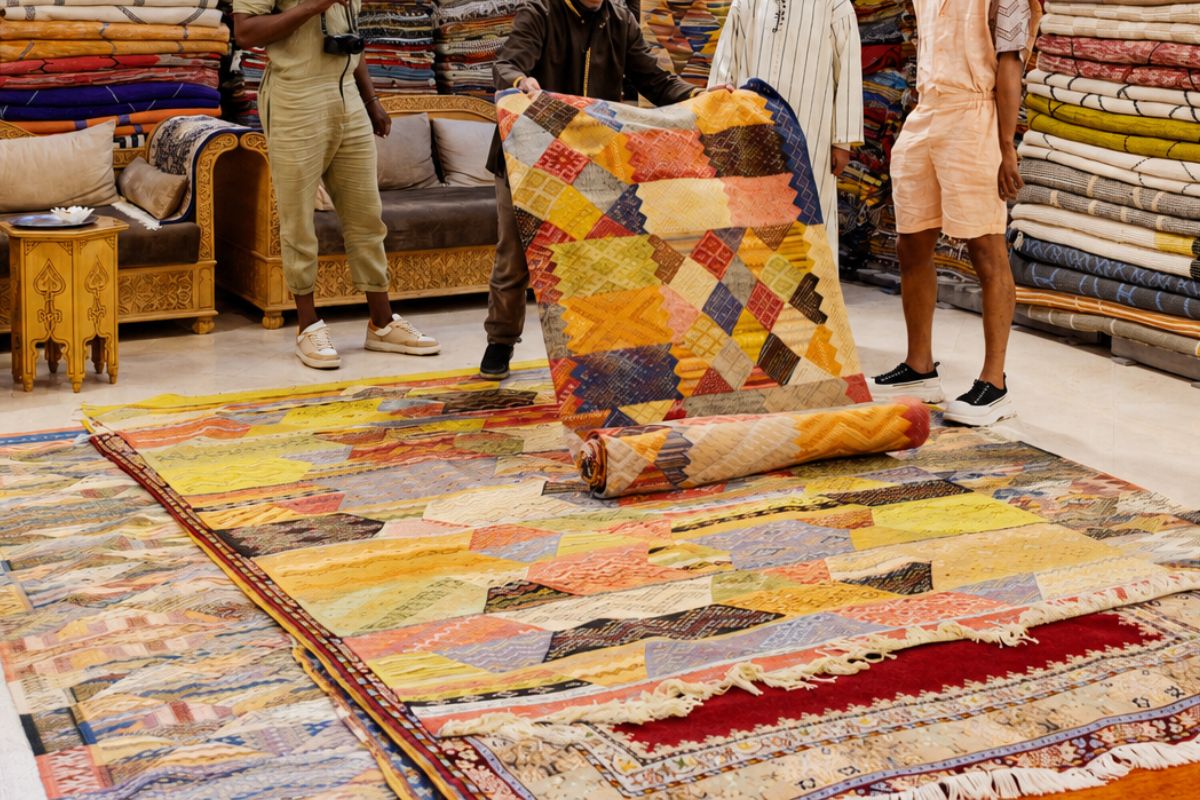
    Buying a rug in Marrakech is a long, social, unhurried transaction, not a retail purchase. Expect mint tea, a presentation in which many rugs are unrolled in front of you whether or not you asked, a confident story about each rug's origin and age that nobody can verify, and a negotiation with no fixed starting price. Expect the shipping question to arrive before you have finished deciding. The three things worth settling before you walk in are your budget, whether you will ship, and how you will pay.

    What this guide can and cannot tell you

    Atlas Rug Guide has never been in a Moroccan souk. Nobody here has bought a rug in Marrakech, handled the stock, or sat through the tea. That matters enough to say at the top rather than in a footnote, because a great deal of the content on this question is written in a first-person voice by people selling tours.

    What this page is: a compilation of what travel writers, tour operators and cooperative sources consistently report about the encounter, checked against the documented supply chain covered elsewhere on this site. Where those sources agree, that is noted. Where a piece of advice is folklore repeated without a source, that is noted too.

    What this page is not: an account of anyone's visit, a recommendation of any shop, or a promise about what you will pay.

    What actually happens, stage by stage

    The accounts converge on a fairly consistent sequence.

    You are invited in. Often by someone in the alley rather than the shop itself. Entering is not a commitment, and everyone involved knows that, though the social pressure is real and deliberate.

    Tea arrives. Refusing is not rude, but accepting is normal and it sets the pace. The pace is the point: the transaction is designed to be slow.

    The unrolling. Rug after rug is brought out and thrown open in front of you, frequently far more than you want to see. This is partly showmanship and partly a genuine way of finding out what you respond to. Travel guides consistently warn against showing obvious enthusiasm for one piece, and that advice is sound for a straightforward reason: it tells the seller where your ceiling is.

    The story. Each rug arrives with a provenance: a tribe, a region, an age, sometimes a symbolic reading of the motifs. See the next section.

    The number. There is no fixed price, and the first figure is an opening position. Negotiating without insulting anyone covers that part properly.

    Shipping and payment. Usually raised before you have committed, and usually presented as easy.

    The provenance story you will be told

    This is the part to prepare for, because it is delivered with total confidence and is almost entirely unverifiable.

    You will hear that a rug is from a specific tribe, that it is a specific number of decades old, that the pattern means protection or fertility or a wish for children, and that it was woven by a named person or her grandmother. Some of that may be true. None of it can be checked, and the seller in a city souk is generally several steps removed from whoever wove the rug. The documented chain runs weaver, weekly market, middleman, processing, then retail, as why the same rug costs four times more in a showroom sets out.

    Two specific cautions. Age claims should be treated as claims: the aged look can be manufactured in weeks by processes documented by the Anou Cooperative. And symbolic readings assigned to motifs are interpretation rather than settled fact, as this site says wherever the subject comes up. Is my Moroccan rug authentic covers what can and cannot be established.

    One travel guide found in this research warns specifically that a piece presented as an antique Berber rug can turn out to be factory made. That is the failure mode in one sentence, and the check for it is physical rather than conversational: look at the back.

    Paying: keep it traceable

    The single most useful discipline is to keep a record that exists outside the shop.

    • Prefer a payment method with recourse. A card transaction leaves a trail and may carry protections your bank defines. Cash does not.
    • Get a written receipt that describes the rug: dimensions, construction, any age or origin claim the seller made, and the price. If a seller will not put an age claim in writing, that is information.
    • Photograph the rug in the shop, including the back and any damage, before it leaves your sight.
    • Be cautious with deposits, and know what a deposit commits you to before you hand one over.
    • Ask about currency and any card surcharge before agreeing a figure, so the price you agreed is the price that leaves your account.

    Rules on carrying and declaring currency, and on importing goods, are set by your own country and by Morocco, and they change. Check your own customs authority rather than relying on advice from this page or from the shop.

    Shipping, and the substitution risk

    Shipping is where a good day can go wrong, and it is under-covered in the travel content.

    The risk is not usually theft, it is substitution: the rug that arrives is not quite the rug you chose. Guarding against it is straightforward and worth doing even though it feels awkward.

    • Photograph the exact rug you bought, front and back, with something for scale, before it is rolled.
    • Have the receipt describe that specific piece, with measured dimensions rather than a rounded description.
    • Ask who is actually shipping it and get the carrier and tracking, rather than a promise.
    • Understand who bears the risk in transit and whether it is insured for what you paid.
    • Consider carrying it yourself if size allows. Many rugs fold smaller than people expect, and airline baggage is often cheaper and always more certain than freight.

    Customs and duty on arrival are your own country's business and no country's rule is universal. Ask your customs authority what applies before you commit, especially on a large purchase.

    What to decide before you walk in

    • A real number you will not exceed, decided in your own currency, before any tea.
    • Whether you are shipping or carrying, because it changes what size you should even look at.
    • That you will check the back of every rug you are serious about. It is the one thing in the whole encounter that does not depend on trusting anybody. What the back of the rug shows is a five-minute read that changes what you see.
    • That you are allowed to leave. Walking out of a long presentation feels rude and is not. The tea is hospitality and it is also part of the transaction.
    • What you would pay if the story were untrue. If that figure is much lower than the asking price, the story is what you are buying.

    For the whole set of failure modes see how to buy a Moroccan rug without getting taken, and for a tradition where the organizations behind the weaving are actually documented, Taznakht rugs and the cooperatives behind the name.

    FAQ

    Is it safe to buy a rug in the Marrakech souk?
    The common problems are commercial rather than criminal: paying well above the local range, an unverifiable age or origin story, and substitution during shipping. Keeping payment traceable, photographing the exact piece and getting a written description handle most of it.

    Should I buy in Marrakech or somewhere else in Morocco?
    Some travel guides suggest smaller market towns are cheaper than the big-city souks. This guide has not verified that and does not recommend specific places to buy.

    Will the seller ship my rug home?
    Usually yes, and it is normally offered. The risk is substitution rather than theft, so photograph the exact rug front and back, get its measured dimensions on the receipt, and ask for a carrier and tracking rather than a promise.

    Can I trust what the seller tells me about the rug's tribe and age?
    Treat it as a claim. The seller in a city souk is generally several steps removed from the weaver, and the aged appearance can be produced deliberately in weeks. The construction question is the one you can verify yourself.

    Do I have to haggle?
    Prices are not fixed and negotiation is expected. There is no correct percentage to open at, and the widely repeated rules about it are not sourced to anything.

  • Haggling for a Rug in Morocco Without Insulting Anyone

    Haggling for a Rug in Morocco Without Insulting Anyone

    Yes, you are expected to negotiate. Prices in a rug shop are not fixed and the first figure is an opening position, not an insult and not a final answer. No, there is no correct percentage to open at. The widely repeated advice to start at two thirds off is a heuristic somebody invented, it is not sourced to anything, and on a hand-knotted rug that took weeks to weave it can land as genuinely rude. The way to be both effective and courteous is to be specific, unhurried and honest about your limit.

    Why the "cultural dance" framing is the wrong one

    Most travel writing on this describes bargaining as a charming ritual, a dance, a piece of local colour laid on for visitors to enjoy. That framing is common and it is worth pushing back on for two reasons.

    The first is respect. The person across the counter is running a business with rent, stock, staff and a family, in an economy where the outcome of this sale matters more to them than it does to you. Treating their livelihood as an entertainment you have travelled to sample is the actual discourtesy, not offering a low number.

    The second is that it makes you worse at it. Someone who thinks they are performing a ritual plays theatrically, over-dramatises, and walks away pleased at a "win" they cannot assess. Someone who understands it as an ordinary commercial negotiation in a market where posted prices do not exist asks better questions and gets better outcomes.

    Bargaining in this context is a pricing mechanism, not folklore. Take it seriously and you will be treated seriously.

    What is actually being negotiated

    Here is the thing almost no guide tells you, and it changes the ethics of the whole exchange.

    You are not negotiating with the weaver, and you are almost never negotiating down her share. The documented chain runs weaver, weekly market, middleman, processing and washing, export, import, retail. AFP reporting from December 2024, carried by outlets including Business Recorder, described weavers in southern Morocco selling large rugs for around 250 dirhams to middlemen who set the prices, with a single carpet taking two to four weeks to make. The Anou Cooperative reported in December 2020 that some artisans earn as little as 5 dirham a day.

    By the time a rug reaches a city showroom, the maker's payment is long since fixed and spent. The margin you are arguing over belongs to intermediaries and to the retailer, and the retailer's part of it is covering real costs. Why the same rug costs four times more in a showroom walks the chain properly.

    So the guilt some buyers feel about negotiating hard, on the grounds that they are squeezing an artisan, is generally misplaced. And the satisfaction some buyers take in a very low price, on the grounds that they beat the system, is equally misplaced: the weaver's share did not change either way.

    The advice in circulation, and which of it holds up

    Sorting the common tips by whether anything supports them.

    "Open at two thirds off and meet in the middle." Unsourced. It appears across travel guides as a rule and originates nowhere in particular. On low-value souvenirs it is harmless. On a rug it can be far enough below any plausible figure that the conversation ends, and the seller is entitled to read it as not serious.

    "Do not show which rug you want." Sound, and for a plain reason: obvious enthusiasm tells the seller your ceiling is high. This is ordinary negotiation, not a trick.

    "Take your time, exchange pleasantries." Sound and consistently reported. The transaction is designed to be slow, and rushing signals either disinterest or that you will pay to leave.

    "Morning is cheaper because the vendor wants the first sale." Folklore. Repeated widely, sourced nowhere. It may be true and this guide has no way to know.

    "Walking away gets you a better price." Partly true and often over-taught. It works when your number is genuine. Performing a walk-away you do not mean, twice, mostly wastes an afternoon.

    "Negotiate shipping as part of the deal." Sound and practical. Shipping is a real cost with real margin in it and it is legitimately part of the total. See buying a rug in the Marrakech souk for the substitution risk that goes with it.

    How to be firm without being rude

    • Decide your number before you walk in, in your own currency, and treat it as real. Everything else is easier once this exists.
    • Open low but not absurd. If you have no idea what the range is, say so and ask what the price covers rather than firing a number.
    • Negotiate on specifics, not on principle. "It has a rewoven section here" and "the wool feels dry at the base" are arguments. "That is too much" is not.
    • Be pleasant and slow. Both sides expect this to take time, and hurry costs you money.
    • Say a real no. "That is more than I am going to spend" is respectful, final, and ends the exchange cleanly.
    • Do not use the story as leverage you do not believe. If the age claim is unverifiable, that is a reason to value the rug as an object, not a debating point to extract a discount with.
    • Buy the rug, not the win. A rug you like at a fair price is a better outcome than a rug you do not at a price you enjoyed getting.

    Walking away, deposits, and payment

    Walking away is normal and nobody will be offended by it. A long presentation does not create an obligation, and the tea is hospitality that the seller has factored in.

    Be careful with deposits. Know what a deposit commits you to and whether it is refundable before you hand one over, especially if the rug is going to be shipped or held. Get it in writing.

    On payment, prefer a method that leaves a trail and may carry protections your bank defines, and agree the currency and any card surcharge before you settle on a figure, so the number you agreed is the number that leaves your account. Ask for a receipt describing that specific rug, with measured dimensions and any claim the seller made about it.

    For what drives the number in the first place, see what actually drives a Moroccan rug's price. For the whole set of failure modes, how to buy a Moroccan rug without getting taken. And for why the word "Berber" on the tag is doing more work than it should, what "Berber rug" actually means.

    FAQ

    How much should I offer for a rug in Morocco?
    There is no correct percentage, and this guide does not publish a target price. Decide a real limit in your own currency beforehand and negotiate on specifics about the rug rather than on a formula.

    Is haggling rude in Morocco?
    No. Prices are not fixed and negotiation is expected. What can be rude is treating the exchange as entertainment, or opening so far below any plausible figure that the seller reads you as not serious.

    Am I taking money from the weaver when I negotiate?
    Generally not. The weaver is paid at the start of the chain and that price is long settled by the time a rug reaches a showroom. The margin under discussion belongs to intermediaries and the retailer.

    Does walking away actually work?
    When your number is genuine, yes, because it is real information. Performing a walk-away you do not mean mostly costs you time.

    Should I negotiate shipping too?
    Yes, it is a legitimate part of the total and is normally treated that way. Settle who ships, how it is tracked and who bears the risk in transit, not just the price.