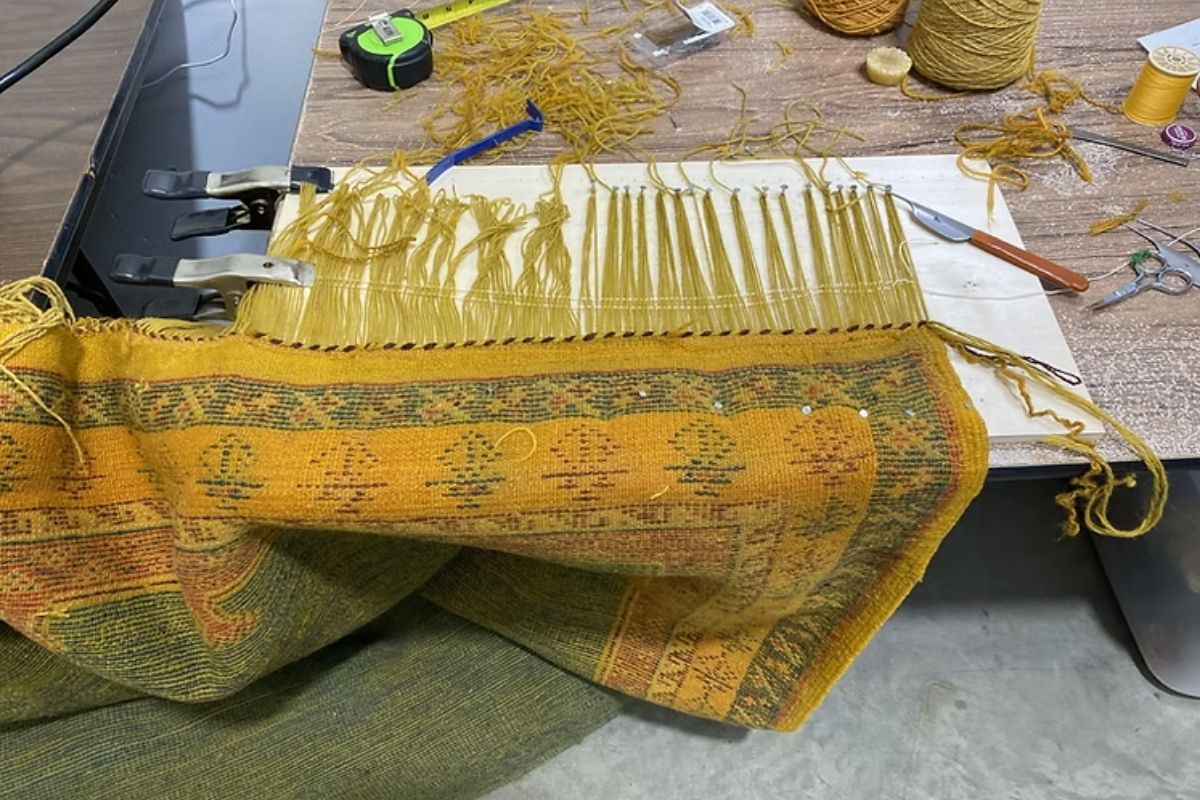
Most damage on a hand-woven Moroccan rug is not a hole in the middle. It starts at an edge, and it starts because the parts that look like decoration are actually the parts holding the rug together. Understanding that one thing changes what counts as a repair and what counts as covering the problem up.
This guide explains what each kind of damage is, structurally, and what a restorer is actually doing when they fix it. It does not price the work, it does not name a workshop, and it does not tell you whether your particular rug is worth restoring. We have not handled your rug, and this site does not appraise, authenticate or value anything.
The fringe is the warp, and that is the whole point
On a hand-knotted or hand-woven rug, the fringe is not sewn on. It is the ends of the warp, the set of long threads that were strung on the loom before a single knot was tied. Every knot in the rug is tied around those threads. Every weft pass runs between them. The fringe you can see is the last few inches of the structural skeleton, left loose where the rug came off the loom and usually secured with a knotted or braided finish.
Two consequences follow, and they are the reason this page exists.
First, losing fringe is not a cosmetic event. A rug shedding fringe is a rug losing the ends of its warp, and once the securing finish at the end of the field goes, the wefts at that end have nothing holding them in place. They start to slide out. Behind them, the end rows of knots lose their anchoring and come away too. The rug does not stop at "no fringe." It carries on unraveling into the field, one row at a time, from the end inward.
Second, a fringe that has been sewn on is a decoration and not a repair. A machine-made fringe tape stitched across the end of a rug replaces the look of the fringe and does nothing for the warp behind it. That may be exactly what a rug's owner wants, and there is no dishonesty in choosing it, but it should be chosen knowingly. If the end of the rug is unraveling, a stitched-on fringe hides the symptom while the cause continues.
The honest repair at that end of the rug is to secure the warp ends again: to re-form the knotted or overcast finish that stops the wefts from migrating. A restorer may also rebuild a short band of the field where knots have already been lost, working new wefts and knots into the existing warp. That is real reweaving, it is slow, and it is priced accordingly.
If you are not sure whether what you are looking at is a knotted pile rug, a flatweave, or a piece that mixes both techniques, that distinction changes what a repair even means, and our guide to flatweave and pile construction is the place to settle it before you get a quote.
Side edges: the selvage, and why it goes first on one side
The long sides of a rug are finished differently from the ends. Rather than loose warp ends, the sides carry a selvage: the outermost warp threads, usually bundled and wrapped or overcast with yarn so the edge is solid rather than raw.
Selvage wear is the most common damage a Moroccan rug in daily use will show, and it is often worse on one side than the other. That asymmetry is usually explained by where the rug sits: the side nearest a doorway, a chair that gets pushed back, or a vacuum's turning point takes more abrasion than the side against a wall.
When the wrapping yarn wears through, the bundled warps underneath are exposed. They abrade, then break, and the edge starts to open. A restorer's response is to re-wrap the selvage with new yarn over the existing warps, matching color as closely as the available wool allows, and to replace any broken warps in the bundle before wrapping over them. A rug that has been re-wrapped well shows a slight difference in tone along the repaired stretch. That is normal and it is not a sign of a bad job.
What to avoid is the improvised version: sewing the opening edge shut with a household needle and thread, or running a bead of adhesive along it. Both pull the edge out of line, both are hard for a restorer to undo later, and adhesive in particular stiffens the wool and can discolor it.
Holes: what caused it decides what is done about it
A hole in the field of a rug is a symptom with several possible causes, and a restorer will want to know which one before touching it.
Wear-through happens where the pile has been walked down to the foundation over years, usually in a traffic line or under a chair leg. The knots are gone, the warp and weft are exposed, and eventually they break.
Moth damage looks different. Carpet moth larvae eat the wool pile, and they do it where they are undisturbed: under furniture, along the edge against a wall, on the underside of a folded rug. Moth damage is often a patch of bare foundation with the pile grazed away around it rather than a clean hole, and it is frequently accompanied by fine debris and silken casings. If that is what you have, the repair is the second job, not the first: an active infestation will eat the new wool as happily as the old.
Burns, tears and pet damage are localized and usually obvious from their shape.
For any of these, a restorer has two broad options.
- Reweaving rebuilds the missing structure in place: new warps where warps are broken, new wefts, and new knots tied in the original technique, then the new pile trimmed to the height of the surrounding rug. Done well it is close to invisible from above and visible from the back, which is where a restorer's work usually shows.
- Patching cuts a piece from a donor rug of similar construction and stitches it into the opening. It is faster and cheaper. It is also a compromise, because the patch's own warp does not continue into the rug's warp, so the join is a line of stress rather than a continuation of the structure.
Neither is wrong. Which one is appropriate depends on the rug, on where the damage sits, and on what the owner wants from the piece. What we will not do here is tell you which one your rug deserves, or what either should cost. Rug restoration is priced by the hour and by the area, it varies enormously between workshops and between countries, and any figure published on a page like this one would be a number you could take to a workshop and find wrong.
The flatwoven end bands are a separate problem
Many Moroccan rugs, including a great many pile rugs, finish at each end with a band of flatweave before the fringe begins. On a piece that is flatwoven throughout, the whole rug is that structure. Flatweave has no pile to wear down, so it fails differently: the weft yarns abrade and part, and where two color blocks meet you can find slits along the join, which in some flatweaving traditions are structural rather than damage.
That last point matters before you ask for a repair. A slit at a color boundary may be how the piece was made. Our guide to Moroccan kilims and hanbels covers the flatwoven end of the tradition and what its normal construction looks like, and it is worth reading before you describe something to a restorer as a fault.
What to do before you call anyone
Four things, in order, and none of them costs anything.
- Stop the damage spreading. If an end is unraveling, keep the rug off that end's traffic line and stop vacuuming over it with a rotating brush. If wefts are visibly sliding out, that end can be temporarily secured by a restorer far more cheaply than it can be rebuilt later.
- Rule out moths before you rule out wear. Check the underside, the parts under furniture and the edge against the wall. Moth treatment comes before repair, always, and it is a separate job.
- Photograph the front and the back of the damage. The back is where a restorer reads the construction, and most of the questions you will be asked over email are answerable from a back photograph.
- Ask the workshop what they will actually do, in the terms above: re-wrapping, re-securing warp ends, reweaving, patching, or a sewn-on fringe. If the answer is "we will fix the fringe" and no further detail is offered, ask which of those two fringe jobs is meant. It is a fair question and a good workshop will answer it plainly.
What this guide deliberately does not tell you
There is no cost figure anywhere on this page, no square-inch rate and no per-knot rate. There is no recommendation of a workshop, a country to send the rug to, or a shipping method. And there is no judgment on whether a given piece is "worth" restoring, because that depends on what the rug means to the person who owns it as much as on what it would sell for.
What is worth saying plainly, and what most of this niche will not say, is that the vocabulary is loose. "Restoration," "conservation," "repair" and "re-fringing" are not defined or certified terms in this trade. Nobody regulates them. Two workshops can use the same word for different work at different prices, which is why the useful question is never "do you do restoration" but "what exactly will you do to this edge." That is the same problem that runs through the rest of this site's buying material, and if you have not read our explanation of what the trade's descriptive words do and do not mean, what a Berber rug actually is is the place that starts.
Leave a Reply