Tag: rug safety

  • The Rug Burn Test: What It Proves, and Doesn’t

    The Rug Burn Test: What It Proves, and Doesn’t

    The burn test can tell you, imperfectly and under controlled conditions, whether a fiber is protein or plastic. That is the whole of what it does. It cannot tell you how old a rug is, where it was made, who made it, whether it was hand-knotted, or whether it was chemically treated to look aged, which are the questions Moroccan rug buyers actually have. This guide does not recommend running it, and the most repeated version of the advice, that pure wool "will not light," is wrong in a way that costs buyers money.

    Where the claim comes from and why it matters

    Two of the buying guides on page one for Moroccan rug advice in August 2026 tell readers to take a lighter to a fiber and report that the flame will not light pure wool but will melt a synthetic. One of them is a travel-tour operator's blog, one is a well-known Morocco travel site. Neither cites anything.

    Wool is comparatively flame resistant. That is a real property and a large part of why it has been used in carpets for centuries. There is a body of textile literature on the burning behavior of wool carpets, including work indexed under the title "Burning Behavior of Carpets: The Advantages of Wool and Flame-Resistant Wool." Comparatively flame resistant is not the same statement as fireproof.

    The practical consequence is specific and predictable. A buyer holds a flame to a fiber from a genuine wool rug, expecting nothing to happen, sees it catch and burn, and concludes the rug is synthetic. The advice has produced a false negative on a real rug. Someone acting on it walks away from a genuine piece or, worse, uses it to argue the price down on a seller who was telling the truth.

    What the test actually shows, at best

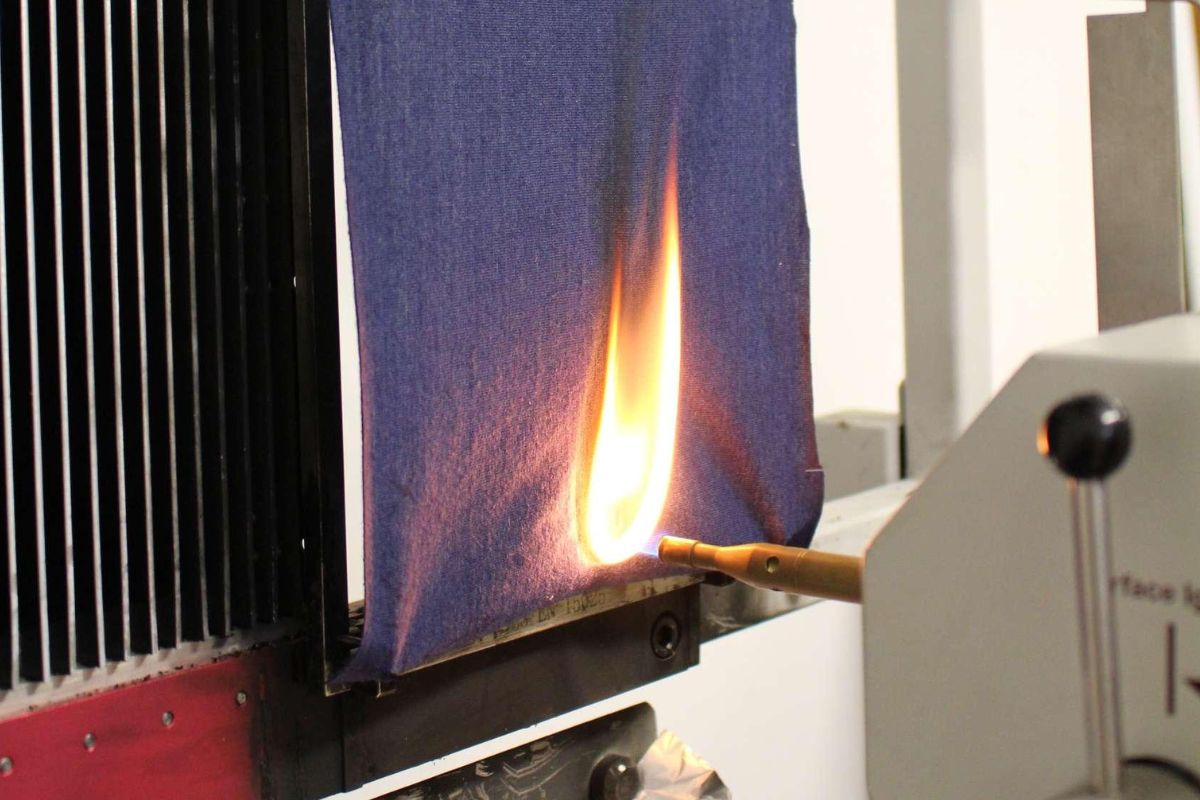
    In a controlled setting, protein fibers and plastics do behave differently. Protein fibers such as wool are harder to ignite, tend to burn slowly and self-extinguish, smell like burning hair, and leave a brittle ash that crushes to powder. Synthetics such as polypropylene and nylon ignite more readily, burn faster, smell acrid or plastic-like, and leave a hard melted bead.

    That is a genuine difference and the reason the test exists at all. Note what it is a test of: fiber chemistry. It is a materials identification, not an authentication.

    Even at that job it has known limits, and even sources that recommend it concede them. Blended fibers have to be separated before testing, because a wool and synthetic blend gives a mixed and unreadable result. And a single strand from one corner tells you about that strand, not about a rug that may use different fibers in pile, warp and weft.

    Why not to do it

    Three reasons, in order of how much they should matter to you.

    It is not your rug. If you are testing in a shop, you are taking a lighter to someone else's property, and taking a strand to test means damaging it first. A seller who agrees is being accommodating, not proving anything.

    It is an open flame on a textile. You may be holding a four-figure wool object in an enclosed retail space with other flammable stock. This site does not publish a protocol for doing this and will not, because there is no version of the instruction that is responsible to give.

    It settles a question you can settle better another way. If fiber content genuinely matters to your decision, a laboratory fiber test gives a definitive answer on the whole rug without burning anything. Against the cost of the rug it is a small expense, and any seller confident in their description will agree to it.

    The other tests sold as proof

    The burn test is not alone. Three more circulate widely and each carries less weight than its reputation.

    The color test. One page-one source advises avoiding "hot" colors, on the theory that a red "hot as a tomato" is machine dyed while a red "as a tulip" is vegetable dyed. Dye chemistry does not divide that neatly, natural dyes produce a wide range of intensities depending on the plant, mordant and process, and a judgment made by eye about a hue is not evidence of anything. Moroccan rug colors: where the palette comes from covers what can honestly be said about the palette.

    The wet cloth rub. Rubbing a damp white cloth on the pile to see whether color transfers is often presented as proof of synthetic dye. It is not. Natural dyes can and do bleed, and a color run is not evidence of a fake. It is covered properly in natural or synthetic dye: how to check, and why bleeding proves nothing.

    The price test. "Too cheap means fake" is the most repeated claim in the niche and the least supported. It is examined in how to buy a Moroccan rug without getting taken, alongside the documented economics that contradict it.

    What these four have in common is that they are quick, they feel like expertise, and they produce a confident answer to a question they do not address.

    What to do instead

    Spend your effort on the checks that actually resolve something.

    • Look at the back. Construction is the one authenticity question you can settle yourself with certainty, and it has direct financial consequences. What the back of the rug shows covers it.
    • Ask what the seller can document, rather than what they assert. Region, town and cooperative are answerable. Tribe and decade usually are not.
    • Treat the aged look as a look. Fading can be manufactured in weeks by processes that are documented, which how new rugs are made to look old sets out.
    • Pay for a fiber test if fiber matters. It is the only version of the burn test question that gives a real answer.
    • Get claims in writing before paying. A written description is something you can act on later. A shop-floor flame is not.

    If you want the full set of questions hiding inside the word, is my Moroccan rug authentic breaks it into the four that have different answers.

    FAQ

    Does pure wool burn?
    Yes. Wool is harder to ignite than most synthetics, tends to burn slowly and self-extinguish, and smells of burnt hair. It is not fireproof, and advice that says a flame "will not light" wool is wrong.

    Should I do a burn test on a rug in a shop?
    No. It damages property that is not yours, it is an open flame on a textile in an enclosed space, and it answers only a fiber question that a laboratory test answers properly.

    What does the burn test actually prove?
    At best, whether a single strand is a protein fiber or a plastic one. It proves nothing about age, origin, tribe, construction or chemical treatment.

    How can I be sure my rug is wool?
    A laboratory fiber test is the definitive answer. Feel and appearance are suggestive but not conclusive, and blends are specifically designed to be hard to judge by hand.

    Does color bleeding mean the dyes are synthetic?
    No. Natural dyes bleed too, so a color run is not evidence of a fake. This is one of the most common false claims in the niche and it has its own page here.
  • How New Rugs Are Made to Look Old in Morocco

    How New Rugs Are Made to Look Old in Morocco

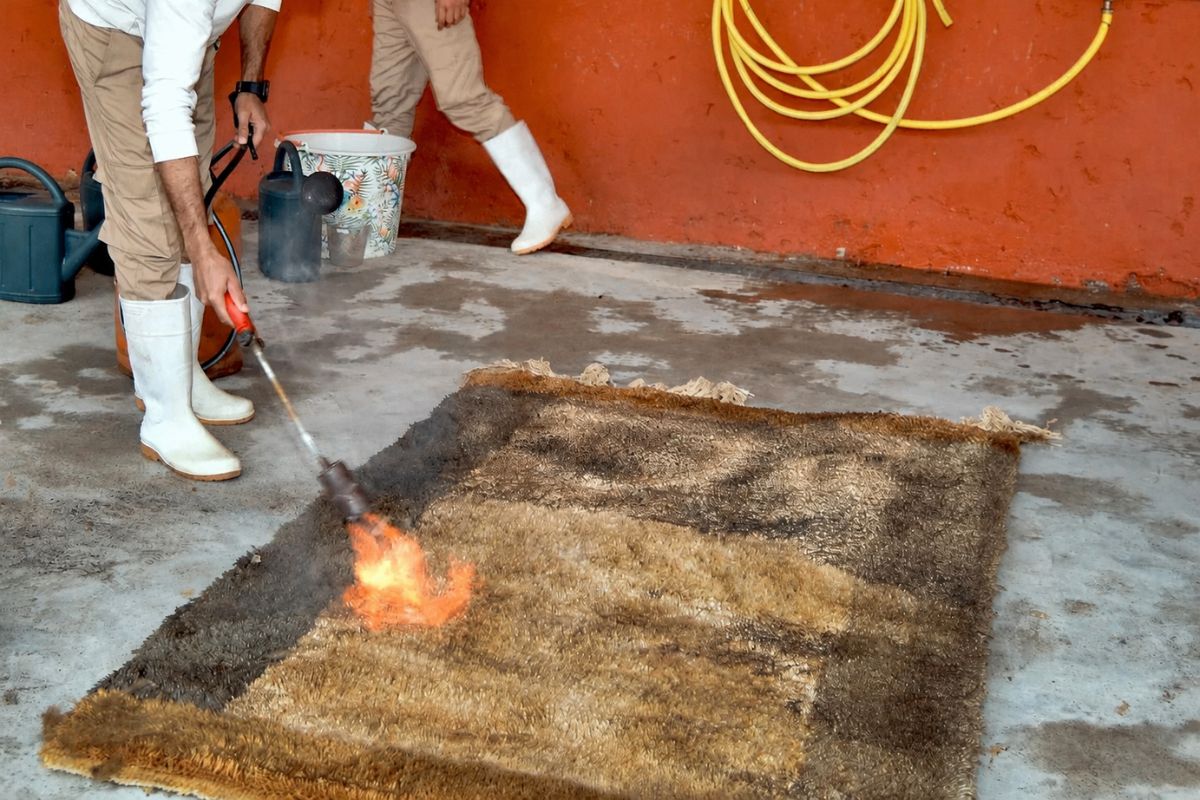
    Most Moroccan rugs sold online as “vintage” are new rugs that have been treated to look old. The account below comes from the Anou Cooperative, a weaver-owned organization in Morocco, which described the process in a blog post of 14 December 2020: rugs covered in dirt and walked on, laid out in the sun, washed in a one-to-one water and bleach solution, sometimes treated with sulfur-heavy chemicals to shorten the process, and in some cases blow torched to burn out plastics and force color fading. Their summary was blunt: “Moroccan vintage rugs don’t really exist.”

    Who says this, and why their account carries weight

    This site went looking for independent reporting on artificial ageing in the Moroccan rug trade in August 2026. There is almost none. Page one for the question is the Anou Cooperative’s own blog, a travel listing for the cooperative, and one US rug dealer and cleaning firm whose description of bleach odor and heavy top-side fading corroborates the account from a trade perspective.

    No newspaper covers it. No consumer body covers it. No rug seller’s blog covers it, which is not surprising, because most of them are selling the product in question.

    Anou is a national service cooperative and part of a network of Amazigh (Berber) weaving and artisan cooperatives, where artisans sell directly rather than through intermediaries. They are not a neutral party: they have an interest in the alternative model they run, and they say so openly. What they are not is a seller of the rugs they are describing. In a market where every other source has inventory to move, an organization owned by the weavers themselves is the closest thing to an independent account that exists on this question.

    The processes, in Anou’s own description

    The 14 December 2020 post describes a supply chain in which middlemen, most of them women according to Anou, commission rugs from weavers and then process them for the online market. The techniques it names:

    • Dirt and foot traffic. Weavers are instructed to cover the finished rug in dirt and walk over it.
    • Sun exposure. The rug is laid out in the sun for an extended period to fade the color.
    • Bleach washing. A one-to-one water to bleach solution, which Anou says takes something like 100 liters to fully soak a large wool rug, applied one to three times on average.
    • Sulfur-heavy chemicals. Used to cut down processing time, with a toxicity Anou describes as not well understood.
    • Blowtorching. Rugs “literally blow torched to burn out plastics” and to promote color fading.

    Anou names Khenifra, Kenitra and Taznakht as production hubs for this, and Instagram and Etsy as the sales channels. Their follow-up post of 3 September 2021 adds that chemicals used in this kind of washing “have been banned by US rug washing facilities since the 1980s” after causing lung complications in workers.

    None of this is invented by this site, and none of it is generalized beyond what Anou wrote. It describes an industry practice, not any particular shop.

    The cost that never appears in the listing

    The environmental account is the part of this that no seller mentions, and Anou is specific about it.

    Bleach does not biodegrade. In Anou’s words, for every rug on Etsy and Instagram, that is “countless liters of bleach poured directly into the rivers that the artisans who made the rug depend on.” The 2021 post reports that streams in the Khenifra region “now run with brine and are no longer potable,” and describes this as a worsening problem rather than a historical one.

    There is a human exposure side too. Anou notes that the people demonstrating the washing process wear boots, and observes that this is for a reason. This site is not in a position to assess the occupational risk and does not attempt to.

    The cooperative also documents that a different way is possible: Cooperative Lfarah produced faded, vintage-style rugs using full-exhaust dyes and sustainable mordants with no chemicals, and their pilot washing techniques cut water use by roughly half against standard practice.

    What this means for the rug already in your house

    The honest answer is that this site does not know what is in your rug, and neither does anybody else who has not tested it.

    What can be said: chemical washing is widespread in this trade, the processes described above leave the rug looking exactly as intended, and there is no way to tell by eye whether a given piece went through them. Anou’s own point about the sulfur-heavy chemicals is that the effects are not well understood, and that uncertainty is part of the honest answer rather than something to paper over.

    What this guide will not do is offer you a home test or a treatment. There is no reliable kitchen-table way to detect chemical residue in wool, and neutralizing protocols circulating online are not something this site is qualified to endorse. If you are concerned about a specific rug:

    • Ask the seller directly whether the rug was chemically washed, and ask for the answer in writing. Many will say yes, because it is normal in the trade.
    • Air it thoroughly, outdoors if you can, before it goes into a bedroom or a child’s room. Ventilation is the one measure that is safe, free and universally recommended for new textiles.
    • Speak to a professional rug cleaning service, one that does not sell rugs, if a smell persists. They handle chemically washed pieces routinely and can tell you what they are seeing.
    • Speak to a clinician, not a rug site, if anyone in the household has symptoms you associate with the rug. That is a medical question and this guide has no standing to answer it.

    Why a new rug smells of chemicals covers what different smells actually indicate, including the separate case of adhesive off-gassing in tufted rugs.

    What it means for what the weaver was paid

    The distressing is also where the money separates from the maker, and this is the part that explains the rest.

    Anou’s December 2020 post describes artisans earning as little as 5 dirham a day, which the cooperative characterizes as under 5% of minimum wage, and receiving payment only for the weaving. The processing that transforms a new rug into a saleable “vintage” one, and multiplies its resale price, happens after the weaver is out of the transaction.

    That fits the wider picture from AFP’s reporting of December 2024, carried by outlets including Business Recorder, which described weavers in southern Morocco traveling to a weekly market to sell to middlemen who set the prices, with a large rug going for around 250 dirhams, roughly 24 US dollars at the time. Ijja Benchri, a weaver from Taznakht quoted in that reporting, said a single carpet took two to four weeks and that she had no choice but to accept what was offered.

    Taznakht rugs and the cooperatives behind the name covers the organizations working against that pattern.

    Can you tell, looking at a rug?

    Usually not, and anyone who tells you they can from a photograph is overstating.

    Some things are suggestive rather than conclusive. A strong bleach or chlorine smell is a signal. Fading that is much heavier on the top surface than in the depth of the pile, or that sits oddly against unfaded areas, is consistent with a surface treatment rather than decades of light. Uniform ageing across a whole rug is less likely than uneven wear from real use.

    But each of these can have another explanation, and a well-executed treatment produces exactly the appearance it is meant to. That is the point of it.

    Which is why this cluster keeps returning to the same conclusion: buy the rug in front of you for what it is, and treat the age story as unverified unless there is documentation behind it. What “vintage” actually means on a listing covers the vocabulary, and how to buy a Moroccan rug without getting taken covers the full set of failure modes. If it is the faded palette you are drawn to, where the Moroccan rug palette comes from is worth reading first.

    Photo credit/source: Nina Roberts; the article identifies the image as “Rugs are washed and torched. Photo: Nina Roberts.

    FAQ

    Are most vintage Moroccan rugs fake?
    The Anou Cooperative, a weaver-owned organization in Morocco, wrote in December 2020 that “Moroccan vintage rugs don’t really exist” at the volume and prices the online market offers, and described the processes used to age new rugs artificially. This site cannot say what proportion of any given seller’s stock that covers.

    What chemicals are used to age Moroccan rugs?
    Anou names a one-to-one water and bleach solution and sulfur-heavy chemicals used to speed the process, and reports that chemicals of this kind were banned by US rug washing facilities in the 1980s after causing lung complications in workers.

    Is a chemically washed rug dangerous to have at home?
    This site does not know and will not guess. Anou itself says the toxicity of some of the chemicals involved is not well understood. Air a new rug thoroughly, ask the seller in writing what was done to it, and consult a professional cleaner or a clinician rather than a rug website if you have a specific concern.

    Can I tell if my rug was artificially aged?
    Usually not by eye. A bleach smell, or fading much heavier on the surface than in the depth of the pile, is suggestive but not conclusive. A well-executed treatment looks exactly like age, which is its purpose.

    Does buying from a cooperative avoid this?
    Cooperatives such as Anou publish what their members are paid and describe their own washing and dyeing methods, which is more transparency than most of the chain offers. This site does not rank or recommend individual sellers and has no commercial relationship with any of them.

  • Why a New Rug Smells of Chemicals

    Why a New Rug Smells of Chemicals

    A new rug that smells of rubber or glue is almost always telling you how it was built. That smell comes from the styrene-butadiene rubber latex adhesive used to hold the pile in place on hand-tufted and some machine-made rugs, and hand-knotted rugs, which are held together by knots and use no adhesive, do not produce it. A different smell, sharp and bleach-like on a rug sold as vintage, points somewhere else entirely: the chemical washing used to make new Moroccan rugs look old. The nose is doing identification work here, not just complaining.

    Two different smells, two different meanings

    This is the distinction almost nothing online makes, and it is the useful part.

    Rubber, glue, burnt-tire, or a faint sweetish chemical smell. This is adhesive off-gassing. It is a construction signal. If you were told the rug was hand-knotted, this smell is at odds with that description and is worth raising with the seller.

    Bleach, chlorine, or a sour chemical smell, usually on a rug sold as vintage. This is not adhesive. It is consistent with the chemical washing documented in the Moroccan trade, covered in how new rugs are made to look old.

    Wet wool, farmyard, or a musty smell. This is often just wool being wool, particularly when a rug has been rolled and wrapped for shipping, or lanolin reacting to humidity. It usually clears with air and is the least concerning of the three.

    Working out which one you have narrows the question considerably before you do anything else.

    Where the rubber smell comes from

    Hand-tufted rugs are made by punching yarn through a fabric backing. Nothing is knotted, so the pile has to be locked in place, and that is done with a latex adhesive spread across the underside, usually covered by a second canvas backing.

    As that adhesive cures it releases volatile organic compounds. The one most associated with the characteristic new-carpet smell is 4-phenylcyclohexene, usually shortened to 4-PCH, which forms during the polymerization of the styrene-butadiene backing adhesive. UL's Chemical Insights group publishes a technical brief on the compound. It is detectable by the human nose at very low concentrations, which is why a small quantity of adhesive can make a whole room smell.

    The practical consequence for a buyer: a strong rubber smell is good evidence of a glued backing, and a glued backing means tufted or machine-made rather than hand-knotted. What the back of the rug shows tells you how to confirm it visually in about ten seconds.

    Is it harmful? The honest state of the evidence

    This is where the sources genuinely disagree, and publishing the disagreement is more useful than picking a side.

    On one hand: 4-PCH is detectable at concentrations measured in parts per billion, and accounts in the indoor air quality literature associate exposure with headaches, eye irritation and nausea in building occupants, with the most cited case being complaints at an EPA headquarters building after carpet installation. There is also work noting that 4-PCH can react with indoor ozone.

    On the other hand: carpet emissions ranked among the lower overall contributors to indoor air quality problems in EPA-era studies, and following laboratory testing and government review no connection was established between 4-PCH and a specific adverse health outcome.

    What is not in dispute: there is no OSHA permissible exposure limit for 4-PCH. LEED guidance references a maximum concentration figure for indoor air quality testing purposes, which is a building standard rather than a health threshold. And people do report symptoms they attribute to new carpet smell, whether or not a causal mechanism has been established.

    So the honest answer is that the smell is unpleasant, common, and not demonstrated to be harmful at household levels, and that the evidence is not strong enough to promise anybody it is harmless either. If someone in your home has asthma or a chemical sensitivity, treat the uncertainty as a reason for caution rather than reassurance.

    How long it lasts, and what actually helps

    Retailer and industry guidance generally puts the off-gassing period for good quality adhesives at a few days to about two weeks with proper ventilation. Lower-grade latex can carry on for months, and a rug that spent weeks sealed in plastic during shipping will smell worse on unrolling and take longer to clear.

    What helps, in order:

    • Air, and a lot of it. Unroll the rug outdoors on a dry day if you can, or in a garage, porch or spare room with the windows open and a fan running. This is the single effective measure and everything else is secondary.
    • Time and patience. The smell curve falls steeply in the first days.
    • Keep it out of a bedroom or nursery until it clears. A simple precaution that costs nothing.
    • Vacuum gently once the rug is in place, which lifts trapped fibers and helps circulation through the pile.

    What this site will not recommend: vinegar soaks, baking soda protocols presented as neutralizing a VOC, ozone generators, or any home chemistry aimed at the adhesive. Wetting a rug with a glued backing risks the adhesive and the backing itself, ozone generators carry their own indoor air quality problems, and none of it addresses the compound in the way it is usually claimed to. Follow the manufacturer's or retailer's own care instructions first.

    When the smell is a reason to return the rug

    The smell is not only an air quality question. It is also a description question.

    If the rug was sold to you as hand-knotted and it smells strongly of adhesive, those two facts are hard to reconcile, because hand-knotted construction uses no adhesive. Check the back. If you find a glued canvas backing, you have a documentation problem rather than a ventilation problem, and that is a conversation with the seller about the description rather than something to air out on a balcony.

    If the smell has not meaningfully faded after several weeks of good ventilation, that is also grounds to go back to the retailer. Persistent odor is commonly attributed to lower-grade adhesive, and most sellers would rather handle a return than a review.

    Get the original description in writing if you do not already have it. Is my Moroccan rug authentic covers what a seller can and cannot actually document, and how to buy a Moroccan rug without getting taken sets out the wider set of risks. If you are choosing between constructions in the first place, flatweave or pile is a good place to start.

    FAQ

    Why does my new rug smell like rubber?
    Almost certainly styrene-butadiene latex adhesive off-gassing from a glued backing, which means the rug is hand-tufted or machine-made rather than hand-knotted. The compound most associated with the smell is 4-phenylcyclohexene.

    Do hand-knotted rugs smell?
    Not from adhesive, because they contain none. A hand-knotted wool rug may smell of wool or of storage, and a Moroccan piece sold as vintage may smell of the chemical wash used to fade it, which is a different issue.

    Is new rug smell toxic?
    The evidence is genuinely mixed. Some indoor air quality accounts associate 4-PCH exposure with headaches and irritation, while EPA-era review did not establish a link to a specific health outcome, and there is no OSHA exposure limit. Ventilate well, keep the rug out of bedrooms until it clears, and speak to a clinician rather than a website about symptoms.

    How long does the smell take to go away?
    Retailer and industry guidance generally says a few days to about two weeks with good ventilation, and longer for lower-grade adhesive or a rug shipped sealed in plastic.

    Should I use vinegar or baking soda on it?
    This site does not recommend home chemistry on a rug with a glued backing. Wetting it risks the adhesive and the backing, and ventilation is what actually reduces the smell. Follow the manufacturer's care instructions.