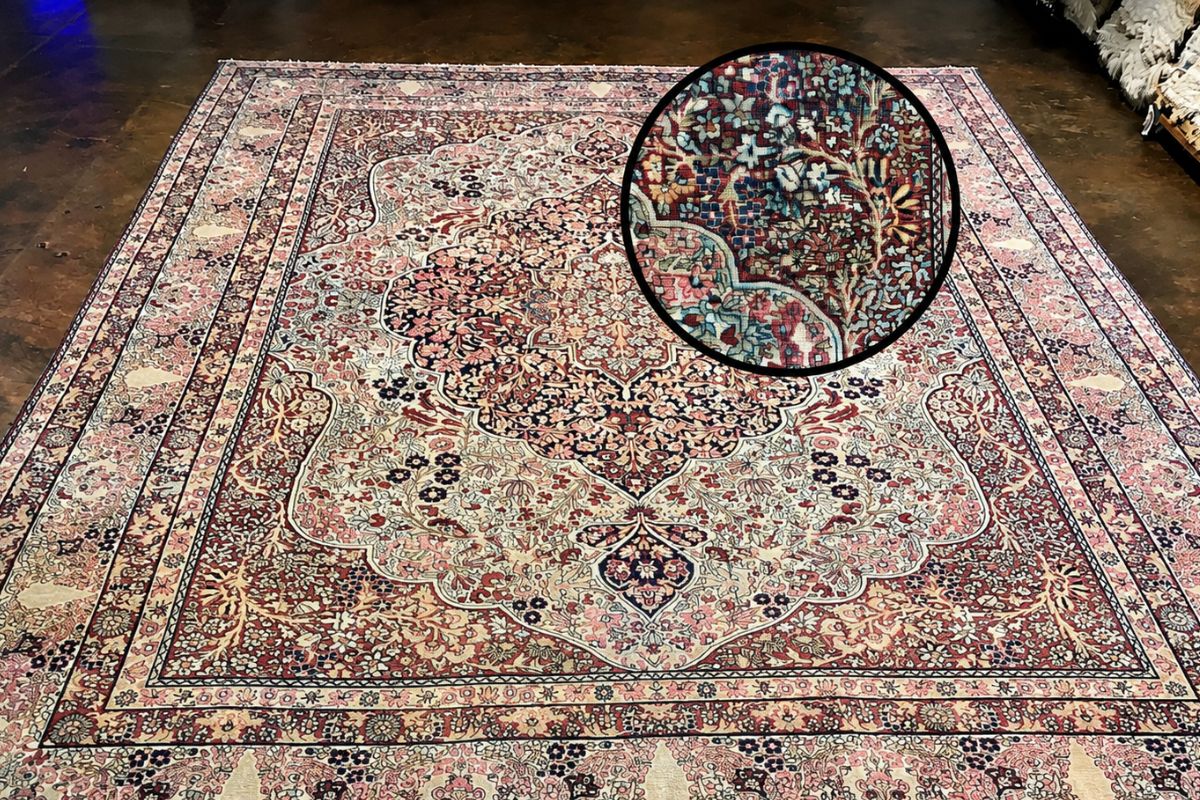
If a rug bleeds, it tells you the dye was never properly fixed into the fiber. It does not tell you whether that dye was natural or synthetic, and it is not evidence that the rug is a fake. This matters because the opposite claim, that natural dyes do not run so a color run proves synthetic dye, is stated outright on seller pages and is contradicted by the rug trade's own specialist sources. A properly mordanted natural dye stays put. A badly fixed dye of either origin bleeds.
Where the false claim comes from
The claim is convenient. It gives a seller a quick on-the-spot test whose result they can predict, and it lets the word "natural" carry a premium.
The trade's own literature does not support it. Nazmiyal's page on color runs in rugs makes the point directly: early synthetic reds, and contemporary red dyes too, are prone to running, but the existence of a red color run does not preclude a natural origin. Other specialist and professional-cleaning sources on the same question converge: clean, easy bleeding is the single most useful indicator of a poor dye job, natural or synthetic, and properly mordanted natural reds do not bleed.
So the test is real, it just answers a different question than the one it is sold as answering. This is the pattern across this whole cluster, and it also applies to the burn test, which is likewise asked to prove far more than it can.
What actually causes a color run
Dyeing wool is not simply staining it. The dye has to bond to the fiber, and for most natural dyes that requires a mordant, a metallic salt that fixes the colour in place. Get the mordanting right and the colour is genuinely locked into the wool. Get it wrong, skip it, or overload the fiber with more dye than it can bond, and the excess sits on the surface waiting for water.
Synthetic dyes have their own fixing requirements, and the same logic applies. Some early synthetic reds were notoriously fugitive, which is where a good deal of the folklore comes from, and the trade's own accounts note that red remains the most run-prone colour family across both dye types.
The variable is process quality, not chemistry of origin. A cheap dye badly fixed will bleed, fade harshly, or in the worst cases damage the wool itself. That is the thing worth avoiding, and it is not what the natural-versus-synthetic argument is about.
Why age makes natural dyes less stable, not more
There is a second reason a genuinely old, genuinely naturally dyed rug can run, and it is the exact opposite of the romantic story.
Specialist and professional cleaning sources describe natural dyes as more sensitive to heat, moisture and chemical exposure than modern synthetics, and note that age and oxidation make them progressively less stable. So an old rug with real vegetable dyes can bleed under a cleaning approach that a newer synthetic-dyed rug would shrug off.
The practical consequence is not academic. It means the rug most likely to be damaged by a careless wash is the valuable one, and it is why professional rug cleaners test for colourfastness before they put water on anything. If you own a piece you believe carries natural dyes, that is a reason to be more careful with cleaning, not less.
What you can honestly tell by looking
Some things are visible, with limits attached to each.
Abrash. Gentle horizontal banding across a field of colour, where the tone shifts slightly from one section to the next. It happens when hand-spun yarn takes dye unevenly or when a weaver moves between dye lots. It is a genuine sign of small-batch, hand-processed work, and it is also easy to imitate, so read it as suggestive rather than conclusive.
Depth and variation within a single colour. Naturally dyed wool often shows subtle variation strand to strand. A flat, perfectly even field is more consistent with an industrial dye lot.
How the colour reads at the base of the pile. Part the pile and look near the foundation. On a rug that has faded with real light exposure, the colour at the base is usually deeper than at the tip. On a rug faded by a surface treatment, the difference can be more abrupt.
What you cannot tell by eye is the actual chemistry. Dye analysis is a laboratory procedure, and no amount of looking substitutes for it. Where the Moroccan rug palette comes from covers what can and cannot honestly be said about the colours themselves.
What this means when a rug bleeds in your home
First, do not conclude you were sold a fake. You have learned something about the dyeing, not about the rug's origin.
Second, treat it as a cleaning constraint from now on. A rug that runs will run again. That means blotting rather than rubbing a spill, avoiding saturating the pile, keeping it out of situations where it will get genuinely wet, and telling any cleaner about it before they start.
Third, if it happened during a cleaning attempt, stop and get professional help rather than escalating. Wet wool holding loose dye spreads colour further with each pass.
And if the rug is one you were told carries natural dyes, the bleeding is not proof that claim was false. It is consistent with an old natural dye that has become unstable, with a badly mordanted natural dye, or with a poorly fixed synthetic. Those cannot be told apart at home.
For the wider set of tests that promise more than they deliver, see how to buy a Moroccan rug without getting taken, and for the fiber half of the same assessment, judging wool quality without a lab. The chemical washing described in how new rugs are made to look old is also worth reading here, since it acts directly on colour.
FAQ
Do natural dyes bleed?
Yes, they can. Properly mordanted natural dyes do not, but badly fixed ones do, and specialist sources note that natural dyes become less stable with age and oxidation. Bleeding is not evidence of synthetic dye.
Does a color run mean my rug is fake?
No. It means the dye was not properly fixed. That is worth knowing for cleaning, but it says nothing about where or how the rug was made.
How can I test for natural dyes at home?
You cannot reliably. Dye analysis is a laboratory procedure. Abrash and subtle colour variation are suggestive but imitable, and this guide does not recommend any home chemical test.
Which colour bleeds most often?
Red, across both dye types, according to the trade's own accounts. Early synthetic reds in particular were prone to running, which is part of where the folklore about bleeding began.
My rug ran while I was cleaning it. What now?
Stop rather than continuing, because wet wool holding loose dye spreads it further with each pass. Get a professional rug cleaner involved, and tell them the rug runs before they start.
Leave a Reply