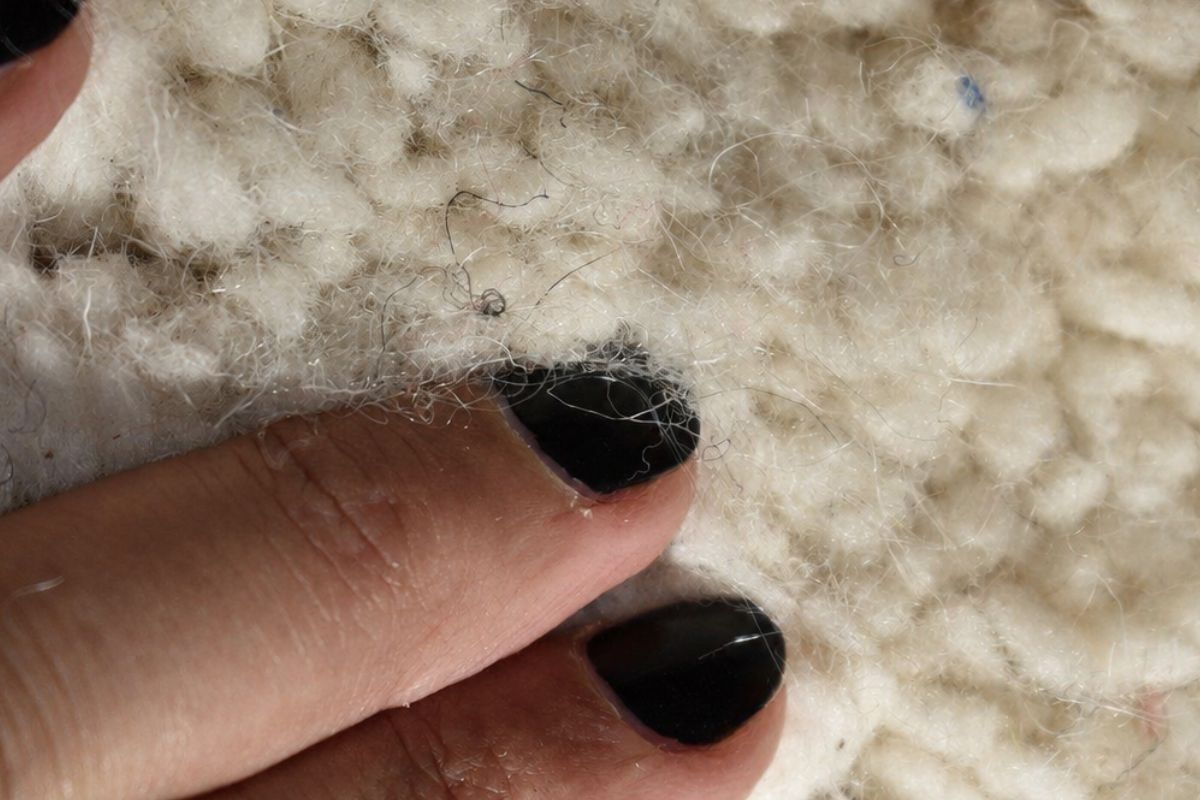
Your hand can tell you four useful things about rug wool: whether it has lanolin still in it, whether it springs back, whether it was hand-spun or machine-spun, and whether it feels alive or dry and chalky. Those are real signals and they matter more to how a rug wears than any knot count does. What your hand cannot tell you is whether the fiber was good to begin with, because chemical washing changes exactly the properties this test reads. On a Moroccan rug sold as vintage, that is not a footnote.
Why wool is the thing to judge
If you only learn one quality check, make it this one rather than the number on the tag. Wool quality governs how the pile recovers from a footstep, how it holds colour, how much it sheds, whether it mats in a traffic path, and how it ages over decades. Knot density, by contrast, mostly governs how fine a pattern the weave can carry, which barely applies to geometric Moroccan designs at all. What KPSI does and does not tell you sets out why.
The good news is that the trade broadly agrees on what good wool feels like, and the descriptions are consistent across dealer and specialist sources. The catch is that every one of those sources is selling rugs, and the checks are written as reasons their stock is good. The checks are still valid. Read them knowing who wrote them.
Lanolin: sheen, coolness, spring
Lanolin is the natural grease in a sheep's fleece. It repels water and dirt, and wool that retains it behaves noticeably better in a rug.
What to feel for. Run your palm flat across the pile. Wool with lanolin in it has a soft, low sheen rather than a bright shine, feels slightly cool to the touch, and has a faint smoothness that is not slipperiness. Press down with your fingertips and release: the pile should come back rather than staying flat. Grip a small area and let go, and it should recover its shape.
The trade description that matches this is consistent across sources: good hand-spun wool is rich in lanolin, has a soft sheen, feels cool and springy, and bounces back under pressure. Lanolin also helps the rug resist dirt and staining in ordinary use, which is a practical benefit rather than a romantic one.
Hand-spun or machine-spun
This one you can feel, and it is worth learning because it changes the character of the whole rug.
Hand-spun yarn comes out unevenly, because a person is drawing it. Run your hand across the pile and it reads as slightly bumpy, with subtle variation along a single strand. That irregularity is also why hand-spun wool takes dye unevenly, producing the gentle banding across a field that the trade calls abrash.
Machine-spun yarn is consistent. It feels softer and smoother precisely because the machine produced an even strand. Specialist sources make the further point that machine processing is thorough enough to strip much of the natural lanolin out of the fiber, which is the trade-off: more uniform, less protected.
Neither is automatically better for every purpose. Hand-spun generally wears well and looks more alive. Machine-spun can be perfectly serviceable. What matters is whether the rug was sold to you as one and is the other.
The signs of poor or dead wool
Poor wool announces itself once you know the vocabulary.
It feels dry rather than supple, sometimes chalky, sometimes with a faint squeak when you rub it between finger and thumb. It does not spring back when pressed. It looks flat rather than having any sheen. Short, brittle fibers work loose, so the rug sheds persistently well past the settling-in period and mats in walked areas.
The trade term worth carrying is tabatchi, or dead wool, which specialist sources describe as wool taken from sheep that were already slaughtered rather than shorn from a living animal. It is widely reported as brittle and prone to exactly the shedding and matting above. This guide is repeating a trade distinction here rather than a laboratory one, and it is not something you can confirm by eye on a specific rug.
What chemical washing does to all of this
Here is the part the trade sources leave out, and on Moroccan rugs it undercuts the whole test.
The processes used to make new rugs look old work directly on the fiber. The Anou Cooperative, a weaver-owned organization in Morocco, described them in a post of 14 December 2020: a one-to-one water and bleach solution, roughly 100 litres to soak a large rug, applied one to three times on average, sometimes with sulfur-heavy chemicals to speed things up. A bleach wash of that strength strips lanolin and can leave wool feeling exactly as the section above describes poor wool: dry, flat, without spring.
So a rug can feel lifeless because the fleece was poor, or because the fleece was fine and the rug was washed hard to produce a faded look. The hand test cannot separate those two, and no one can tell you which happened from a photograph. It runs the other way too: heavy conditioning can make mediocre wool feel better than it is.
The honest conclusion is narrower than the trade's. Your hand tells you the wool's condition now, which is what you will actually live with. It does not tell you the fiber's original quality or how it got this way. How new rugs are made to look old covers the processes in full.
What to ask, since the hand test has limits
- "Has this rug been washed, and how?" Chemical washing is normal in this trade and a straight seller will say so. The answer tells you how to read what your hand just told you.
- "Is the wool hand-spun or machine-spun?" Then check the answer against the pile. A mismatch is worth pursuing.
- Ask about shedding. Some settling is normal on a new hand-knotted rug. Persistent shedding months later is a fiber problem.
- Look at the pile in a walked area if the rug is genuinely old. Real wear tells you more about the wool than a fresh corner does.
- Get the description in writing before paying, so a wool claim is something you can act on later.
For the checks that settle construction rather than fiber, see what the back of the rug shows. For the dye half of the same question, natural or synthetic dye. And for the wider set of risks, how to buy a Moroccan rug without getting taken. The style with the strongest reputation for wool is covered in the Beni Ourain rug guide.
FAQ
How can I tell if rug wool is good quality?
Feel for a soft low sheen, a cool touch, and spring that returns when you press the pile. Dry, chalky wool that stays flat and sheds persistently is the opposite signal.
What is lanolin and why does it matter in a rug?
It is the natural grease in a sheep's fleece. Wool that retains it resists dirt and moisture better, feels springier, and generally wears longer. Heavy processing and chemical washing strip it out.
Is hand-spun wool better than machine-spun?
Not automatically. Hand-spun is uneven, retains more lanolin, and gives the rug abrash and character. Machine-spun is smoother and more uniform but more processed. The problem is only when one is sold as the other.
What is tabatchi or dead wool?
A trade term for wool taken from sheep that were already slaughtered rather than shorn. It is described in the trade as brittle and prone to shedding and matting. This guide could not verify it on any specific rug and reports it as a trade distinction.
Can a bleach wash make good wool feel bad?
Yes, and that is the main limit of the hand test on Moroccan rugs. The strong washes documented in the trade strip lanolin, so a rug can feel dry because of what was done to it rather than because the fleece was poor.
Leave a Reply