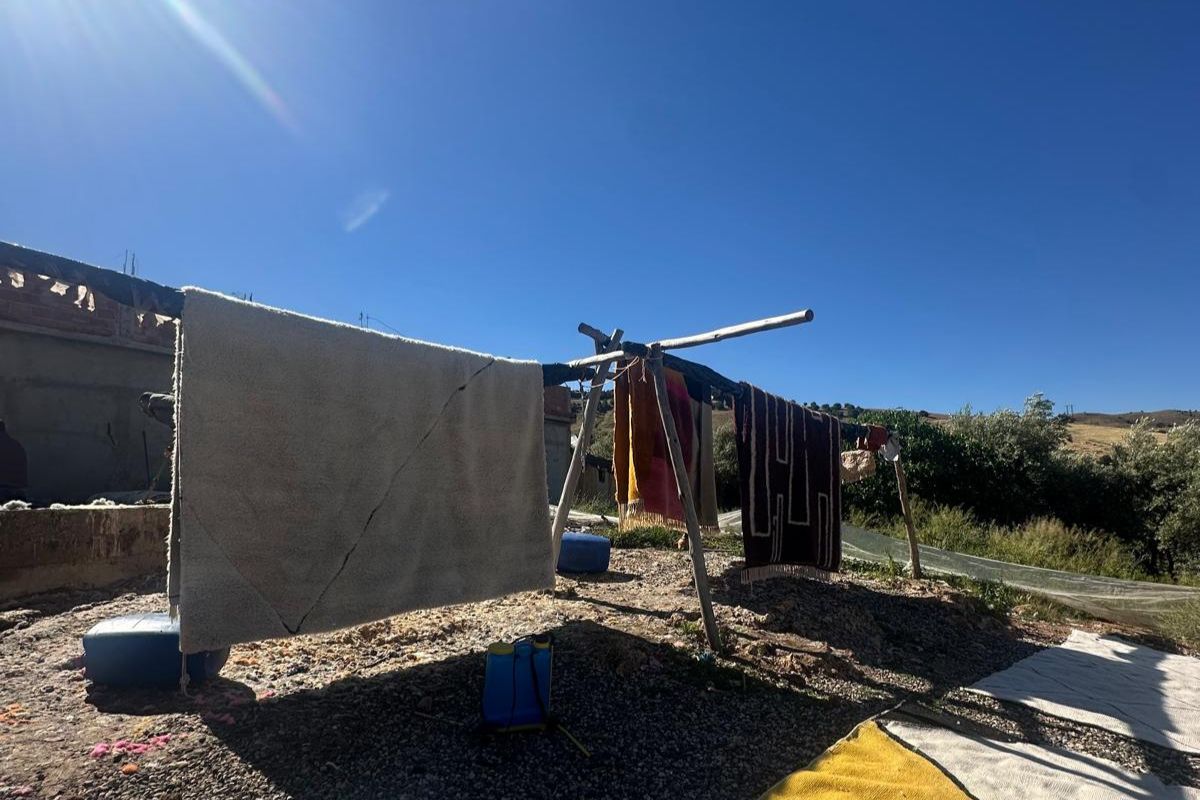
Wool holds odor because it holds moisture. The fiber absorbs both more readily than synthetic pile, so whatever produced the smell, a pet accident, mildew from a damp spill, or moisture picked up in storage, is usually still sitting in the fiber rather than gone. Full drying and airflow do more than any spray. Sunlight and fresh air outdoors help because ultraviolet light breaks down the bacteria and mold producing the smell, not because it "airs the smell away" in some vaguer sense. One popular home fix, baking soda, is mildly alkaline and works against the same wool chemistry this site's own care guide warns against, so it is not the safe default it's usually presented as, and this page explains why before it tells you what to do instead.
Why wool holds a smell longer than it should
Wool is a protein fiber, and that same absorbency that makes it comfortable underfoot and resistant to a quick spill also makes it good at holding onto moisture once it's actually soaked in. Odor itself is mostly a byproduct of bacteria and mold metabolizing whatever moisture and organic material is present, whether that's spilled liquid, pet residue, or just humidity that got trapped against the fiber. A synthetic rug with the same spill dries faster and gives bacteria a shorter window to establish themselves. Wool, done incorrectly, gives them longer. This is the same mechanism behind the pH-neutral cleaning rule on this site's care pillar: wool's protein structure and its natural lanolin coating both respond badly to the wrong chemistry, and getting a smell out means working with that structure, not against it.
Where the smell usually comes from
Diagnosis matters here more than most rug problems, because the right response is different depending on the source.
A surface spill that was cleaned but not fully dried usually smells musty and localized to one area. A pet accident that reached the rug's foundation, not just the pile surface, tends to smell stronger, return after cleaning, and often needs professional attention rather than a home fix. Storage moisture, covered in storing a wool rug for a season or a year, produces a general musty smell across the whole rug rather than one spot. And a brand-new rug with an odd chemical or "off" smell is usually a different question entirely, tied to dyes, sizing or manufacturing residues rather than moisture; new rug chemical smell covers that case specifically and this page does not repeat it.
The safe path: full drying and airflow first
Before reaching for any product, address the moisture itself. A rug that is fully dry all the way through the pile, not just dry on the surface, stops feeding whatever bacteria or mold is producing the smell. Where practical, take the rug outside on a dry day and hang it over a fence, railing or clothesline rather than leaving it flat on the ground. Ultraviolet light's effect on bacteria and mold is well established in general terms: UV disrupts the organisms producing the odor, which is a different and more direct mechanism than simply "fresh air."
Flip the rug partway through to expose the back as well as the front, and be aware this overlaps with a different concern covered in sun fading in sunlight: a short, occasional airing outdoors for odor control is not the same exposure as a rug living permanently in direct sun, but it's still worth limiting to what the smell actually needs rather than leaving it out longer than necessary.
Why baking soda is not the safe default it looks like
This is the point worth slowing down on, because it's repeated everywhere and rarely questioned. Baking soda, sodium bicarbonate, is mildly alkaline, commonly cited around pH 8.3, which sits at or above the upper end of the roughly pH 5.5 to 8.0 range that professional rug-cleaning sources describe as safe for wool. This site's own care guide already states the reason that range matters: push wool alkaline and the fiber felts, the lanolin that protects it is stripped, and dyes become unstable, all covered in cleaning products that quietly destroy wool.
A light sprinkle, briefly applied and immediately vacuumed out, is a smaller and shorter exposure than the same product left to "sit overnight," which is exactly how it's recommended on most odor-removal pages sampled for this guide, almost none of which are written with wool specifically in mind. We could not find a wool-trade or extension source that recommends baking soda specifically for a wool rug, as distinct from carpet in general, which is a meaningful gap given how often the advice is repeated. If you use it at all, keep the contact time short, vacuum it out completely, and test a hidden corner first, the same discipline this site applies to every cleaning product on wool. On a valuable or naturally dyed hand-knotted piece, skipping it entirely and going straight to airflow, or to a product explicitly labeled safe for wool, is the more conservative choice.
Vinegar sits closer to wool's comfortable range, being mildly acidic rather than alkaline, but it carries its own strong smell during use and should never be combined with an enzyme or soap-based product. As with anything else on this list, test it on a hidden corner before applying it to a visible area, and never mix cleaning products together.
Moisture and mildew: the smell that means something is actually wrong
A smell that persists after the rug is genuinely, fully dry and has had a few days of open air is a different situation from ordinary odor. That pattern usually means mildew or mold has already established itself in the fiber or the foundation, not just moisture sitting on the surface, and no amount of baking soda, vinegar or fabric spray addresses an active mold problem. Masking a mildew smell rather than treating its actual cause is also the scenario most likely to end with a rug that needs to be discarded rather than saved, because the damage keeps progressing underneath whatever's covering the smell.
When to call a professional rug cleaner instead
A specialist rug cleaner, not a general carpet cleaning service, is the right call once a smell has moved past "musty after a spill." Specifically: any pet accident that reached the rug's foundation rather than just the pile surface, any smell that persists after several days of full drying and open air, and any smell you associate with visible discoloration or a soft, damp-feeling patch in the pile, which points toward mold rather than surface odor. How to care for a Moroccan wool rug covers the wider routine this fits into, and a specialist can assess whether the rug is salvageable before you spend more time on it yourself.
FAQ
Does baking soda ruin a wool rug?
Not necessarily in a single light application, but it is mildly alkaline and sits at the edge of or above the pH range professional sources describe as safe for wool. Left to sit for hours, as many general odor-removal guides suggest, it carries more risk than a brief, tested application vacuumed out promptly.
Will airing a rug outside actually get rid of the smell?
Often, yes, for surface-level moisture and mild bacterial odor. Sunlight and airflow address the moisture and the organisms causing the smell directly, rather than covering it. It won't resolve an established mildew problem.
How do I know if the smell is mildew and not just soil?
A smell that persists after the rug is fully, genuinely dry and has had several days of open air, especially alongside any discoloration or a damp feel in the pile, points toward mildew rather than ordinary soil or a one-off spill.
Can I use fabric refresher spray on a wool rug?
Test any spray product on a hidden corner first and check that it's labeled safe for wool specifically. A spray that masks a smell without addressing trapped moisture won't solve an underlying mildew problem.
When should odor mean I call a professional instead of trying it myself?
When a pet accident reached the rug's foundation, when the smell persists after full drying and airing, or when you notice discoloration or a soft, damp patch alongside the smell. Those signs point to a problem past what airflow or a light surface treatment can fix.
Leave a Reply