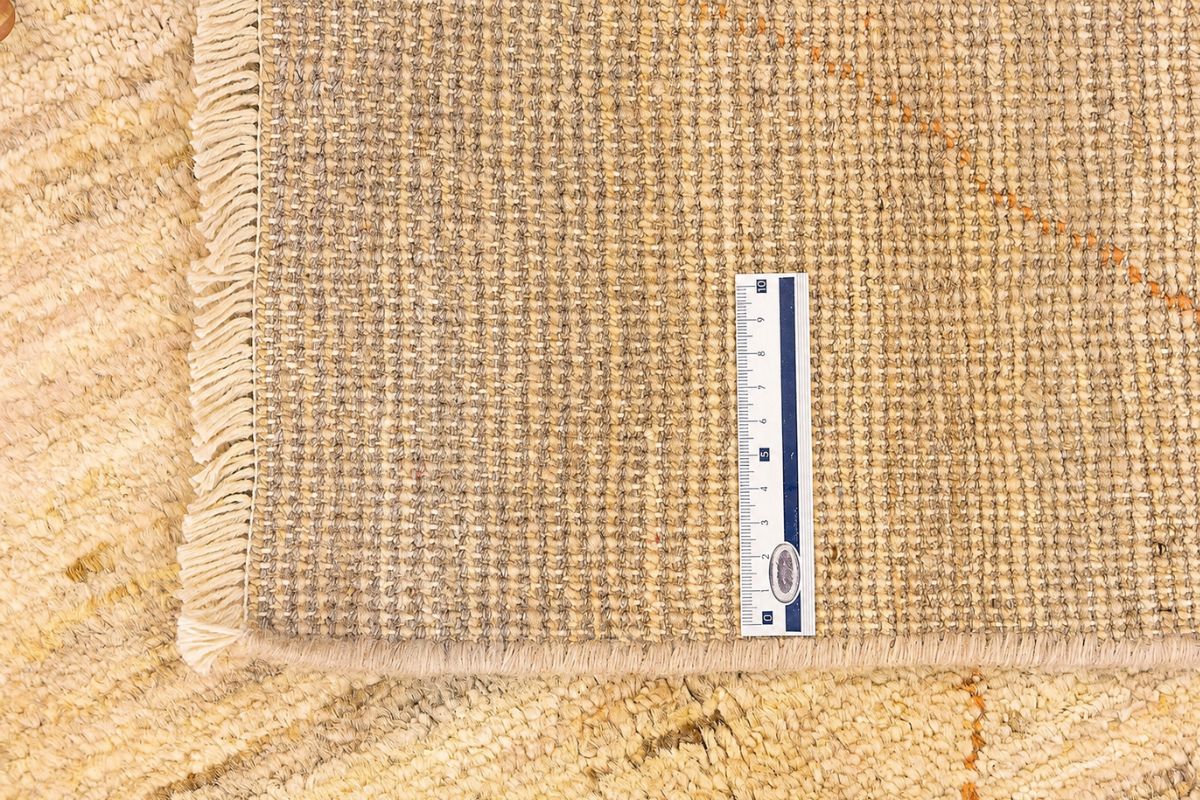
Knots per square inch measures one thing honestly: how fine a pattern a weave is capable of resolving. It is a real and useful metric in the tradition it comes from, where detailed curvilinear designs need a dense weave to render a curve without it turning into a staircase. It does not measure quality, it does not measure durability, and on Moroccan pile rugs, which are geometric, sparse and often deliberately open, it is close to the wrong question. This guide publishes no KPSI figure of its own for any Moroccan style, for reasons set out below.
What the metric counts
KPSI applies only to hand-knotted rugs. You count the knots along one inch horizontally, count the knots along one inch vertically, and multiply. A weave with ten knots across and twelve down is 120 KPSI.
You count on the back, where the knots are visible, and on a genuine hand-knotted piece the count varies slightly from place to place because a person tied them. That variation is normal. A single measured square inch is a sample, not a specification, and where a rug is quoted at an exact figure, someone has usually rounded a range into a number that sounds like a fact.
The convention is well documented and not controversial. It appears in the general reference literature on knot density and in the explainers published by rug dealers and manufacturers.
What it genuinely predicts: design resolution
Think of it as the weave's resolution. Every knot is one point of color, so the number of knots per inch sets how much detail can exist in that inch.
This matters enormously for a certain kind of rug. Fine floral and curvilinear Persian and Oriental designs, with tendrils, arabesques and shaded medallions, need a high knot count to render those curves smoothly. At a low density the same design would come out blocky. That is the real reason high-KPSI weaving is prized in those traditions: not because the rug lasts longer, but because it can carry designs a coarser weave cannot.
It is also a straightforward proxy for labor. More knots per inch means more knots in total, which means more weeks at the loom, which is a legitimate part of what a fine Persian rug costs.
What it does not predict
Three things, and the dealer explainers largely agree on this, which is worth noticing.
Quality. A higher figure does not make a better rug and a lower figure does not make a worse one. Several dealer and manufacturer guides state this outright, including explainers published by Jaipur Rugs, TSAR Carpets and Sharafi & Co. When even the trade says the metric is misunderstood, a seller pushing a number at you is departing from their own trade's guidance.
Durability. This is the most common misconception. Knot density enables elaborate design rather than adding strength, a point made explicitly in Landry & Arcari's guidance on knots and density. What actually governs how a rug wears is the quality of the wool, the tightness and evenness of the weave overall, the pile height, and how the rug is used and cared for.
Wool quality or worth. A densely knotted rug in poor, brittle wool is a poor rug. Fiber quality and knot count are independent variables, and the one that matters more day to day is the wool.
Why it barely applies to Moroccan rugs
Here is the category error, and it is the reason this page exists.
Moroccan pile rugs are geometric. Their design vocabulary is diamonds, lozenges, lines, crosses and open fields, and much of the visual character comes from the pile itself: high, loose, shaggy, with the wool doing the work rather than the pattern resolution. Beni Ourain in particular is defined by an open, high pile and sparse line work. Applying a fineness metric to that is like judging a wool blanket by thread count.
The dealer literature actually concedes the principle. The point that knot density is crucial for detailed curvilinear floral patterns and much less important for geometric tribal designs appears in the trade's own explainers. Moroccan rugs are the textbook case of the second category.
When this site searched specifically for KPSI figures or benchmark ranges for Moroccan and Beni Ourain rugs in August 2026, page one returned seller collection pages and no figures at all. There is no established Moroccan KPSI benchmark to shop against, which is a useful thing to know before somebody quotes you one.
The one Moroccan knot-count claim in circulation
There is an exception, and it is instructive.
One specific pair of numbers does circulate: a knot count for Beni Ourain and a higher one for Beni Mrirt, used across seller pages to explain why Beni Mrirt costs more. This guide went looking for the source of that figure and found the same numbers repeated across four competing sellers' websites, phrased differently and landing in the same range, with no citation behind any of them. No lab measurement, no named researcher, no cooperative source. Repetition across competitors looks like corroboration and is not.
The full working is in what the Beni Ourain and Beni Mrirt knot-count claims actually rest on, which also sets out what genuinely does differ between the two, because plenty does. The underlying idea that a denser weave takes more wool and more labor is entirely reasonable. Treating an uncited number as a specification is not.
How to use the number if a seller quotes one
- Ask how it was measured, and over what area. A real answer describes counting on the back and a range. An exact figure with no method behind it is marketing.
- Ask what they think it tells you. If the answer is "it means better quality," they have said something the trade's own explainers contradict.
- Judge the wool instead. Feel it. Springy, slightly greasy with lanolin, resilient under pressure. That tells you more about how the rug will live than any density figure.
- Judge the weave for evenness, not fineness. Consistent tension and a rug that lies flat matter more than knots per inch.
- Do not pay a premium for a number nobody will source. If the density claim is doing the work of justifying the price, ask what else justifies it.
For the checks that do settle something, see what the back of the rug shows and is my Moroccan rug authentic. For the wider set of buying risks, how to buy a Moroccan rug without getting taken, and for the style itself, the Beni Ourain rug guide.
FAQ
What is a good KPSI for a Moroccan rug?
There is no established benchmark, and this guide publishes no figure. Moroccan pile rugs are geometric and often deliberately openly knotted, so knot density is not the metric that describes them well.
Does a higher knot count mean a better rug?
No. Dealer and manufacturer explainers state this themselves. Higher density allows finer pattern detail and reflects more labor, but wool quality, weave evenness and construction matter more for how a rug performs.
Does KPSI affect how long a rug lasts?
Not directly. Knot density enables elaborate design rather than adding durability. Wool quality, overall weave tightness, pile height and use are what govern wear.
How is KPSI measured?
Count knots across one inch and down one inch on the back of the rug, then multiply. On a hand-knotted piece the count varies from place to place, so a single exact figure is a sample rather than a specification.
Why do sellers quote knot counts for Beni Ourain and Beni Mrirt rugs?
Because a specific pair of figures circulates widely across seller sites. This guide looked for the original source of those numbers and could not find one cited anywhere, which is covered in detail on the Beni Ourain versus Beni Mrirt page.
Leave a Reply