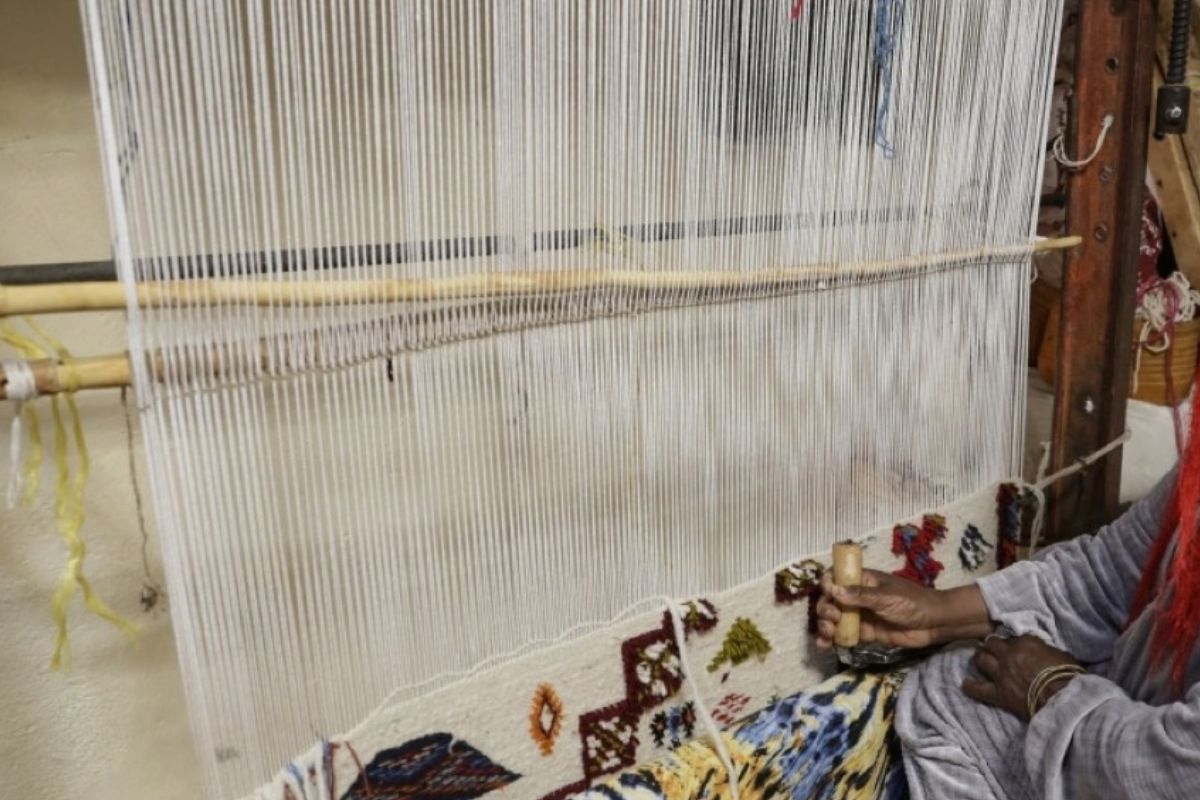
Moroccan rug weaving tradition decline is real in specific, documented ways: fewer young women are learning the craft, middlemen keep most of the sale price, and cheap machine-made imitations compete for the same buyers. It is not, however, a single collapsing industry. In some regions cooperatives are stabilizing incomes and pulling younger weavers back in. The honest answer sits between "dying out" and "unaffected," and which side you land on depends on the region, the cooperative, and the generation you ask.
What's Driving the Moroccan Rug Weaving Tradition Decline
The decline shows up most clearly in three places: the number of teenage girls choosing to learn the loom, the natural-dye skill set, and the informal weekly-market economy that historically set prices. Reporting from weaving towns in the south of Morocco has quoted weavers directly on the pay gap: a rug that a weaver sells for a small fraction of its price will often resell in a Marrakech bazaar for many times more, with intermediaries setting the terms at the point of sale. That gap, repeated over years, is the single biggest reason cited by weavers themselves for why their daughters are not taking up the trade.
What is not declining at the same rate is demand. Moroccan rugs, especially Beni Ourain and Azilal styles, remain in strong demand internationally, and cooperative-based sales channels are growing. The craft is not short of buyers. It is short of a fair way to connect a weaver's labor to a buyer's price, and that mismatch is the real driver of the "dying tradition" narrative more than any drop in interest from either side.
Why Fewer Young Women Are Learning to Weave
Weaving in most Amazigh (Berber) communities has historically passed from mother to daughter, learned by watching and imitating rather than through formal instruction. That transmission depends on the craft paying enough to be worth the years of practice, and it also depends on older weavers being willing to teach. Both conditions are under pressure. Low per-rug earnings push young women toward other work, including migration to cities, and some older weavers are reportedly reluctant to share techniques out of concern over how they might be used or copied. Add limited schooling in weaving skills and rural isolation in some Atlas and anti-Atlas villages, and the generational handoff gets harder in exactly the years it needs to happen.
This is not uniform across Morocco. In towns organized around cooperatives, the picture looks different: the women who weave most of Morocco's rugs often work through a collective that pools sales, shares training, and gives younger members a reason to stay. Where that structure exists, the decline slows or reverses locally, even while it continues elsewhere.
The Loom and the Knot Still Set Real Limits
Whatever changes in the market, the physical craft has not changed as much as marketing copy sometimes suggests. A hand-knotted Moroccan rug is still built one row at a time on a fixed loom, and the technique used to tie each strand of wool, the Berber knot, still determines the pile height, density, and durability of the finished piece regardless of which region it comes from. Understanding how a Moroccan rug is actually made, from raw fleece through washing, spinning, dyeing, and knotting, is the fastest way to tell a genuine hand-woven piece from a machine-tufted look-alike sold under the same name. That distinction matters more as the decline in traditional weaving increases the number of imitation products entering the market under Moroccan branding without Moroccan hands behind them.
What the Symbols Do and Don't Tell You
Marketing around Moroccan rugs frequently assigns fixed meanings to specific motifs: a diamond "means" fertility, a zigzag "means" water, and so on. Treat these claims with real caution. The Peabody Museum of Archaeology and Ethnology at Harvard University, in its published collection notes on Berber art, documents that Amazigh weavers across North Africa work from "an extensive vocabulary of symbols and motifs" built up over generations, but it does not present that vocabulary as a fixed dictionary with one meaning per shape (Peabody Museum, "Artistry of the Everyday: Beauty and Craftsmanship in Berber Art," read 2026-09-18). Meaning in Amazigh weaving is generally understood by scholars to be local, orally transmitted, and specific to the weaver's own family or tribe rather than standardized across regions. When a listing states a single, confident meaning for a motif without naming where that reading comes from, that is folklore dressed as fact, and it is worth reading it as folklore, interesting but unverified, rather than as documented history.
This matters for the decline conversation too. As fewer weavers pass down techniques directly, the oral context that once explained a specific motif in a specific village is exactly the kind of knowledge that disappears first, well before the visual pattern itself stops being copied.
Where the Craft Is Holding: Cooperatives and Direct Sale
The clearest counter-trend to decline is the shift toward artisan-owned cooperatives that sell directly to buyers instead of through a chain of middlemen. The Anou Cooperative, an artisan-owned marketplace based in Fez, states that its model is built specifically to close the earnings gap that pushes weavers out of the craft, reinvesting marketplace revenue into artisan training rather than routing it through outside buyers (The Anou Cooperative, "About Anou," read 2026-09-18). This is not an isolated example. Similar structures exist in weaving towns across the south, including in Taznakht's weaving cooperatives, where a large concentration of weavers has organized around a shared weekly market rather than each depending on a single middleman relationship.
Cooperatives don't reverse the decline everywhere and don't fix every part of it. Natural-dye knowledge, in particular, is not something a fair sale price alone restores once it has lapsed in a household for a generation. But they do address the specific mechanism, the pay gap, that weavers themselves point to most often when asked why their daughters aren't learning to weave. That makes cooperative-sourced rugs a meaningfully different purchase than a bazaar or wholesale-sourced one, both ethically and in terms of what you're actually buying.
What This Means If You're Buying a Moroccan Rug
If the tradition is under pressure, where you buy has more effect on that pressure than most other decisions you'll make about the rug. A few practical takeaways:
- Ask where the rug was sourced. Cooperative or direct-from-artisan channels put more of the price in the weaver's hands than a generic import wholesaler does.
- Don't take symbol-meaning claims at face value unless the seller can say whose tradition, which region, and how they know. "Ancient symbol for protection" with no further detail is a sales phrase, not a documented fact.
- Genuine hand-knotted construction still shows irregularities row to row; a perfectly uniform, machine-tufted back is a different product regardless of what it's marketed as.
- A rug's price reflects the market it passed through as much as its quality. A higher price at a cooperative-linked retailer does not automatically mean a better rug, but it often means more of that price reached the person who made it.
None of this requires becoming an expert overnight. It mostly requires asking one or two direct questions before buying, which is more scrutiny than most rug purchases get.
FAQ
Is Moroccan rug weaving actually disappearing?
It's declining in specific ways, fewer young weavers, less natural-dye knowledge, and pressure from cheap imitations, but it is not vanishing everywhere at the same rate. Cooperative-based weaving towns are holding up better than areas without that structure.
Why don't more young Moroccan women learn to weave?
The most commonly cited reason, from weavers themselves, is pay: a rug can sell for many times its original sale price by the time it reaches a city bazaar, with little of that increase reaching the weaver. Reduced schooling in weaving skills and rural isolation also play a role in some regions.
Do Moroccan rug symbols have fixed meanings?
Not according to museum and academic sources on Amazigh textile art, which describe an extensive but locally specific vocabulary of motifs rather than a single fixed dictionary of meanings. Treat confident, unattributed symbol-meaning claims as folklore unless a named source documents that meaning for that specific region.
Does buying a cooperative-made rug actually help preserve the tradition?
It addresses the pay gap that weavers most often cite as the reason younger women leave the craft, which is one of the main pressures behind the decline. It does not by itself restore skills, like specific natural-dye methods, that have already lapsed in a household.
How can I tell a hand-woven Moroccan rug from a machine-made copy?
Check the back and the pile for slight irregularities row to row; genuine hand-knotted construction is rarely perfectly uniform. Understanding the knotting technique and the loom process behind a real Moroccan rug makes it much easier to spot a machine-tufted imitation sold under the same name.
Leave a Reply