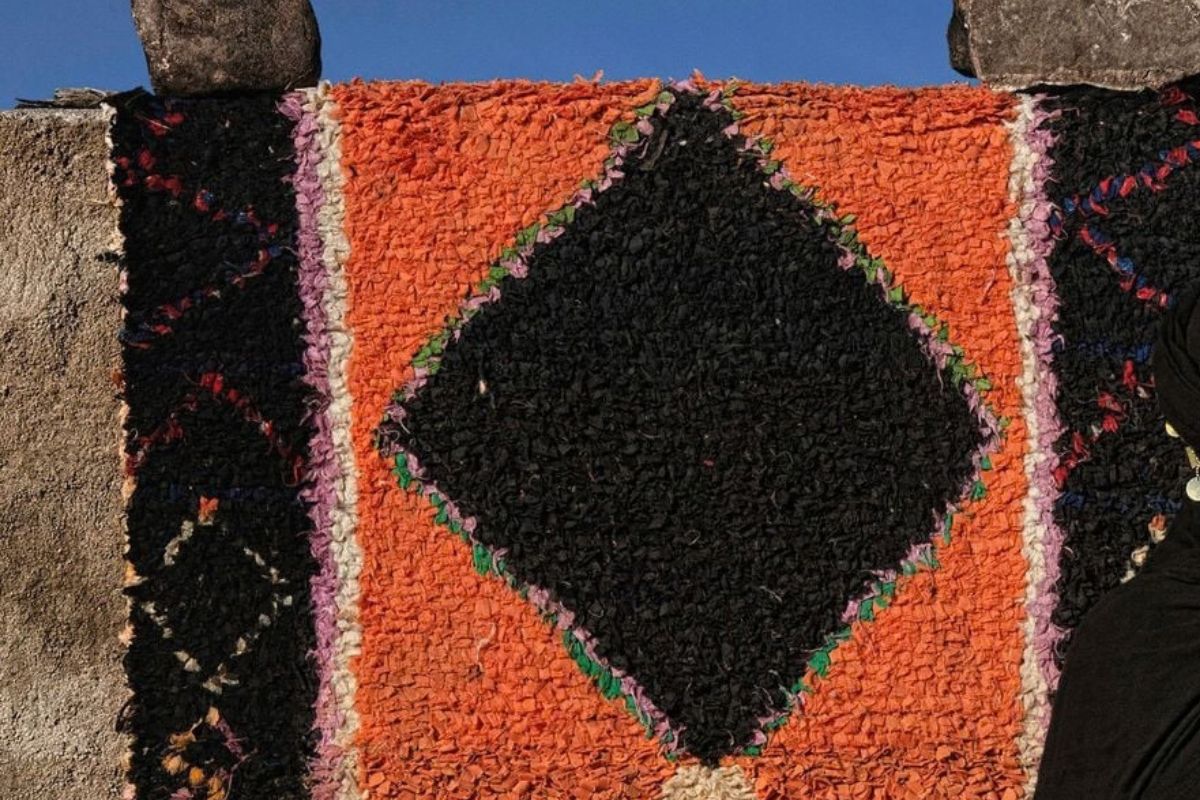
Moroccan rug symbols meaning breaks into two different kinds of claims, and most pages online blur them together. A small set of motifs are documented through named academic fieldwork tied to a specific weaving community, a specific era, and a specific researcher's published notes. A much larger set, the "eye means protection, zigzag means water, tree of life means renewal" style list repeated across dozens of rug retailer blogs, has no named ethnographic source at all. Both categories exist on real rugs. Only one of them can be checked.
Moroccan Rug Symbols Meaning: Two Kinds of Answers
Search "moroccan rug symbols meaning" and the first page reads like a single settled glossary: a diamond or rhombus for the protective eye, an X for a woman's body and fertility, zigzags for water, a stepped shape for a ladder toward spiritual ascent, scissors for a blacksmith's talisman. Retailer sites, decor blogs and a few rug dealers all list nearly the same set, often in the same order, and almost none of them name who documented the meaning, in which village, or in which decade.
That list is genuinely useful as a starting vocabulary. It is not, on its own, evidence. A symbol repeated on fifty commercial pages with no cited fieldwork is a marketing convention until someone traces it to a source, not before.
What Is Actually Documented
The clearest academic account of Amazigh (Berber) textile symbolism comes from Cynthia Becker, a professor of African art history at Boston University, whose fieldwork with the Ait Khabbash community in the Tafilalet oasis of southeastern Morocco anchors her book Amazigh Arts in Morocco: Women Shaping Berber Identity. According to Cynthia Becker's faculty page at Boston University (read 2026-09-18), her research documents how specific motifs carried meaning within that particular community: a "little birds" motif resembling a pigeon's claw was tied to female fertility, because pigeons were associated with fertility of the land and beautiful women were likened to pigeons in Ait Khabbash speech and song. Becker's account also connects diamond and X-shaped motifs to the female body and to fertility symbolism that appears consistently across textiles, tattoos and hairstyles within that one weaving tradition.
Two things matter about how that documentation is framed. First, it is fieldwork-based: Becker lived with and interviewed the weavers whose work she describes, and the meaning is attached to what those specific women said about their own designs, not to a general Berber iconography. Second, it is local: the meaning is reported for the Ait Khabbash, part of the Ait Atta confederation in one region of Morocco, not asserted as the meaning of that motif wherever it appears on any Moroccan rug. Becker's book carries a Choice book award and sits inside peer-reviewed art history scholarship, which is a different standing than a shop page citing "ancient Berber tradition" with no author attached.
What Is Repeated Everywhere but Not Documented
The symbol list that dominates search results, the eye for protection, the zigzag for water, the tree of life for the bridge between earth and sky, the chevron for harvest abundance, the ladder for personal ascension, the scissors motif as a smith's talisman, is treated online as if it were one fixed key that applies across every Berber weaving group, every era and every region. That claim does not match what documented fieldwork actually shows. Becker's own research is explicit that meaning was locally produced, tied to a specific community's oral tradition, and not standardized across Morocco's many distinct Amazigh groups. A single universal dictionary contradicts the one serious academic account this topic has, rather than confirming it.
None of this means every item on the popular list is false. Weavers across regions plausibly did use zigzags to suggest water, and diamonds to suggest protection or fertility, because these are old and widespread visual conventions in North African textile traditions generally. What is missing is the citation: which weaver, which village, which researcher recorded that reading, and when. Where that citation does not exist, the honest label is folk-attributed or contested, not documented fact. A claim like "the scissors motif is a blacksmith's talisman" may describe a real regional belief, but until it is traced to a named ethnographic source rather than a chain of blog posts quoting each other, it belongs in the contested column, not the documented one.
Why the Same List Keeps Appearing
Berber symbolism was passed down orally, through weavers showing daughters and nieces how to set up a loom, not through a written key that a shop could photograph and post. When a written explanation is needed for a customer-facing page, the easiest path is to copy whatever the last blog already published, and that is very likely how the same eight or nine symbols and the same tidy one-line meanings have circulated, largely unchanged, across the rug trade's marketing content for years. A tourist market rewards a clean, confident answer over a hedged academic one, so the hedge tends to disappear first.
The women who actually wove these rugs are the ones whose testimony would settle a given motif's meaning, and their choices are the subject of Who Weaves Moroccan Rugs: The Women Behind Them, which covers how design decisions were made in practice rather than how a retailer later explains them.
Regional Weaving Groups Do Not Share One Visual Vocabulary
Morocco's Amazigh weaving traditions are not one tradition. Beni Ourain work is generally plain, undyed wool with sparse dark line motifs; Boujad rugs lean toward bold saturated color fields; Azilal pieces are often loosely geometric and asymmetric. These are broad regional tendencies buyers and dealers commonly describe, not a fixed rulebook, and they exist alongside dozens of smaller, less-documented local traditions. A cooperative model like the one described in Taznakht Cooperatives: 3,500 Weavers, One Weekly Market pools work from many individual weavers across a region, which is itself a reason a single fixed symbol key is unlikely: the cooperative structure exists precisely because weaving in this part of Morocco was never centralized into one workshop with one pattern book.
The physical process also varies by region and affects which motifs are even possible to render. The specific knotting method described in The Berber Knot: How a Moroccan Rug Is Tied determines how sharp or blurred a geometric motif comes out, and coarser, low-knot-count pieces cannot reproduce the same fine detail as a tightly knotted one. A motif that reads as a clean diamond on one rug may be an approximate diamond shape on another simply because of technique, not because the weaver intended a different symbol.
What a Rug's Construction Tells You That a Symbol Story Cannot
Rather than trusting a generic "this symbol means X" caption on a listing, the more verifiable information is usually in how the rug was actually made. How Moroccan Rugs Are Made: Fleece to Finished Rug covers the fleece-to-finished-rug process that a seller can describe concretely, region by region, in a way a symbol claim usually cannot. Knot density, wool preparation and loom type are things you can ask about and sometimes verify by inspection; a claimed symbolic meaning for a specific rug's specific motif, absent a named weaver or documented community, generally cannot be verified at all.
The Museum Record
Museum treatment of Amazigh textiles reinforces the same pattern. The Musée Pierre Bergé des Arts Berbères at Jardin Majorelle (read 2026-09-18) in Marrakech, opened in 2011, organizes its collection of more than 600 Berber cultural objects by region and tribal group, with explanatory text addressing where a piece came from and which Berber tribes it represents, rather than presenting one universal iconographic key applied to every object in the collection. That regional, tribe-by-tribe framing is consistent with how the one detailed academic account of Berber textile symbolism, Becker's fieldwork, actually describes meaning: attached to a place and a people, not floating free of both.
This matters for how you read a rug you already own or are considering buying. A listing or a shop owner offering a single, tidy translation for every motif on a rug is giving you the tourist-market version, regardless of how confidently it is delivered. A source that instead says "this reading comes from weavers in this specific region" or "this meaning isn't settled, but here's what's claimed and by whom" is giving you something closer to the museum and academic standard.
FAQ
Are Moroccan rug symbols real, or all invented for tourists?
Both categories exist. Some motif meanings are documented through named academic fieldwork tied to a specific weaving community. A much larger set of meanings circulating on retail and decor sites has no cited source and should be treated as folk-attributed or contested rather than as settled fact.
What does the diamond or eye shape on a Berber rug mean?
It is widely described online as a protection symbol, sometimes called the evil eye motif, but this reading is repeated across commercial sites without a named ethnographic source. Treat it as a commonly claimed meaning, not a documented one, unless a specific source is cited for the specific rug or region in question.
Did every Berber weaver use the same symbols with the same meanings?
No. Documented fieldwork describes meaning as local to one weaving community's oral tradition, not standardized across Morocco's many distinct Amazigh groups, regions and eras.
How can I tell if a seller's symbol explanation is documented or just marketing copy?
Ask which weaver, village or region the explanation comes from, and whether it traces to a named source. A seller who can answer specifically is describing something closer to documented practice; a generic one-line meaning applied to every rug in the shop is almost always the repeated commercial version.
Where can I read a serious academic source on this topic?
Cynthia Becker's Amazigh Arts in Morocco: Women Shaping Berber Identity, based on fieldwork with the Ait Khabbash in southeastern Morocco, is the clearest academic account. Her faculty page at Boston University lists her publications and research background.
Leave a Reply